How Modern Sitting Changes the Body From the Hips Up
The chair may be one of the most underestimated influences on the modern human body. Nothing dramatic happens when someone sits down, which makes prolonged sitting appear harmless. There is no immediate injury, tearing sensation, or obvious warning that physical capacity has started changing. Yet the human body constantly adapts to the demands placed upon it. Spend your days walking, lifting, climbing, squatting, and carrying, and your muscles adapt to those demands. Spend most waking hours supported by chairs, cars, couches, and desks, and adaptation still occurs. The difference is that the body begins adapting to an environment where movement has become increasingly unnecessary.
This matters enormously when discussing weak glutes and back pain. Many people assume their lumbar spine must be damaged when their lower back begins aching after work. They stretch the painful area, massage it, apply heat, or search for a better office chair. Others become afraid of bending, lifting, twisting, or exercising because they believe movement will make their backs worse. Those approaches focus almost entirely on where the person feels the pain. However, the painful location does not always reveal the entire functional problem.
The larger issue may involve what has happened throughout the hips, pelvis, legs, trunk, and nervous system. Modern sedentary living removes thousands of movements that previous generations performed without calling them exercise. Hip extension decreases, walking declines, squatting disappears, and climbing becomes optional. Muscles that once worked throughout the day now receive fewer meaningful challenges. Over time, strength, endurance, coordination, and movement confidence can decline together.
Sitting alone should not receive all the blame because low-back pain has many potential contributors. Previous injuries, sleep quality, stress, obesity, smoking, physical workload, conditioning, and psychosocial factors can all influence symptoms. Research also does not prove that sitting automatically causes low-back pain in every person. The more useful question concerns what prolonged sitting replaces. When sitting replaces walking, lifting, squatting, carrying, rotating, and climbing, the body loses repeated opportunities to maintain physical capacity.
The Glutes Were Built for Much More Than Sitting
Most people think about the glutes as cosmetic muscles. Human anatomy gives them a far more important assignment. The gluteus maximus, gluteus medius, and gluteus minimus help connect lower-body movement with pelvic control. Together, they contribute to hip extension, rotation, stabilization, walking, climbing, lifting, running, and changing positions.
The gluteus maximus becomes particularly important when the hip must generate substantial force. Standing from a low chair requires the hips to extend while the body moves upward. Climbing stairs demands repeated hip extension against body weight. Squatting, sprinting, jumping, hiking, and lifting also place substantial demands on the posterior hip. These activities provide exactly the kind of loading that prolonged sitting largely removes.
The gluteus medius performs another crucial function because it helps control the pelvis during single-leg loading. Walking repeatedly shifts most body weight onto one leg while the opposite leg moves forward. During that brief period, muscles surrounding the hip help stabilize the pelvis and control the femur. A physically active person performs thousands of these repetitions every day. A sedentary lifestyle can reduce those opportunities dramatically.
Research has found differences in gluteal strength among some people with low-back pain. Systematic research involving more than 2,000 participants found reduced gluteus medius strength among people experiencing low-back pain. Researchers have also identified differences involving gluteal trigger points and muscular function. Findings concerning activation timing, muscle size, and fatigue remain less consistent, which prevents simplistic conclusions.
Weak glutes do not automatically cause every case of back pain. Back pain can reduce activity, and reduced activity can weaken the glutes. Both processes may also occur together, creating a cycle of discomfort and deconditioning. That relationship makes the hip-pelvis-spine system worth evaluating whenever chronic back problems continue despite repeated symptom treatment.
What “Gluteal Amnesia” Actually Means
Fitness and rehabilitation circles often use the phrase “gluteal amnesia” to describe glutes that appear underactive. Some people also call the condition “dead butt syndrome.” These phrases create memorable images, but the muscles have not literally forgotten how to contract. Gluteal amnesia is not a formal medical diagnosis, and the nervous system does not simply disconnect the buttocks after sitting.
A more accurate explanation involves adaptation, reduced loading, altered coordination, and declining capacity. The nervous system continuously organizes movement according to strength, experience, pain, fatigue, habit, and environmental demands. When particular muscles receive less meaningful loading, their strength and endurance can decline. Meanwhile, the body becomes increasingly practiced at whatever movement strategies it performs most frequently.
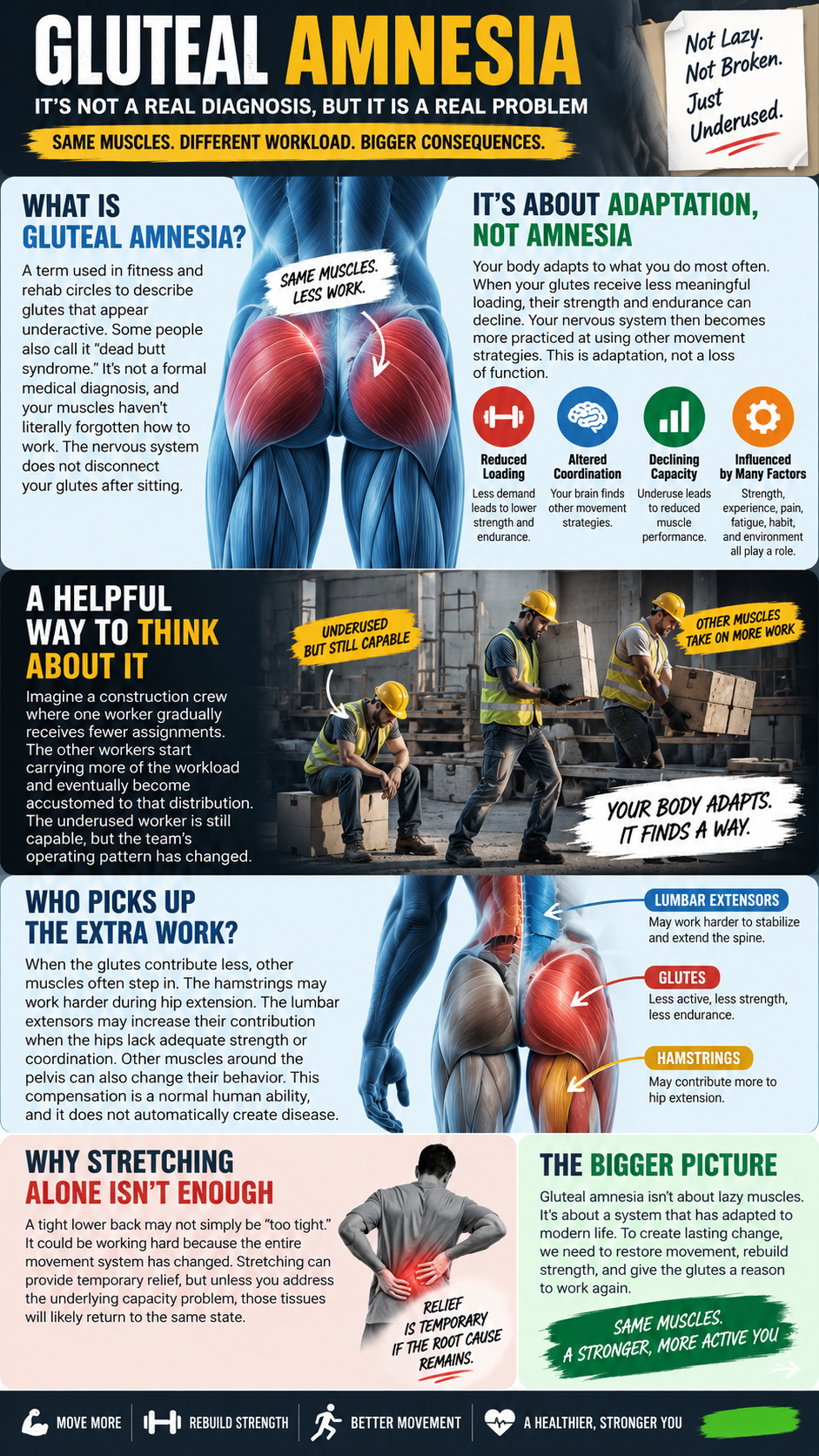
Imagine a construction crew where one worker gradually receives fewer assignments. The other workers begin carrying more of the workload and eventually become accustomed to that distribution. The underused worker remains capable of contributing, but the team’s operating pattern has changed. Something similar can happen throughout the musculoskeletal system when certain muscles receive less demand.
The hamstrings may contribute more heavily to hip extension during some tasks. Lumbar extensors may increase their contribution when the hips lack adequate strength or coordination. Other muscles surrounding the pelvis can also alter their behavior. None of these adaptations automatically creates disease because compensation represents a normal human ability. Problems become more likely when repeated demands exceed what those tissues can comfortably tolerate.
This explains why endlessly stretching a tight lower back may provide only temporary relief. The muscle being stretched may not simply be “too tight.” It may be working hard because the entire movement system has changed. Unless the underlying capacity problem improves, the same tissues can repeatedly return to their previous state.
The Real Problem Is a Movement Deficit
The argument surrounding sitting often becomes unnecessarily simplistic. One side portrays sitting as inherently destructive, while another dismisses posture and sitting time entirely. Human physiology supports a more nuanced interpretation. Sitting is a normal human activity, but living almost entirely in seated positions creates an environment with very little movement diversity.
Consider how dramatically daily life has changed. Breakfast happens in a chair before a seated commute to work. Many people then spend eight hours behind a desk before sitting during another commute. Dinner follows at a table, while television, phones, and streaming services dominate the evening. Even shopping, banking, entertainment, and social interaction can now happen without leaving home.
Someone sleeping eight hours and sitting another ten has only six hours remaining for everything else. Cooking, bathing, chores, exercise, walking, family responsibilities, and recreation must fit inside that shrinking window. Consequently, many adults spend most waking hours with their hips flexed and their glutes minimally challenged. Their bodies receive remarkably few reasons to maintain high levels of strength or endurance.
The deeper problem is therefore not simply “too much sitting.” It is too little movement variability and too little muscular demand. Hip extension becomes less frequent, loaded squatting disappears, and climbing becomes optional. Carrying heavy objects becomes unusual, while walking distances continue shrinking. The body begins reflecting the environment it experiences most often.
This concept also explains why buying a more expensive ergonomic chair cannot completely solve the problem. Better ergonomics may improve comfort and reduce unnecessary strain during work. However, no chair can replace walking, resistance training, hip extension, squatting, carrying, or rotational movement. Comfort matters, but comfort alone cannot create physical capacity.
How Sitting Changes the Hip-Spine Relationship
The lumbar spine does not function independently from the rest of the body. It sits between the rib cage above and the pelvis below. The pelvis then transfers forces toward both hips and legs. Every significant human movement therefore requires coordination among multiple joints, muscles, and neurological systems.
Walking demonstrates this relationship beautifully. One leg moves forward while the opposite leg travels behind the body. The pelvis rotates slightly while the trunk counter-rotates and the arms swing. Muscles surrounding the hips control the pelvis as body weight shifts from one leg to another. The nervous system coordinates these events without requiring conscious thought.
Now imagine removing thousands of those repetitions from everyday life. Hip extension occurs less frequently, while pelvic stabilizers receive fewer endurance challenges. Ankle movement declines, trunk rotation decreases, and cardiovascular demands fall. The nervous system receives fewer opportunities to practice coordinated whole-body movement.
Then the weekend arrives and physical demands suddenly increase. Someone spends three hours gardening after sitting throughout the workweek. Another person moves furniture despite performing little resistance training. Someone else plays golf, tackles yard work, or starts an aggressive exercise program after months of inactivity. The activity itself may not be dangerous, but the person’s current capacity may not match the sudden workload.
This mismatch between physical demand and physical capacity provides a useful framework for understanding many musculoskeletal complaints. The spine should not be viewed as fragile or easily damaged. Human spinal tissues tolerate substantial forces when appropriately conditioned. Problems become more likely when workload repeatedly exceeds the capacity developed through everyday movement and training.
When the Lower Back Begins Carrying More of the Load
The lumbar muscles should participate in movement. They stabilize the trunk, control motion, produce extension, and contribute during lifting. Problems can develop when the distribution of muscular work no longer matches the person’s conditioning or movement strategy.
Imagine someone whose hips and glutes have gradually lost strength. Rising from the floor becomes more difficult because the lower body produces less force. The nervous system still needs to complete the movement, so it selects whatever strategy works. The person may use additional trunk momentum, depend heavily on the hamstrings, or increase lumbar extensor activity.
Repeated often enough, these strategies can become habitual. Muscles surrounding the lower back may feel persistently tight because they repeatedly contribute to demanding tasks. Stretching those muscles may temporarily feel excellent because it changes sensory input and reduces tension. However, the tightness can return when the same movement environment remains unchanged.
This helps explain why some people repeatedly cycle through short-term symptom relief. Massage provides several comfortable days before tightness returns. Heat reduces discomfort temporarily, yet the ache resurfaces after another long workday. Rest helps initially, but prolonged inactivity eventually leaves the person feeling even stiffer.
Symptom relief certainly has value, but persistent back pain requires a broader question. Instead of asking only which tissue hurts, we should also ask why that tissue repeatedly becomes overloaded. Restoring strength, endurance, coordination, and movement variability can address factors that symptom-focused approaches may miss.
Weak Glutes Can Affect More Than the Lower Back
The pelvis connects the trunk to the lower extremities, making hip function relevant throughout the kinetic chain. Changes in hip strength and coordination can influence how the femur behaves during walking, running, squatting, climbing, and landing. The knee, ankle, foot, pelvis, and trunk then respond to those forces.
Reduced lateral hip control can allow different movement strategies during single-leg loading. The femur may rotate differently while the pelvis shifts to maintain balance. The trunk may compensate by leaning, while the foot and ankle adapt below. These changes do not guarantee injury, but they demonstrate why treating one isolated body part can miss important contributors.
The body behaves more like an orchestra than a collection of independent instruments. One musician does not create the entire performance, yet poor coordination can change the final sound. Similarly, the glutes do not single-handedly control back health. They participate within a much larger network involving muscles, joints, connective tissues, sensory systems, and the brain.
Effective rehabilitation therefore asks functional questions rather than searching for one villain. Can the person extend the hips comfortably and generate adequate force? Can the pelvis remain controlled during single-leg loading? Can someone squat, hinge, walk, rotate, climb, and carry without excessive difficulty? Those abilities reveal much more than simply asking whether the glutes feel tight or weak.
The Body Needs Capacity, Not Permanent Protection
Modern culture has created an enormous market around physically supporting the human body. We support the lumbar spine, arches, knees, wrists, elbows, and neck. Support can certainly help during specific injuries or activities. However, permanent external support cannot replace internal physical capacity.
Muscles need appropriate resistance to remain strong. Joints benefit from regular movement through tolerable ranges. Bones respond to loading, while the cardiovascular system responds to exertion. The nervous system also requires varied sensory information to maintain coordinated movement.
A body capable of movement therefore requires regular exposure to movement. The answer to a sedentary environment cannot come entirely from making sitting more comfortable. Eventually, the movements that modern life removed must return. That restoration becomes the foundation for addressing weak glutes and back pain at home.
Healing Begins by Changing What Created the Problem
If years of sedentary living contributed to weak glutes and back pain, one corrective exercise will rarely solve everything. The body did not lose strength, endurance, and movement capacity during a single afternoon. Those changes developed gradually through thousands of hours spent sitting and moving too little. Reversing that pattern requires restoring the physical demands that modern life quietly removed.
This changes how we should think about persistent lower-back discomfort. Many people repeatedly treat the painful area without asking why those tissues keep becoming irritated. They stretch their backs, apply heat, use massage devices, and rest whenever symptoms return. These strategies can provide temporary relief, but relief does not automatically rebuild physical capacity.
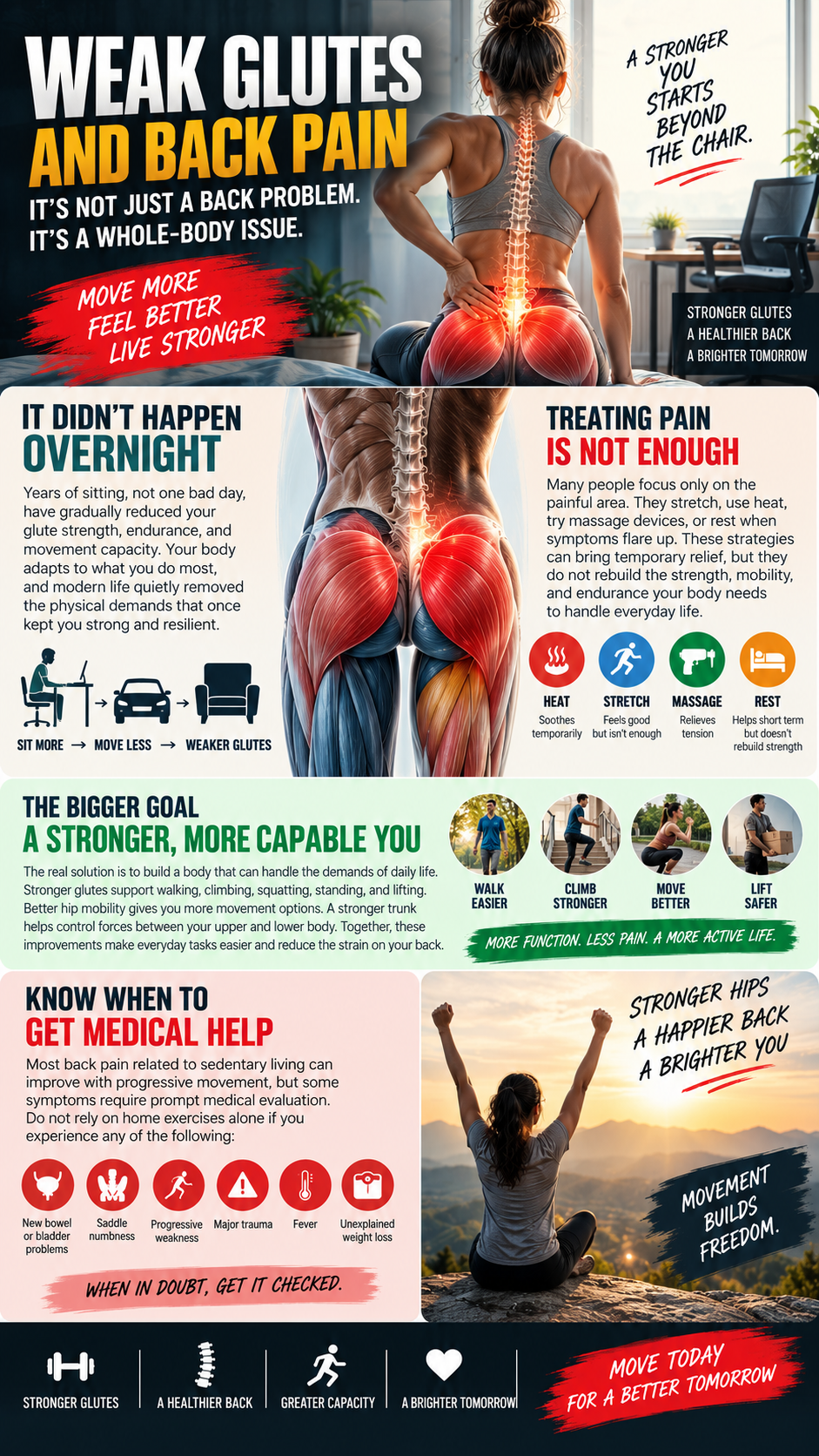
The deeper objective involves creating a body that handles ordinary physical demands more effectively. Stronger glutes can contribute during walking, climbing, squatting, standing, and lifting. Better hip mobility creates additional movement options, while improved trunk endurance helps control forces traveling between the upper and lower body.
Certain symptoms require prompt evaluation rather than home exercise alone. New bowel or bladder problems, saddle numbness, progressive weakness, major trauma, fever, or unexplained weight loss deserve medical attention. Outside those warning signs, progressive movement can become an important part of addressing uncomplicated back discomfort.
Put Movement Back Into the Entire Day
The first change should occur outside the gym because sedentary living is primarily an environmental problem. Thirty minutes of exercise offers substantial benefits, but prolonged sitting still dominates the remaining day. The body needs repeated opportunities to stand, walk, extend the hips, shift weight, and change positions.
During long work periods, change position every thirty to sixty minutes when practical. Walk around the house, climb stairs, refill your water, or move gently for several minutes. These short periods do not need to become workouts. Their purpose is restoring movement frequency throughout the day.
Three minutes of movement performed ten times creates thirty additional minutes of daily activity. Those periods also generate hundreds of additional steps and repeated cycles of hip movement. Over several months, these seemingly insignificant choices can substantially change the environment influencing your body.
Standing desks can provide variety, but standing motionless all day simply creates another static position. Alternate between sitting, standing, walking, and other comfortable positions whenever possible. Instead of searching for perfect posture, create greater postural variety.
Rediscover Walking as Daily Medicine
Walking may be one of the most underestimated tools for rebuilding a sedentary body. Every stride coordinates the feet, ankles, knees, hips, pelvis, trunk, shoulders, and nervous system. The glutes participate as weight transfers between the legs, while the pelvis and trunk move rhythmically.
Start with a distance your body comfortably tolerates. Someone severely deconditioned might begin with ten-minute walks after meals. Another person may comfortably tolerate twenty or thirty minutes. Consistency matters more than choosing an impressive starting distance.
Increase duration or pace gradually as endurance improves. Hills can eventually create greater demands through the hips and glutes. However, increasing everything simultaneously can overwhelm someone whose body has spent years adapting to inactivity.
Allow the arms to swing naturally during walking and avoid forcing an artificially rigid posture. Human gait includes coordinated movement through the pelvis and trunk. Walking should restore movement rather than become another exercise in holding the body still.
Give the Hips Their Movement Back
Prolonged sitting keeps the hips flexed for large portions of the day. Driving, office work, eating, and evening entertainment can all occur in nearly identical hip positions. Eventually, moving the hip behind the body can feel increasingly unfamiliar.
Gentle mobility work can reintroduce those missing positions. A half-kneeling hip flexor stretch provides a practical example. Place one knee on a padded surface with the opposite foot forward. Gently tuck the pelvis before shifting forward until comfortable tension develops across the front of the hip.
Avoid aggressively arching the lower back while stretching. Excessive lumbar extension creates apparent movement without necessarily improving hip extension. Controlled positioning keeps the emphasis around the hip while reducing unnecessary compensation.
Mobility should never become an endless stretching project. Newly available motion needs to become usable through walking, squatting, climbing, and strengthening. Movement that exists only during stretching offers less practical value than movement the body can control.
Strong Glutes Need Resistance, Not Just Activation
The fitness industry often talks about “activating” the glutes as though someone simply needs to flip a muscular switch. Activation exercises can improve awareness, but weak muscles eventually require resistance. Years of deconditioning cannot be reversed by squeezing the glutes for several seconds each morning.
A glute bridge provides an accessible starting point for many people. Lie on your back with the knees bent and feet comfortably planted. Control the trunk while pressing through the feet and extending the hips. Raise the pelvis without aggressively arching the lower back, then lower slowly.
Once bridges become easy, the challenge should progress. Resistance bands, external weights, longer pauses, or appropriate single-leg variations can increase muscular demand. Repeating the same easy exercise indefinitely eventually stops producing meaningful adaptation.
Squatting should also return to everyday movement. Begin by sitting into a stable chair and standing without excessive momentum. Greater depth or resistance can gradually follow as strength improves. This fundamental pattern develops the hips and legs while restoring confidence in lowering and raising the body.
Do Not Forget the Side of the Hip
Gluteal rehabilitation should not focus exclusively on the gluteus maximus. The gluteus medius and other lateral hip muscles help control the pelvis when body weight shifts onto one leg. Walking, climbing stairs, and stepping over obstacles repeatedly require this ability.
Side-lying hip abduction provides a simple home exercise. Keep the pelvis controlled while slowly raising the upper leg without rolling backward. Controlled tension matters more than trying to lift the leg as high as possible.
Resistance-band side walking can provide additional challenge as strength improves. Maintain slight hip and knee flexion while taking controlled sideways steps. Keep the knees stable and avoid allowing the pelvis to sway excessively.
Eventually, supported single-leg exercises can create greater functional demand. Step-ups, split squats, controlled balance work, and single-leg hinges combine strength with coordination. These exercises begin converting isolated muscular strength into strength that can serve everyday movement.
Relearn How to Hinge, Squat, and Lift
Back pain often changes someone’s relationship with movement. After one painful bending episode, a person may begin treating every forward movement as dangerous. Avoidance then reduces activity, and declining activity can further reduce physical capacity.
The hip hinge provides one useful strategy for handling heavier objects. Stand several inches from a wall with your back facing it. Push the hips backward until they gently contact the wall while allowing slight knee flexion. The torso should naturally incline forward as the pelvis moves backward.
Return to standing by driving through the hips under control. Gradually move farther from the wall as coordination improves. Eventually, resistance can be introduced when the movement becomes comfortable.
This exercise does not mean the spine should never bend. Human spines are designed to move. The purpose involves developing another movement option for situations requiring greater force.
Strengthen the Trunk Alongside the Glutes
Strong glutes cannot function independently because the pelvis connects directly with the trunk. Abdominal and spinal muscles help control forces moving between the upper and lower body. Improving their endurance therefore complements hip strengthening.
Bird-dog exercises can train coordination by extending opposite limbs while controlling the trunk. Dead-bug variations challenge abdominal control while the arms and legs move. Side planks develop lateral trunk endurance that complements the lateral hip muscles.
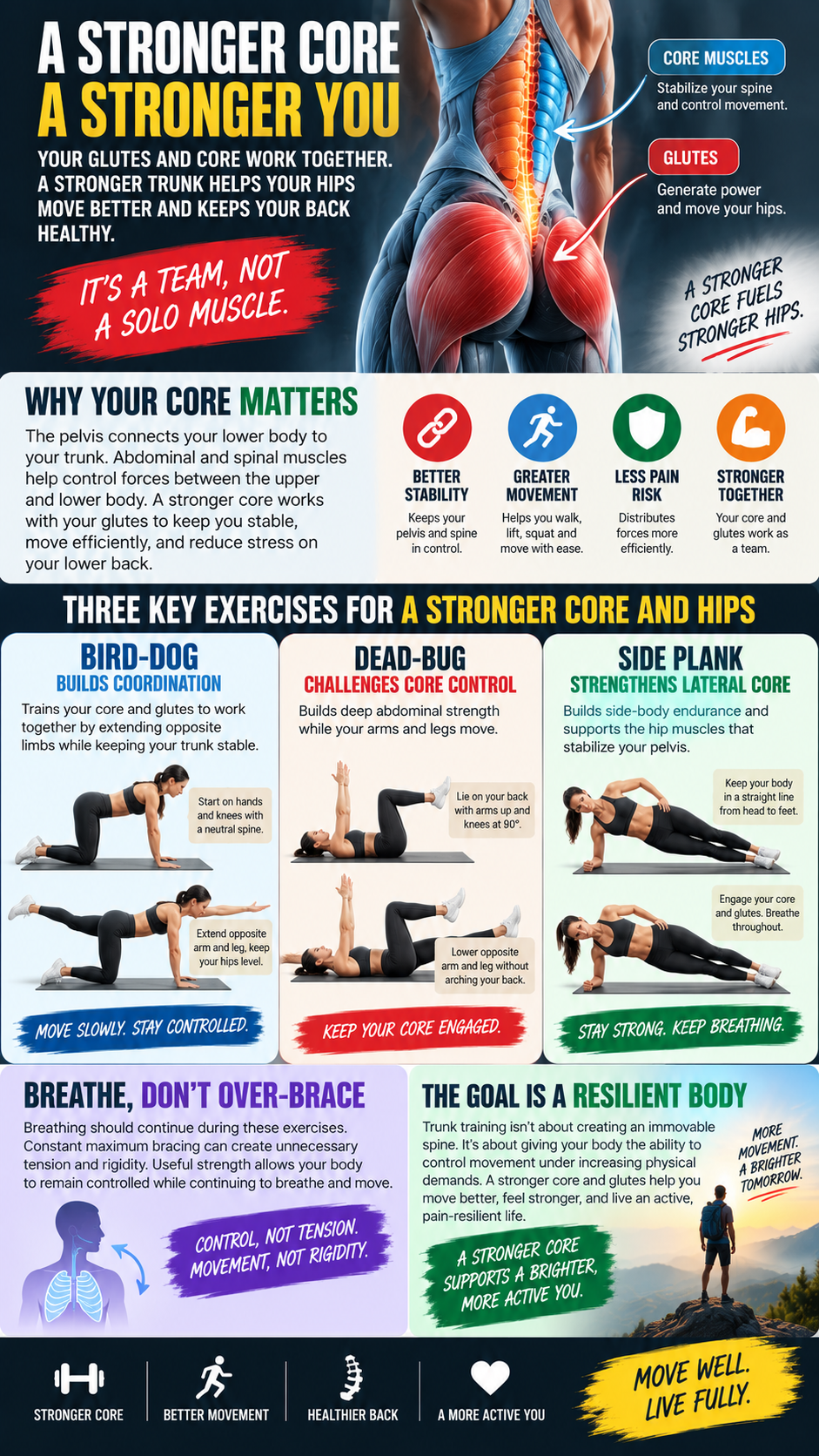
Breathing should continue during these exercises. Constant maximum bracing can create unnecessary tension and rigidity. Useful strength allows the body to remain controlled while continuing to breathe and move.
The objective is not creating an immovable spine. Instead, trunk training should improve the body’s ability to control movement under increasing physical demands.
Turn Your Home Into a Movement Environment
Exercise sessions matter, but the environment surrounding those sessions matters just as much. Small changes can make movement more common without turning daily life into a continuous workout. Take stairs when practical, walk during phone conversations, and carry groceries rather than avoiding every physical task.
Household activities can provide surprisingly useful movement. Gardening requires kneeling, hinging, reaching, and changing levels. Cleaning involves walking, pushing, pulling, rotating, and squatting. Floor activities can challenge hip mobility and make getting down and standing again easier.
The objective involves making movement normal again. A healthy body should not experience walking, carrying, climbing, or getting onto the floor as unusual events. Those activities belong inside ordinary human life.
Stop Trying to Stretch Away a Strength Problem
Persistent back tightness does not automatically mean the lower back needs more stretching. Muscles can feel tight because of fatigue, guarding, reduced movement, or increased workload. Stretching may temporarily change the sensation without changing the reason that sensation keeps returning.
Imagine lower-back muscles repeatedly working hard because the hips and surrounding musculature lack sufficient capacity. Stretching those muscles might feel wonderful temporarily. Yet the same workload returns when the person resumes prolonged sitting and poorly tolerated physical tasks.
Mobility and strength therefore belong together. Restore comfortable movement, then develop strength through those ranges. Teach the hips to produce force while the trunk controls movement and the legs manage progressively greater loads.
Build Capacity Instead of Protecting the Back Forever
The ultimate goal is not creating a perfectly protected spine. The goal involves developing a body capable of tolerating the demands of everyday life. Walking should become easier, stairs should require less effort, and lifting should feel increasingly natural.
Progress occurs when the body repeatedly experiences manageable physical challenges. A ten-minute walk becomes twenty minutes. Chair squats progress toward stronger loaded squats. Basic bridges eventually become more demanding hip-extension exercises.
Weak glutes and back pain are rarely solved by one magical movement. The better strategy involves restoring what sedentary living gradually removed: strength, mobility, endurance, coordination, and movement variety. Those qualities give the body more options when everyday demands increase.
Your back does not need a lifetime of fear and protection. It needs a capable body surrounding it. Restore movement throughout the day, strengthen the hips and glutes, train the trunk, walk regularly, and progressively challenge yourself. That is how a body conditioned by sitting begins becoming a body conditioned for life again.