
When the Gut Starts Fermenting Food Too Soon
A healthy digestive system should perform several remarkable tasks without attracting much attention. It breaks food apart, absorbs nutrients, manages microorganisms, and moves waste steadily forward. When that system changes, however, ordinary foods can suddenly produce extraordinary reactions. Vegetables create pressure, fruit triggers gas, and fiber can leave the abdomen painfully distended.
This pattern often creates enormous confusion because the foods themselves appear innocent. Garlic, onions, apples, broccoli, asparagus, and legumes contain valuable nutrients and plant compounds. Yet many also contain carbohydrates that intestinal microorganisms readily ferment. When excessive microbial activity develops inside the small intestine, those carbohydrates can become fuel in the wrong location.
Instead of progressing normally through digestion, food begins interacting with microorganisms before absorption has finished. Microbes metabolize available carbohydrates and produce gases, including hydrogen. Methane-producing organisms can accompany slower intestinal transit and constipation. Pressure rises as fermentation increases, while bowel habits may shift dramatically.
This is where small intestinal bacterial overgrowth, or SIBO, enters the conversation. SIBO does not mean bacteria are inherently dangerous. The digestive tract depends upon microorganisms for numerous biological functions. Location, quantity, microbial composition, and activity determine whether those organisms support or disrupt normal physiology.
The colon normally contains an extraordinarily dense microbial population. Fermentation naturally occurs there because microbes process material that escaped earlier digestion. The small intestine operates under different conditions because digestion and nutrient absorption dominate its workload. Excessive fermentation upstream can therefore disrupt a system designed primarily for absorption.
That timing difference helps explain one of SIBO’s strangest characteristics. A carbohydrate tolerated perfectly one year can create substantial bloating the next. The food did not necessarily change, but the digestive environment receiving it did. Understanding that distinction prevents food from becoming the convenient villain.
For this reason, endless dietary elimination can miss the larger problem. Avoiding onions may reduce fermentation without explaining why onions suddenly became intolerable. Removing apples may decrease bloating while leaving impaired motility untouched. Restriction can control symptoms without correcting the conditions that produced them.
A better investigation asks what changed within the digestive system itself. Intestinal motility, bowel transit, digestive secretions, medications, anatomy, and microbial activity all deserve consideration. When these systems become disrupted, fermentation may begin occurring earlier and more aggressively.
The important question becomes much more useful than asking which food to eliminate next. We need to understand what allowed excessive fermentation to develop upstream. That investigation begins with the remarkable differences between the small intestine and colon.
The Small Intestine Was Built for Absorption, Not Heavy Fermentation
Your digestive tract functions more like an organized production line than a simple hollow tube. Different sections perform specialized jobs under carefully controlled chemical and microbial conditions. Changing one environment can interfere with everything happening farther downstream.
The stomach begins the process using acid, enzymes, and muscular contractions. Food then enters the small intestine, where pancreatic enzymes and bile support further digestion. Nutrients cross the intestinal surface and enter circulation through an enormous absorptive network.
The colon performs another important job. It houses dense microbial communities that ferment undigested carbohydrates and produce numerous metabolic compounds. This fermentation represents a normal component of human digestion when it occurs within an appropriate environment.
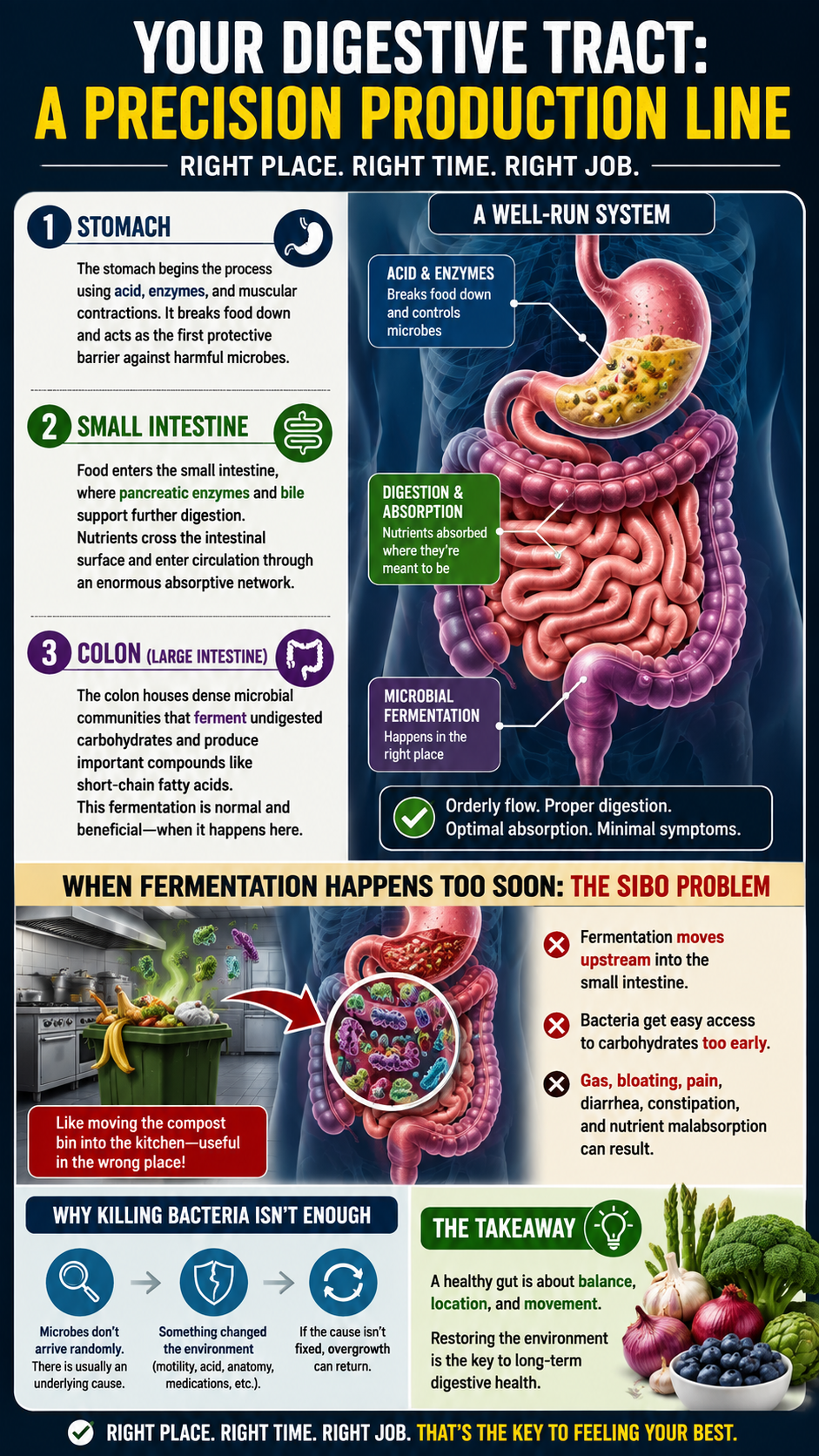
Trouble develops when excessive fermentation occurs much earlier. Food entering the small intestine can encounter larger microbial populations before digestion and absorption finish. Those microorganisms suddenly gain access to carbohydrates that would normally travel farther downstream.
Imagine moving the composting department into the middle of a restaurant kitchen. Composting itself remains useful, but its location creates the problem. Something beneficial in one environment becomes disruptive when relocated into another.
SIBO follows a similar principle. The digestive tract needs microorganisms, yet their distribution matters enormously. When microbial activity becomes excessive within the small intestine, normal food can generate abnormal symptoms.
This distinction also explains why simply killing bacteria provides an incomplete strategy. Microorganisms did not necessarily arrive randomly. Something may have changed the environment enough to allow their accumulation.
When Healthy Fiber Becomes Microbial Fuel
Fiber remains an important component of many nutrient-dense diets. Certain fibers support stool formation, microbial diversity, and beneficial fermentation inside the colon. However, different fibers behave differently throughout the gastrointestinal tract.
Some carbohydrates resist complete human digestion and become available to intestinal microorganisms. Bacteria metabolize these substrates through fermentation and release gases and other compounds. The location and speed of this process can strongly influence symptoms.
Many troublesome carbohydrates belong to the group known as FODMAPs. This acronym describes fermentable oligosaccharides, disaccharides, monosaccharides, and polyols. These compounds occur naturally within numerous otherwise nutritious foods.
Garlic and onions contain fructans, while legumes contain galacto-oligosaccharides. Certain fruits provide excess fructose or sugar alcohols. Asparagus, mushrooms, wheat products, and numerous prebiotic supplements can also deliver substantial fermentable material.
None of this makes these foods inherently unhealthy. Instead, they provide more substrate for microbial fermentation. Someone with excessive small-intestinal fermentation may therefore react dramatically to foods another person digests comfortably.
The amount consumed also matters. A small serving may remain below someone’s symptom threshold. A larger serving can provide enough substrate to generate considerable fermentation and intestinal distention.
Consequently, “healthy foods make me bloated” should not automatically become “healthy foods are bad for me.” A more accurate interpretation examines the digestive environment encountering those foods. Food tolerance provides information about physiology.
The Machinery That Normally Keeps Bacteria Moving
SIBO becomes far more interesting when we stop asking what kills bacteria. A more important question examines what normally prevents excessive microorganisms from accumulating. The body possesses several systems designed for exactly that purpose.
Stomach acid represents one important protective mechanism. Strong gastric acidity helps begin protein digestion while limiting many swallowed microorganisms. Food then encounters bile, pancreatic enzymes, and additional digestive secretions farther downstream.
Anatomy also provides important protection. The ileocecal region separates the small intestine from the bacteria-rich colon. Structural changes or previous gastrointestinal surgery can alter normal flow and create conditions favoring microbial accumulation.
Yet intestinal movement may represent one of the most important defenses. The digestive tract constantly propels material forward through coordinated muscular contractions. Efficient transit prevents food, secretions, and microorganisms from remaining stagnant indefinitely.
Anything significantly slowing this system deserves attention. Motility disorders, certain neurological conditions, metabolic disease, medications, structural abnormalities, and chronic constipation may alter intestinal movement. Previous abdominal surgery can also change anatomy and transit.
Current gastroenterology guidance recognizes several underlying conditions associated with SIBO. Management therefore involves more than reducing microorganisms. Identifying and correcting predisposing causes remains an important component of treatment when possible.
This point fundamentally changes the therapeutic objective. Repeatedly reducing bacteria without examining the environment can create an endless cycle. Long-term improvement requires understanding what allowed overgrowth to develop.
Meet the Gut’s Between-Meal Cleaning Crew
Several hours after eating, the digestive tract enters another important phase. Coordinated electrical and muscular waves begin traveling through portions of the stomach and small intestine. Scientists call this activity the migrating motor complex, or MMC.
Think of the MMC as an intestinal housekeeping cycle. During fasting periods, these contractions help move residual food, secretions, and microorganisms forward. That movement helps prevent material from remaining stagnant between meals.
Disrupted motility can interfere with this cleaning process. Residual material may remain longer inside the small intestine, while microorganisms receive additional opportunities to proliferate. Fermentation can then become easier to sustain.
Meal timing becomes interesting within this context. Constant grazing keeps the digestive tract repeatedly processing incoming food. Distinct periods between meals allow fasting physiology to emerge more clearly.
This does not mean aggressive fasting cures SIBO. Such a claim would oversimplify an extremely complex condition. However, normal motility and appropriate meal spacing deserve consideration within a broader digestive strategy.
The MMC also helps explain why recurrence deserves deeper investigation. If motility remains impaired after microbial reduction, the original ecological conditions may persist. Symptoms can eventually return because the environment never truly changed.
Methane, Hydrogen, and the Different Faces of Overgrowth
Not every person experiencing microbial overgrowth produces the same gases. Hydrogen represents one commonly measured fermentation product during breath testing. Methane provides another important clue about intestinal ecology.
Methane creates an interesting distinction because archaea produce it rather than bacteria. Specialists increasingly call elevated intestinal methane intestinal methanogen overgrowth, or IMO. This terminology better reflects the microorganisms involved.
Methane has a particularly important relationship with constipation. Research has repeatedly associated intestinal methane production with slower transit and constipation. This connection can create a difficult physiological loop.
Slower movement allows intestinal material to remain longer. Longer retention provides microorganisms additional opportunities to interact with available substrates. Increased fermentation can then accompany worsening digestive symptoms.
Other patients experience diarrhea rather than constipation. Hydrogen-associated fermentation may accompany different bowel patterns, although symptoms alone cannot reliably identify the underlying gas. Hydrogen sulfide metabolism has also attracted increasing scientific interest.
These distinctions demonstrate why SIBO should never become a universal label for every bloated patient. Different microbial ecosystems can produce different metabolic effects. Effective investigation requires more precision than simply diagnosing “bad gut bacteria.”
What Excessive Fermentation Does to the Body
Visible abdominal expansion receives most of the attention because patients can see it. Yet significant SIBO can affect much more than waist circumference. The small intestine performs critical nutritional work throughout every meal.
Most nutrient absorption occurs across the small intestinal surface. Amino acids, fatty acids, vitamins, minerals, and carbohydrates must cross this barrier efficiently. Disruption can therefore affect nutritional status in more significant cases.
Vitamin B12 deficiency represents one recognized complication of substantial bacterial overgrowth. Problems involving fat digestion can also develop when bacteria interfere with normal bile acid metabolism. More advanced malabsorption can produce additional nutritional consequences.
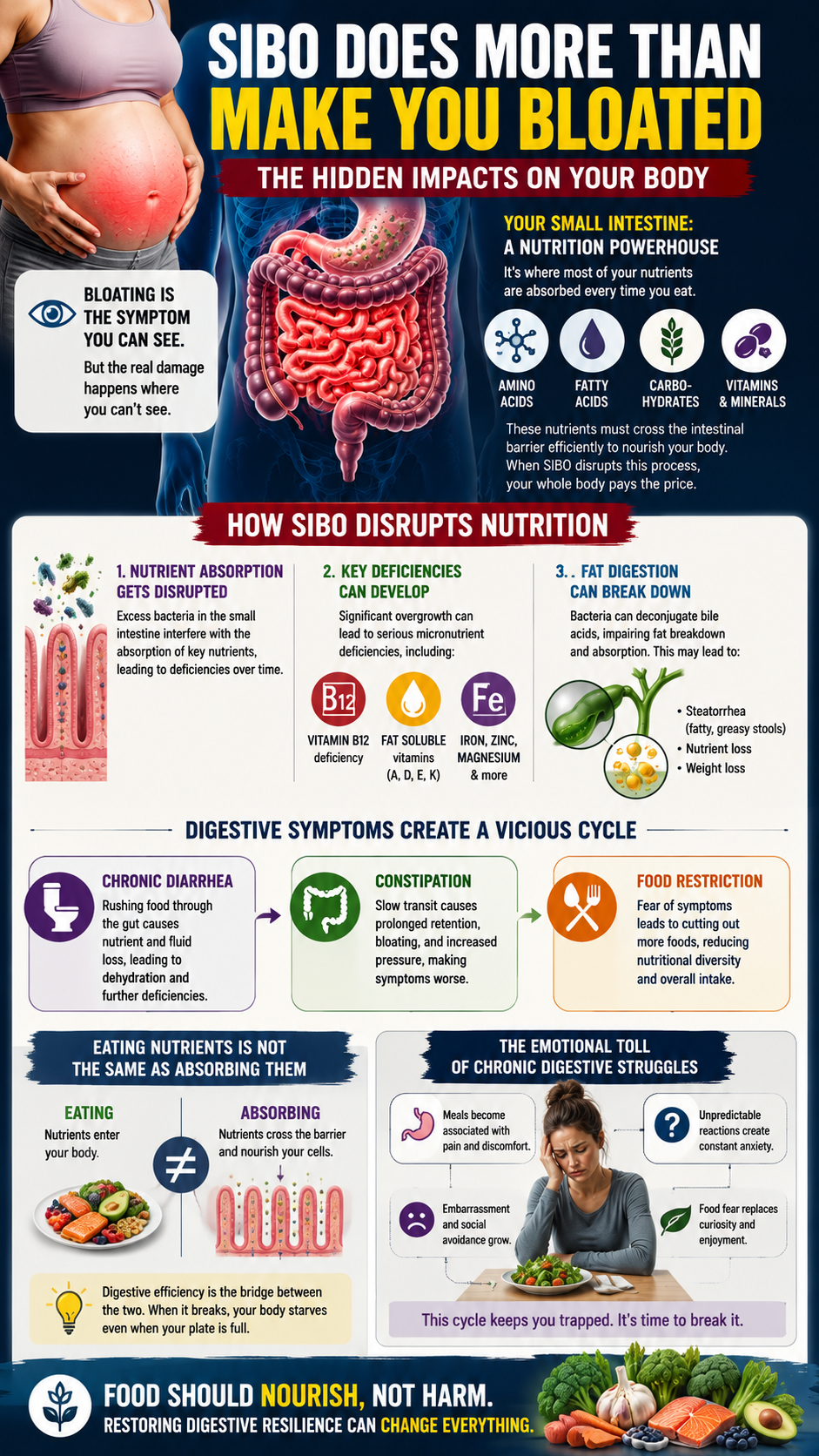
Digestive symptoms themselves can compound these problems. Chronic diarrhea increases nutrient and fluid losses, while constipation creates prolonged intestinal retention. Severe food restriction can further decrease nutritional diversity.
People may therefore consume an excellent diet while becoming progressively less nourished. Eating nutrients and absorbing nutrients represent two different biological events. Digestive efficiency connects those two processes.
Chronic bloating can also alter someone’s relationship with food. Meals become associated with discomfort, embarrassment, and unpredictability. Eventually, people begin fearing ingredients rather than investigating the mechanism behind their reactions.
That cycle deserves interruption. Food should provide nourishment rather than constant anxiety. Restoring digestive resilience offers a more meaningful goal than maintaining an increasingly narrow diet.
Breath Testing Offers Clues, Not Absolute Answers
Hydrogen and methane breath tests remain commonly used when SIBO or IMO appears clinically appropriate. Testing generally involves consuming glucose or lactulose after specific preparation. Breath samples then measure gas concentrations over several hours.
These tests offer convenience because they remain noninvasive. However, they also contain meaningful limitations. Transit speed, preparation, test substrate, and interpretation can influence the final result.
A rapid intestinal transit time can complicate lactulose testing. Glucose testing presents different strengths and limitations because glucose becomes absorbed earlier. Neither method transforms a complicated digestive ecosystem into a perfectly simple diagnosis.
Symptoms also overlap with numerous other conditions. Lactose intolerance, fructose malabsorption, celiac disease, constipation, pelvic-floor dysfunction, and motility disorders can create similar complaints. Irritable bowel syndrome can also produce substantial bloating and altered bowel habits.
This uncertainty should encourage better investigation rather than therapeutic guesswork. Testing becomes most valuable when combined with history, symptoms, bowel patterns, medication use, and known risk factors.
Persistent bloating therefore deserves more than a social-media diagnosis. SIBO represents one important possibility among several. Understanding the underlying physiology remains more valuable than collecting another diagnostic label.
Begin With Patterns Before Reaching for Products
The first practical step requires observation rather than supplementation. Digestive symptoms contain valuable information about meal timing, food quantity, fermentation, and intestinal transit. Most people simply have never recorded those patterns carefully.
Spend approximately two weeks documenting what happens after meals. Record the foods consumed, approximate portions, meal times, bowel movements, and symptom onset. Pay particular attention to when abdominal expansion begins.
Symptoms appearing shortly after certain meals provide different information from symptoms developing many hours later. Morning improvement also matters. An abdomen that begins flat and expands throughout the day creates a useful pattern.
Bowel movements deserve equal attention. Record frequency, consistency, straining, urgency, and incomplete evacuation. Constipation can contribute substantially to bloating and may interact with methane production.
Next, compare reactions after highly fermentable foods. Garlic, onions, legumes, wheat products, apples, and certain sweeteners provide useful examples. Repeated reactions can identify patterns worth investigating.
This journal does not diagnose SIBO. Instead, it replaces vague frustration with organized information. Better information creates better decisions.
Give the Digestive Tract Time Between Meals
Constant snacking has become remarkably normal within modern eating patterns. Breakfast leads into a snack, followed by lunch, another snack, dinner, and evening eating. The digestive tract receives little separation between feeding periods.
Structured meal spacing may support normal fasting motility in appropriate individuals. Allowing several hours between meals provides opportunities for migrating motor complex activity. This approach focuses on rhythm rather than calorie restriction.
Many adults can experiment with distinct meals instead of continuous grazing. Exact timing should reflect individual needs, medications, activity, and metabolic health. Extreme fasting is neither required nor appropriate for everyone.
Hydration should continue throughout the day. Water does not provide the same fermentable substrate as food. Adequate fluid intake also supports normal bowel function.
Anyone using glucose-lowering medications should approach fasting changes carefully. Pregnancy, eating disorders, underweight status, and several medical conditions require additional consideration. Digestive improvement should never come at the expense of overall health.
Temporarily Lower the Fermentation Load
Reducing highly fermentable foods can provide significant symptom relief for some people. The objective involves lowering microbial substrate while investigating deeper causes. It should not automatically become a permanent lifestyle.
Begin with foods consistently producing the strongest reactions. Large servings of onions, garlic, beans, certain fruits, wheat products, and sugar alcohols commonly create problems. Portion size often determines whether symptoms appear.
Replacing those foods temporarily can preserve nutritional diversity. Many people tolerate leafy greens, carrots, cucumber, zucchini, and other lower-fermentation vegetables more comfortably. Individual response should always guide food selection.
Protein and appropriate dietary fats can provide satisfying nutrition while fermentable carbohydrate intake decreases. Meals should remain nutrient-dense rather than becoming unnecessarily restrictive. The goal involves controlling symptoms without creating nutritional deficiencies.
Once symptoms improve, begin challenging the digestive system gradually. Permanent avoidance tells us little about restored function. Carefully expanding food variety provides a better test of resilience.
A therapeutic diet should therefore have an exit strategy. Restriction creates breathing room, while reintroduction measures progress. Confusing those two purposes can leave people trapped inside unnecessarily limited diets.
Stop Assuming More Fiber Always Means Better Digestion
Fiber carries an almost universally healthy reputation. That reputation can cause people with severe bloating to increase fiber aggressively. Unfortunately, more fermentation substrate can sometimes produce more symptoms.
Many prebiotic supplements contain inulin, fructooligosaccharides, or similar fermentable compounds. Microorganisms readily metabolize these ingredients. Someone experiencing excessive fermentation may therefore notice dramatic increases in gas and distention.
That reaction does not prove fiber is unhealthy. It demonstrates that dosage, timing, location, and microbial environment matter. Nutrition rarely behaves according to simple slogans.
Rapidly increasing fiber can also overwhelm an otherwise healthy digestive system. Gradual adjustments usually provide more useful information. Tolerance should guide progression rather than arbitrary fiber targets.
When a supplement repeatedly creates substantial bloating, reconsider the strategy. Doubling the dose because discomfort supposedly represents “detoxification” makes little physiological sense. Symptoms deserve interpretation rather than celebration.
Think Before Automatically Adding Probiotics
Probiotics represent another area where marketing often moves faster than physiology. People hear the phrase “gut problem” and immediately purchase billions of microorganisms. That approach assumes every digestive disturbance reflects insufficient bacteria.
SIBO presents an obvious contradiction to that assumption. The problem may involve excessive microbial activity within an inappropriate intestinal location. Simply adding more organisms does not automatically correct that geography.
Different probiotic strains also perform different functions. Their effects depend upon the host, existing microbiome, diet, dosage, and digestive environment. The word probiotic describes an enormous category rather than one uniform treatment.
Current gastroenterology guidance does not support probiotics as a universal treatment for bloating. Evidence remains mixed and context-dependent. Individualized decisions make more sense than automatic supplementation.
If probiotics repeatedly worsen pressure, gas, or distention, pay attention. Greater discomfort does not prove a product is restoring microbial balance. Sometimes the digestive system is simply telling you that the current intervention does not fit.
Improve the First Stages of Digestion
Modern eating often treats meals like another task requiring maximum speed. People eat while driving, working, scrolling, or standing over the kitchen counter. Digestion, however, begins before food reaches the small intestine.
Slow down enough to chew thoroughly. Mechanical breakdown increases food surface area and supports later enzymatic digestion. Large poorly chewed particles require more work farther downstream.
Eating calmly also changes the neurological environment surrounding digestion. Stress can influence gastrointestinal motility, visceral sensitivity, and symptom perception. A calmer meal cannot cure SIBO, but it supports normal digestive physiology.

Avoid routinely consuming enormous meals when smaller portions produce fewer symptoms. Substrate quantity influences fermentation. Overloading a sensitive digestive system can magnify discomfort even when the foods themselves remain nutritious.
A gentle walk after eating provides another practical strategy. Movement supports metabolic health and may encourage gastrointestinal activity. Remaining physically active also supports bowel regularity.
Foundational habits rarely look exciting enough for supplement advertisements. Their lack of glamour does not reduce their physiological importance. Consistency often produces more value than complicated protocols followed irregularly.
Constipation Must Become Part of the Investigation
Someone can address diet perfectly while ignoring one major obstacle: poor intestinal transit. Chronic constipation allows intestinal contents to remain longer within the digestive tract. That stagnation can contribute to bloating and discomfort.
Methane makes this relationship particularly important. Higher methane production has been associated with constipation and slower transit. Patients with methane-dominant patterns may therefore require special attention to bowel function.
Begin by tracking actual bowel frequency and stool quality. Hard stools, straining, incomplete evacuation, and long gaps between movements provide useful information. These patterns should not simply become accepted as personal normality.
Adequate hydration, movement, and appropriate food choices can support regularity. Fiber requires careful individualization because aggressive increases can worsen bloating in some people. More is not automatically better.
Persistent evacuation difficulty may involve pelvic-floor dysfunction or another motility disorder. Home strategies cannot correct every mechanical problem. Appropriate evaluation becomes important when constipation remains stubborn.
Improving transit can change the entire digestive environment. Faster clearance reduces stagnation and alters microbial access to substrates. That makes bowel regularity much more than a comfort issue.
Reintroduce Foods Like a Scientist
Once symptoms settle, the next phase should involve carefully expanding the diet. Choose one previously troublesome food rather than introducing several simultaneously. Keep the remaining meal familiar.
Begin with a small serving and observe the response. Increase the portion gradually across later exposures when tolerance remains good. This process helps identify individual thresholds.
Someone may tolerate several bites of avocado but react to an entire fruit. A small amount of onion may cause little trouble, while a large serving produces significant fermentation. Dose frequently determines symptom severity.
Reintroduction also prevents unnecessary food fear. Every successfully tolerated food expands nutritional variety and psychological freedom. That progress matters just as much as another supplement disappearing from the protocol.
A severe reaction provides information rather than failure. Return to the previous tolerated level and reassess the broader digestive picture. Recovery rarely follows a perfectly straight line.
Recognize When the Body Needs More Investigation
Not every case of bloating belongs in an at-home digestive experiment. Certain symptoms deserve timely professional evaluation because more serious conditions can resemble SIBO. Ignoring those signals can delay appropriate diagnosis.
Unexplained weight loss, gastrointestinal bleeding, anemia, persistent vomiting, fever, or progressively severe pain deserve evaluation. Significant nighttime symptoms should also receive appropriate attention. These findings should not automatically be blamed on fermentation.
Persistent diarrhea can create dehydration and nutritional problems. Severe constipation can signal significant motility or evacuation disorders. Both deserve deeper assessment when basic measures fail.
Previous abdominal surgery adds another important layer because anatomy may have changed. Diabetes, neurological disorders, inflammatory bowel disease, and several systemic conditions can also alter intestinal movement. These circumstances require individualized investigation.
Root-cause thinking should never mean rejecting appropriate testing. Quite the opposite, it demands more accurate testing because the mechanism matters. Treating every bloated abdomen as SIBO violates that principle.
Recovery Should Expand Your Life, Not Shrink Your Menu
The most meaningful measure of digestive progress is not how many foods someone can avoid. Success appears when the digestive system becomes increasingly resilient. Food variety should expand whenever physiology permits.
Bloating should become less frequent and less intense. Bowel movements should become more predictable, while meals create less anxiety. Previously troublesome foods may gradually return in reasonable quantities.
Some legitimate intolerances may remain, and complete dietary freedom is not guaranteed. Individual biology creates genuine differences in food tolerance. Nevertheless, continually losing foods should trigger investigation rather than resignation.
The larger lesson reaches beyond SIBO itself. Nutrition cannot be separated from digestion, microbial ecology, intestinal movement, and absorption. A nutritious ingredient only fulfills its potential when the digestive system can process it appropriately.
Garlic did not suddenly become poisonous because it causes bloating. Broccoli did not transform into inflammatory junk food because the abdomen expands afterward. Those reactions reveal something about the environment encountering the food.
Instead of building a longer list of forbidden ingredients, investigate that environment. Examine meal timing, constipation, intestinal motility, fermentable carbohydrate load, medications, previous surgery, and other contributing factors. Use testing thoughtfully when the clinical picture warrants it.
SIBO remains a complicated and evolving area of digestive medicine. Breath testing has limitations, symptoms overlap with other conditions, and no single intervention works universally. Those uncertainties make individualized reasoning more important, not less.
Ultimately, the objective reaches far beyond achieving a flatter stomach after dinner. The small intestine must digest food, absorb nutrients, control microbial populations, and move intestinal contents efficiently. Restoring those functions represents a far more meaningful target.
Healthy food should nourish the body without creating constant fear. When nutritious meals repeatedly produce bloating, the answer is not automatically another elimination diet. Sometimes the most valuable question begins farther upstream.
What changed inside the digestive system that made ordinary food difficult to handle?
Answering that question can transform the entire approach to SIBO, chronic bloating, gut health, intestinal fermentation, constipation, and food intolerance. Instead of spending years running from food, the focus moves toward rebuilding the digestive environment that receives it.