The 33 Chiropractic Principles Explained with Everyday Analogies
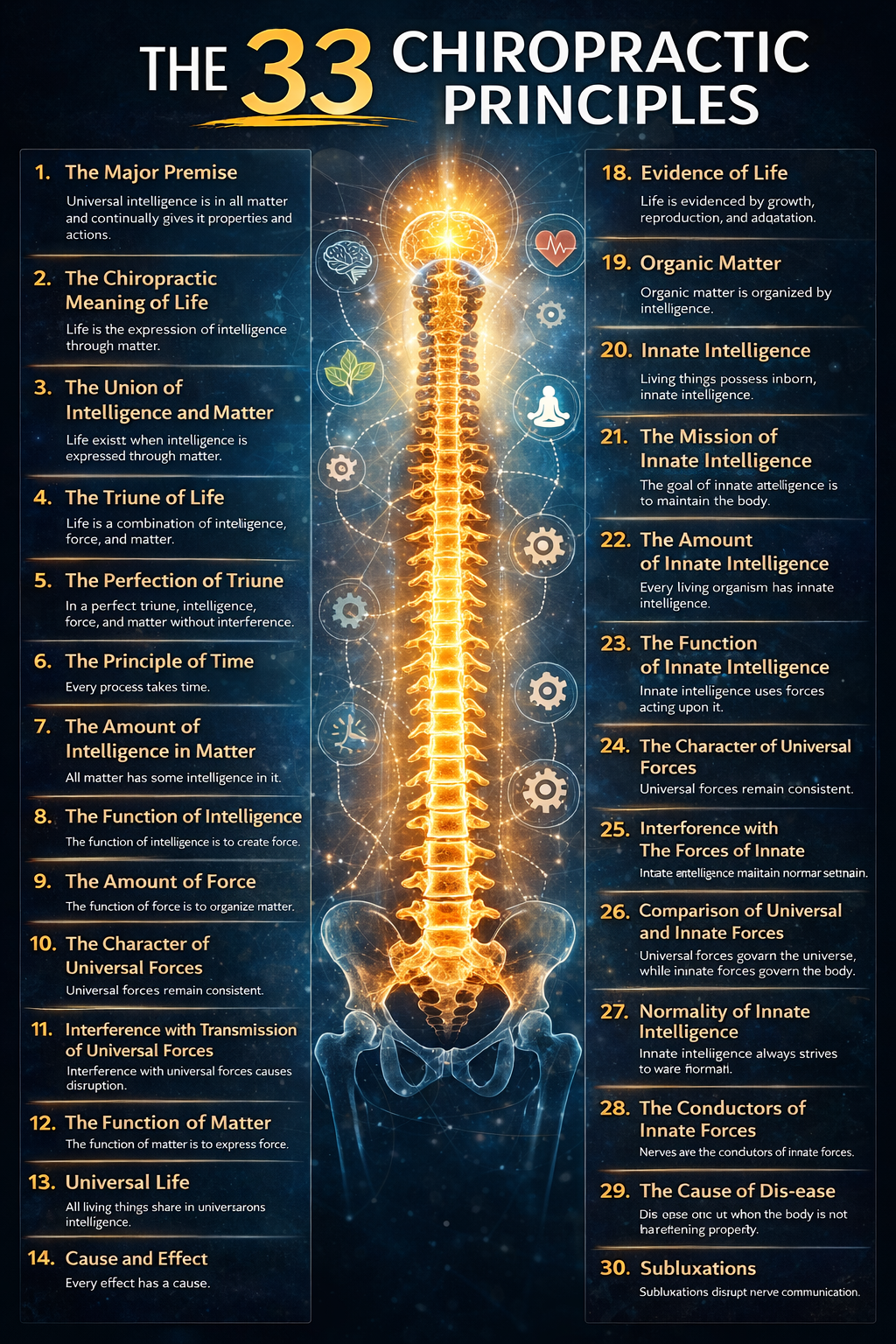
Most people think of chiropractic as simply adjusting the spine to relieve pain. While spinal care is certainly part of the profession, the philosophical foundation of chiropractic is much deeper than symptom relief. At its core lies a framework known as the 33 Chiropractic Principles, first organized by R.W. Stephenson in the influential work The Chiropractic Textbook.
These principles attempt to answer one of the most profound questions in biology and philosophy: What makes living systems function the way they do?
Rather than viewing the body as a collection of mechanical parts that occasionally break down, the 33 principles describe life as an organized process governed by intelligence, energy, and structure working together in harmony. According to this perspective, the human body is not merely a machine that needs external control; it is a self-regulating, self-healing system constantly working to maintain balance and order.
Understanding these principles is valuable not only for chiropractors or healthcare professionals but for anyone interested in how life actually operates. When you begin to see how intelligence organizes matter, how energy creates movement, and how communication coordinates every function in the body, you start to recognize patterns that appear throughout nature. The same organizing forces that guide the growth of a forest, the formation of a snowflake, or the movement of the planets also govern the processes occurring inside the human body every second.
This is why many chiropractors refer to these ideas not simply as the principles of chiropractic, but as principles of life itself. They describe universal laws that apply to every living organism—from the smallest cell to the most complex human system. When these principles are understood, health begins to make more sense, and so does disease. Rather than seeing illness as random misfortune, we can begin to understand it as the result of disrupted communication or imbalance within a highly organized system.
Learning the 33 principles offers a new lens through which to view health, biology, and the human body. They encourage us to appreciate the extraordinary intelligence already present within us and to recognize how important it is to preserve the systems that allow that intelligence to express itself fully.
With this perspective in mind, the following sections will walk through each of the 33 principles, explaining what they mean and illustrating them with examples from everyday life so that these ideas become practical and easy to understand.
1. The Major Premise
The major premise proposes that a universal intelligence exists in all matter and continuously gives it its properties and actions. In chiropractic philosophy, this intelligence is viewed as the organizing principle behind life itself. It is the reason a fertilized egg becomes a fully developed human being and why the body can repair tissue, regulate temperature, and maintain balance without conscious effort.
An everyday example can be seen in nature when a seed grows into a tree. No gardener instructs the seed how to build roots, form leaves, or produce bark. The information necessary for growth already exists within the seed itself. The same organizing intelligence that grows the tree also directs the countless processes happening inside the human body every moment.
2. The Chiropractic Meaning of Life
In chiropractic philosophy, life is defined as the expression of intelligence through matter. When intelligence is actively organizing matter and producing activity, life is present.
Imagine electricity flowing through a light bulb. When electrical energy passes through the filament, the bulb illuminates. If the electrical flow stops, the bulb becomes dark even though the physical structure of the bulb remains intact. The body functions similarly. When life energy is actively coordinating the body’s systems, the organism functions as a living being.
3. The Union of Intelligence and Matter
This principle states that life exists when intelligence is united with matter. Matter alone does not produce life unless intelligence is organizing it.
Consider a smartphone sitting on a table with no operating system installed. It may contain all the physical components necessary to function, but without the software directing those components, it cannot perform any tasks. In a similar way, the human body relies on intelligence to organize its physical structures into a living, functioning organism.
4. The Triune of Life
The triune of life describes the three components necessary for living processes: intelligence, force, and matter. Intelligence creates force, and force acts upon matter to produce function.
A simple analogy is driving a car. The driver represents intelligence, the fuel and engine represent force, and the vehicle itself represents matter. If any one of these elements is missing, the car cannot move. The same principle applies to biological life.
5. The Perfection of the Triune
When intelligence, force, and matter work together without interference, the system functions perfectly. In chiropractic philosophy, health reflects the proper coordination of these three components.
Think of a symphony orchestra performing a musical piece. The composer provides the intelligence, the musicians generate the force of sound, and the instruments represent matter. When all three work harmoniously, beautiful music is produced.
6. The Principle of Time
Every process requires time to unfold. Biological processes do not occur instantly but progress through stages.
For example, when someone begins exercising regularly, physical improvements such as stronger muscles and increased endurance develop gradually over weeks and months. In the same way, healing within the body requires time as tissues repair and adapt.
7. The Amount of Intelligence in Matter
This principle states that all matter contains some degree of intelligence. While the degree of complexity may vary, organization exists at every level.
A snowflake forming in a cloud demonstrates this concept beautifully. Each snowflake develops a highly organized geometric pattern without any human direction. The structure emerges naturally from the laws governing matter and energy.
8. The Function of Intelligence
The role of intelligence is to create force. Intelligence generates the energy necessary to organize matter into action.
When a person decides to stand up from a chair, that decision originates as a thought in the brain. The brain then generates nerve impulses that travel to the muscles, producing the force required for movement.
9. The Amount of Force Created by Intelligence
The amount of force produced is proportional to the needs of the system.
For instance, a thermostat in a home detects the surrounding temperature and signals the heating system to produce just enough heat to maintain the desired environment. Similarly, the body generates the precise amount of nerve energy required to regulate each organ and tissue.
10. The Function of Force
Force acts upon matter to produce movement or change. In chiropractic philosophy, nerve impulses represent the force used by the body to coordinate tissues.
An everyday example is electricity powering household appliances. The electrical force acts upon the components of a refrigerator, allowing it to cool food. Without the electrical energy flowing through it, the refrigerator cannot function.
11. The Character of Universal Forces
Universal forces operate consistently throughout the universe according to predictable laws.
Gravity is a simple example. Whether on Earth, the Moon, or another planet, gravity consistently pulls objects toward the center of mass. Natural laws remain stable and dependable.
12. Interference with Transmission of Universal Forces
When something interferes with the transmission of force, the outcome changes.
Imagine a garden hose delivering water to plants. If the hose becomes kinked, the water flow is reduced. The water still exists, but its ability to reach the plants becomes limited.
13. The Function of Matter
Matter serves as the medium through which forces act.
Consider a musical instrument such as a violin. The instrument itself is the matter, but the music emerges only when the musician applies force through the bow and strings. The instrument provides the structure that allows the sound to be produced.
14. Universal Life
Universal life refers to the life principle present in all living organisms. This life force governs growth, repair, and adaptation.
A forest illustrates this beautifully. Trees grow toward sunlight, roots extend toward water, and ecosystems adapt over time. Life continually expresses itself throughout nature.
15. No Motion Without the Effort of Force
Movement requires force. Nothing moves without energy being applied.
A bicycle does not move simply because it exists. A rider must pedal to generate the force needed to propel it forward. Similarly, biological motion requires energy generated by the body.
16. Intelligence in Both Organic and Inorganic Matter
Both living and nonliving matter demonstrate forms of organization and structure.
Crystals forming in mineral deposits create precise geometric shapes. These structures arise naturally without human involvement, illustrating how matter organizes itself according to underlying principles.
17. Cause and Effect
Every effect has a cause. Understanding the cause helps explain the outcome.
If a person plants tomatoes in fertile soil, waters them regularly, and provides sunlight, the result is a healthy crop. The effect—the tomatoes—is the direct result of those causes.
18. Evidence of Life
Life is demonstrated through processes such as growth, reproduction, adaptation, and responsiveness.
A plant bending toward sunlight provides a simple example. The plant responds to its environment and adjusts its growth accordingly, demonstrating that it is alive.
19. Organic Matter
Organic matter refers to matter organized by intelligence into living structures.
A living cell is an extraordinary example of organization. Within a microscopic space, thousands of chemical reactions occur every second, maintaining the structure and function of the organism.
20. Innate Intelligence
Innate intelligence refers to the intelligence present within living organisms that governs their biological processes.
Your body does not require conscious instruction to heal a cut, digest food, or regulate blood pressure. These processes occur automatically through the body’s internal regulatory systems.
21. The Mission of Innate Intelligence
The mission of innate intelligence is to maintain the body in proper condition.
When someone touches a hot surface, the nervous system instantly triggers a withdrawal reflex. This protective response occurs without conscious thought, illustrating the body’s ability to safeguard itself.
22. The Amount of Innate Intelligence
Every living organism possesses innate intelligence.
A bird building a nest demonstrates this beautifully. The bird instinctively gathers materials and constructs a structure suited to protect its eggs, even though it has never attended an architectural class.
23. The Function of Innate Intelligence
Innate intelligence coordinates the functions of the body.
It regulates heart rate, breathing, hormone levels, and countless other processes simultaneously. The human body carries out millions of coordinated actions every second.
24. The Forces of Innate Intelligence
Innate intelligence expresses itself through forces within the body, primarily through nerve impulses.
The nervous system serves as the communication network that carries these signals from the brain to tissues throughout the body.
25. The Function of the Forces of Innate Intelligence
These forces maintain normal body function by directing tissues and organs.
When you run, the nervous system increases heart rate, breathing rate, and blood flow to muscles. This coordination allows the body to meet the demands of physical activity.
26. Comparison of Universal and Innate Forces
Universal intelligence governs the universe as a whole, while innate intelligence governs the internal functions of living organisms.
The laws of physics guide planetary motion in the solar system. Similarly, biological systems operate according to internal regulatory laws that maintain life.
27. Normality of Innate Intelligence
Innate intelligence naturally seeks to maintain normal function and balance within the body.
When a person becomes dehydrated, the body triggers thirst to encourage fluid intake. This response helps restore balance and maintain health.
28. The Conductors of Innate Forces
The nervous system conducts the forces generated by innate intelligence.
Nerves carry messages from the brain to muscles, glands, and organs, allowing the body to coordinate its activities.
29. Interference with Transmission of Innate Forces
When something interferes with nerve communication, the coordination of body functions can be affected.
A simple analogy is a phone call with poor reception. The message becomes distorted, and the intended information may not reach the listener clearly.
30. The Cause of Dis-Ease
Dis-ease refers to a state in which the body is not functioning in harmony.
When communication between systems is disrupted, coordination becomes impaired. For example, if traffic lights in a city stop working, congestion and accidents become more likely because the normal flow of traffic is disrupted.
31. Subluxations
In chiropractic philosophy, subluxations are disturbances that interfere with the normal transmission of nerve signals.
An analogy is stepping on a garden hose while watering plants. The water still exists, but the flow reaching the plants becomes restricted.
32. The Principle of Coordination
Health requires coordination among all parts of the body.
A successful sports team depends on players working together toward a common goal. When each player performs their role properly, the team functions effectively.
33. The Law of Demand and Supply
The body supplies what tissues demand in order to maintain balance.
When muscles require more oxygen during exercise, the heart pumps faster to deliver increased blood flow. The body continuously adjusts to meet the needs of its tissues.
Closing Perspective: The Big Picture of the 33 Principles
When the 33 Chiropractic Principles are viewed together, they form a complete picture of how life operates within the body. The early chiropractic thinkers who organized these ideas, including R.W. Stephenson, were attempting to describe the laws that govern living systems in the same way physics describes the laws that govern the universe.
The first group of principles establishes a foundational understanding that life is not random. Intelligence organizes matter through force, and this process produces the coordinated activity we call life. From the growth of a tree to the beating of the human heart, complex systems function because intelligence is directing them through energy acting upon physical structure. These principles invite us to recognize that living organisms are not mechanical machines assembled by chance but organized systems guided by internal intelligence.
The middle principles shift the focus from universal life to the living body itself. They explain that within every organism exists innate intelligence, the internal coordinating system responsible for maintaining balance, growth, and repair. Every breath, every heartbeat, every chemical reaction occurring within your cells is part of a highly organized process being directed by this internal intelligence. Without it, the physical body would simply be matter without life.
The final group of principles addresses what happens when this system of coordination is disrupted. If the communication between the brain and body becomes distorted or blocked, the body cannot properly regulate its tissues. The result is dysfunction, which chiropractic philosophy describes as dis-ease, meaning the body is no longer operating with ease or harmony. When communication is restored, coordination improves, and the body regains its ability to function normally.
Taken together, these 33 principles form a single overarching message: life is an organized process governed by intelligence, expressed through the nervous system, and dependent on clear communication throughout the body. When that communication remains unobstructed, the body has a remarkable ability to regulate itself, adapt to challenges, and maintain balance.
Understanding these principles encourages a deeper appreciation for how the body works and why maintaining proper communication within the nervous system is so central to health. Rather than viewing the body as a collection of isolated parts, the principles remind us that the body functions as a unified, intelligent system constantly working to maintain order, coordination, and life.