
The Forgotten Metabolic Skill
Your body carries an extraordinary energy reserve. Even a relatively lean person stores thousands of calories within body fat. Yet millions of people feel hungry several hours after eating. They become irritable when lunch gets delayed. Afternoon energy disappears, cravings intensify, and another snack suddenly feels essential. Meanwhile, unwanted body fat remains stubbornly attached. The problem is not simply that the body lacks energy. In many cases, the deeper issue involves how effectively it can move between available fuels.
That ability is called metabolic flexibility. It describes how efficiently the body adjusts fuel use according to availability and demand. After eating, metabolism should readily process incoming nutrients. Between meals, it should increasingly draw upon stored energy. During exercise, muscles should adjust their fuel mixture according to intensity. Overnight, the body should continue producing energy despite receiving no food. Healthy metabolism constantly makes these transitions without requiring conscious thought.
Modern life has changed the environment surrounding that system. Food remains available from morning until midnight. Refined carbohydrates and ultra-processed foods deliver concentrated energy within minutes. Sitting eliminates much of the muscular demand that once accompanied daily life. Poor sleep alters appetite and glucose regulation. Chronic overnutrition can eventually collide with low energy expenditure. The result can be a metabolism increasingly surrounded by fuel yet increasingly poor at managing it.
Your Body Was Never Designed to Burn One Fuel
The human metabolism is not a gasoline engine limited to one energy source. It resembles a sophisticated hybrid system capable of processing several fuels. Glucose, fatty acids, amino acids, glycogen, and ketones can all contribute under different conditions. The proportions change continually.
After consuming carbohydrates, blood glucose rises and insulin helps coordinate its use and storage. Skeletal muscle can burn glucose or store it as glycogen. The liver also stores glycogen while helping regulate circulating glucose. Meanwhile, insulin temporarily suppresses the release of stored fatty acids. Incoming energy gets priority because food has just arrived.
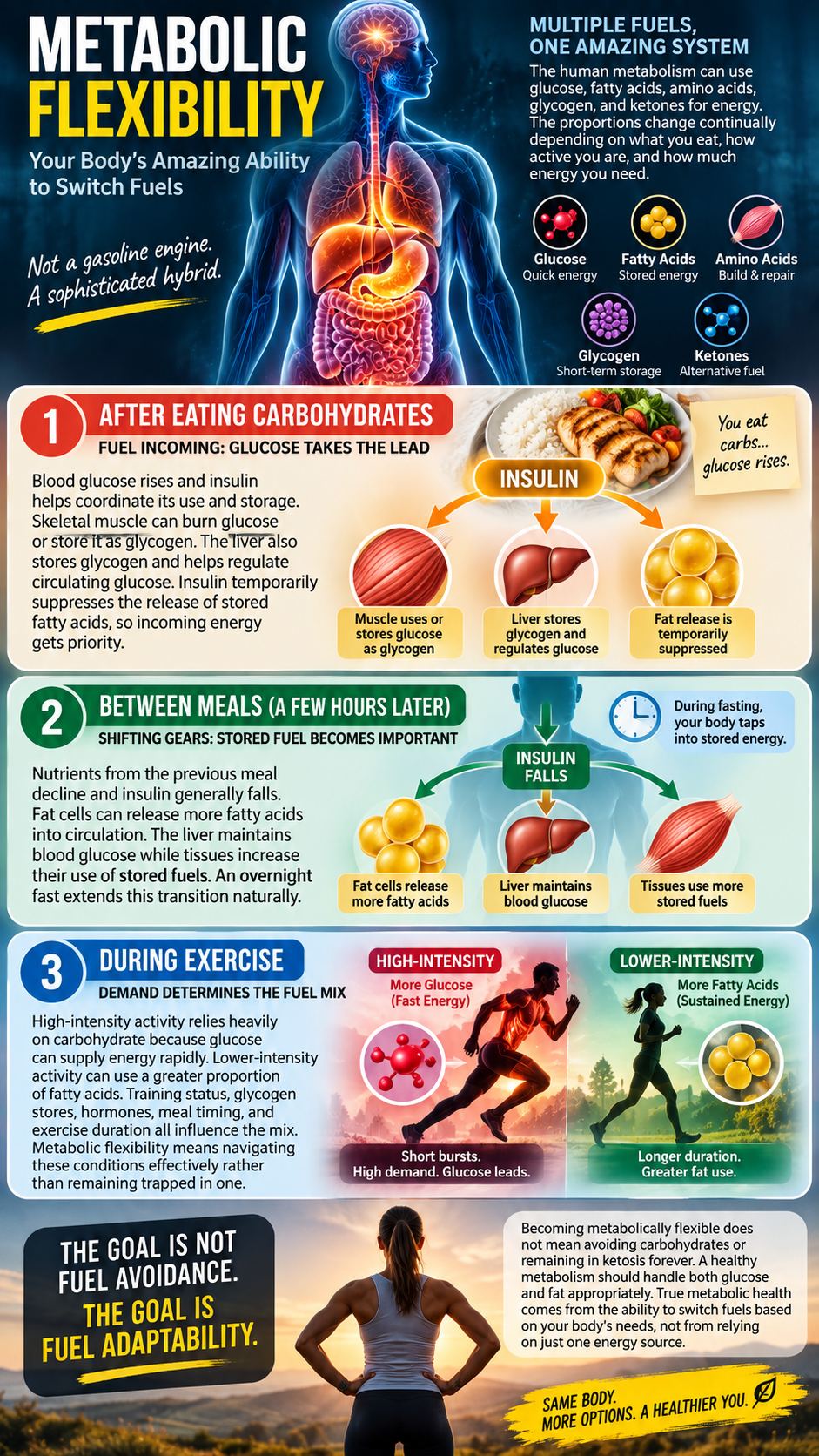
Several hours later, the metabolic landscape should change. Nutrients from the previous meal decline and insulin generally falls. Fat cells can release more fatty acids into circulation. The liver maintains blood glucose while tissues increase their use of stored fuels. An overnight fast extends this transition naturally.
Exercise creates another metabolic environment. High-intensity activity relies heavily on carbohydrate because glucose can supply energy rapidly. Lower-intensity activity can derive a greater proportion from fatty acids. Training status, glycogen stores, hormones, meal timing, and exercise duration influence the mixture. Metabolic flexibility means navigating these conditions effectively rather than remaining trapped in one.
That distinction matters because becoming metabolically flexible does not mean permanently avoiding carbohydrates. Neither does it mean remaining in ketosis forever. A healthy metabolism should handle both glucose and fat appropriately. The goal is not fuel avoidance. The goal is fuel adaptability.
Where Metabolic Inflexibility Begins
The metabolic crisis did not begin because humans suddenly developed defective biology. Our environment changed faster than our physiology. For most of human existence, acquiring food required effort. Today, acquiring calories may require nothing more than opening an app.
Breakfast can begin shortly after waking. A sweetened coffee follows during the commute. Something small appears midmorning, followed by lunch several hours later. Afternoon fatigue invites another snack or caffeinated drink. Dinner arrives before evening television, and nighttime eating extends the feeding window further.
The body can certainly handle frequent meals under many circumstances. However, trouble can develop when frequent energy intake accompanies chronic caloric surplus and minimal physical demand. Skeletal muscles remain relatively full of fuel because they rarely deplete it. Adipose tissue receives the overflow. Eventually, visceral and ectopic fat can increase while insulin sensitivity deteriorates.
Ultra-processed foods intensify this environment because they make consuming large amounts of energy remarkably easy. Refined starches, sugars, fats, salt, flavorings, and engineered textures can create highly palatable combinations. Many require little chewing and deliver substantial calories before fullness becomes pronounced. Liquid calories can disappear even faster.
The metabolic problem therefore extends beyond one villainous nutrient. Chronic energy surplus matters. Physical inactivity matters. Sleep matters. Muscle mass matters. Food quality matters. Genetics and age matter. Insulin resistance matters enormously. Metabolic dysfunction develops when these pressures converge for long enough.
Insulin Is Not the Enemy, but Insulin Resistance Is a Warning
Insulin has become one of nutrition’s most misunderstood hormones. Some people blame insulin for virtually every pound of body fat. Others treat insulin as irrelevant because calorie balance still matters. Human physiology is more nuanced.
Insulin performs essential functions required for survival. After eating, it helps glucose enter responsive tissues and promotes glycogen storage. It also reduces unnecessary glucose production by the liver. Insulin suppresses lipolysis because the body temporarily has incoming energy available. That response represents normal metabolism.
The important question concerns what happens afterward. Insulin should generally decline as nutrients disappear from circulation. Stored energy then becomes increasingly available. Problems develop when tissues become resistant to insulin and stronger signaling becomes necessary.
The pancreas can compensate by producing additional insulin. This compensation may maintain apparently normal glucose for years. Consequently, fasting glucose alone may not reveal the entire metabolic picture. Waist circumference, triglycerides, HDL cholesterol, hemoglobin A1c, blood pressure, fasting insulin, and post-meal responses can provide additional context.
Insulin-resistant skeletal muscle handles glucose less effectively. The liver may continue producing glucose despite abundant circulating energy. Adipose tissue can become metabolically dysfunctional as well. Eventually, the elegant choreography between eating, storage, fasting, and fuel mobilization becomes increasingly disorganized.
When Stored Fat Starts Appearing Where It Does Not Belong
Body fat is not inherently harmful. Adipose tissue provides an essential storage system that protects the body from uncontrolled nutrient overflow. Healthy subcutaneous fat can store substantial energy safely. Trouble develops when that storage system becomes chronically overwhelmed or dysfunctional.
Fat can then accumulate within tissues not intended for large-scale storage. Researchers call this ectopic fat. The liver represents one particularly important location. Excess liver fat commonly accompanies insulin resistance and metabolic dysfunction. Certain lipid intermediates within muscle and liver can also interfere with insulin signaling.
Visceral fat creates additional concerns. This fat surrounds abdominal organs and strongly associates with cardiometabolic risk. Enlarged fat cells can develop abnormal inflammatory signaling. Fatty-acid release may increase while normal adipokine patterns change. These changes can further disrupt metabolic regulation.
A remarkable paradox then appears. Someone may carry tremendous stored energy while still experiencing frequent hunger and fatigue. The issue is not that every calorie inside fat tissue becomes permanently inaccessible. Rather, metabolic signals governing storage, mobilization, appetite, and oxidation have become less coordinated.
Eating temporarily solves the immediate hunger. However, constantly supplying more energy can perpetuate the same environment. The person becomes trapped between abundant storage and frequent perceived demand. That cycle helps explain why metabolic health requires more than simply telling someone to eat less.
Mitochondria Decide What Happens to the Fuel
Releasing fatty acids from adipose tissue is only part of fat metabolism. Those fatty acids must ultimately be processed and oxidized by tissues. This brings us to the mitochondria, the cellular structures heavily involved in producing ATP from available nutrients.
Mitochondria respond to demand. Active skeletal muscle requires enormous quantities of ATP compared with resting muscle. Exercise therefore sends a powerful message: increase the machinery required to produce energy. Repeated aerobic activity stimulates adaptations that improve oxidative capacity.
Resistance training contributes differently but just as importantly. Stronger muscles provide a larger metabolic reservoir for glucose. Training depletes glycogen, creating room for incoming carbohydrate. Muscle contractions can also increase glucose uptake through mechanisms that do not rely completely on insulin.
Inactivity sends the opposite message. When muscles rarely work hard, they have less reason to maintain high metabolic capacity. Long periods of sitting also remove contractions that would otherwise consume circulating fuel. The problem becomes particularly significant when inactivity accompanies constant energy intake.
Mitochondrial dysfunction has associations with insulin resistance and obesity, although the relationship remains complicated. Nutrient overload itself can strain metabolic pathways. Therefore, metabolic restoration should not revolve around finding a supplement claiming to “boost mitochondria.” The body needs genuine physiological demand.
What Metabolic Inflexibility Can Do to the Body
Metabolic inflexibility is not a single diagnosed disease with one universally accepted laboratory cutoff. Instead, impaired fuel switching frequently appears alongside insulin resistance, obesity, metabolic syndrome, and type 2 diabetes. It provides a useful lens for understanding how metabolic deterioration can progress.
The earliest changes may appear deceptively ordinary. Waist circumference increases. Energy becomes less stable. Hunger arrives sooner. Triglycerides begin climbing while HDL cholesterol may fall. Blood pressure can increase. Liver fat accumulates quietly.

The pancreas initially fights back against insulin resistance by producing more insulin. Glucose may therefore remain within standard ranges for some time. Eventually, compensation may become insufficient. Fasting and post-meal glucose can then rise, followed by prediabetes or type 2 diabetes in susceptible individuals.
Fatty liver can worsen the situation by disturbing hepatic glucose and lipid metabolism. Increasing visceral fat adds another source of metabolic dysfunction. Reduced activity further lowers energy demand. Poor sleep can amplify hunger and worsen insulin sensitivity. Each disturbance begins feeding the next.
Fortunately, the same adaptability that allows metabolism to deteriorate also allows it to improve. Muscle responds to training. Liver fat can decrease. Insulin sensitivity can improve. Mitochondrial capacity can increase. Meal patterns can change. The body retains a remarkable capacity to respond when its environment changes.
Rebuilding the Metabolism That Knows How to Switch Fuels
Understanding metabolic inflexibility matters only when that knowledge changes how someone lives. Fortunately, the metabolic system remains remarkably adaptable. Muscle responds to physical demand, while mitochondria respond to repeated energy requirements. Insulin sensitivity can improve when chronic metabolic pressures decline. Liver fat can decrease, and glucose handling can improve alongside better metabolic health. The body does not need another extreme diet. It needs an environment that restores the signals required for metabolic adaptability.
That distinction separates metabolic restoration from ordinary weight-loss thinking. Traditional dieting often focuses almost entirely on reducing food. Someone restricts calories, loses weight, becomes exhausted, and eventually returns to previous habits. Weight frequently returns because the environment that produced the problem never meaningfully changed. Metabolic flexibility asks a deeper question. Can the body efficiently manage incoming nutrients while accessing stored energy when food disappears?
Achieving that ability requires restoring metabolic contrast. Eating should create a fed state, while time between meals creates a postabsorptive state. Exercise should increase energy demand, while sleep provides recovery. Muscle should regularly consume glycogen instead of remaining chronically inactive. The liver should receive periods without another incoming wave of nutrients. These changing conditions teach metabolism something modern life rarely demands: adaptation.
Muscle Changes Where Your Food Goes
Skeletal muscle deserves far more attention in discussions about weight loss. Most people view muscle as something built for appearance or athletic performance. Physiologically, muscle functions as one of the body’s largest metabolic organs. It consumes glucose, stores glycogen, oxidizes fatty acids, and creates enormous energy demand during physical activity.
After eating, skeletal muscle becomes an important destination for circulating glucose. Insulin helps facilitate glucose uptake, particularly when muscle remains insulin sensitive. Exercise creates another pathway because contracting muscle can increase glucose uptake through mechanisms not entirely dependent on insulin. That makes physical activity uniquely powerful for improving metabolic health.
Glycogen adds another dimension. Muscle stores carbohydrate as glycogen for future activity. Exercise consumes that glycogen and creates room for replenishment. Someone who repeatedly challenges muscle therefore handles incoming carbohydrate within a different metabolic environment than someone who remains sedentary.
Resistance training also helps preserve lean tissue during weight loss. That protection matters because aggressive dieting can reduce muscle alongside body fat. Losing substantial muscle may lower physical capacity and reduce metabolically active tissue. Successful fat loss should therefore preserve or improve the machinery responsible for using energy.
Age makes this increasingly important. Muscle naturally becomes harder to maintain without adequate resistance training and nutrition. Adults who progressively lose muscle while gaining visceral fat experience an unfavorable metabolic exchange. Reversing that trajectory can dramatically change how the body handles fuel.
Mitochondria Need a Reason to Burn Energy
Mitochondria have become fashionable within wellness marketing, yet their fundamental biology remains surprisingly practical. These cellular structures help transform nutrients into ATP, which cells use for energy. Fatty acids must ultimately enter oxidative pathways if the body intends to use them effectively.
Simply releasing fatty acids from fat cells does not guarantee meaningful fat oxidation. Tissues must possess both the machinery and the energetic need to process those fatty acids. Exercise supplies that need.
Aerobic training repeatedly increases ATP demand within working muscle. Over time, muscle responds by improving oxidative capacity. Mitochondrial adaptations, increased capillary supply, and cardiovascular improvements help deliver and process fuel more effectively. The body becomes better equipped for sustained energy production.
Resistance exercise provides a different challenge. Greater force production requires rapid ATP turnover and substantial glycogen use. Recovery then requires additional energy while muscle repairs and adapts. Combining resistance and aerobic training exposes metabolism to several different fuel demands.
That diversity matters because metabolic flexibility grows through changing conditions. A metabolism that encounters only sitting and eating receives little reason to expand its metabolic range. A metabolism challenged by walking, resistance training, aerobic exercise, feeding, fasting, and recovery receives a very different message.
The Liver Must Escape Nutrient Gridlock
The liver functions like a metabolic distribution center. It receives nutrients, stores glycogen, produces glucose, processes fatty acids, manufactures ketones, and helps regulate circulating energy. When the liver becomes overloaded with fat, those processes can become increasingly dysfunctional.
Metabolic dysfunction-associated steatotic liver disease frequently accompanies insulin resistance and excess visceral adiposity. Fat accumulating within liver cells can interfere with insulin signaling. The liver may continue releasing glucose despite adequate circulating energy. Triglyceride metabolism can also become abnormal.
Reducing liver fat therefore matters far beyond the liver itself. Improvements can influence glucose regulation, insulin sensitivity, and lipid metabolism. Weight loss can substantially reduce liver fat when excess adiposity contributes to the problem. Exercise can improve liver health even before dramatic changes appear on the bathroom scale.
Alcohol deserves consideration because the liver must prioritize its metabolism. Frequent alcohol consumption can complicate efforts to improve liver health and energy balance. Reducing or eliminating alcohol may therefore become useful for people addressing fatty liver or metabolic dysfunction.
The liver also responds to periods without incoming nutrients. During fasting, liver metabolism shifts toward maintaining blood glucose and increasing fat-derived fuel production. Constant caloric intake reduces opportunities for this transition. Defined meal periods can help restore clearer differences between feeding and fasting.
Metabolic Flexibility Does Not Mean Permanent Ketosis
A common misunderstanding equates metabolic flexibility with burning fat constantly. That definition contradicts the concept itself. A flexible metabolism should handle glucose effectively when glucose becomes available. It should increase fat utilization when conditions favor stored-energy use.
Carbohydrate therefore deserves context rather than fear. Highly active muscle can use substantial carbohydrate because exercise depletes glycogen. Sedentary insulin-resistant muscle exists within a different environment. The same carbohydrate intake can therefore produce different metabolic consequences between individuals.
Lower-carbohydrate diets may help some people reduce glucose excursions, appetite, or overall energy intake. Others may thrive with greater amounts of minimally processed carbohydrates, especially alongside substantial physical activity. Metabolic health cannot be reduced to one universal macronutrient percentage.
Dietary fat requires the same nuance. Eating more fat does not automatically force the body to burn stored body fat. The body can oxidize dietary fat while stored fat remains untouched. Long-term fat loss still requires stored energy to contribute meaningfully to overall energy needs.
Ketones also require appropriate interpretation. Nutritional ketosis demonstrates that fat-derived fuels are being produced, but it does not independently prove ideal metabolic health. Someone can produce ketones while overeating energy. Another person can remain outside ketosis while improving insulin sensitivity and losing visceral fat.
The real objective is range. Metabolism should move toward glucose utilization after appropriate meals and toward greater fat utilization between them. Exercise should alter fuel selection according to intensity. Overnight fasting should increase reliance on stored energy without creating metabolic distress.
Sleep Can Determine Tomorrow’s Fuel Choices
Metabolic restoration becomes considerably harder when sleep remains chronically inadequate. Sleep influences glucose regulation, appetite, stress hormones, recovery, and food choices. Restricting sleep can impair insulin sensitivity within surprisingly short periods.
Fatigue also changes behavior. Someone who sleeps poorly may crave concentrated energy the following afternoon. Exercise becomes less attractive because the body already feels exhausted. Caffeine consumption increases, bedtime moves later, and another poor night follows.
Circadian biology makes this problem even more important. Metabolism changes throughout the day according to internal biological rhythms. Glucose tolerance, hormone secretion, body temperature, and digestive processes all follow circadian patterns.
Late-night eating can extend the feeding window into a period normally associated with biological rest. That pattern often accompanies screen exposure and delayed sleep. The combination can disturb both sleep and metabolic timing.
Improving sleep therefore attacks metabolic dysfunction from several directions simultaneously. Better sleep can improve exercise performance, appetite regulation, recovery, and daily decision-making. Metabolic flexibility requires periods of challenge, but it also requires sufficient recovery.
Chronic Stress Keeps the Energy Alarm Ringing
Stress physiology exists to protect survival. During an acute threat, cortisol and catecholamines help mobilize available energy. Blood glucose rises because muscles may suddenly need fuel. Heart rate increases while the body prepares for action.
Modern stress rarely ends with physical escape from danger. Emails, financial concerns, relationship problems, constant notifications, and work pressures can repeatedly activate stress responses. Yet the mobilized energy often accompanies hours spent sitting.
Stress can also influence eating behavior. Highly palatable foods temporarily provide reward during uncomfortable emotional states. Poor sleep then magnifies cravings, while fatigue reduces physical activity. The cycle becomes metabolically expensive.
Cortisol should not become another hormone blamed for every weight problem. Its functions remain essential. However, chronic stress deserves attention when it contributes to overeating, poor sleep, inactivity, or impaired glucose regulation.
Metabolic restoration therefore includes nervous-system recovery. The body needs moments when physiological arousal decreases. Without recovery, even intelligent nutrition can become harder to maintain.
What You Can Do at Home to Restore Metabolic Flexibility
Understanding the mechanism provides direction, but everyday behavior creates change. Fortunately, many powerful metabolic signals require no laboratory, expensive equipment, or complicated program. They begin with what happens inside the kitchen, bedroom, neighborhood, and living room.
Create Real Space Between Meals
Begin by examining how frequently calories enter your body. Breakfast, sweetened coffee, snacks, lunch, afternoon treats, dinner, and evening food can create an extraordinarily long feeding window. Even beverages can repeatedly add energy between meals.
Instead of grazing throughout the day, build satisfying meals that reduce the need for constant snacking. Protein should anchor many meals because it supports muscle and promotes satiety. Minimally processed foods generally provide greater nutritional density and require more chewing.
Allow several hours between meals when individual health permits. Water and noncaloric beverages can replace habitual caloric drinks. The objective is not suppressing legitimate hunger. Rather, it is removing unnecessary eating that occurs from routine, boredom, or convenience.
An overnight fasting period provides another practical opportunity. Finishing dinner several hours before sleep naturally extends time without incoming calories. Approximately twelve hours overnight provides a reasonable starting point for many healthy adults.
Longer fasting periods may suit some people, but they are not mandatory. People using glucose-lowering medications require individualized guidance before substantial fasting changes. Pregnancy, eating disorders, frailty, and certain medical conditions also require special consideration.
Turn the Kitchen Into a Metabolic Advantage
Environment often defeats willpower. A pantry filled with pastries, crackers, candy, sugary beverages, and refined snacks creates repeated decisions throughout the day. Changing what surrounds you reduces those decisions.
Build meals around nutrient-dense, minimally processed foods. Eggs, fish, poultry, meat, vegetables, avocados, olives, berries, and other appropriate whole foods can form the foundation. Exact choices should reflect individual needs and tolerances.

Protein becomes particularly valuable during metabolic restoration. Adequate intake supports muscle maintenance and recovery from exercise. It also improves satiety for many people, helping create natural spaces between meals.
Refined carbohydrates provide an obvious target for reduction. Sugary drinks, desserts, pastries, and highly refined cereals can deliver large amounts of rapidly available energy. Removing much of that exposure can improve dietary quality without requiring fear of every carbohydrate.
Whole-food carbohydrates can then match individual metabolic demand. Someone performing substantial resistance or endurance training may tolerate more carbohydrate than a sedentary insulin-resistant person. Context matters more than dietary ideology.
Make Your Muscles Demand Fuel
Exercise changes the metabolic equation because it creates somewhere for nutrients to go. Resistance training should therefore become a regular part of restoring metabolic flexibility.
Home exercise can accomplish far more than many people assume. Chair squats, lunges, modified push-ups, rows, resistance bands, carries, and dumbbell movements can challenge large muscle groups. Fancy machines remain optional.
Progression matters. Muscle adapts when demands gradually increase. More resistance, repetitions, range of motion, or exercise difficulty can provide that progression.
Two or three resistance sessions weekly can provide a useful foundation for many adults. Individual health, fitness, injuries, and age should determine the exact program. Proper technique remains more important than lifting impressive amounts of weight.
Walking after meals adds another valuable signal. Ten to twenty minutes of walking creates muscular demand while nutrients enter circulation. This habit can also replace the common pattern of eating dinner and immediately sitting for several hours.
Daily movement should extend beyond formal exercise. Stand regularly, climb stairs when practical, carry groceries, garden, and walk during phone calls. These ordinary activities accumulate into meaningful energy demand.
Develop the Machinery for Fat Oxidation
Aerobic activity complements resistance training by challenging oxidative metabolism. Brisk walking, cycling, swimming, hiking, and similar activities can all develop aerobic capacity.
Moderate exercise does not need to leave someone exhausted. Consistency matters more than turning every workout into punishment. Repeated aerobic demand encourages the body to become better at sustained energy production.
More conditioned individuals can add occasional higher-intensity intervals when appropriate. High-intensity work increases carbohydrate utilization substantially and creates another metabolic challenge. That does not impair flexibility; it helps train another part of it.
Combining strength, aerobic exercise, and ordinary movement exposes the body to changing fuel requirements. Those changing demands help rebuild the adaptability that sedentary living gradually removes.
Protect the Night
Sleep deserves the same seriousness as nutrition and exercise. Most adults generally need seven to nine hours, although individual requirements differ. Regular sleep timing also helps reinforce circadian rhythms.
Create an environment that signals biological night. Keep the bedroom dark and comfortably cool. Reduce bright screens before bedtime when possible. Seek outdoor morning light after waking to help anchor circadian timing.
Closing the kitchen earlier supports this process. Late-night eating extends the feeding window while adding calories during a period of minimal activity. Finishing food earlier can simultaneously support meal timing and sleep routines.
Caffeine deserves attention because afternoon consumption can remain active into the night. Alcohol can also impair sleep architecture despite creating initial drowsiness. Both habits deserve investigation when sleep remains poor.
Teach Hunger to Stop Controlling the Schedule
Mild hunger does not always represent an emergency. Sometimes it reflects habit, boredom, stress, or a conditioned expectation that food should arrive at a particular time.
Pause before automatically eating between meals. Ask whether a complete meal sounds appealing or only one specific snack. Consider whether fatigue, thirst, emotional stress, or environmental cues triggered the desire.
True hunger deserves nourishment. The goal is not chronic deprivation or ignoring physiological needs. Excessive restriction can damage training performance, sleep, mood, and long-term adherence.
Metabolic flexibility should ultimately make eating less stressful, not more restrictive. A person should become increasingly comfortable moving between appropriately fed and fasted conditions.
Watch the Waist, Strength, Energy, and Metabolic Markers
Body weight cannot tell the entire story. Water, glycogen, digestive contents, and muscle changes can alter scale readings. Waist circumference can provide additional information about abdominal fat changes.
Strength also matters. Becoming stronger while losing inches suggests something different from simply becoming lighter and weaker. Walking endurance and exercise capacity provide additional measures of metabolic progress.
Energy between meals offers another practical signal. Someone who previously crashed every afternoon may notice increasing stability. Cravings may become less intense while longer spaces between meals feel easier.
Laboratory testing can provide additional context when appropriate. Glucose, hemoglobin A1c, triglycerides, HDL cholesterol, liver enzymes, blood pressure, and other markers can help assess metabolic health. Fasting insulin may add information in selected situations.
No single measurement defines metabolic flexibility. Progress should appear across several dimensions rather than one number. Better body composition, stronger muscle, improved fitness, stable energy, and healthier metabolic markers collectively tell a more meaningful story.
The Real Goal Is Metabolic Freedom
The deepest mistake in modern weight loss is treating stored body fat as the enemy. Fat storage is an essential survival mechanism. The problem emerges when the body becomes exceptionally good at storing energy while rarely needing to retrieve it.
Modern life continually practices the storage side of metabolism. Food remains available everywhere. Movement becomes optional. Chairs replace muscular work, while artificial light extends eating late into the night. Ultra-processed foods make consuming excess energy effortless.
Restoring metabolic flexibility means practicing the other side again. Muscles need to consume glycogen. Mitochondria need sustained energy demand. The liver needs relief from constant nutrient traffic. Adipose tissue needs opportunities to release stored fuel.
None of these changes requires metabolic extremism. You do not need to fear carbohydrates forever. You do not need to fast for days. You do not need punishing workouts or a cabinet filled with supplements.
What the body needs is contrast. Eat nourishing meals, then stop eating for a while. Challenge muscles, then allow them to recover. Use carbohydrates when metabolic demand supports them. Let stored fat contribute when incoming food disappears.
Repeat those conditions often enough, and the metabolic environment begins changing. Muscle becomes a better destination for glucose. Insulin sensitivity can improve. Mitochondrial capacity increases with training. Liver fat can decline as chronic energy overload decreases.
Eventually, the most meaningful changes may appear outside the scale. Afternoon crashes become less common. A delayed meal stops feeling catastrophic. Exercise becomes easier. Hunger becomes calmer and more predictable.
That is what metabolic flexibility actually looks like in daily life. It is not a magical fat-burning switch that stays permanently activated. It is the ability to move intelligently between fuels as circumstances change.
Your body already knows how to store energy. Modern life gives it endless opportunities to practice that skill. The forgotten challenge is teaching the body to retrieve that energy again.
When food quality, meal timing, muscle, movement, sleep, and recovery begin working together, metabolism receives a different message. It no longer needs to depend entirely on the next meal for available energy.