The Machine That Changed Sleep Medicine Without Solving the Mystery
Every night, millions of people secure a mask over their face before climbing into bed. A small bedside machine hums to life, delivering pressurized air through a hose that keeps the airway open until morning. Continuous Positive Airway Pressure, better known as CPAP, has become the gold standard for managing obstructive sleep apnea. Physicians prescribe it because it reduces nighttime oxygen deprivation, decreases excessive daytime sleepiness, and lowers the risk of complications associated with untreated sleep apnea. For many patients, the machine provides immediate relief. Yet despite its remarkable ability to manage symptoms, one question remains surprisingly absent from most conversations: what caused the airway to collapse in the first place?
That question represents the dividing line between symptom management and root-cause medicine. CPAP successfully prevents the airway from closing while the machine operates. It does not strengthen weakened muscles, restore normal posture, rebuild spinal alignment, improve jaw mechanics, or reverse decades of structural deterioration. The device acts much like braces supporting a weakened wall. It prevents the structure from falling, but it does not repair the damaged foundation underneath. Patients often assume their anatomy simply failed with age, when in reality the body usually follows a long mechanical journey before the first sleep study ever takes place.
Understanding that journey changes everything. Sleep apnea rarely begins inside the throat alone. Instead, it develops through years of gradual changes involving the spine, skull, jaw, tongue, rib cage, breathing muscles, connective tissues, and nervous system. Every one of those structures contributes to maintaining an open airway throughout the night. When they lose their natural relationship with one another, breathing becomes progressively more difficult long before the first loud snore ever echoes through the bedroom. The airway eventually collapses because the entire structural framework supporting it has become unstable.
Sleep Apnea Begins Decades Before the Diagnosis
Most people believe obstructive sleep apnea appears suddenly after weight gain or advancing age. Modern research tells a far different story. The condition often develops slowly over many years, beginning with subtle mechanical adaptations that quietly reshape the body long before symptoms become obvious. These changes accumulate gradually until the airway finally reaches a tipping point where it can no longer remain open during deep sleep.
The earliest contributors often appear during childhood. Chronic nasal congestion encourages mouth breathing. Seasonal allergies limit airflow through the nose. Enlarged tonsils alter tongue position. Poor oral habits change the shape of the palate as the face develops. These seemingly unrelated problems influence craniofacial growth during the years when the airway is literally being built. A child who breathes through the mouth instead of the nose frequently develops a narrower upper jaw, a higher palate, and reduced space available for the tongue. Those structural changes often persist into adulthood.
Life continues adding new layers to the problem. Long hours reading textbooks become long hours staring at computer screens. Smartphones replace books while encouraging constant forward head posture. Automobile accidents create lingering cervical injuries. Office work weakens postural muscles while tightening the chest and neck. Every adaptation appears insignificant by itself, yet together they slowly reshape the architecture responsible for keeping the airway open. By middle age, many individuals unknowingly carry decades of accumulated structural stress that places constant pressure on the tissues surrounding the throat.
Researchers studying obstructive sleep apnea increasingly recognize that airway size depends upon skeletal anatomy as much as body weight. Two people with identical body fat percentages can have dramatically different risks for sleep apnea because their jaws developed differently, their cervical posture varies, or their tongues occupy different positions within the mouth. Body weight certainly influences airway obstruction, but structural design determines how much reserve capacity the airway possesses before collapse occurs.
The Airway Is Suspended Inside a Living Framework
Many people imagine the airway as a simple breathing tube extending from the nose into the lungs. In reality, the upper airway functions more like a suspension bridge supported by dozens of interconnected structures. Bones provide the framework. Muscles maintain stability. Ligaments preserve alignment. Fascia distributes mechanical tension. Nerves coordinate every movement with astonishing precision. Remove balance from any one component and the entire system begins compensating.
The cervical spine forms one of the most important support columns within this framework. Seven vertebrae position the head directly above the shoulders while protecting the spinal cord. Dozens of muscles attach to these vertebrae, controlling head movement, jaw position, tongue stability, and breathing mechanics. Just beneath the jaw sits the hyoid bone, a remarkable structure suspended entirely by muscles rather than joints. The hyoid anchors the tongue while helping stabilize the upper airway throughout every breath.
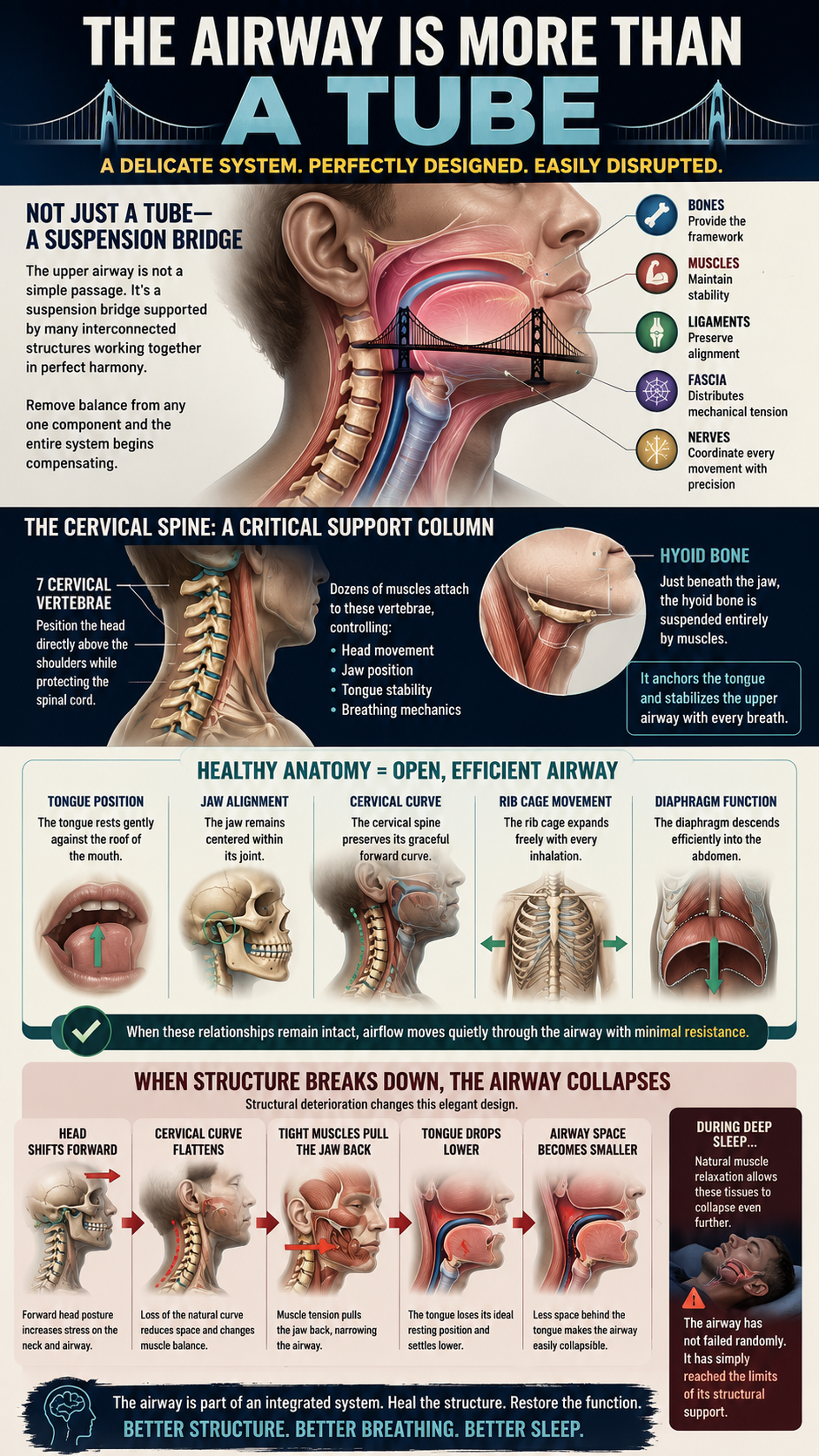
Healthy anatomy depends upon these structures maintaining their intended relationships. The tongue should rest gently against the roof of the mouth. The jaw should remain centered within its joint. The cervical spine should preserve its graceful forward curve. The rib cage should expand freely with every inhalation. The diaphragm should descend efficiently into the abdomen. When these relationships remain intact, airflow moves quietly through the airway with minimal resistance.
Structural deterioration changes this elegant design. The head gradually shifts forward. The cervical curve begins flattening. Tight muscles pull the jaw backward. The tongue loses its ideal resting position and settles lower inside the mouth. Space behind the tongue becomes progressively smaller. During deep sleep, natural muscle relaxation allows those already narrowed tissues to collapse even further. The airway has not failed randomly. It has simply reached the limits of its structural support.
Forward Head Posture Quietly Narrows the Airway
Modern life encourages one posture more than any other. People spend countless hours looking downward at phones, laptops, tablets, and computer monitors. This seemingly harmless habit gradually shifts the head several inches in front of the shoulders, creating what healthcare professionals call forward head posture. Although many associate this posture with neck pain, headaches, or muscle tension, its influence extends much deeper than simple discomfort.
The average human head weighs approximately ten to twelve pounds when balanced directly above the spine. Every inch the head moves forward dramatically increases the effective load carried by the neck muscles. Those muscles must contract continuously to prevent the skull from falling toward the chest. Over time they fatigue, shorten, and lose flexibility. Ligaments stretch beyond their normal length while joints adapt to their altered positions. The body accepts this new posture as its normal alignment even though every supporting structure now works harder than intended.
Forward head posture also changes the position of the jaw and tongue. As the skull migrates forward, the lower jaw frequently rotates backward relative to the upper jaw. The tongue follows this movement because numerous muscles connect these structures together. Space within the upper airway decreases, particularly behind the tongue where obstructive sleep apnea commonly occurs. Deep sleep further relaxes these muscles, allowing gravity to complete the collapse.
Imaging studies continue demonstrating associations between cervical posture and upper airway dimensions. Researchers have observed that individuals with more pronounced forward head posture often exhibit narrower airways and altered breathing mechanics compared with those maintaining healthier spinal alignment. While posture alone does not explain every case of sleep apnea, it clearly influences one of the body’s most important breathing passages. Ignoring posture means overlooking one of the largest mechanical contributors to airway instability.
A Better Night’s Sleep Begins Long Before Bedtime
The search for CPAP alternatives often begins with frustration. Many patients grow tired of wearing a mask every night. Others struggle with dry mouth, facial irritation, air leaks, or the inconvenience of traveling with a machine. While CPAP remains one of the most effective treatments for moderate and severe obstructive sleep apnea, its limitations become obvious after years of dependence. The machine works only while it remains attached. The moment it comes off, the airway returns to the same condition that existed before treatment began. That reality explains why so many people ask whether they can improve the underlying problem rather than simply manage its nightly consequences.
The encouraging news is that the human body possesses an extraordinary ability to adapt when mechanical stress is removed and healthy movement returns. Bones remodel throughout life. Muscles strengthen in response to proper loading. Connective tissue becomes more resilient with consistent mobility. The nervous system continuously rewires itself through a process known as neuroplasticity. Although no single therapy reverses every case of sleep apnea, addressing the structural factors that contributed to airway narrowing may improve breathing mechanics over time. Success depends upon approaching the body as one integrated system rather than treating the airway as an isolated tube.
Structural chiropractic care fits naturally into this philosophy because it focuses on restoring alignment, improving movement, and optimizing communication between the spine and nervous system. These changes alone do not eliminate every case of obstructive sleep apnea. They do, however, create a healthier environment for the muscles, joints, and connective tissues responsible for maintaining an open airway. Lasting improvement often occurs when structural rehabilitation becomes part of a comprehensive plan that also addresses breathing habits, inflammation, body composition, sleep posture, and overall health.
Restoring Cervical Alignment May Improve Airway Mechanics
The neck serves as the architectural bridge between the brain and the rest of the body. Every movement of the head influences the muscles supporting the jaw, tongue, throat, shoulders, and upper chest. When cervical alignment deteriorates, those muscles must compensate continuously, often pulling the airway into a less favorable position. Years of compensation eventually reshape the body’s resting posture, narrowing the space available for airflow during sleep.
Structural chiropractic care seeks to restore the normal cervical curve rather than simply reduce neck pain. Specific spinal adjustments improve joint mobility while corrective exercises strengthen weakened postural muscles. Many structural programs also incorporate cervical traction, rehabilitation equipment, and ergonomic coaching designed to encourage long-term remodeling instead of temporary symptom relief. This comprehensive approach recognizes that stable posture develops through consistent adaptation rather than isolated treatment sessions.
Research examining cervical posture continues to demonstrate relationships between forward head posture and upper airway dimensions. Although more high-quality clinical trials remain necessary, existing evidence suggests that improving cervical alignment may positively influence breathing efficiency, neck muscle function, and overall sleep quality. Patients frequently report reduced muscle tension, easier nasal breathing, and improved comfort while sleeping after completing structural rehabilitation programs. These improvements may not replace CPAP in severe cases, but they often enhance the body’s natural ability to support the airway.
Healthy posture also creates benefits extending far beyond sleep. Improved cervical alignment reduces mechanical stress placed upon spinal discs, decreases abnormal muscle tension, enhances balance, and promotes more efficient breathing throughout the day. Every hour spent breathing more efficiently while awake contributes to healthier respiratory patterns that continue after bedtime arrives.
Your Tongue May Be the Strongest Airway Muscle You Never Considered
Few people realize the tongue contains eight separate muscles working together almost every second of the day. Those muscles influence swallowing, speaking, chewing, facial development, and airway stability. During healthy nasal breathing, the tongue naturally rests against the roof of the mouth, gently supporting the upper jaw while remaining clear of the airway. This position creates remarkable stability throughout the structures surrounding the throat.
Modern lifestyles frequently disrupt this natural relationship. Chronic mouth breathing encourages the tongue to rest low inside the mouth instead of against the palate. Poor posture pulls the jaw backward while changing tongue position even further. Over many years, these subtle adaptations reduce airway space and increase the likelihood of obstruction during sleep. Once muscle tone naturally decreases during deep sleep, the tongue often falls backward into the already narrowed airway.
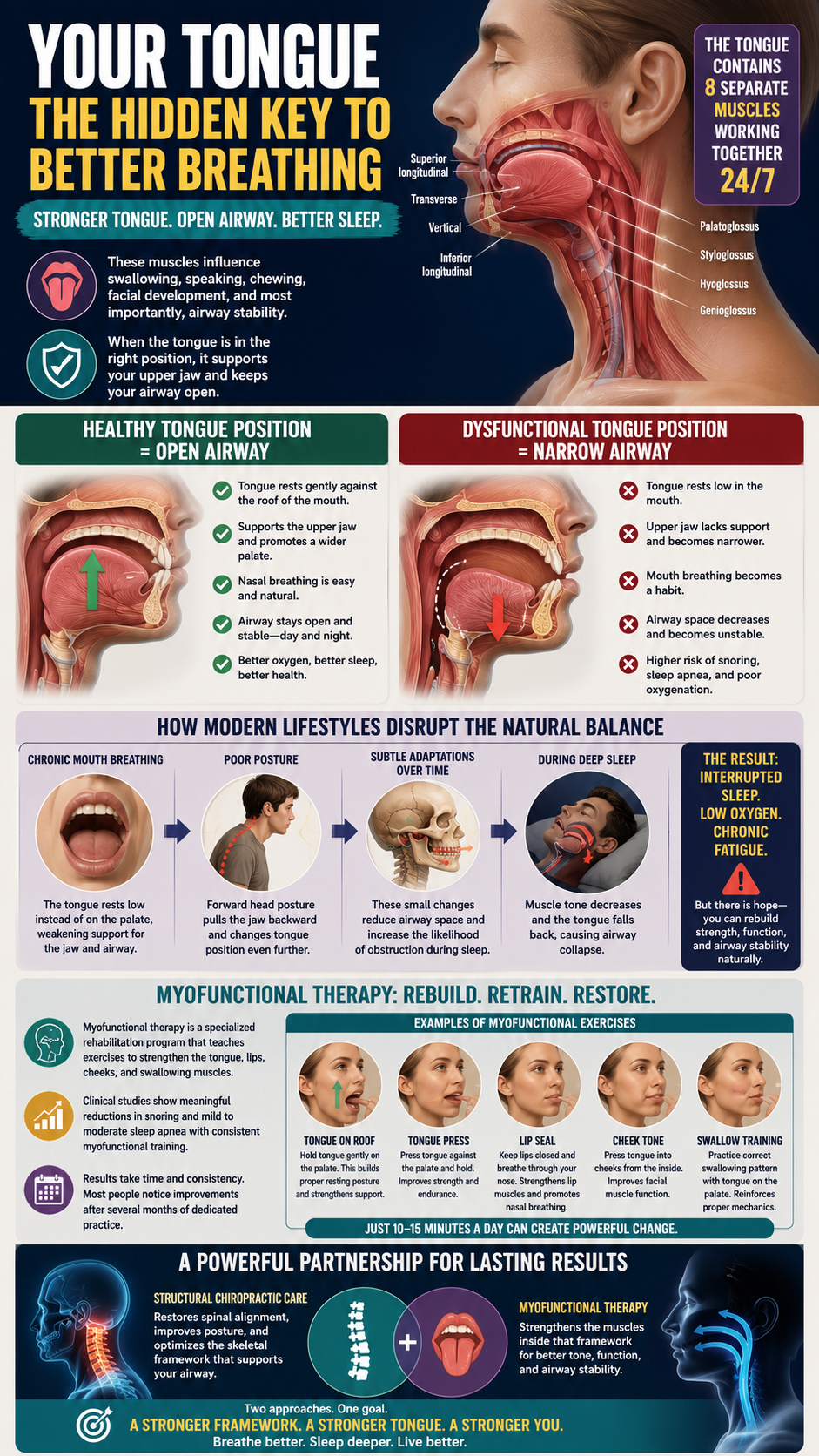
Myofunctional therapy has emerged as one of the most promising noninvasive approaches for improving upper airway muscle function. This specialized rehabilitation program teaches exercises designed to strengthen the tongue, lips, cheeks, and muscles involved in swallowing. Several clinical studies have demonstrated meaningful reductions in snoring and mild to moderate obstructive sleep apnea following consistent myofunctional training. The exercises require dedication because muscular adaptation develops gradually, yet many patients experience noticeable improvements after several months of regular practice.
Combining structural chiropractic care with myofunctional therapy addresses two complementary aspects of airway health. Chiropractic focuses on restoring the skeletal framework supporting the airway, while myofunctional exercises strengthen the muscles operating within that framework. Together they create a more stable environment that may reduce airway collapse while improving breathing efficiency both day and night.
Learning to Breathe Through Your Nose Changes Everything
Breathing seems automatic, yet the route air travels dramatically influences overall health. The nose performs far more than filtering dust from inhaled air. Nasal passages warm incoming air, humidify it, trap pathogens, regulate airflow resistance, and produce nitric oxide, a molecule that improves oxygen delivery while supporting healthy blood vessel function. Mouth breathing bypasses nearly all these advantages.
Habitual mouth breathing also alters facial mechanics. The tongue rests lower inside the mouth instead of supporting the palate. Jaw muscles become imbalanced. Dry tissues increase inflammation throughout the throat. Snoring frequently worsens because air travels through a less stable airway. Over time, chronic mouth breathing reinforces many of the structural problems already contributing to sleep apnea.
Retraining nasal breathing often begins with identifying why mouth breathing developed. Allergies, chronic sinus congestion, deviated septums, enlarged turbinates, and environmental irritants commonly obstruct nasal airflow. Addressing these obstacles creates the foundation for healthier breathing habits. Saline nasal irrigation, proper hydration, allergy management, and reducing indoor pollutants may significantly improve nasal airflow for many individuals.
Conscious breathing exercises also help retrain the nervous system. Slow diaphragmatic breathing encourages greater parasympathetic activity while reducing excessive reliance on accessory neck muscles. Practicing nasal breathing during walking, exercise, and quiet relaxation teaches the body to favor healthier breathing patterns throughout the day. Those improvements frequently carry into nighttime breathing because the nervous system gradually adopts them as its new default behavior.
Inflammation Makes a Narrow Airway Even Smaller
Structural problems alone rarely explain every case of obstructive sleep apnea. Chronic inflammation frequently acts as an invisible accomplice, swelling delicate airway tissues while disrupting muscle recovery throughout the body. Every inflammatory trigger increases the likelihood that already compromised structures will struggle to maintain adequate airflow during sleep.
Highly processed foods rich in refined sugars, industrial seed oils, and ultra-processed carbohydrates promote systemic inflammation through multiple biological pathways. Excess visceral fat produces inflammatory cytokines that influence nearly every organ system, including the tissues surrounding the airway. Smoking irritates the respiratory tract while impairing tissue healing. Excessive alcohol relaxes airway muscles and increases nighttime obstruction. Poor sleep itself further amplifies inflammatory signaling, creating a vicious cycle that becomes increasingly difficult to escape.
Reducing inflammation begins inside the kitchen rather than the pharmacy. A dietary pattern emphasizing vegetables, high-quality proteins, healthy fats, berries, herbs, spices, and minimally processed foods provides nutrients supporting tissue repair while reducing inflammatory stress. Maintaining stable blood sugar throughout the day also improves metabolic health, decreases fat accumulation around the neck, and supports healthier hormone regulation. Even modest reductions in body weight often produce measurable improvements in obstructive sleep apnea because less inflammatory tissue surrounds the upper airway.
Regular physical activity further strengthens this anti-inflammatory strategy. Walking, resistance training, swimming, and cycling improve insulin sensitivity while reducing visceral fat and enhancing cardiovascular fitness. Exercise also strengthens respiratory muscles, improves sleep quality, and increases overall energy levels. Every improvement reduces one more obstacle standing between the airway and healthy nighttime breathing.
Your Sleeping Position May Influence Every Breath
Gravity never stops working, even during sleep. Body position dramatically influences how the tongue, jaw, soft palate, and surrounding tissues behave throughout the night. Many people experience significantly worse obstructive sleep apnea while sleeping flat on their back because gravity encourages the tongue and soft tissues to fall directly into the airway.
Sleeping on the side often reduces this mechanical collapse by allowing gravity to pull tissues away from the airway instead of toward it. Positional therapy has therefore become an important strategy for individuals whose sleep apnea primarily occurs while lying supine. Special pillows, wearable positioning devices, and simple behavioral techniques may help encourage side sleeping without disrupting sleep quality.
Neck support deserves equal attention. Pillows that excessively flex or extend the cervical spine may worsen airway narrowing by altering jaw position and reducing natural cervical curvature. Choosing a pillow that supports the neck while maintaining neutral spinal alignment allows airway structures to remain in a more favorable position throughout the night. Patients frequently underestimate how profoundly a poorly designed pillow influences breathing mechanics over eight uninterrupted hours.
Bedroom conditions also matter. Dry air irritates airway tissues while encouraging congestion. Excessive heat may increase restless sleep. Allergens trapped inside bedding promote chronic nasal inflammation. Maintaining a cool, clean sleeping environment with appropriate humidity creates conditions supporting healthier breathing while complementing other structural interventions.
Building a Healthier Airway One Day at a Time
People searching for CPAP alternatives often hope for a single breakthrough capable of replacing their machine overnight. Human physiology rarely works that way. Lasting improvement usually develops through dozens of small changes working together over months rather than days. Every healthier habit strengthens another piece of the structural foundation supporting the airway.
Standing taller throughout the day reduces forward head posture. Breathing through the nose strengthens natural airway function. Corrective exercises improve muscular balance. Structural chiropractic care restores healthier spinal mechanics. Myofunctional therapy retrains the tongue and surrounding muscles. Anti-inflammatory nutrition reduces tissue swelling. Regular exercise improves metabolic health while strengthening respiratory function. Better sleep posture minimizes gravitational airway collapse. Individually these strategies may appear modest. Together they create a powerful cumulative effect that supports healthier breathing naturally.
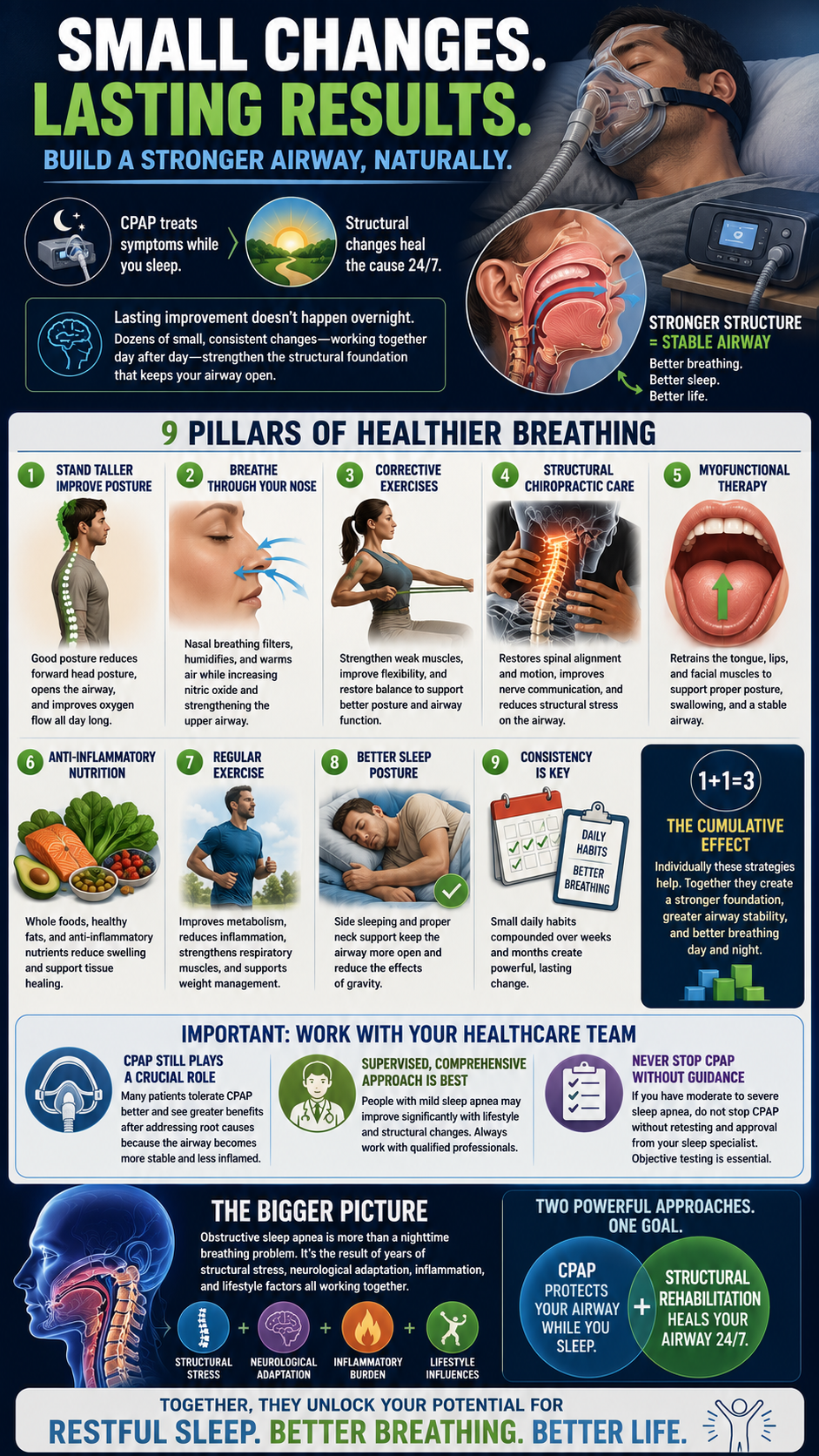
Many patients discover they tolerate CPAP better after addressing these contributing factors because their airway becomes more stable and less inflamed. Others with mild obstructive sleep apnea may experience meaningful improvement through comprehensive lifestyle changes under the supervision of qualified healthcare professionals. Those with moderate or severe disease should never discontinue prescribed CPAP therapy without repeat evaluation and guidance from their sleep specialist. Objective testing remains essential because improved symptoms do not always reflect complete resolution of airway obstruction.
The greatest lesson emerging from modern sleep research is that obstructive sleep apnea represents far more than a nighttime breathing disorder. It reflects years of accumulated structural stress, neurological adaptation, inflammatory burden, and lifestyle influences acting together upon one of the body’s most delicate anatomical systems. CPAP successfully protects the airway while you sleep. Structural rehabilitation seeks to improve the body supporting that airway every hour of every day. When those two philosophies work together instead of competing, patients gain the greatest opportunity to reclaim restful sleep, healthier breathing, and a better quality of life.
Your Nervous System Controls Every Breath You Take
Most people think breathing occurs automatically because the lungs simply fill with air. The process actually depends upon extraordinary neurological coordination. Every inhalation requires the brain to activate the diaphragm, stabilize the rib cage, position the tongue, regulate airway muscles, monitor oxygen levels, and coordinate dozens of supporting muscles throughout the neck and chest. Thousands of signals travel across the nervous system every minute simply to maintain effortless breathing.
The cervical spine plays a central role within this neurological network. Specialized sensory receptors inside spinal joints continuously report body position to the brain. These mechanoreceptors help coordinate balance, posture, muscle activation, and breathing efficiency. Healthy spinal movement provides accurate information. Restricted joints may alter the quality of sensory input reaching the central nervous system. Researchers continue investigating how these changes influence muscle coordination, respiratory control, and autonomic nervous system regulation.
The autonomic nervous system deserves particular attention because it governs unconscious body functions including heart rate, digestion, blood pressure, and breathing rhythm. Healthy sleep requires a shift toward parasympathetic dominance, often called the rest-and-digest state. Chronic pain, poor posture, shallow breathing, and persistent muscle tension encourage greater sympathetic activity instead. The body remains physiologically alert even while attempting to sleep. That heightened state increases muscle fatigue, reduces restorative sleep, and may contribute to unstable breathing patterns throughout the night.
Structural chiropractic care approaches the spine as both a mechanical and neurological system. Restoring healthy joint motion seeks to improve communication between the spine and brain while reducing abnormal muscular tension. Although chiropractic should never replace appropriate medical management for obstructive sleep apnea, improving spinal mechanics may positively influence breathing efficiency, posture, and neuromuscular coordination. These changes address contributors that a CPAP machine cannot directly modify because they occur long before airflow reaches the airway.
The Real Problem Extends Far Beyond the Throat
Viewing sleep apnea as a disorder isolated to the throat dramatically oversimplifies one of the body’s most complex physiological systems. The airway reflects the health of the entire musculoskeletal and nervous system. Structural imbalance, chronic inflammation, poor breathing mechanics, weakened muscles, altered jaw position, and years of postural stress gradually combine until nighttime breathing becomes compromised. By the time a sleep study confirms obstructive sleep apnea, the body has often been adapting to these problems for decades.
CPAP remains an important medical therapy because preventing oxygen deprivation saves lives. No responsible discussion of CPAP alternatives should suggest abandoning prescribed treatment without medical supervision. Yet managing symptoms should never prevent clinicians from investigating why those symptoms developed. The future of sleep apnea care lies not in choosing between structural correction and conventional medicine, but in understanding how both approaches can work together to improve long-term health.
The most effective strategy begins by recognizing that the airway does not exist independently. It reflects the condition of the spine supporting it, the muscles surrounding it, the nervous system regulating it, and the lifestyle shaping it every single day. Addressing those foundational influences opens the door to meaningful structural improvement rather than lifelong dependence upon mechanical assistance alone.