
Cookware looks inert, but it’s not always. Heat, acidity, salt, cooking time, abrasion (metal utensils, scouring pads), and wear all change what can migrate from a pan into your food. That migration is usually small—but “small” isn’t the same as “zero,” and the highest exposures tend to happen in the exact situations people do every week: simmering tomato sauce, deglazing with wine or vinegar, slow-cooking salty soups, or reheating leftovers for a long time.
Below is a practical, evidence-grounded look at five popular pan categories—aluminum, stainless steel, titanium, HexClad, and ceramic—with a focus on the specific question you asked: which types are safest for avoiding metal introduction into food.
1) Aluminum cookware: lightweight, great heat transfer… and the most reactive in this list
Why aluminum can migrate into food
Aluminum is a reactive metal compared with stainless steel or titanium. When aluminum is exposed to acidic foods (tomatoes, citrus, vinegar, wine) and salt, the surface can corrode and release aluminum ions into the food. Research consistently shows higher leaching in acidic conditions and with longer cook times.
A key nuance: aluminum comes in different forms.
- Bare (uncoated) aluminum: most likely to react with acids/salt.
- Anodized aluminum: a hardened oxide layer reduces reactivity, but it can still be compromised by scratches, harsh detergents, or heavy wear over time.
- Nonstick-coated aluminum: the coating can reduce metal contact until it scratches or degrades.
The “wild card” risk: contamination (lead) in some imported aluminum cookware
Beyond aluminum itself, there’s a serious quality-control issue: certain imported cookware has been found to leach lead into food. The FDA has issued warnings and updates identifying specific products and urging consumers not to use them.
Not all aluminum cookware has this problem—but it’s one of the reasons aluminum is hard to “rank safe” unless you know the brand, supply chain, and testing.
When aluminum is most likely to be a problem
- Long simmering tomato sauce, chili, soups with tomato base
- Cooking with vinegar, lemon, wine reductions
- Salty brines/stock cooked for hours
- Scratched/worn anodized surfaces
Bottom line: Aluminum is excellent for performance and weight, but it’s the most likely of your list to introduce metal into food—especially with acid and salt.
2) Stainless steel: stable and durable, but not “zero-leach” (nickel + chromium can migrate)
What can leach from stainless steel
Stainless steel is an alloy—commonly including iron, chromium, and often nickel (especially in 18/10). Under certain cooking conditions (especially acidic foods and new cookware), small amounts of nickel (Ni) and chromium (Cr) can migrate into food. This has been documented in peer-reviewed studies, including tomato-based cooking experiments.
Who should care most
- Nickel-sensitive individuals (contact dermatitis or systemic nickel allergy) may notice symptoms flare with high-nickel stainless and acidic cooking.
- People trying to minimize total metal exposure as a long-term strategy may still prefer lower-migration materials.
How to reduce stainless migration
- Pre-condition new stainless: boil water + a little vinegar for 10 minutes, rinse, then cook a few cycles before using for long acidic simmers.
- Avoid storing acidic foods in stainless overnight.
- Choose high-quality fully clad stainless (better manufacturing and surface finishing tends to reduce odd behavior and hot spots that drive localized corrosion).
Bottom line: Stainless is generally a very good everyday choice, but it can introduce small amounts of nickel/chromium, especially with acidic foods and new pans.
3) Titanium cookware: potentially the lowest metal migration—if it’s truly titanium
Titanium’s “why it’s different”
Titanium forms a stable oxide layer that gives it excellent corrosion resistance. This is a major reason titanium is widely used in medical and dental applications; the surface passivation makes it unusually inert in harsh environments.
The big catch: “titanium cookware” is often not pure titanium
A lot of products marketed as “titanium” are:
- Titanium-reinforced coatings
- Titanium ceramic nonstick
- Titanium particles in a surface treatment
- A titanium-colored finish on another metal
Those may still have an aluminum core or other base metal and won’t behave like true titanium.
Practical guidance
If your goal is specifically minimizing metal introduction, titanium can be excellent when it’s genuinely titanium at the food-contact surface. Otherwise you’re really judging the underlying pan (often aluminum) and the coating.
Bottom line: True titanium at the cooking surface is one of the best candidates for minimal reactivity and migration.
4) HexClad: a hybrid category (steel + nonstick “valleys”)—safe is more about the coating story than the metal story
HexClad is marketed as a hybrid: raised stainless steel pattern with nonstick valleys. According to HexClad’s own materials description, their TerraBond™ surface is described as a PTFE-free ceramic nonstick, with stainless steel ridges protecting the coating.
Why this matters for your question
You asked about metals introduced into food. With HexClad, there are two relevant pathways:
- Metal exposure from the stainless portions (similar to stainless cookware—nickel/chromium in acidic cooking can occur).
- Coating wear in the “valleys,” which can expose whatever substrate is underneath or change the surface over time.
A real-world issue: product lines and changing formulations
Hybrid cookware is a moving target: different lines, different coatings, and changing marketing claims over time. Independent discussions and reviews also show confusion around whether some HexClad lines use PTFE vs ceramic-style coatings, depending on model and era.
That doesn’t mean it’s “dangerous,” but it does mean you can’t assign a single safety label without knowing the exact line and the manufacturer’s disclosure.
Bottom line: HexClad is not the simplest choice if your primary goal is “least metal into food.” It behaves partly like stainless and partly like coated cookware, and your safety profile depends on the exact product line and how it wears.
5) “Ceramic” cookware: two different things people mix up (true ceramic vs ceramic-coated metal)
This category causes the most confusion.
A) True ceramic (fully ceramic vessels)
A fully ceramic pot (not ceramic-coated metal) is typically very inert. The main concern becomes glaze quality (lead/cadmium risks in poorly made or traditional glazed pottery). The FDA has long warned about lead-glazed pottery and advises against using pottery with leachable lead for cooking/serving/storing food.
B) Ceramic-coated cookware (the common “ceramic nonstick” pan)
Most “ceramic nonstick” pans are metal pans (often aluminum) with a sol-gel ceramic-like coating. Industry/technical reporting notes these are more accurately “quasi-ceramic,” made via sol-gel processes at lower firing temperatures than traditional ceramics.
What’s the risk here?
- Wear and lifespan: Many ceramic-coated pans lose nonstick performance faster than expected, leading people to scrape harder and accelerate coating breakdown.
- Substrate exposure: Once coating wears, you’re effectively cooking on the underlying metal (often aluminum), returning you to the leaching dynamics of that metal.
- Heavy metals: With reputable brands, this is less common, but the category has had recurring concerns about testing and transparency. Consumer Reports has cautioned that “non-toxic” claims are not always reliable and recommends skepticism and verification.
- Import/lead: Separate from ceramic coatings, the broader cookware market has had FDA warnings about lead-leaching products.
Bottom line: “Ceramic” can be excellent if it’s truly ceramic and properly tested. But the common ceramic-coated nonstick pan is often an aluminum pan wearing a coating, and once worn it can revert to aluminum exposure patterns.
The practical “risk multipliers” no one talks about (but they drive most of the exposure)
No matter which pan you pick, these factors often matter more than the label:
- Acid + time + heat = the migration recipe
Tomato sauce simmered for 2 hours is a bigger stress test than frying eggs for 3 minutes. - Salt accelerates corrosion
Especially in reactive metals and in damaged surfaces. - Scratches change everything
Scratched coatings expose substrates and create high-energy sites that increase reactivity. - New pans can leach more at first
This has been observed in multiple metals, including stainless (Ni/Cr) and aluminum.
Ranking these five by “safeness” for avoiding metal introduction into food (best → worst)
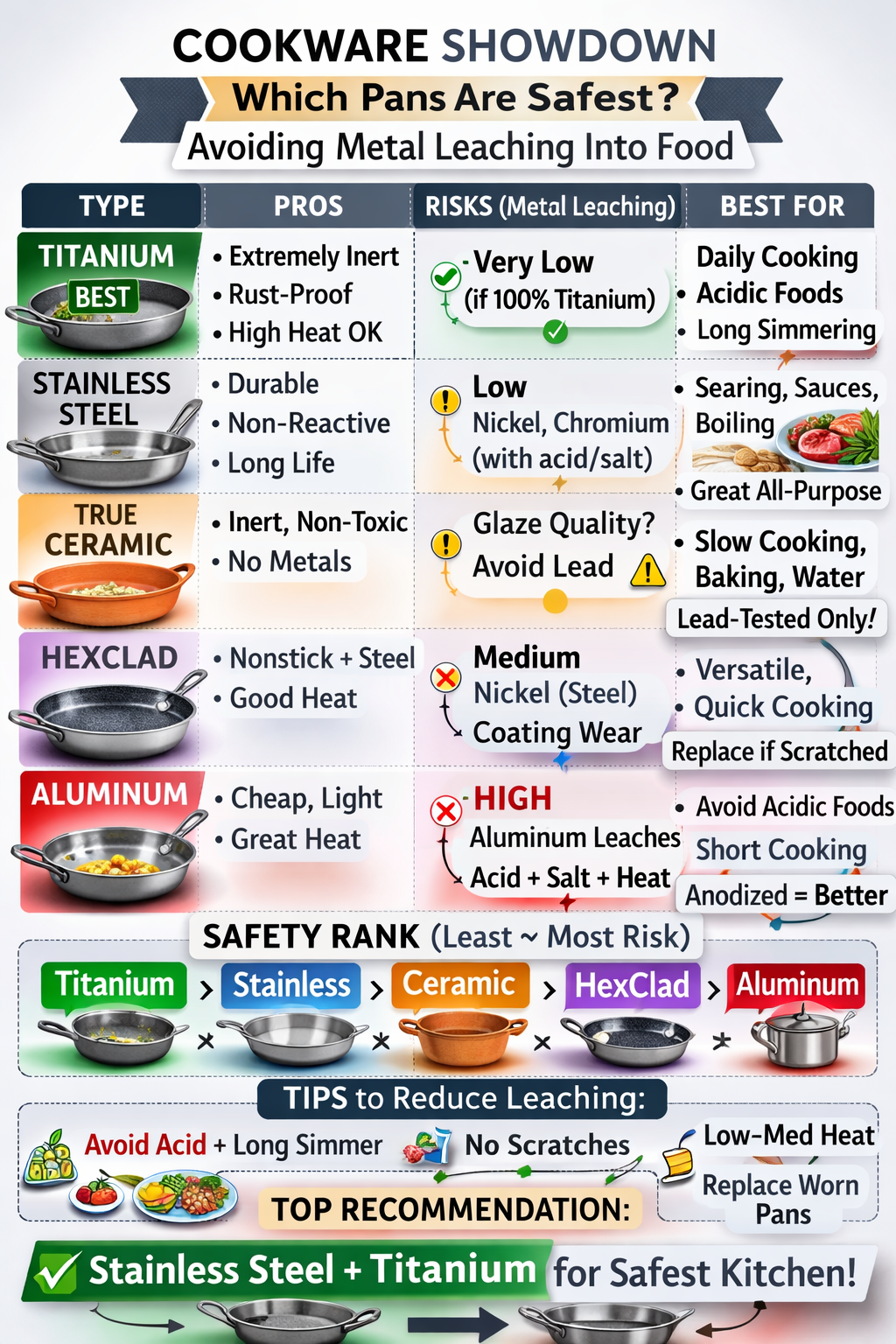
This ranking assumes normal home use, and prioritizes your specific metric: least likelihood of introducing metals into food.
1) Titanium (true titanium cooking surface)
Most inert/corrosion-resistant on your list when it’s real titanium at the food-contact surface.
2) Stainless steel (high-quality fully clad)
Very stable overall, but can leach small amounts of Ni/Cr with acidic cooking—still generally low and predictable with good cookware.
3) True ceramic (fully ceramic, tested glaze)
If it’s truly ceramic and the glaze is verified lead-safe, metal introduction is minimal. But because many shoppers end up with ceramic-coated aluminum, and because glaze quality varies, it lands mid-pack in real-world kitchens.
4) HexClad (hybrid stainless + coating)
Part stainless (possible Ni/Cr in acidic cooking) and part coated surface with durability/line-variation questions. Without exact model verification, it’s harder to guarantee low migration over years of use.
5) Aluminum (especially bare/uncoated)
Most likely to react with acidic/salty foods and therefore most likely to introduce metal—plus the broader market has had serious contamination events in some imported products.
Top recommendation: what I’d buy if the goal is “lowest metal migration” without babying the pan
Best overall recommendation: High-quality fully clad stainless steel cookware for most households, plus a true titanium piece (if verified) for your highest-acid/long-simmer tasks.
Why not recommend “ceramic nonstick” as the #1? Because most ceramic nonstick is a coated metal system whose safety profile changes as it wears, and it’s harder to keep performance without eventually scraping/overheating/replacing.
The simplest “buy once, cry once” setup
- Stainless steel stockpot + saucepan + sauté pan (fully clad)
- Titanium skillet or pot only if you can verify it’s truly titanium at the cooking surface
- Keep any coated cookware (ceramic nonstick or hybrids) as a convenience tool, not the daily driver—and replace once scratched/worn
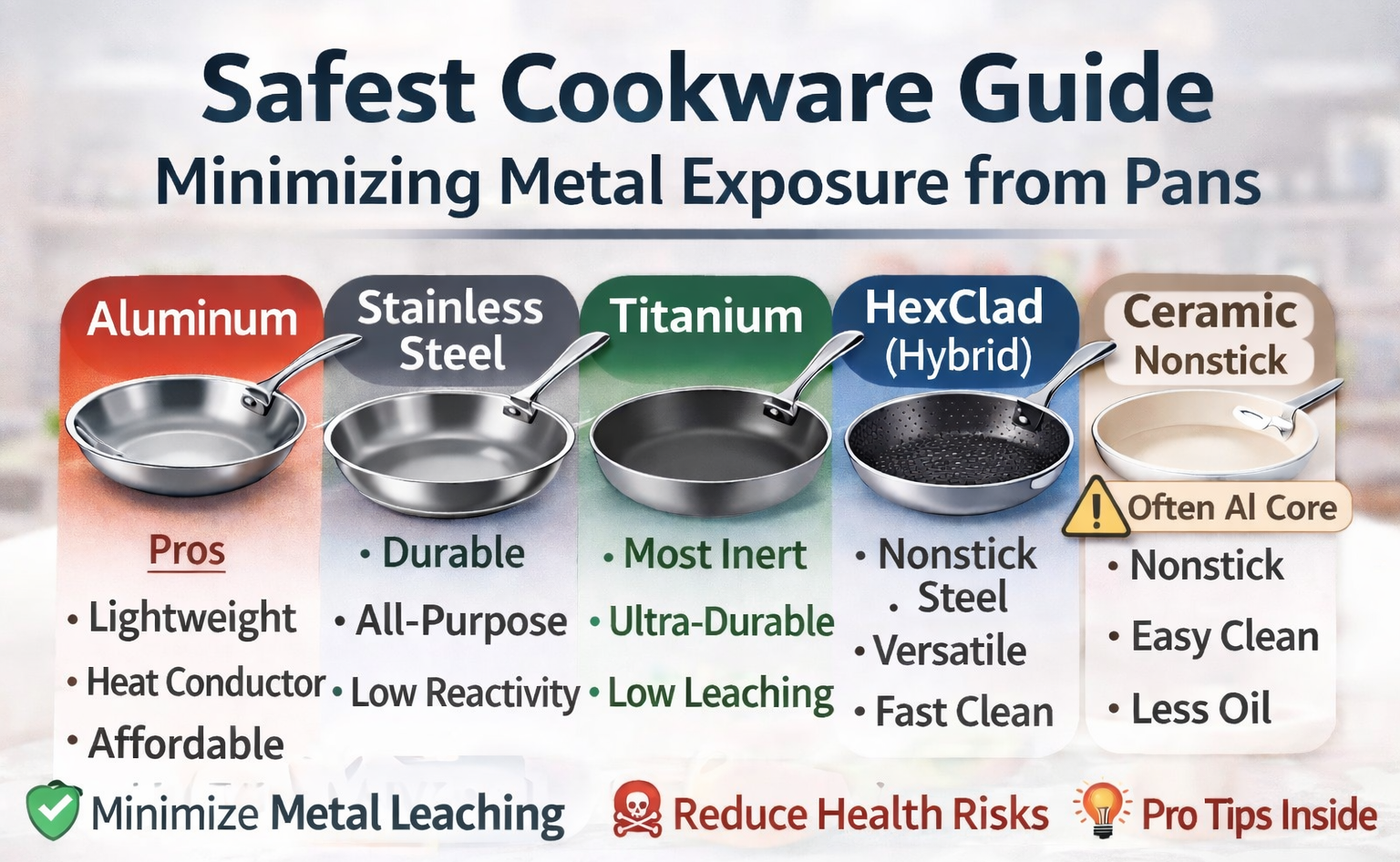
Cookware Metal Leaching & Material Safety – Reference List
- Ranau, R., Oehlenschläger, J., & Steinhart, H. (2001). Aluminium levels of fish fillets baked and grilled in aluminium foil. Food Chemistry, 73(1), 1–6.
- Semwal, A. D., et al. (2006). Leaching of aluminium from utensils during cooking of food. Journal of the Science of Food and Agriculture, 86(14), 2425–2430.
- Stahl, T., et al. (2011). Migration of aluminum from food contact materials to food — A health risk assessment. Food Additives & Contaminants, 28(7), 928–938.
- Kamerud, K. L., Hobbie, K. A., & Anderson, K. A. (2013). Stainless steel cookware as a significant source of nickel and chromium in food. Journal of Agricultural and Food Chemistry, 61(39), 9495–9501.
- European Food Safety Authority (EFSA). (2008). Safety of aluminium from dietary intake. EFSA Journal, 6(7), 754.
- U.S. Food and Drug Administration (FDA). (2023). Letter to Retailers and Distributors of Certain Cookware Products.
https://www.fda.gov/food/environmental-contaminants-food/letter-retailers-and-distributors-cookware - U.S. Food and Drug Administration (FDA). (2022). Questions and Answers on Lead-Glazed Traditional Pottery.
https://www.fda.gov/food/environmental-contaminants-food/questions-and-answers-lead-glazed-traditional-pottery - European Commission Joint Research Centre (JRC). (2013). Guidelines on Testing Conditions for Articles in Contact with Foodstuffs.
- American Ceramic Society. (2022). Ceramic-Coated Cookware: Safety and Performance Considerations.
https://ceramics.org - Oldani, C., et al. (2007). Surface characterization and corrosion behavior of titanium in food-related environments. Materials Science and Engineering C, 27(4), 714–718.
- Consumer Reports. (2023). You Can’t Always Trust Claims on “Non-Toxic” Cookware.
- World Health Organization (WHO). (2011). Evaluation of Certain Food Additives and Contaminants: Aluminium.