
The idea that something as simple as walking speed could predict how long a person will live initially sounds reductive, even implausible. Longevity is typically discussed in the language of cholesterol panels, genetic polymorphisms, coronary artery calcium scores, inflammatory biomarkers, and increasingly complex imaging technologies. Yet over the past two decades, a growing body of research has identified an unexpectedly powerful predictor of survival that requires no laboratory, no imaging suite, and no specialized equipment. It requires only a stopwatch and a measured distance. The speed at which a person walks has repeatedly emerged as a strong, independent indicator of mortality risk.
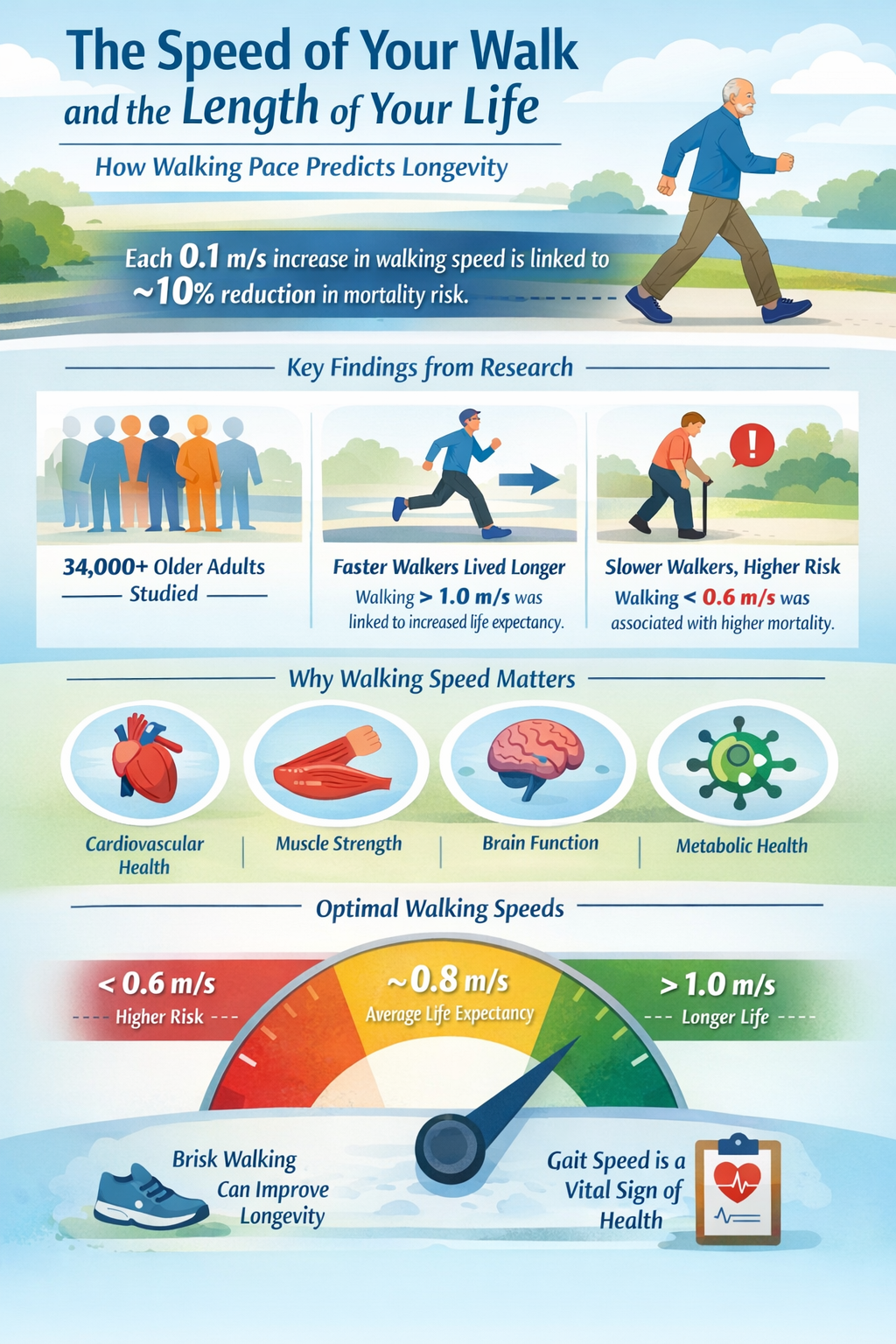
One of the most influential investigations into this phenomenon was led by geriatrician Stephanie Studenski and published in JAMA in 2011. The study, titled “Gait Speed and Survival in Older Adults,” pooled data from nine large cohort studies and included more than 34,000 participants aged 65 and older. Participants were followed longitudinally, and their walking speed was measured over a short, standardized distance. Researchers then analyzed how that speed correlated with survival over subsequent years. What they found was not a weak association buried in statistical noise, but a remarkably consistent gradient of risk. Faster walkers lived longer. Slower walkers had higher mortality rates.
The numbers themselves were striking. A walking speed of approximately 0.8 meters per second, which translates to roughly 1.8 miles per hour, corresponded closely with median life expectancy for age and sex. Individuals walking faster than 1.0 meter per second tended to live longer than predicted based on demographics alone, while those walking slower than 0.6 meters per second faced significantly elevated mortality risk. Perhaps most compelling was the incremental finding: for every 0.1 meter per second increase in gait speed, there was roughly a 10 to 12 percent reduction in mortality risk. In clinical terms, that magnitude of effect rivals or exceeds many pharmacologic interventions aimed at modifying long-term outcomes.
The implications of these findings extend well beyond geriatric medicine. While the initial research focused on adults over 65, subsequent analyses in broader populations have supported the same general conclusion: habitual walking pace is associated with all-cause mortality, cardiovascular mortality, and overall life expectancy. Data from the UK Biobank, which includes health information from hundreds of thousands of individuals, demonstrated that self-reported brisk walkers had longer life expectancy across multiple body mass index categories compared to slow walkers. Importantly, this association persisted even after adjusting for smoking status, baseline illness, and socioeconomic variables.
To understand why walking speed is such a potent predictor, it is necessary to appreciate what walking actually represents physiologically. Gait speed is not simply a measure of leg strength. It is a composite reflection of cardiovascular capacity, pulmonary efficiency, neuromuscular coordination, balance, musculoskeletal integrity, metabolic health, and central nervous system processing. Walking requires the brain to integrate sensory input, maintain postural stability, coordinate muscle activation, and sustain energy production. Any impairment in these systems—whether from vascular disease, neurodegeneration, systemic inflammation, sarcopenia, or metabolic dysfunction—can manifest as a slower walking pace.
Cardiovascular health plays a central role in this equation. A brisk walking speed requires adequate cardiac output and vascular elasticity to deliver oxygen efficiently to working muscles. When arterial stiffness increases or endothelial function declines, exercise tolerance drops. Subclinical atherosclerosis may not immediately present as chest pain or shortness of breath, but it can subtly limit exertional capacity. Over time, that limitation appears as reduced gait speed. In this way, walking pace may serve as an integrated stress test, revealing early cardiovascular compromise long before catastrophic events occur.
Muscle mass and strength are equally important contributors. Age-related loss of skeletal muscle, known as sarcopenia, is strongly associated with frailty, falls, hospitalization, and mortality. Muscle is not merely a structural tissue; it is a metabolically active organ that regulates glucose disposal, insulin sensitivity, and inflammatory signaling. Individuals with preserved lean mass tend to maintain higher walking speeds because they possess the mechanical and metabolic resources necessary for efficient movement. Conversely, diminished muscle mass reduces stride length, power generation, and endurance, all of which slow gait and correlate with worse long-term outcomes.
Neurological integrity further influences walking velocity. Gait requires rapid communication between cortical motor centers, the cerebellum, spinal cord pathways, and peripheral nerves. Subtle cognitive impairment, white matter changes, or early neurodegenerative processes can impair this communication. Researchers have observed that slower gait speed sometimes precedes measurable cognitive decline, suggesting that walking pace may also function as an early marker of neurological aging. The integration of balance, proprioception, and executive function required for efficient ambulation makes gait speed an indirect window into brain health.
Metabolic health cannot be separated from this discussion. Insulin resistance, chronic low-grade inflammation, mitochondrial dysfunction, and hormonal dysregulation all reduce energy production efficiency. Walking briskly demands ATP generation and coordinated metabolic flexibility. When cells struggle to shift between fuel sources or when inflammatory cytokines impair muscle function, physical performance declines. Thus, slower walking speed may reflect deeper metabolic inefficiencies that simultaneously elevate cardiovascular and all-cause mortality risk.
It is important to clarify that walking speed itself is unlikely to be the direct cause of longer life. Rather, it functions as a summary variable, capturing the cumulative effect of multiple biological systems. In epidemiological terms, gait speed behaves as a powerful integrative biomarker. Unlike isolated laboratory values that measure one pathway in isolation, walking pace reflects the coordinated performance of the entire organism. That holistic quality may explain why it consistently predicts survival across diverse populations and study designs.
Several subsequent investigations have reinforced the original findings. Analyses from large population-based cohorts have demonstrated that brisk walking pace is associated with lower risk of cardiovascular events, reduced incidence of type 2 diabetes, and decreased overall mortality. In some studies, walking pace has shown stronger predictive value than total physical activity volume alone, suggesting that intensity and functional capacity matter as much as cumulative movement time. The distinction between leisurely and brisk walking appears to reflect meaningful differences in physiological reserve.
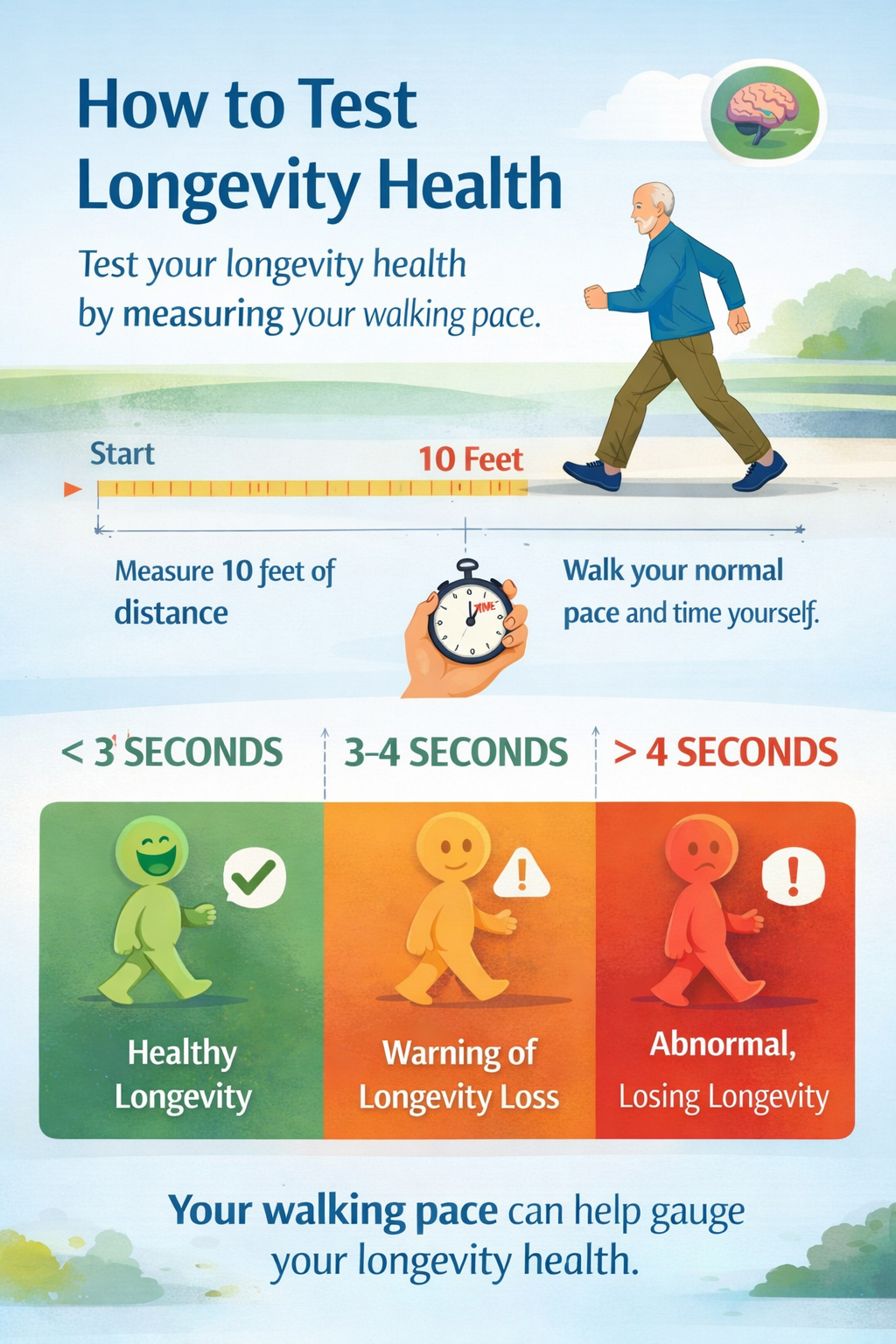
The practical implications of this research are substantial. Measuring gait speed is simple, inexpensive, and reproducible. A clinician can mark a four-meter or six-meter distance in a hallway, instruct a patient to walk at their usual pace, and calculate meters per second with a stopwatch. This measurement can then be tracked over time. Declines in gait speed may prompt further investigation into cardiovascular status, muscle mass, nutritional sufficiency, hormonal balance, or neurological health. Improvements in walking speed, conversely, may reflect successful intervention.
From a preventive perspective, the findings suggest that maintaining functional capacity should be a primary health objective, not an afterthought. Resistance training to preserve muscle mass, interval training to improve cardiovascular efficiency, balance exercises to protect neurological integration, and nutritional strategies to support mitochondrial function all contribute to walking performance. When individuals improve these foundational systems, walking speed often increases as a natural byproduct. The enhancement of gait speed may therefore serve as a tangible marker of improved systemic resilience.
The research also reframes how aging is conceptualized. Chronological age does not move in lockstep with biological age. Two individuals of identical age may have markedly different gait speeds and, according to the data, markedly different survival trajectories. Walking pace thus becomes a functional expression of biological aging. Rather than asking only how old someone is, clinicians and researchers increasingly ask how well their systems are functioning. In that context, gait speed offers a concise answer.
There are limitations to consider. Most foundational studies have been observational, meaning they demonstrate association rather than causation. It is theoretically possible that unmeasured confounders contribute to the observed relationship between gait speed and survival. However, the consistency of findings across populations, adjustment models, and analytic methods strengthens confidence in the robustness of the association. Additionally, walking speed is influenced by environmental factors, cultural norms, and individual motivation, which may introduce variability. Even so, the predictive signal remains strong.
In recent years, wearable technology has made continuous monitoring of walking pace more accessible. Smartphones and fitness trackers can estimate step cadence and speed, providing individuals with real-time feedback about functional capacity. As digital health tools evolve, gait speed may become an even more prominent component of personalized longevity assessment. The simplicity of the metric makes it uniquely suited to large-scale public health application.
Ultimately, the message embedded within this research is both sobering and empowering. Sobering, because a slow walking pace may indicate deeper systemic compromise that warrants attention. Empowering, because walking speed is modifiable. Unlike immutable genetic factors, gait performance can improve through targeted intervention. Cardiovascular conditioning, strength training, metabolic optimization, and neurological stimulation can all enhance walking capacity. In this sense, gait speed is not merely a predictor of lifespan; it is a lever that can potentially influence it.
The elegance of this finding lies in its integration. The human body operates as an interconnected network, not as isolated compartments. When that network functions efficiently, movement is fluid and brisk. When it deteriorates, movement slows. The pace at which a person walks down a hallway quietly encodes information about heart function, muscle integrity, metabolic flexibility, and neurological coordination. Researchers have simply quantified what attentive observers have long suspected: vitality expresses itself in movement.
As the science of longevity continues to advance, increasingly sophisticated biomarkers will undoubtedly emerge. Yet it is unlikely that many will rival the practicality and predictive clarity of gait speed. In a healthcare landscape often dominated by complexity, walking pace stands out for its simplicity and depth. It reminds us that functional capacity is not peripheral to health; it is central. And in the measured rhythm of a person’s stride, we may glimpse not only how they move through space, but how resiliently they move through time.