
The Modern Epidemic No One Is Measuring Correctly
Across modern society, a silent but far-reaching health crisis continues to expand: widespread deficiency of Vitamin D. Despite routine blood testing, supplement use, and public health messaging, millions of individuals remain functionally deficient, often without awareness of the problem. What makes this issue particularly dangerous is that it is frequently masked by laboratory reference ranges that fail to reflect true biological needs, allowing individuals to remain deficient while being told their levels are acceptable.
The core issue lies in how deficiency is defined and interpreted. Clinical laboratory values are typically derived from population averages rather than optimal physiological benchmarks, which creates a distorted baseline when the majority of the population is already deficient. Individuals with levels that impair immune function, metabolic efficiency, and neurological health are often categorized as “normal,” leading to a false sense of security. This misclassification allows dysfunction to persist quietly, driving chronic symptoms that are treated individually rather than traced back to a foundational imbalance.
Why Vitamin D Requirements Are Massively Underestimated
Mainstream Vitamin D recommendations were originally established to prevent severe bone diseases such as rickets, not to optimize total-body health in a modern environment filled with stressors and inflammatory triggers. The commonly recommended intake of 600 to 800 international units may prevent extreme deficiency, but it is not sufficient to support immune resilience, hormonal balance, or metabolic efficiency for most individuals. This gap between minimal survival requirements and optimal functional needs is one of the primary reasons deficiency remains so widespread.

Vitamin D requirements vary significantly based on individual physiology and lifestyle factors. Body fat plays a major role because Vitamin D is stored in adipose tissue, which reduces its availability in circulation for metabolic processes. Geographic location influences production due to differences in sunlight exposure, particularly in regions farther from the equator where ultraviolet B radiation is limited for much of the year. Skin pigmentation, age-related changes in synthesis, and genetic variations in metabolism further complicate the picture, making standardized dosing approaches ineffective for achieving optimal levels across diverse populations.
What Vitamin D Deficiency Is Doing to the Body
Vitamin D deficiency disrupts multiple systems simultaneously because it regulates gene expression and cellular signaling pathways throughout the body. At the immune level, low Vitamin D impairs the body’s ability to mount an effective defense against pathogens while increasing inflammatory signaling. This imbalance weakens resistance to infections and contributes to chronic inflammation, which is a key driver of many modern diseases.
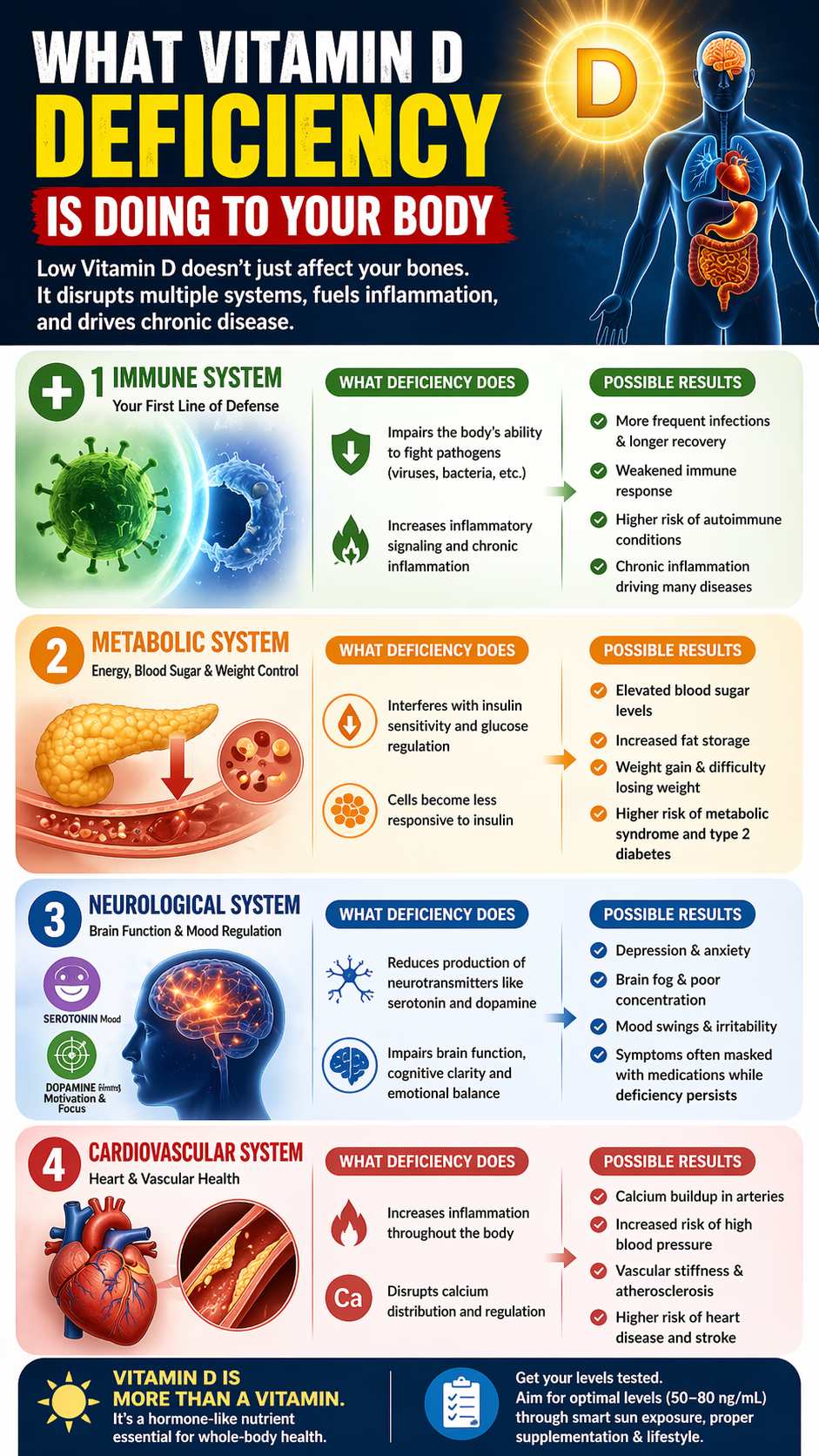
Metabolically, deficiency interferes with insulin sensitivity and glucose regulation. Cells become less responsive to insulin, leading to elevated blood sugar levels and increased fat storage. Over time, this contributes to weight gain, metabolic syndrome, and type 2 diabetes. Many individuals struggling with persistent fatigue or difficulty losing weight are experiencing these metabolic effects without realizing that Vitamin D plays a central role in the process.
Neurologically, Vitamin D influences neurotransmitter production and brain function. It supports the synthesis of serotonin and dopamine, which are essential for mood stability and cognitive clarity. When levels are low, individuals may experience depression, anxiety, and brain fog, symptoms that are often treated with medications while the underlying deficiency remains unaddressed. Cardiovascular health is also impacted, as Vitamin D helps regulate inflammation and calcium distribution, preventing calcium from accumulating in arteries and contributing to vascular disease.
Why Mainstream Doses Fail to Correct Deficiency
The persistence of Vitamin D deficiency despite supplementation reveals a fundamental flaw in current dosing strategies. Standard recommendations assume that individuals absorb and utilize Vitamin D efficiently, but many people have underlying digestive issues that limit absorption of fat-soluble nutrients. Conditions such as gut inflammation, reduced bile production, and microbiome imbalances interfere with the body’s ability to absorb Vitamin D effectively, making low-dose supplementation insufficient.
Even when absorption occurs, Vitamin D must be converted into its active form through processes that depend on liver and kidney function. If these organs are under stress from toxins, poor diet, or chronic inflammation, conversion efficiency declines. This means individuals can take recommended doses consistently and still fail to achieve optimal levels. The problem is compounded by the lack of attention to essential cofactors, particularly magnesium and vitamin K2, which are necessary for activation and proper utilization. Without these nutrients, Vitamin D cannot perform its regulatory functions effectively.
Optimal Vitamin D Ranges for True Health
Understanding optimal Vitamin D ranges requires moving beyond the concept of minimal sufficiency and focusing on levels that support full physiological function. Conventional guidelines often consider levels above 30 ng/mL as adequate, but this threshold is based on preventing bone disease rather than optimizing immune, metabolic, and neurological health. Research and clinical experience indicate that most individuals function best with levels between 50 and 80 ng/mL.
Within this optimal range, the body is better equipped to regulate inflammation, maintain stable blood sugar levels, support brain function, and protect cardiovascular health. Levels below this range may not produce immediate symptoms but often contribute to long-term dysfunction that manifests as chronic disease. Achieving these optimal levels requires a personalized approach that accounts for individual variability rather than relying on generalized recommendations.
The Role of Modern Lifestyle in Sustaining Deficiency
Modern lifestyle patterns play a significant role in the persistence of Vitamin D deficiency. Most individuals spend the majority of their time indoors, limiting exposure to sunlight, which is the body’s primary source of Vitamin D production. Even when outdoors, the widespread use of sunscreen blocks ultraviolet B radiation, preventing the skin from synthesizing Vitamin D effectively.
Dietary intake provides limited support, as few foods contain significant amounts of Vitamin D. While certain animal-based foods offer modest levels, they are rarely consumed in quantities sufficient to correct deficiency. At the same time, digestive issues further reduce absorption, creating a situation where both production and intake are inadequate. These combined factors create a consistent deficit that requires intentional intervention to correct.
How to Fix Vitamin D Deficiency at Home
Correcting Vitamin D deficiency begins with testing, as measuring 25-hydroxyvitamin D levels provides a clear baseline for intervention. Instead of aiming for the lower end of the normal range, the goal should be to reach levels between 50 and 80 ng/mL, where optimal function occurs. Regular testing allows individuals to monitor progress and adjust their approach based on results.
Sunlight exposure is one of the most effective ways to increase Vitamin D levels naturally. Spending time outdoors during midday hours with direct exposure to the skin allows the body to produce Vitamin D efficiently. Consistency is key, as regular moderate exposure produces more stable results than occasional prolonged exposure. Care should be taken to avoid burning, as gradual adaptation to sunlight supports safe and effective production.
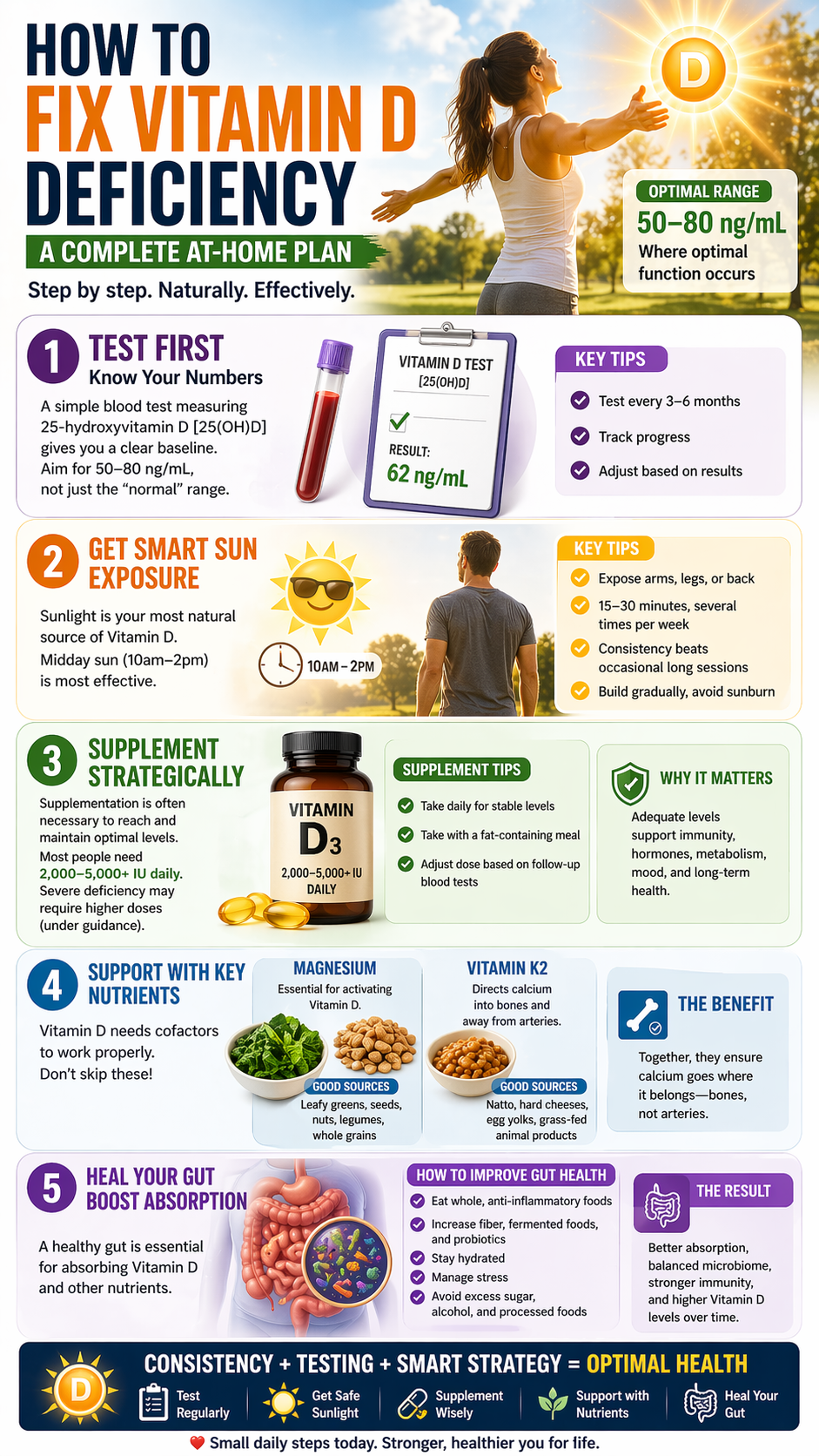
Supplementation is often necessary, particularly for individuals with limited sun exposure or significant deficiency. Effective dosing requires moving beyond minimal recommendations and tailoring intake to individual needs. Many individuals require several thousand international units daily to achieve optimal levels, and adjustments should be made based on follow-up testing. Consistent daily intake ensures stable blood levels and supports long-term improvement.
Magnesium intake should be optimized to support the activation of Vitamin D within the body. Increasing magnesium through diet or supplementation enhances the enzymatic processes required for conversion into its active form. Without adequate magnesium, Vitamin D remains inactive and unable to perform its functions effectively. Vitamin K2 should also be included to regulate calcium metabolism, ensuring that calcium is directed into bones rather than accumulating in soft tissues.
Improving gut health is an essential component of correcting deficiency, as absorption depends on a well-functioning digestive system. Reducing inflammatory foods, supporting digestion, and restoring balance in the microbiome enhance nutrient uptake and improve overall health. Individuals who struggle to raise their Vitamin D levels despite supplementation often find that addressing gut health produces significant improvements.
Maintaining Optimal Levels Long Term
Maintaining optimal Vitamin D levels requires consistency and attention to changing environmental conditions. Seasonal variations in sunlight exposure can significantly impact levels, making it necessary to adjust supplementation and prioritize outdoor activity during periods of reduced sunlight. Regular monitoring ensures that levels remain within the optimal range and allows for adjustments based on individual response.
Developing consistent daily habits that support Vitamin D production and utilization creates a stable foundation for long-term health. This includes regular sunlight exposure, adequate nutrient intake, and ongoing attention to digestive and metabolic health. By maintaining these practices, individuals can prevent deficiency from returning and support sustained physiological balance.
A Foundational Shift in Health
The Vitamin D deficiency epidemic highlights a broader issue in modern health approaches, where foundational imbalances are often overlooked in favor of symptom-based treatment. By focusing on optimal levels rather than minimal thresholds and addressing the factors that influence absorption and utilization, individuals can take meaningful control of their health.
Restoring adequate Vitamin D levels supports immune function, metabolic health, neurological stability, and cardiovascular resilience. This approach represents a shift toward addressing root causes rather than managing symptoms, allowing the body to function more efficiently and maintain long-term health.