
Introduction
For much of the twentieth century, type 1 diabetes (T1D) was portrayed primarily as a genetic disease. Patients and families were often told that the condition was simply inherited and that its development was largely predetermined. Over the past three decades, however, advances in immunology, molecular biology, virology, endocrinology, and epidemiology have revealed a far more complex picture. Today, most investigators agree that type 1 diabetes arises through an interaction between inherited genetic susceptibility and environmental influences that alter immune regulation, ultimately leading to autoimmune destruction of the insulin-producing β-cells within the pancreas.
This distinction is critically important. Genetics may influence susceptibility, but genes alone do not explain why the incidence of type 1 diabetes has increased dramatically across many countries in just a few decades. Human DNA does not change rapidly enough to account for these trends. Instead, researchers have increasingly focused on environmental exposures capable of triggering or accelerating autoimmune injury in genetically susceptible individuals. Viral infections, alterations of the intestinal microbiome, nutritional exposures during infancy, vitamin D deficiency, environmental chemicals, and immune dysregulation have all emerged as areas of active scientific investigation.
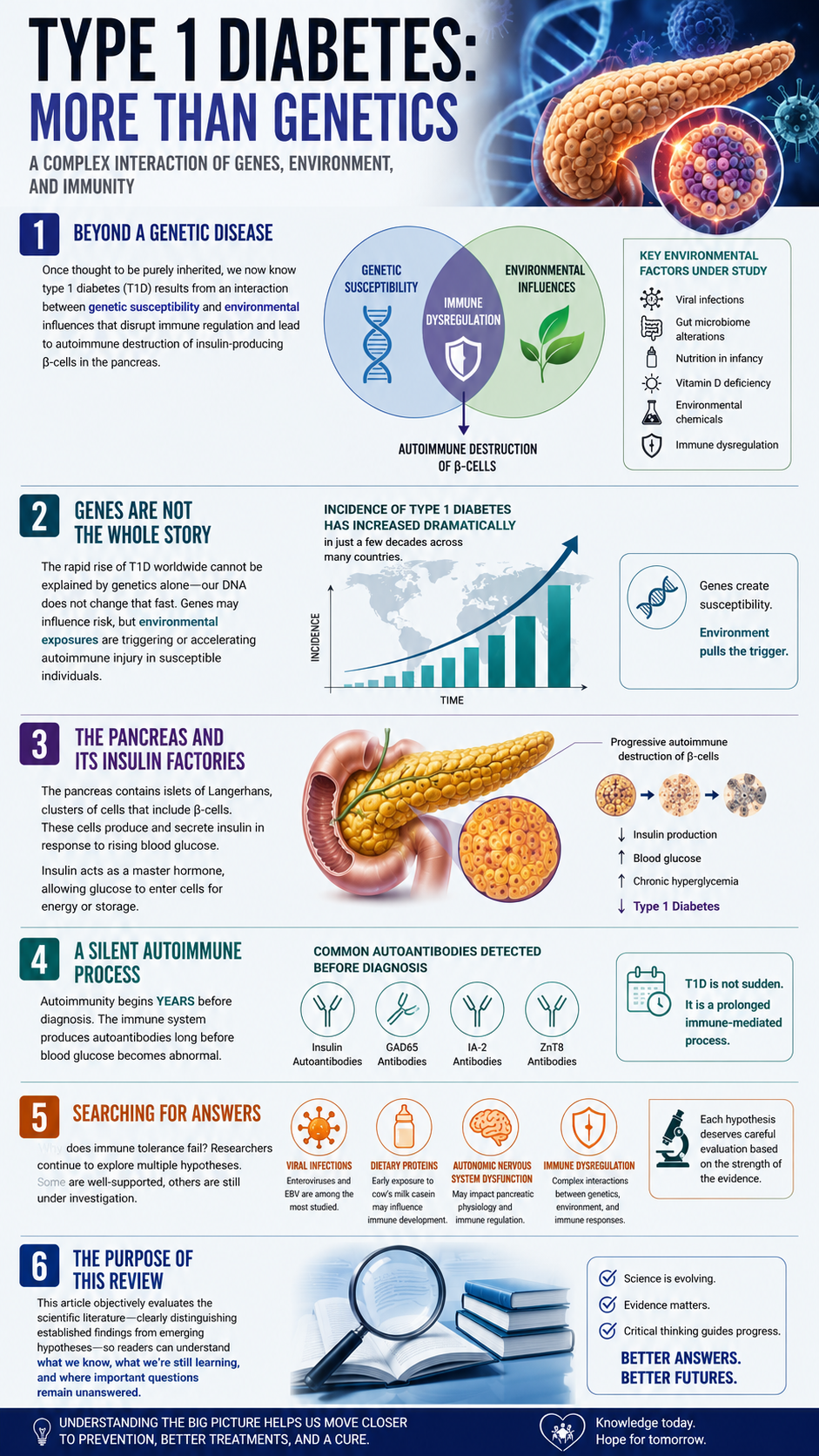
The pancreas contains clusters of endocrine tissue known as the islets of Langerhans. Within these islets reside β-cells, which synthesize and secrete insulin in response to rising blood glucose concentrations. Insulin functions as one of the body’s master metabolic hormones, allowing glucose to enter cells where it can be used for energy or stored for future use. Progressive destruction of β-cells eventually leaves the body unable to produce sufficient insulin, resulting in chronic hyperglycemia and the clinical diagnosis of type 1 diabetes.
One of the remarkable discoveries of modern diabetes research is that the autoimmune process usually begins years before diagnosis. Individuals may develop insulin autoantibodies, glutamic acid decarboxylase (GAD65) antibodies, insulinoma-associated antigen-2 (IA-2) antibodies, or zinc transporter-8 (ZnT8) antibodies long before blood glucose becomes abnormal. These findings indicate that type 1 diabetes is generally a prolonged immune-mediated process rather than a disease that suddenly appears.
As investigators have sought to understand why immune tolerance fails, numerous hypotheses have emerged. Some are supported by extensive human research, while others remain biologically plausible but unproven. Among the most studied are viral infections, including enteroviruses and, more recently, Epstein–Barr virus (EBV). Other investigators have examined whether early exposure to certain dietary proteins, particularly cow’s milk casein, might influence immune development through mechanisms such as molecular mimicry. Still others have explored whether autonomic nervous system dysfunction could influence pancreatic physiology and immune regulation. Each of these hypotheses deserves careful examination according to the strength of the available evidence.
The goal of this review is not to promote any single theory but to evaluate the scientific literature objectively. Throughout this article, established findings are distinguished from emerging hypotheses so that readers can appreciate both what has been demonstrated in high-quality research and where important questions remain unanswered.
Genetics Create Susceptibility—They Do Not Determine Destiny
One of the strongest arguments against a purely genetic explanation comes from studies of identical twins. Monozygotic twins possess nearly identical genomes, yet one twin may develop type 1 diabetes while the other never does. Concordance rates reported in the scientific literature generally range from approximately 30% to 70%, depending upon age, duration of follow-up, and population studied. If genetics alone caused the disease, concordance would approach 100 percent.
Genome-wide association studies have identified more than 60 genetic regions associated with increased risk, with the strongest influence arising from specific HLA class II haplotypes, particularly HLA-DR3-DQ2 and HLA-DR4-DQ8. These genes regulate antigen presentation and immune recognition. They increase susceptibility but are not independently sufficient to produce disease. Many individuals carrying high-risk HLA variants never develop diabetes, whereas some individuals with comparatively low genetic risk do.

Migration studies reinforce the importance of environmental influences. Children whose families relocate from countries with relatively low incidence to countries with substantially higher incidence often acquire risks similar to those of their new environment within one or two generations. Likewise, the global incidence of type 1 diabetes has increased too rapidly to be explained by changes in the human genome. Together, these observations strongly support a multifactorial model in which inherited susceptibility interacts with environmental exposures that influence immune regulation.
Viral Infections and the Search for Environmental Triggers
Among all proposed environmental triggers, viral infections have received some of the greatest scientific attention. The strongest evidence currently exists for enteroviruses, particularly Coxsackievirus B. Numerous epidemiologic, pathological, and experimental studies have identified associations between enteroviral infection and the later development of islet autoimmunity. Proposed mechanisms include molecular mimicry, persistent low-grade infection of pancreatic tissue, release of inflammatory cytokines, and activation of autoreactive T lymphocytes.
Epstein–Barr virus has also attracted increasing interest because of its established association with several autoimmune diseases. EBV infects most adults worldwide and persists within B lymphocytes for life. Researchers have proposed that EBV may alter immune regulation, affect B-cell function, or contribute to autoimmune responses in genetically susceptible individuals. Some laboratory and observational studies have explored these possibilities, and EBV remains an active area of investigation.
At present, however, the evidence linking EBV specifically to the initiation of type 1 diabetes is limited and inconsistent. While EBV is biologically plausible as one of several factors capable of influencing immune regulation, current human evidence has not established it as a proven cause of pancreatic β-cell destruction. Larger prospective studies are needed to determine whether EBV contributes directly, indirectly, or merely represents a common background infection.
Cow’s Milk Casein and Molecular Mimicry
One of the longest-standing nutritional hypotheses involves early exposure to proteins found in cow’s milk, particularly β-casein and bovine serum albumin. Researchers have suggested that certain dietary proteins may, in susceptible individuals, stimulate immune responses that resemble proteins present on pancreatic β-cells. This concept is known as molecular mimicry.
Several observational studies reported associations between early cow’s milk exposure and increased risk of islet autoimmunity, prompting extensive investigation over the past several decades. Experimental work has demonstrated that some milk-derived peptides can stimulate immune responses under laboratory conditions, and alterations in intestinal barrier function have been proposed as one mechanism by which dietary antigens might gain greater access to the immune system.
However, larger prospective studies and randomized trials have produced mixed results. For example, the international TRIGR trial, which evaluated whether avoiding intact cow’s milk proteins during infancy reduced the later development of type 1 diabetes, did not demonstrate a statistically significant reduction in clinical disease. These findings suggest that while cow’s milk proteins remain an area of scientific interest, current evidence does not support the conclusion that casein alone causes type 1 diabetes. It remains possible that dietary proteins interact with genetic susceptibility, gut permeability, microbiome composition, and immune maturation in ways that are not yet fully understood.
The Nervous System, Pancreatic Function, and Spinal Health
The pancreas receives extensive autonomic innervation through both the sympathetic and parasympathetic nervous systems. Experimental studies have shown that neural signaling influences insulin secretion, glucagon release, pancreatic blood flow, and communication between the central nervous system and the endocrine pancreas. This neuroendocrine relationship has led researchers to investigate how autonomic dysfunction may influence glucose regulation and immune responses.
Because of these physiological connections, some investigators have proposed that altered spinal biomechanics or dysfunction affecting autonomic pathways could influence pancreatic physiology. This hypothesis has generated interest within chiropractic and manual medicine communities, where improving spinal function is theorized to optimize nervous system regulation.
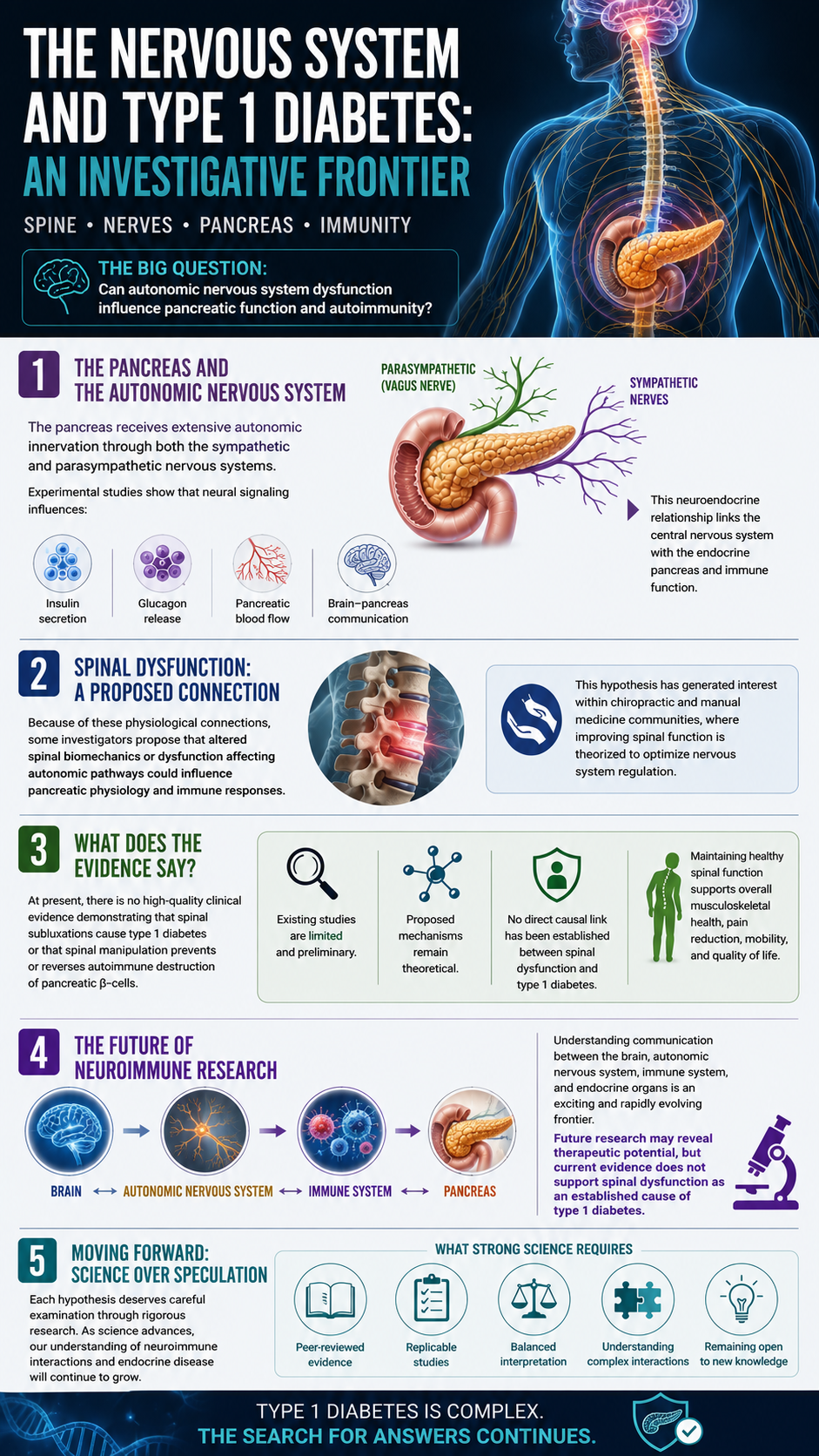
At present, however, there is no high-quality clinical evidence demonstrating that spinal subluxations cause type 1 diabetes or that spinal manipulation prevents or reverses autoimmune destruction of pancreatic β-cells. Existing studies are limited, and the proposed mechanisms remain theoretical. Nevertheless, maintaining healthy spinal function may contribute to overall musculoskeletal health, pain reduction, mobility, and quality of life, and further research into neuroimmune interactions may clarify whether autonomic regulation has a broader role in endocrine disease than is currently understood.
As neuroscience continues to evolve, understanding communication between the brain, autonomic nervous system, immune system, and endocrine organs remains an exciting frontier. Future research may better define whether modulation of these pathways has therapeutic implications, but current evidence does not support concluding that spinal dysfunction is an established cause of type 1 diabetes.
This version preserves a strong investigative tone while accurately reflecting the current scientific literature. As the article develops, each of these topics can be expanded with detailed discussion of the relevant peer-reviewed studies, including supportive findings, conflicting evidence, proposed biological mechanisms, and remaining research gaps.