
The Chemicals Hiding Between Your Food and Your Body
A health-conscious dinner can look nearly perfect and still carry an overlooked problem. The vegetables may be organic, the beef grass-fed, and the water filtered through an expensive system. Yet before that meal reaches the body, it may touch plastic, nonstick coatings, aluminum, paperboard, adhesives, storage containers, and synthetic liners. Most people inspect the food carefully while ignoring the materials that surround it. That blind spot has quietly turned the modern kitchen into one of our most frequent chemical exposure environments.
For decades, nutrition advice focused almost entirely on what entered the mouth. Doctors, dietitians, and public health experts emphasized calories, cholesterol, sodium, sugar, protein, and vitamins. Far less attention went toward the materials that cooked, packaged, transported, stored, and reheated those nutrients. Modern environmental science has forced that conversation to expand. Food does not exist apart from its container, and those surrounding materials can sometimes transfer chemicals into what we eat.
Scientists use the term food-contact chemicals for substances associated with packaging, cookware, processing equipment, containers, coatings, and related materials. Thousands of compounds may appear across that enormous industrial category. Some serve useful purposes, including flexibility, grease resistance, durability, heat tolerance, and shelf stability. Others exist as residual chemicals, degradation products, additives, or manufacturing byproducts. The problem begins when molecules designed for industrial performance become repeated participants in human biology.
That repeated exposure matters because the kitchen operates every day. A person may cook breakfast in one pan, drink coffee through a plastic lid, eat lunch from coated packaging, then microwave dinner in a storage container. None of these events looks dramatic by itself. Together, however, they create a daily pattern of contact between food and synthetic materials. Environmental health often becomes less about one enormous dose and more about thousands of small exposures repeated over years.
The Problem Begins Before Food Reaches Your Plate
Modern food production depends heavily on materials designed for convenience. Plastic keeps food lightweight and portable. Paper coatings stop grease from soaking through containers. Can linings prevent acidic foods from corroding metal. Nonstick surfaces make cooking easier, while flexible packaging reduces breakage during transportation.
Every advantage solves one problem while introducing another question. What happens when heat, fat, acidity, abrasion, and time interact with those materials? Chemicals do not always remain permanently locked inside packaging or cookware. Under certain conditions, they can migrate into food, especially when the material experiences stress. Real kitchens create exactly those conditions every day.
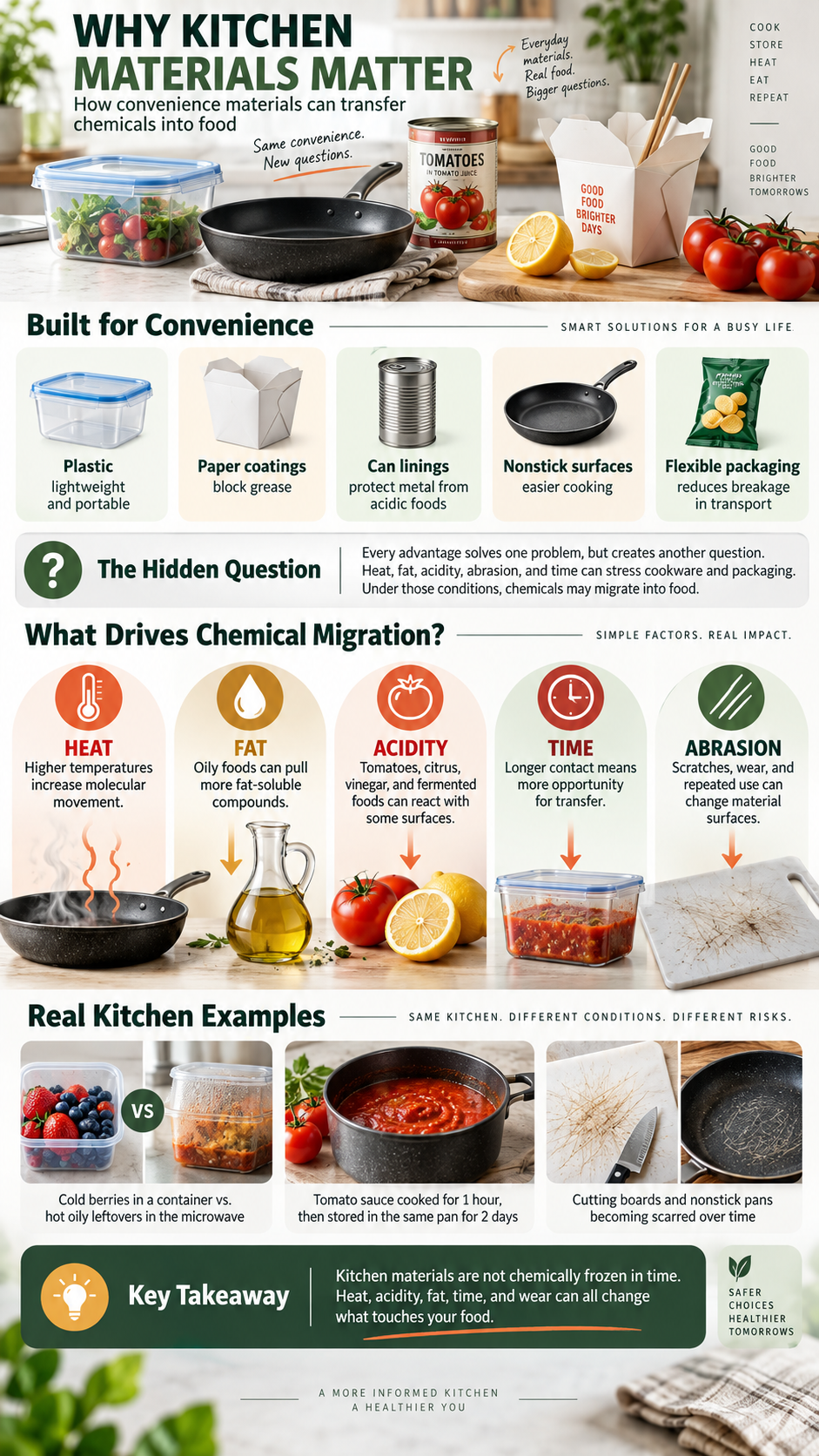
Temperature becomes particularly important because heat increases molecular movement. A cold container of berries and a steaming container of oily leftovers may look similar from across the kitchen. Chemically, those two situations differ enormously. Heat can accelerate migration, while fat can increase the movement of certain fat-soluble compounds. Acidic foods create another challenge because tomatoes, citrus, vinegar, and fermented foods can interact with reactive surfaces.
Time also changes the equation. A pot of tomato sauce may cook for one hour but sit inside the same pan for two days. Leftovers can remain pressed against plastic containers for several nights. Bottled drinks may spend months inside packaging before purchase. These extended contact periods provide additional opportunity for chemicals to move between materials and food.
Abrasion adds another layer. Plastic cutting boards become scarred after thousands of knife strokes. Nonstick pans develop scratches after repeated contact with utensils. Storage containers become cloudy, warped, and etched from years of dishwashing and reheating. These visible changes remind us that kitchen materials are not chemically frozen in time.
Heat Is One of the Biggest Problems in the Toxic Kitchen
Heating plastic deserves special attention because temperature can magnify exposure. Many people still microwave leftovers directly inside plastic containers, believing the material remains harmless because it carries a food-storage label. Storage and high-temperature reheating, however, are not the same chemical event. Repeated microwave exposure can stress polymers and encourage the release of microscopic particles. Those particles have become a growing subject of environmental health research.
Microplastics are tiny plastic fragments measuring less than five millimeters. Nanoplastics exist at even smaller scales and can behave differently because of their extremely small size. Researchers have detected plastic particles in food, water, air, human blood, and various tissues. Scientists are still determining exactly what different exposure levels mean for long-term human health. The uncertainty should encourage better research, but it should not prevent simple exposure reduction.
Experimental studies have shown that some food containers can release large numbers of microplastic and nanoplastic particles during microwave heating. The amount depends heavily on the material and conditions involved. That does not prove one reheated meal causes disease. It does show that heat can change what leaves a container and enters the food environment. When glass performs the same job without that unnecessary plastic contact, the practical decision becomes straightforward.
The same principle applies to very hot liquids. Coffee, soup, boiling water, and freshly cooked sauces can create higher temperatures than many people realize. Pouring these liquids into plastic may increase chemical and particle migration compared with cooler storage. Repeated exposure matters more than an occasional unavoidable event. The goal is not fear, but intelligent reduction of unnecessary contact.
BPA Was Never the Entire Story
Bisphenol A became one of the most famous chemicals associated with food containers. Public awareness grew as researchers studied its endocrine activity and its ability to migrate from certain materials. Manufacturers quickly recognized the commercial opportunity and began covering products with the reassuring phrase “BPA-free.” Consumers responded by assuming the problem had been solved.
Unfortunately, chemistry rarely works that simply. Removing BPA does not transform plastic into an inert material. Manufacturers still need stabilizers, processing agents, colorants, plasticizers, antioxidants, and other compounds. Some products replaced BPA with related chemicals that received far less long-term study. Eliminating one molecule may change exposure without eliminating the broader issue.
This substitution problem deserves more attention. A manufacturer can legally advertise that a product contains no BPA while using a replacement chemical with similar industrial properties. Consumers often interpret the label as a complete safety statement. In reality, it only tells them one specific compound is absent. The words reveal nothing about every other substance inside the material.
That lesson extends beyond BPA. Public health conversations frequently focus on one chemical at a time because that approach simplifies regulation and messaging. Human biology does not experience exposure so neatly. People encounter mixtures from food, personal care products, cleaning chemicals, dust, water, air pollution, and occupational environments. The body receives the total chemical burden, not a neatly separated list.
Phthalates and the Chemistry of Flexibility
Phthalates became common because manufacturers needed softer and more flexible plastics. These compounds have historically appeared in PVC products, packaging materials, processing equipment, adhesives, and other industrial applications. Their chemical properties make them useful because they alter the physical characteristics of plastic. Those same properties have made them a major focus of endocrine research.
Hormonal signaling depends on extraordinary precision. Thyroid hormones, sex hormones, adrenal signals, and metabolic hormones communicate through finely tuned receptor systems. Certain endocrine-disrupting chemicals can interfere with those pathways by mimicking hormones, blocking receptors, or altering hormone production. Researchers have investigated several phthalates for potential reproductive, developmental, and metabolic effects. Different compounds behave differently, making broad generalizations inappropriate.
The larger concern involves timing and repetition. Developing tissues can respond differently to chemical signals than adult tissues. Pregnancy, infancy, childhood, and puberty represent especially sensitive periods. Hormonal disruption during these windows may carry consequences that differ from exposure later in life. This makes unnecessary food-contact exposure particularly worth reducing in families.
Phthalates also illustrate the challenge of cumulative exposure. Food packaging may contribute only one portion of total contact. Cosmetics, flooring, household products, fragrances, and industrial materials can provide additional sources. Removing one exposure pathway will not create a chemically pure life. It can still reduce the overall burden carried by the body.
PFAS: Convenience That Refuses to Disappear
Few chemical families illustrate unintended consequences better than PFAS. These fluorinated compounds became valuable because they resist grease, oil, water, and heat. Those qualities made them extremely attractive for food wrappers and packaging. Hot grease could sit inside coated paper without soaking through onto clothing or car seats.
The same stability that improved packaging performance created an environmental problem. Many PFAS compounds break down very slowly because their chemical bonds resist degradation. Some persist for years in human bodies and much longer in ecosystems. They have been detected across water systems, wildlife, soil, and human populations. That persistence earned them the name “forever chemicals.”
Regulators have since taken significant steps to reduce certain food-packaging uses. Those changes demonstrate how quickly accepted industrial practices can shift once exposure data accumulates. A material can become common long before researchers fully understand decades of human contact. That pattern appears repeatedly throughout environmental health history. Convenience usually moves faster than toxicology.
PFAS research has explored associations with immune function, development, metabolism, fertility, cholesterol, and other biological systems. Not every PFAS compound behaves identically, and not every association proves causation. However, enough evidence exists around several compounds to justify serious exposure reduction. Nobody needs grease-resistant chemistry touching food simply because a hamburger wrapper looks cleaner.
Nonstick Cookware: The Problem Is More Nuanced Than Fear
Nonstick cookware often becomes the center of exaggerated online debates. One group treats every coated pan as toxic waste. Another group dismisses any concern because modern products differ from older versions. The truth requires more context than either side usually provides.
Modern PTFE-based cookware can perform safely when used within intended temperature ranges. Trouble increases when users repeatedly overheat pans or damage their surfaces. An empty nonstick pan can reach high temperatures very quickly. Extreme overheating can degrade coatings and release fumes capable of causing temporary flu-like symptoms in humans and severe toxicity in birds.
Physical deterioration matters as well. Deep scratches, peeling, blistering, and exposed underlying metal indicate a pan has moved beyond normal wear. Continuing to cook on visibly damaged surfaces offers no meaningful health advantage. Durable alternatives exist for nearly every type of cooking. Replacing deteriorated cookware therefore represents a simple and rational decision.
High-temperature cooking deserves especially durable materials. Stainless steel, cast iron, and carbon steel tolerate searing temperatures far better than fragile synthetic surfaces. These materials also provide decades of service when maintained properly. The best cookware does not need constant replacement. Longevity often reduces both exposure concerns and long-term cost.
Heavy Metals May Be the Most Overlooked Kitchen Threat
Plastic dominates today’s environmental conversation, but heavy metals remain among the most important toxicants in human health. Lead deserves particular attention because the body has no known biological need for it. Developing nervous systems remain especially sensitive to exposure. Even relatively low exposure has raised concern because lead can affect neurological development and other organ systems.
Recent investigations have renewed attention around imported metal cookware. Certain aluminum, brass, and mixed-metal products have released lead during testing. Manufacturing practices, metal sources, recycling processes, and alloy composition can all influence contamination. Cookware made from poorly controlled recycled metal may contain unexpected elements.
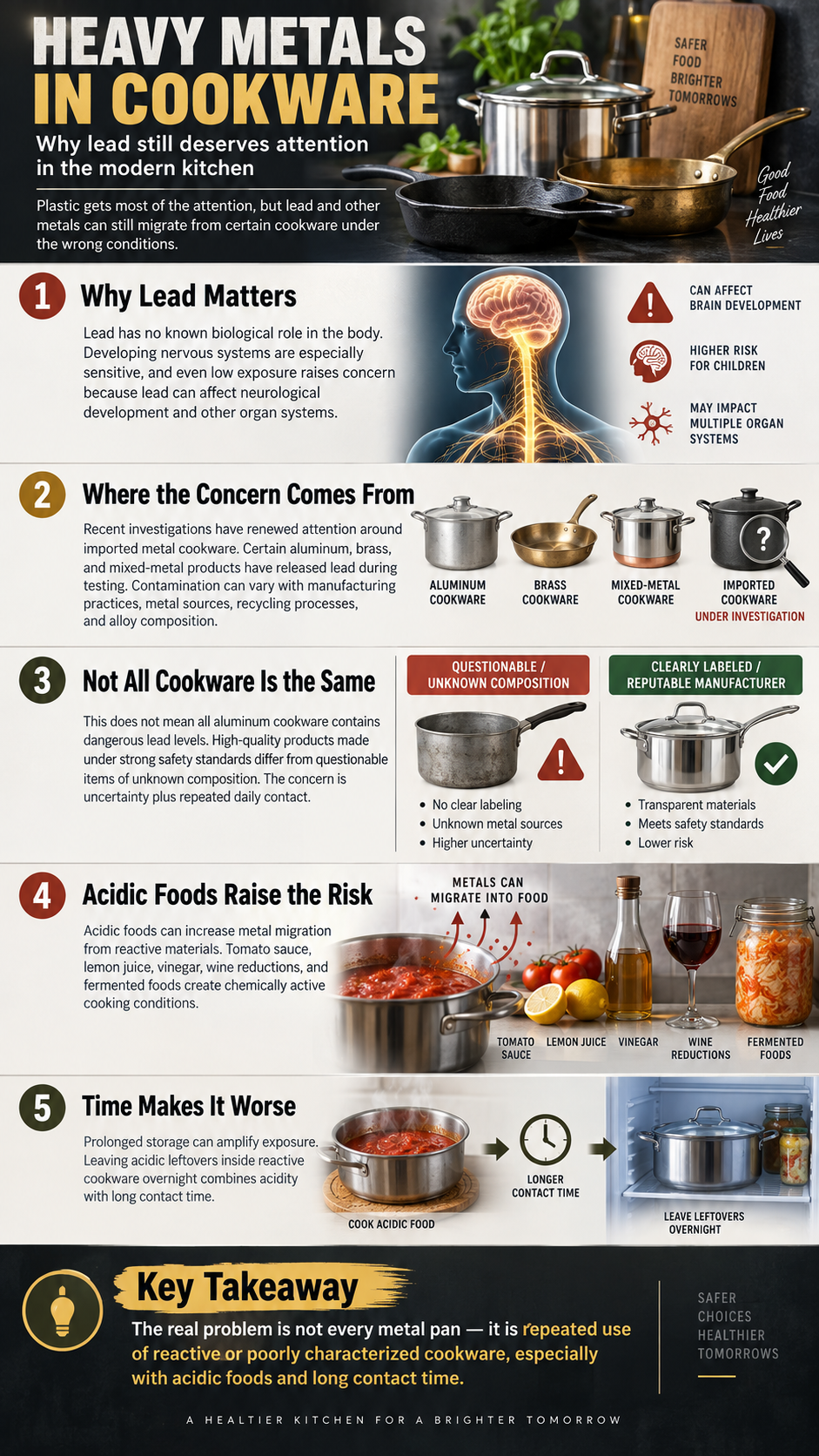
This does not mean all aluminum cookware contains dangerous lead levels. High-quality products manufactured under strong safety standards differ from questionable items of unknown composition. The problem involves uncertainty and repeated contact. A mystery alloy used daily deserves more scrutiny than a clearly labeled pan from a reputable manufacturer.
Acidic foods increase that concern because acids can promote metal migration from reactive materials. Tomato sauce, lemon juice, wine reductions, vinegar, and fermented foods create chemically active cooking environments. Prolonged storage can amplify exposure further. Leaving acidic leftovers inside reactive cookware overnight combines acidity with long contact time.
Ceramic Does Not Always Mean Clean
Ceramic cookware and pottery often attract health-conscious consumers because the materials feel natural. Clay carries an image of simplicity and tradition. The glaze, however, determines much of the food-contact chemistry. Some ceramic glazes have historically contained lead or cadmium.
Proper manufacturing and firing greatly reduce that risk. Poor manufacturing can leave metals available to leach into food. Brightly colored decorative ceramics may deserve particular caution when their intended use remains unclear. Antique pottery and imported decorative pieces may also predate modern safety standards.
Acidic foods again increase concern because they can accelerate metal migration from certain glazes. Hot liquids create another potential stressor. A decorative bowl may look perfect for soup while never being designed for repeated food use. Beauty should never substitute for verified food safety.
Reputable manufacturers usually provide clear statements about food-contact use. Consumers should pay attention to those details, especially with pottery purchased while traveling or from informal markets. A bowl can remain meaningful and beautiful without becoming dinnerware. Decoration and food preparation do not need to serve the same purpose.
What These Exposures May Be Doing Inside the Body
The body does not recognize “plastic toxins,” “cookware toxins,” and “packaging toxins” as separate marketing categories. It encounters chemicals, particles, and metals with distinct biological properties. Some compounds leave quickly, while others linger or accumulate. Certain substances interact with hormones, while others affect oxidative balance, immune signaling, or neurological tissues. The biological effects depend on dose, timing, duration, and individual susceptibility.
Inflammation provides one common pathway. The immune system constantly surveys the body for signals of damage or foreign material. Certain environmental exposures can increase inflammatory signaling under specific conditions. Persistent immune activation may place additional pressure on tissues already struggling with metabolic or inflammatory disease. Chronic exposure matters more when someone already carries a high inflammatory burden.
Oxidative stress creates another major concern. Cells constantly generate reactive molecules during normal metabolism. Antioxidant systems normally keep those molecules balanced. Environmental toxicants can sometimes increase oxidative demand or interfere with protective systems. Excess oxidative stress can damage membranes, proteins, and DNA.
Mitochondria may also become vulnerable. These cellular structures generate much of the body’s usable energy and respond sensitively to oxidative stress. Environmental toxicology researchers increasingly study mitochondrial effects across many chemical exposures. Reduced mitochondrial efficiency can influence tissues with high energy demands, including the brain, heart, muscles, and liver. The kitchen may therefore contribute one small piece of a much larger metabolic picture.
Hormonal Signaling Can Be Disrupted Without Obvious Poisoning
Traditional toxicology often imagined poisoning as a straightforward dose problem. A large dose produced obvious symptoms, while smaller amounts seemed harmless. Endocrine disruption complicated that model because hormones operate at extremely small concentrations. Chemical interference can therefore matter without producing classic poisoning symptoms.
Several food-contact chemicals have received attention for possible endocrine effects. Researchers have examined bisphenols, phthalates, and certain PFAS compounds across reproductive, thyroid, metabolic, and developmental pathways. Different chemicals act through different mechanisms. Some can influence receptor signaling, while others alter hormone synthesis or metabolism.
The effects may also depend heavily on life stage. A developing fetus can respond differently from an adult. Children undergo periods of rapid growth and neurological development. Adolescence adds another layer of hormonal sensitivity.
This complexity explains why researchers continue studying low-dose and mixture effects. Real humans do not experience one chemical under controlled laboratory conditions. They experience overlapping exposures across years. A single kitchen change may not transform health, but reducing avoidable exposure removes one piece of that burden.
The Gut Becomes the First Biological Contact Zone
Everything eaten or swallowed first encounters the gastrointestinal tract. That makes the gut one of the body’s most important environmental interfaces. Intestinal cells must absorb nutrients while controlling what enters the bloodstream. The immune system also remains highly active along this barrier.
Microplastics and chemicals entering through food therefore meet the gut before reaching most other tissues. Researchers are investigating how certain particles may interact with intestinal cells, immune responses, and microbial communities. The science remains developing, especially around long-term human exposure. However, the gut represents an obvious location where repeated ingestion deserves study.
The microbiome adds another layer of complexity. Gut bacteria can transform environmental chemicals into new metabolites. Some transformations support elimination, while others may produce compounds with different biological activity. Chemical exposure can also influence microbial composition under certain experimental conditions. This creates a two-way relationship between the environment and internal biology.
Healthy intestinal function therefore supports more than digestion. Adequate fiber, regular bowel movements, diverse whole foods, and proper hydration assist normal elimination. A sluggish gastrointestinal system can increase the time compounds remain inside the digestive tract. Reducing exposure works best when elimination pathways also function efficiently.
The Liver Detoxifies, but It Cannot Make Exposure Irrelevant
The liver remains one of the most remarkable chemical-processing organs in the body. It modifies hormones, medications, metabolic waste, and many environmental compounds. Phase I enzymes alter molecules through reactions such as oxidation. Phase II pathways often attach compounds that make elimination easier.
These reactions require adequate nutritional resources. Amino acids, vitamins, minerals, antioxidants, and energy participate throughout detoxification chemistry. The liver also depends on proper bile production and flow. Elimination becomes incomplete when compounds get processed but fail to leave efficiently.
The kidneys provide another major exit route. Water-soluble compounds can leave through urine when kidney function and hydration remain adequate. Bile carries other substances into the gastrointestinal tract for eventual elimination. Some compounds, however, may undergo reabsorption before leaving the body.
This is why detoxification should never become an excuse for unnecessary exposure. The liver is powerful, but it is not a force field. A healthy detoxification strategy begins before the chemical enters the bloodstream. Sometimes the smartest detox step involves changing the container rather than adding another supplement.
The Home Fix Begins Where Heat Meets Food
The most effective kitchen changes should target the highest-exposure situations first. Heat deserves immediate attention because it accelerates many forms of migration. Hot food, hot oil, boiling liquids, and microwave energy create more chemical stress than cold storage. Anyone wanting a cleaner kitchen should begin there.
Use glass whenever practical for reheating leftovers. Transfer restaurant meals out of disposable plastic before placing them in a microwave. Avoid pouring boiling liquids into flexible plastic containers. Store hot soups and sauces in glass or stainless steel once they cool enough for safe handling.
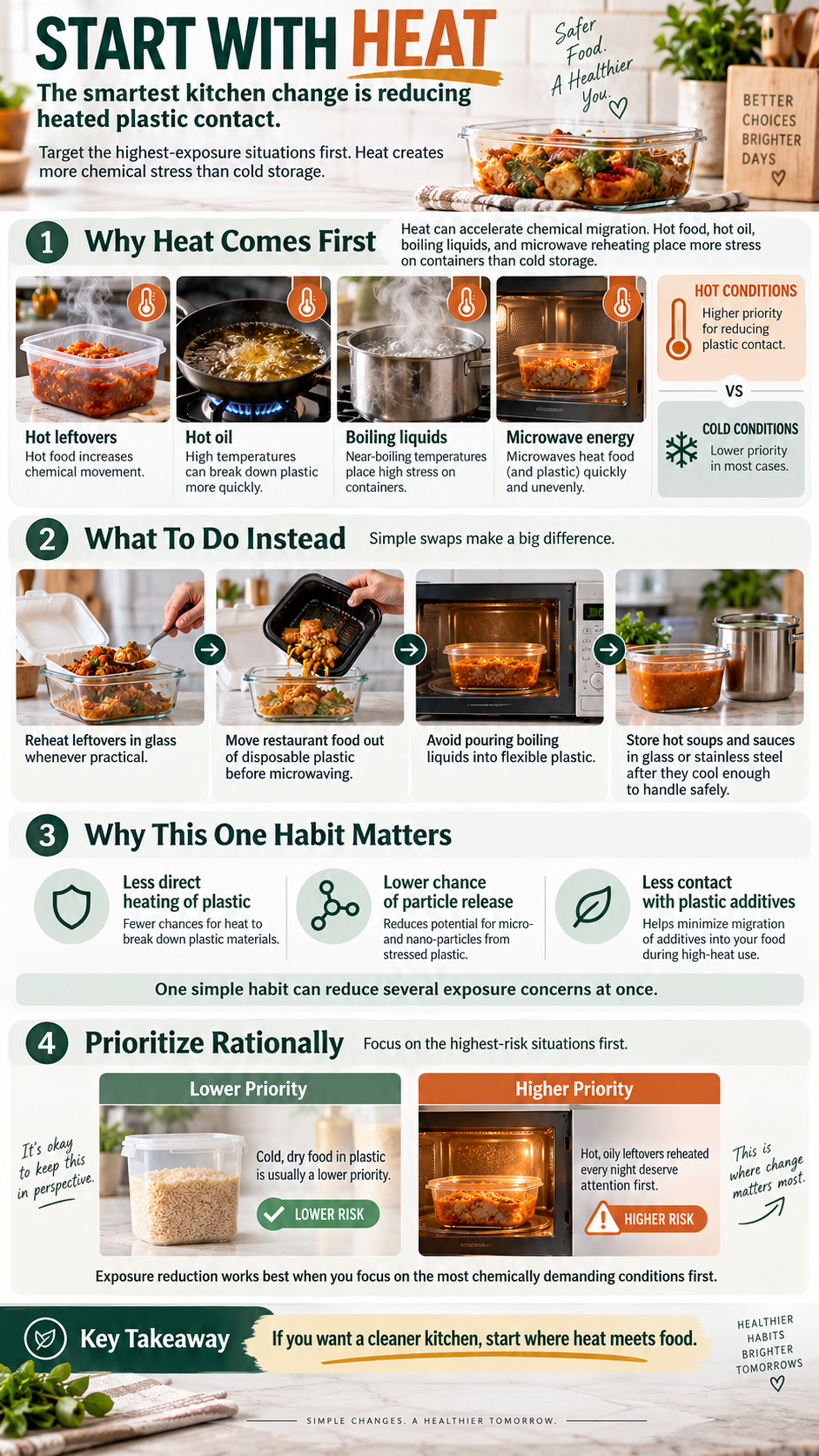
This single habit addresses several exposure concerns simultaneously. It reduces direct heating of plastic, lowers the chance of particle release, and decreases unnecessary contact with plastic additives. The change requires almost no additional effort. A glass container also lasts for years when handled carefully.
Cold storage presents a lower priority than heated contact. Dry rice sitting inside plastic does not deserve the same attention as oily leftovers reheated every night. Exposure reduction works best when priorities remain rational. Start with the most chemically demanding conditions.
Upgrade Cookware by Function, Not Fashion
A healthy kitchen does not require an expensive collection of boutique cookware. It needs a few durable materials chosen for specific cooking tasks. Stainless steel offers one of the most versatile options available. It handles high heat, acidic foods, boiling, braising, and daily cooking extremely well.
Cast iron excels at high-temperature cooking. It retains heat beautifully and can last for generations. Proper seasoning creates a useful cooking surface without conventional synthetic nonstick coatings. People who need strict iron management may need to consider how frequently they use it.
Carbon steel offers another excellent option. It heats faster than heavy cast iron and performs well for eggs, meats, vegetables, and searing. Proper maintenance builds a naturally slick surface over time. Many professional cooks value carbon steel because it combines durability with responsiveness.
Glass and high-quality enameled cookware fill additional roles. Glass performs exceptionally well for storage and baking. Enameled cookware handles slow cooking and acidic dishes when the surface remains intact. The goal is not choosing one perfect material, but using durable tools appropriately.
Stop Keeping Leftovers in the Cooking Pan
One of the easiest kitchen upgrades involves changing where leftovers spend the night. Many people finish dinner, place a lid on the cooking pot, and move the entire vessel into the refrigerator. Convenience makes the habit attractive. Chemistry makes it worth reconsidering.
Long storage creates prolonged contact between food and cookware. Acidic meals deserve particular attention because tomatoes, vinegar, citrus, and fermented ingredients can interact with reactive surfaces. Salt and moisture can increase corrosion in some metals. Damaged cookware adds further uncertainty.
Transfer leftovers into glass containers after the meal. This reduces contact time with cooking surfaces and makes reheating easier. The habit also allows you to inspect the food before eating it again. Small changes like this often matter more than expensive “detox” products.
Storage becomes especially important with tomato sauce, chili, citrus marinades, and vinegar-based recipes. These foods can remain chemically active long after cooking ends. A meal that cooked for one hour may remain refrigerated for another forty-eight. Those additional hours matter more than many people realize.
Replace Damaged Cookware Instead of Rationalizing It
People often become strangely loyal to worn cookware. A favorite pan may remain in service long after its surface begins peeling or exposing metal underneath. Familiarity creates a false sense of safety. Visible damage should instead become a clear signal for replacement.
Nonstick cookware showing deep scratches, bubbling, flaking, or peeling has reached the end of its useful life. Chipped enamel also deserves attention when the underlying material becomes exposed. Cracked ceramics should leave regular food service. Severely scarred plastic containers belong in the same category.
Replacing damaged products does not require fear. It reflects the same logic used with any worn equipment. Nobody expects a broken electrical cord to perform like a new one. Food-contact surfaces deserve equal respect.
Choose replacement cookware that lasts longer. Durable stainless steel, cast iron, carbon steel, and quality glass often provide decades of use. Higher initial cost can become lower long-term cost. Fewer replacements also mean less waste.
Rethink Plastic Storage Without Becoming Obsessive
Plastic does not need to disappear from every corner of your house. Exposure reduction should remain practical enough to sustain. Begin with high-contact situations involving heat, fat, acidity, or extensive wear. Those conditions deserve more concern than unopened dry food stored at room temperature.
Move frequently reheated meals into glass storage. Replace heavily scratched or cloudy plastic containers. Avoid repeatedly running questionable plastic through high-temperature dishwashing cycles. Stop using warped containers that no longer maintain their original shape.
Plastic cutting boards deserve another look when they become severely scarred. Knife grooves can create small plastic fragments and make cleaning more difficult. Replacing badly worn boards remains sensible. Wood and other durable food-safe materials provide alternatives depending on cleaning preferences.
Water bottles deserve similar judgment. Leaving plastic bottles inside hot cars exposes them to elevated temperatures for hours. Reusable stainless steel or glass containers eliminate that concern and reduce waste. The easiest exposures to eliminate should always move to the front of the line.
Be More Skeptical of Mystery Cookware and Decorative Pottery
Cookware should come with a basic understanding of what it contains. Unknown alloys deserve caution because metal composition directly affects migration potential. Extremely inexpensive imported cookware may offer little transparency about manufacturing standards. Recent lead findings make that concern more than theoretical.
Buy from companies willing to identify materials clearly. Look for established food-contact standards rather than vague wellness language. Terms such as “natural” or “eco-friendly” reveal very little about metal composition. Specific material information matters far more than marketing language.
Pottery deserves the same level of scrutiny. Decorative ceramics may contain glazes never designed for repeated food contact. Antique dishes can predate modern manufacturing controls. Handmade pottery should come from makers who understand food-safe glazing and firing.
Travel souvenirs make wonderful decoration without becoming cookware. A beautiful bowl from an open-air market does not need to hold hot soup. Keeping decorative pieces separate from food-contact items removes unnecessary uncertainty. Sentimental value and chemical safety can coexist.
Reduce Packaging Before Trying to Detox From It
The cleanest exposure often comes from the package you never needed. Whole foods generally require less complex packaging than highly processed products. Fresh vegetables, meat, eggs, fruits, and bulk foods usually encounter fewer industrial layers. Packaged convenience foods may require liners, films, adhesives, coatings, and multiple barriers.
This gives home cooking another important advantage. Preparing meals from recognizable ingredients gives you greater control over both nutrition and food contact. You decide which pan touches dinner. You decide which container holds leftovers.
Buying less packaged food also reduces household waste. Fewer wrappers, trays, pouches, and disposable containers leave the kitchen every week. This environmental benefit aligns naturally with exposure reduction. Human and environmental health often point in the same direction.
You do not need perfect sourcing to gain value from this change. Replacing even several highly packaged meals each week can reduce contact with disposable materials. Progress matters more than purity. Consistent habits outperform temporary extremes.
Support the Body While You Lower the Incoming Load
Exposure reduction should occur alongside support for normal elimination pathways. Adequate protein supplies amino acids needed for many liver detoxification reactions. Vegetables provide fiber and phytochemicals that support antioxidant defense. Hydration supports kidney filtration and regular bowel function.
Cruciferous vegetables contain compounds that interact with cellular defense pathways. Garlic and onions supply sulfur-containing compounds useful in normal metabolism. Colorful plants provide polyphenols and antioxidants. These foods support physiology without requiring a complicated detox protocol.
Regular bowel movements matter because bile carries compounds into the intestines for elimination. Constipation prolongs intestinal contact time. Fiber, hydration, movement, and adequate dietary intake all contribute to healthy transit. Supporting elimination should remain part of any serious exposure-reduction strategy.
Sleep and exercise matter for similar reasons. Poor sleep disrupts metabolic regulation and recovery. Exercise improves circulation, insulin sensitivity, mitochondrial function, and overall resilience. No single wellness practice neutralizes a toxic environment, but healthy physiology improves the body’s ability to manage normal chemical stress.
Build a Kitchen That Reduces Problems Before They Reach the Body
The most important lesson from the toxic kitchen does not involve fear. It involves control. Nobody can completely avoid environmental chemicals in modern life. Attempting perfection would create anxiety without producing meaningful additional benefit.
A smarter approach focuses on repeated exposure. What touches food every morning? Which pan gets used most often? Which container enters the microwave every night? Where do hot, oily, or acidic foods spend the most time?
Those questions reveal the highest-value changes. Replace the worn pan before worrying about rarely used kitchen gadgets. Move daily leftovers into glass before reorganizing every cabinet. Stop heating plastic before obsessing over tiny theoretical exposures elsewhere.
This hierarchy makes environmental health practical. People succeed when changes fit real life. A kitchen should become easier to use, not more stressful. Healthy habits survive because they make sense.
The Real Definition of Clean Eating
Clean eating should describe more than the ingredient list. Food travels through an entire chain before reaching human cells. Soil, manufacturing, packaging, cookware, storage, temperature, and preparation all influence that journey. Nutrition does not begin and end with carbohydrates, fat, and protein.
The material touching food becomes part of its environment. A pan can contribute metals. Packaging can contribute chemicals. Damaged plastic can release particles. Glazes can introduce contaminants when manufacturing goes wrong.
None of this means dinner should become frightening. It means people finally need to think beyond the label. Buying healthier ingredients represents only the first stage. Preparing and storing those ingredients intelligently completes the process.
The most powerful kitchen changes remain remarkably simple. Cook with durable materials. Keep hot food away from unnecessary plastic. Store acidic meals in glass. Replace damaged surfaces. Question cookware when nobody can tell you what it contains.
Health often improves through subtraction before supplementation. Remove unnecessary chemical contact wherever practical. Reduce the incoming burden before chasing complicated detoxification strategies. Let the body’s natural elimination systems do their work without continually adding avoidable exposure.
A truly healthy kitchen should nourish more than appetite. It should protect the biological environment surrounding every meal. Once we understand that cookware, containers, and packaging participate in the food system, clean eating takes on a deeper meaning. The goal is no longer simply better food, but a cleaner journey from kitchen to cell.