
Breathing Starts With Structure
You can have healthy lungs and still breathe poorly. That statement surprises people because breathing is usually discussed as a lung function. Yet the lungs cannot pull themselves open, lift the ribs, or create the pressure needed to draw air inward. Every breath depends on a moving mechanical system. The diaphragm contracts, the rib cage expands, and the spine accommodates that movement. Abdominal muscles control pressure below the lungs. Neck and shoulder muscles assist when demand increases. When this system loses mobility, coordination, or strength, breathing can become less efficient long before someone recognizes the structural problem.
Modern life steadily interferes with this system. Hours at a desk reduce thoracic movement. Phones encourage prolonged head-forward positions. Driving limits rotation through the trunk. Chronic stress increases muscular tension and often changes breathing rhythm. Physical inactivity decreases the demand placed on the rib cage and diaphragm. Over time, the body becomes exceptionally skilled at functioning within a smaller range. Breathing continues because survival requires it, yet efficiency may gradually decline.
This is where the problem usually begins. The body rarely wakes up one morning with a suddenly dysfunctional diaphragm from posture alone. Instead, thousands of small adaptations accumulate. Ribs move less during ordinary breathing. The thoracic spine becomes less comfortable with extension and rotation. Accessory muscles around the neck begin helping more often. The abdomen may remain constantly braced. Eventually, a person may feel chest tightness, frequent sighing, neck tension, shallow breathing, or difficulty taking a satisfying breath.
The important question is not simply whether air enters the lungs. Air will usually keep entering despite imperfect mechanics. A better question asks how much work the body performs to make that breath happen. Efficient breathing distributes movement throughout the trunk. Inefficient breathing increasingly relies on compensation. The body can tolerate compensation for years, but repetition gives small problems enormous influence.
The Diaphragm Is the Primary Breathing Muscle
The diaphragm forms a broad muscular dome beneath the lungs. It separates the chest from the abdominal cavity and anchors around the lower rib cage. Portions also attach near the sternum and lumbar spine. When the diaphragm contracts, its dome moves downward and enlarges the thoracic cavity. Pressure inside the chest falls, encouraging air to enter the lungs.
A healthy diaphragm does much more than push the abdomen outward. Effective inspiration produces movement around the lower trunk. The lower ribs should widen laterally and expand posteriorly. The abdominal wall should accommodate pressure as the diaphragm descends. This coordinated movement allows the chest and abdomen to behave like an adaptable cylinder.
That distinction matters because many people mistakenly practice diaphragmatic breathing by forcefully pushing their stomach forward. They turn breathing into another muscular task instead of restoring coordination. Excessive abdominal movement without lower-rib expansion can still reflect poor mechanics. A well-organized breath should involve the diaphragm, ribs, abdomen, and spine together.
The diaphragm also contributes to trunk stability. During lifting, walking, coughing, and exercise, it helps regulate pressure inside the abdomen. This pressure works with the abdominal wall, pelvic floor, and deep spinal muscles. Breathing and spinal stability therefore operate through overlapping systems. The diaphragm must manage both respiratory movement and mechanical demand.
Problems appear when the system becomes too rigid. Someone who constantly tightens the abdomen may limit natural expansion. A person who habitually sucks in the stomach can create a similar restriction. Chronic pain may increase protective bracing around the trunk. Stress can add another layer of unnecessary muscular tension.
The diaphragm rarely works poorly in isolation. Its performance reflects the environment surrounding it. A stiff rib cage limits expansion. A rigid trunk changes pressure management. Poor posture alters the starting position of the chest. Weak conditioning increases respiratory demand during simple activities. Treating the diaphragm without addressing those influences often misses the larger problem.
The Rib Cage Must Move to Breathe Well
The rib cage protects the heart and lungs, but protection does not require rigidity. Each rib connects with the thoracic spine. Most also connect with the sternum through cartilage. These joints allow small movements that collectively create meaningful changes in chest volume.
Upper ribs tend to increase the front-to-back dimensions of the chest. Lower ribs contribute significantly to lateral expansion. Real respiration involves three-dimensional movement rather than one simple direction. The chest widens, lifts, rotates, and changes shape with every breath.
Restricted rib movement can develop after injuries, surgeries, prolonged sitting, chronic guarding, respiratory illness, or reduced physical activity. Scoliosis and other spinal changes can also influence rib mechanics. Even without obvious pathology, years of limited movement can reduce how comfortably the rib cage expands.
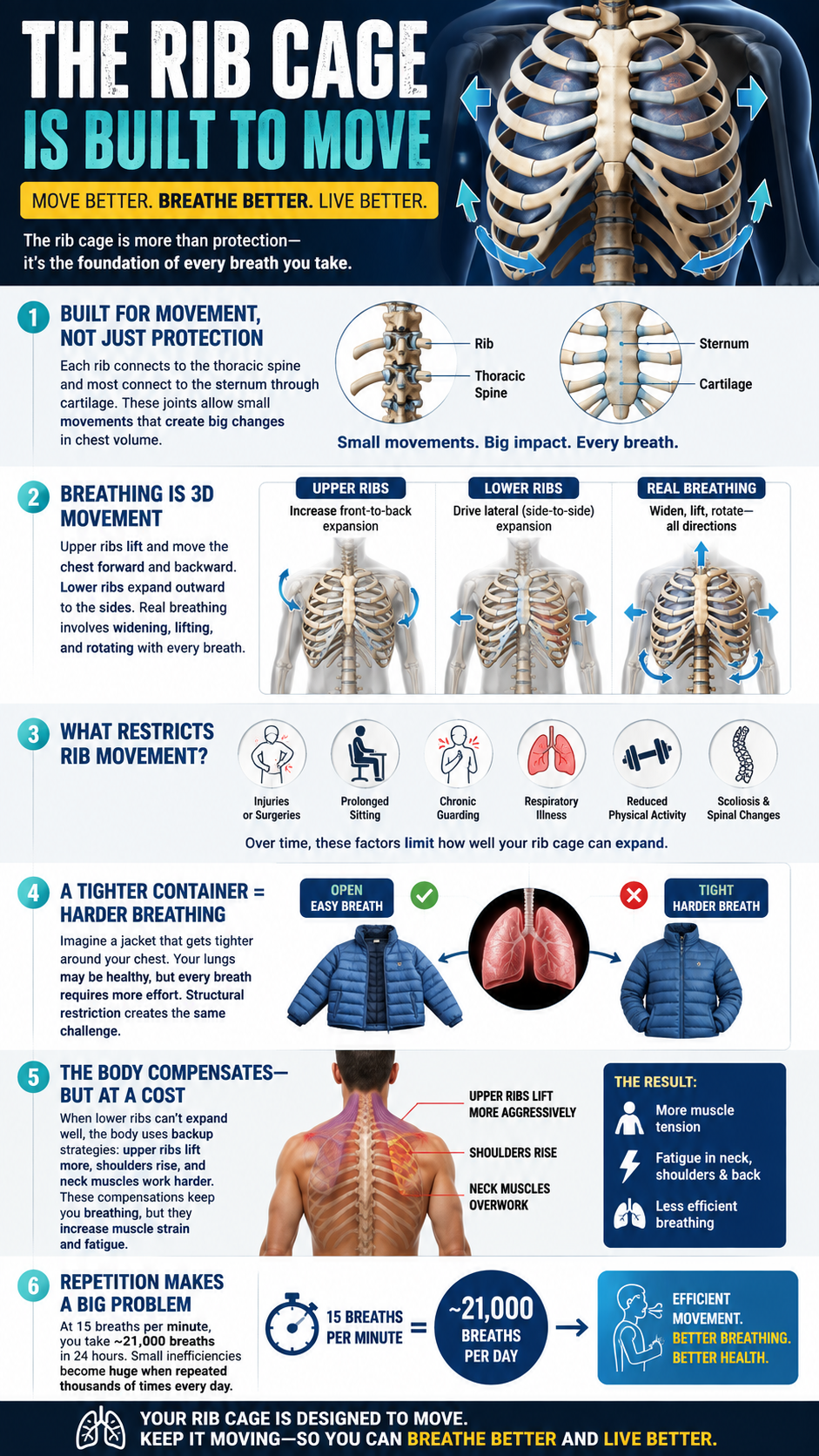
Imagine wearing a jacket that becomes progressively tighter around your chest. Your lungs may remain healthy, but every inhalation must work against greater resistance. Structural restriction creates a similar mechanical challenge. The comparison is imperfect because living tissues remain dynamic. Still, it illustrates why the container surrounding the lungs matters.
When lower ribs stop expanding efficiently, the body recruits another strategy. Upper ribs lift more aggressively. The shoulders may rise. Muscles around the neck help create additional chest expansion. These compensations maintain ventilation, but they increase muscular work.
That extra work occurs thousands of times daily. At fifteen breaths each minute, the body takes roughly twenty-one thousand breaths in twenty-four hours. Even a small mechanical inefficiency becomes enormous when repeated that often. Breathing patterns therefore deserve the same attention given to repetitive movements elsewhere in the body.
The Spine Forms the Back Wall of the Breathing System
Every rib connects to the thoracic spine, making spinal motion inseparable from rib motion. The twelve thoracic vertebrae provide a moving foundation for the chest. When the thoracic region rotates, bends, or extends, rib positions change with it. During respiration, those relationships influence how easily the chest expands.
Prolonged sitting can reduce thoracic movement because the body receives little reason to use it. Computer work often combines spinal flexion with limited rotation. Phone use adds more time with the head forward and upper back rounded. Driving keeps the pelvis and trunk relatively fixed. After years of repetition, the nervous system treats these positions as familiar territory.
The problem is not flexion itself. Spines were designed to flex. Trouble develops when one position dominates the day. A body that rarely extends eventually becomes less comfortable extending. A trunk that seldom rotates may gradually lose usable rotation. Movement that disappears from daily life often becomes harder to access.
Rigid posture creates another version of the same problem. Some people respond to poor posture by pulling their shoulders backward all day. They lift the chest, arch the lower back, and tighten the abdomen. That posture looks upright but can restrict relaxed breathing.
Healthy structure depends on movement variety rather than one permanent alignment. The spine should bend, rotate, flex, extend, and return to neutral. A mobile thoracic spine gives the rib cage more options. Those options help breathing adapt to sitting, walking, exercise, sleep, and changing physical demands.
Why Neck and Shoulder Tension Can Follow Poor Breathing
The muscles around the neck can assist breathing when respiratory demand rises. The scalenes can elevate upper ribs. The sternocleidomastoid can help lift the sternum and chest. These muscles become extremely useful during intense exercise or respiratory distress.
They were not designed to dominate every quiet breath. When lower-rib mechanics decline, the body may recruit them more frequently. Shoulders begin rising during inhalation. The upper chest becomes the primary visible area of movement. Neck muscles remain active even while someone sits quietly.
This pattern can contribute to muscular fatigue and tension. Twenty thousand daily breaths create an extraordinary repetition load. Add eight hours of computer work and forward-head positioning, and those tissues face even greater demand. Massage may temporarily relax them, yet the breathing strategy can immediately recruit them again.
Persistent neck pain has many causes, so breathing should never become a universal explanation. Disc problems, nerve irritation, joint dysfunction, headaches, injury, and other conditions require consideration. However, respiratory muscle overuse deserves attention when neck tension accompanies upper-chest breathing.
A better assessment asks why these muscles are working so hard. If the lower rib cage barely moves, the body may have limited alternatives. Restoring rib motion and diaphragmatic coordination can reduce unnecessary dependence on accessory muscles.
The Role of Posture Without the Posture Myth
Posture affects breathing because body position changes the geometry of the chest. However, posture should not become another rigid rule. No single position represents perfect posture for every person throughout the day.
Slumping can compress the front of the torso and reduce comfortable chest expansion. Excessive extension can create unnecessary tension through the back and abdominal wall. Both extremes may interfere with relaxed breathing when maintained for long periods.
The more important issue involves duration. Sitting in one position for ten minutes rarely creates a meaningful problem. Remaining there for several hours changes the equation. Joints receive fewer movement opportunities, while muscles maintain similar activation patterns.
Movement breaks solve more than posture policing. Standing, walking, rotating, reaching, and changing positions restore variety. The spine gets exposed to movement it cannot receive while frozen behind a desk.
Better posture therefore means adaptable posture. The body should tolerate many positions without becoming trapped inside one. Respiratory mechanics improve when the trunk can change shape freely.
What Structural Breathing Dysfunction Can Do to the Body
Poor breathing mechanics rarely damage the body through one dramatic event. Their impact comes from repetition and compensation. Neck muscles work harder. Rib motion decreases. Thoracic stiffness may worsen. Abdominal pressure becomes less adaptable. Exercise can feel harder because respiratory mechanics and conditioning decline together.
Reduced activity then compounds the problem. A person who becomes winded easily may exercise less. Less exercise reduces respiratory demand and thoracic movement. The body becomes increasingly deconditioned, making ordinary activity feel harder.
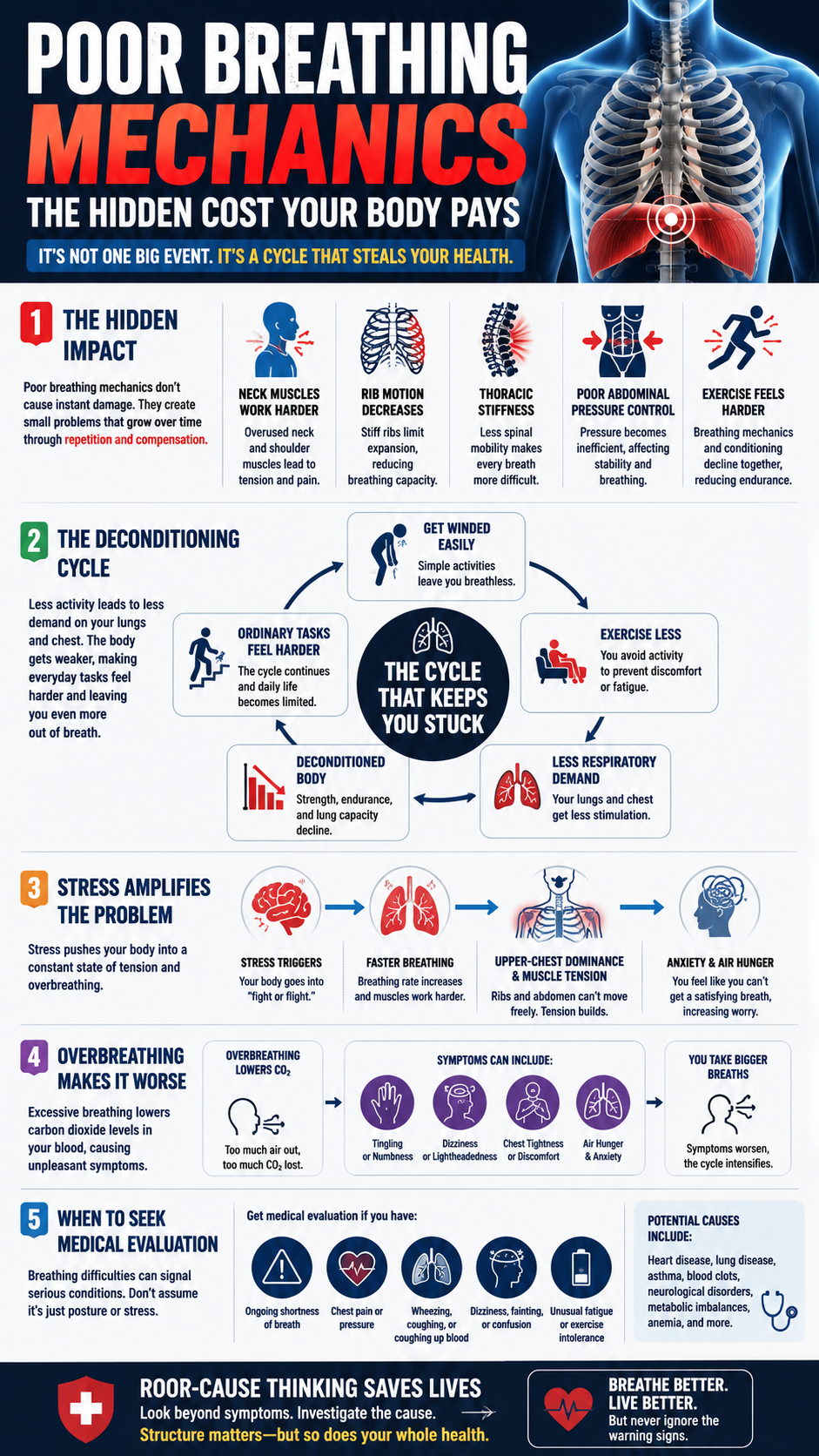
Stress can amplify this cycle. Faster breathing increases muscular work and may encourage upper-chest dominance. Chronic tension limits rib and abdominal movement. The person then feels unable to take a satisfying breath, which can increase anxiety.
Overbreathing can also alter blood carbon dioxide levels. Excessive ventilation may produce tingling, dizziness, chest discomfort, or air hunger. People sometimes respond by taking even bigger breaths, intensifying the problem.
These symptoms deserve appropriate medical evaluation when unexplained. Structural dysfunction should never become an excuse to ignore heart, lung, neurological, metabolic, or blood disorders. Root-cause thinking requires investigating dangerous possibilities before settling on a mechanical explanation.
Start With the Exhale
Most people who struggle to breathe comfortably focus on inhalation. They repeatedly attempt deeper breaths because they believe more air will solve the problem. Yet every inhalation begins from the position created by the previous exhale.
A comfortable exhale allows the diaphragm to relax upward. The lower ribs move inward while the chest volume decreases. This position gives the diaphragm a better starting point for its next contraction.
Forcing an aggressive exhale creates another problem. The goal is not to squeeze every molecule of air from the lungs. Instead, allow the ribs to settle naturally before the next inhalation arrives.
A quiet nasal inhalation should follow without lifting the shoulders. Feel expansion around the lower ribs rather than only through the upper chest. Keep the neck relaxed and avoid pushing the abdomen forward.
Breathing retraining works best when it feels easier, not more dramatic. Bigger breaths are not always better breaths. Coordination matters more than volume.
Practice 360-Degree Breathing at Home
Lie on your back with your knees comfortably bent. Place both hands around the lower rib cage. Allow several normal breaths before changing anything.
Notice where movement occurs. Does the abdomen rise while the ribs remain still? Does one side expand more than the other? Do the shoulders lift during inhalation?
Next, let your exhale happen slowly and comfortably. Feel the lower ribs settle beneath your hands. Avoid tightening the abdomen aggressively.
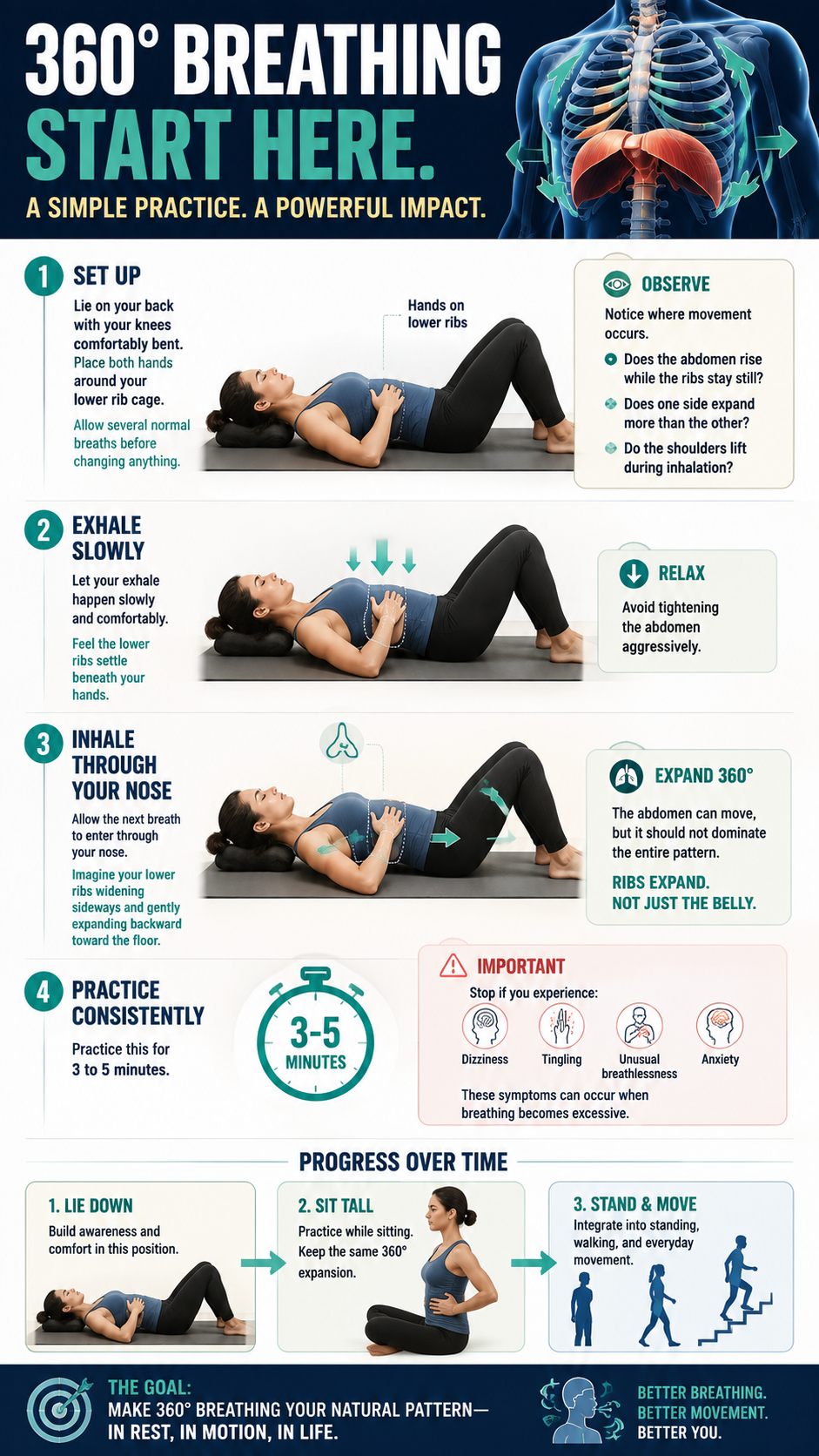
Allow the next breath to enter through your nose. Imagine the lower ribs widening sideways and gently pressing backward toward the floor. The abdomen can move, but it should not dominate the entire pattern.
Practice for three to five minutes. Stop if dizziness, tingling, unusual breathlessness, or anxiety develops. Those symptoms can appear when breathing becomes excessive.
Once this position feels comfortable, practice while sitting. Later, move to standing and walking. Breathing should eventually coordinate with everyday movement rather than remain an isolated floor exercise.
Restore Thoracic Rotation
The thoracic spine needs rotation because walking, reaching, and breathing all involve rotational mechanics. Modern sedentary life provides very little of that movement. Restoring it can improve the mechanical environment surrounding the ribs.
Sit near the front of a chair with your feet flat. Cross your arms loosely across your chest. Rotate gently toward one side without forcing your lower back.
Return to the center and repeat toward the opposite direction. Notice differences without treating asymmetry as a diagnosis. Most people naturally move better in one direction.
Complete several slow repetitions each way. Breathing normally during the movement prevents excessive bracing. Gradually explore more range as comfort improves.
This simple movement works because it reintroduces motion where daily life often removes it. The goal is not to stretch aggressively. The goal is to remind the spine that rotation remains available.
Reintroduce Thoracic Extension
Many people spend most of the day with the thoracic spine flexed forward. Extension therefore becomes an important movement to reclaim. Again, the objective involves motion rather than extreme posture.
Sit in a sturdy chair and place your upper back against the top edge. Support your head gently with your hands. Lean backward through the upper back while keeping the lower back relatively controlled.
Move slowly and return to neutral. Repeat several times without forcing painful range. Keep breathing throughout the exercise.
Thoracic extension can also occur during reaching movements. Lift both arms overhead while standing and allow the upper chest to open comfortably. Avoid turning the movement into an exaggerated lower-back arch.
Perform these movements throughout the day rather than relying on one long session. Frequent exposure teaches the nervous system that those ranges remain normal and useful.
Stop Holding Your Stomach In
Constant abdominal bracing can interfere with diaphragm movement. Many people tighten their stomach throughout the day without realizing it. Some learned the habit for appearance, while others believe constant bracing protects the spine.
Stand comfortably and notice your abdominal wall. If it feels tense, let it soften slightly. Take several normal breaths and observe whether the ribs move differently.
Now gently brace as though preparing to lift something heavy. Breathing immediately becomes more restricted because the trunk needs increased stiffness under load. That response is useful during lifting but unnecessary while sitting quietly.
The body should move between relaxation and tension based on demand. Permanent bracing removes that adaptability. Good core function means controlling pressure, not maintaining maximum tension.
Use Walking as Respiratory Training
Walking may be one of the most overlooked breathing exercises available. Arm swing rotates the thoracic spine. Rib movement increases as breathing demand rises. The diaphragm works harder while the entire body remains coordinated.
Begin with a comfortable pace that allows steady breathing. Increase duration before chasing speed. As conditioning improves, introduce hills or faster intervals.
Walking after meals adds regular movement without requiring complicated scheduling. Ten to fifteen minutes several times daily can create meaningful movement exposure. Consistency matters more than intensity.
Avoid obsessing over breathing formulas during every walk. The respiratory system should adapt naturally as effort changes. Breathing faster during exertion represents normal physiology.
Over time, improved conditioning reduces the respiratory cost of daily activity. Stairs feel easier, walking becomes more comfortable, and the body gains greater confidence under movement.
Strengthen the Structure That Supports Breathing
Mobility alone cannot create resilient breathing mechanics. The spine and rib cage also need muscular support. Strength training teaches the trunk to manage pressure while the diaphragm continues breathing.
Rows strengthen the upper back and shoulder girdle. Loaded carries challenge trunk stability while walking. Squats and hinges require coordinated abdominal pressure. Appropriate pulling and pushing movements train the chest and back through larger ranges.
Start with loads you can control without breath holding or pain. Exhale during the hardest portion when appropriate. More advanced lifting may require intentional bracing strategies, but beginners should first learn control.
Strengthening should complement breathing rather than replace it. A mobile body without strength lacks control. A strong body without mobility becomes unnecessarily rigid.
The best structure combines both qualities. It creates movement when needed and stability when required.
Change the Environment That Created the Problem
Five minutes of breathing exercises cannot fully undo ten hours of immobility. Daily habits therefore matter as much as corrective techniques. The environment that created the restriction must change.
Stand regularly during desk work. Walk during phone calls whenever practical. Rotate the trunk between tasks. Reach overhead several times throughout the day.
Change chairs or sitting positions instead of chasing perfect ergonomics. Even an ideal workstation cannot replace movement. The human body benefits from variation rather than one optimized position.
Leave room for physical play, gardening, carrying, climbing stairs, and other natural movements. These activities challenge breathing in ways that isolated exercises cannot duplicate.
The goal is to build a life that requires the chest, spine, and diaphragm to move. Structure responds to demand. A body exposed to diverse movement usually retains more options.
Where Chiropractic Care Can Fit
Because ribs attach to the thoracic spine, musculoskeletal assessment can uncover restrictions that influence breathing mechanics. Chiropractors can evaluate spinal motion, rib mobility, posture, muscular tension, and movement patterns.
Manual treatment may improve pain or mobility in selected musculoskeletal conditions. However, structural care should never claim to cure lung disease simply by adjusting the spine. That conclusion exceeds current evidence.
The strongest approach combines manual care with movement. Improved mobility should lead into breathing retraining, walking, strengthening, and daily habit changes. Otherwise, old patterns can quickly return.
A patient should gradually become less dependent on treatment. Better care increases self-management and physical capacity. The objective is not endless correction but improved function.
Structural assessment becomes especially useful when symptoms change with position, movement, or rib mechanics. These clues can help identify musculoskeletal contributions to breathing discomfort.
Know When Breathing Symptoms Require Medical Evaluation
Not every breathing problem comes from the diaphragm, ribs, or spine. Shortness of breath can accompany asthma, heart disease, anemia, infection, blood clots, arrhythmias, metabolic disorders, and many other conditions.
Sudden severe breathlessness requires urgent attention. Chest pressure, fainting, confusion, coughing blood, or blue-gray skin can signal an emergency. Breathing exercises should never delay appropriate care.
Persistent unexplained breathlessness also deserves investigation. Structural restrictions can coexist with lung or cardiovascular disease. Finding one problem does not exclude another.
Root-cause thinking requires disciplined investigation. It should expand the diagnostic lens rather than narrow it prematurely. The goal is understanding the whole person.
Once serious pathology has been addressed, biomechanics can become an important piece of the recovery plan. Breathing works best when physiology and structure receive equal respect.
Better Breathing Requires a Body That Can Move
Breathing does not belong exclusively to the lungs. Every inhalation depends on the diaphragm, ribs, spine, abdominal wall, nervous system, and supporting muscles. Each structure contributes something different to the same essential task.
Modern life gradually reduces the movement this system needs. Sitting narrows spinal motion. Screens encourage prolonged static positions. Stress increases muscular tension. Deconditioning reduces respiratory capacity.
The body adapts remarkably well, but adaptation always carries a cost. When rib motion declines, another area moves more. When the diaphragm loses mechanical advantage, accessory muscles compensate. When activity decreases, conditioning declines.
Improvement begins by restoring options. Quiet breathing retrains coordination. Thoracic movement gives the ribs greater freedom. Walking rebuilds conditioning. Strength training improves pressure control and structural resilience.
The most effective strategy does not search for one magical breathing technique. It rebuilds the mechanical environment that makes good breathing possible. That process happens through repeated movement, not occasional correction.
Your lungs still perform the essential exchange of oxygen and carbon dioxide. Yet the body surrounding them determines how efficiently air moves in and out. Better breathing begins when that structure regains the freedom to move.