
The Toxic Question Sitting in Millions of Mouths
Few healthcare debates have endured longer than the controversy surrounding mercury amalgam fillings. For more than 180 years, dentists have placed amalgam restorations into the teeth of patients throughout the world. During that same period, critics have questioned whether a material containing approximately fifty percent mercury belongs inside the human body at all. The debate has become one of the most polarizing discussions in modern healthcare because it forces patients, practitioners, and researchers to confront two competing realities. On one side stands the position of conventional dentistry, which argues that amalgam fillings have demonstrated safety and durability through decades of clinical use. On the other side stands biological dentistry, which argues that mercury remains a neurotoxin regardless of where it is found and that chronic exposure may contribute to a wide range of health problems that conventional models fail to recognize.
The disagreement persists because both sides often ask different questions. Conventional dentistry typically asks whether mercury amalgam fillings cause obvious disease in the average patient. Biological dentistry asks whether decades of continuous exposure create subtle biological stress that accumulates over time. Those are not the same question. One looks for immediate harm. The other investigates long-term physiological burden. Understanding this distinction is essential because it reveals why the controversy remains unresolved despite generations of debate. The issue extends far beyond a dental filling. The issue concerns toxicology, cellular health, neurological function, immune regulation, and whether the body pays a price for carrying a known toxic metal year after year.
Where the Mercury Amalgam Problem Really Begins
The real problem does not begin with the filling itself. The real problem begins with mercury. Human physiology has no biological requirement for mercury. The body does not use mercury to produce hormones, generate energy, build tissues, support immunity, or repair cells. Unlike minerals such as magnesium, zinc, selenium, and iron, mercury contributes nothing beneficial to human biology. When mercury enters the body, detoxification systems immediately identify it as a foreign substance requiring management and elimination.
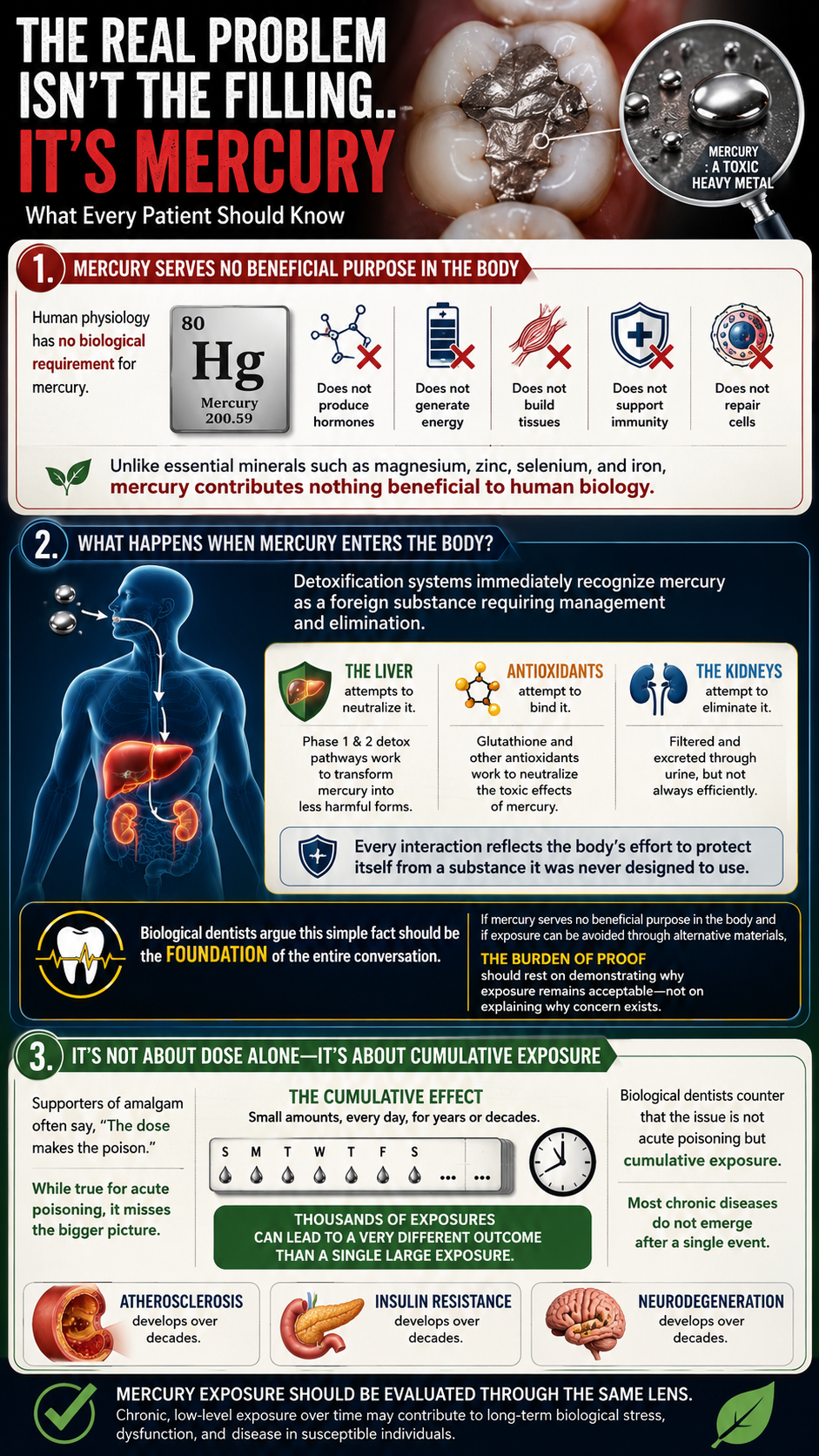
This distinction matters because biological systems treat mercury differently than essential nutrients. The liver attempts to neutralize it. Antioxidants attempt to bind it. The kidneys attempt to eliminate it. Every interaction reflects the body’s effort to protect itself from a substance it was never designed to utilize. Biological dentists argue that this simple fact should form the foundation of the entire conversation. If mercury serves no beneficial purpose inside the body and if exposure can be avoided through alternative materials, then the burden of proof should rest upon demonstrating why exposure remains acceptable rather than explaining why concern exists.
Supporters of amalgam frequently point out that the dose makes the poison. They argue that mercury exposure from fillings remains below levels associated with obvious toxicity in most individuals. Biological dentists counter that the issue is not acute poisoning but cumulative exposure. Most chronic diseases do not emerge after a single event. Atherosclerosis develops over decades. Insulin resistance develops over decades. Neurodegeneration develops over decades. Biological dentistry proposes that mercury exposure should be evaluated through the same lens. Small exposures repeated thousands of times may create a very different outcome than a single large exposure.
How Mercury Found Its Way Into Dentistry
Mercury entered dentistry during the nineteenth century when practitioners desperately needed a durable and affordable restorative material. Gold fillings worked well but remained expensive and difficult to place. Most patients simply could not afford them. Amalgam offered a practical solution. By combining mercury with silver, copper, and tin powders, dentists created a material that could be placed quickly and withstand years of chewing forces. The material solved important economic and clinical problems, which explains why it gained widespread acceptance despite concerns regarding mercury content.
Even during its earliest years, controversy followed amalgam closely. Physicians already understood that mercury possessed toxic properties. Industrial workers exposed to mercury frequently developed neurological symptoms and health complications. Critics questioned whether placing mercury directly into the mouth represented a wise medical decision. Supporters responded by arguing that mercury became chemically bound within the filling and therefore posed little danger. This disagreement evolved into a professional conflict known as the Amalgam Wars, a series of debates that shaped dentistry for generations.
Technology eventually transformed the discussion. Researchers developed instruments capable of detecting mercury vapor released from fillings. Numerous studies confirmed that chewing, brushing, grinding, and exposure to heat increased mercury emissions. The modern debate therefore shifted away from whether mercury escapes from amalgam and toward a more complex question. Does the resulting exposure matter enough to affect human health? Conventional dentistry generally says no for most patients. Biological dentistry believes the answer may depend upon genetics, toxic burden, nutritional status, and individual susceptibility.
What Mercury Does Inside the Human Body
Mercury attracts attention from toxicologists because it behaves differently than many environmental toxins. Once mercury vapor enters the lungs, it rapidly passes into circulation and travels throughout the body. Unlike larger molecules that struggle to penetrate protected tissues, mercury can cross the blood-brain barrier and gain access to the central nervous system. It can also cross the placental barrier, exposing developing fetal tissues during pregnancy. These characteristics make mercury particularly significant because they allow exposure to affect multiple organ systems simultaneously.

Inside cells, mercury exhibits a strong attraction to sulfur-containing compounds. This seemingly small detail creates enormous biological consequences because sulfur plays a central role in detoxification, antioxidant protection, protein structure, and enzyme function. Glutathione, often called the body’s master antioxidant, relies heavily upon sulfur chemistry. Mercury can bind to glutathione and reduce its effectiveness. As antioxidant defenses weaken, oxidative stress increases. Oxidative stress occurs when free radicals accumulate faster than the body can neutralize them. Excessive oxidative stress contributes to inflammation, cellular damage, accelerated aging, and impaired physiological function.
Mercury also interferes with mitochondrial function. Mitochondria serve as the energy factories of the body. Every organ depends upon energy generated by these microscopic structures. When mitochondria function efficiently, cells produce adequate energy for repair, detoxification, immune defense, and normal metabolism. Mercury can impair mitochondrial enzymes, reduce energy production, and increase free radical generation. Biological practitioners frequently point to this mechanism when explaining why symptoms associated with heavy metal burden often appear widespread rather than isolated. A problem affecting cellular energy has the potential to influence nearly every organ system simultaneously.
Mercury and the Brain
No aspect of the mercury debate receives more attention than its potential effects on the brain. The human brain consumes extraordinary amounts of energy and depends upon precise communication between billions of neurons. Mercury possesses the ability to interfere with both processes. Once inside nervous tissue, mercury can increase oxidative stress, disrupt neurotransmitter signaling, impair mitochondrial function, and stimulate inflammatory pathways. These effects help explain why neurological symptoms frequently appear among individuals concerned about heavy metal burden.
Many patients describe symptoms such as brain fog, forgetfulness, poor concentration, reduced productivity, mental fatigue, and mood instability. These complaints do not prove mercury toxicity because numerous factors can produce similar symptoms. However, biological practitioners often investigate mercury exposure when patients present with persistent neurological complaints that resist conventional explanations. They view mercury not necessarily as the sole cause but as one possible contributor to a larger pattern of dysfunction.
Chronic inflammation within the nervous system has emerged as a major focus of modern neuroscience. Researchers increasingly recognize that inflammation can impair memory, concentration, and cognitive performance. Mercury’s ability to activate inflammatory pathways raises important questions regarding its potential role in long-term neurological health. While disagreement continues regarding the significance of exposure from dental fillings specifically, few researchers dispute that mercury can influence neurological function under certain conditions.
Mercury and Thyroid Dysfunction
The thyroid gland represents another important target within the biological dentistry discussion. This small gland regulates metabolism, energy production, temperature regulation, mood, digestion, and countless other physiological processes. Even minor disruptions in thyroid function can produce significant symptoms. Mercury may influence thyroid health through several mechanisms, including increased oxidative stress, impaired enzyme activity, and interference with mineral balance.
One mineral deserves particular attention in this discussion. Selenium plays a critical role in both thyroid hormone metabolism and mercury detoxification. The body relies upon selenium-dependent enzymes to convert inactive thyroid hormone into its active form. Mercury possesses a strong affinity for selenium, which may reduce its availability for other physiological functions. Biological practitioners often emphasize selenium-rich foods and nutritional support because optimal selenium status supports both thyroid health and antioxidant protection.
Patients struggling with chronic fatigue, unexplained weight gain, cold intolerance, brain fog, and low motivation often discover underlying thyroid dysfunction. Biological dentists frequently view mercury as one potential contributor among many. Nutritional deficiencies, chronic stress, inflammation, infections, and environmental toxins may all influence thyroid performance. Mercury simply represents one additional burden that may push an already stressed system closer to dysfunction.
Why Some People Become Sick While Others Do Not
One of the strongest arguments presented by biological dentistry involves individual susceptibility. Not everyone responds to environmental exposures in the same way. Two people may carry identical fillings yet experience dramatically different outcomes. One remains symptom-free while the other develops significant health challenges. Conventional risk assessments often focus on averages, but averages do not always reflect individual biology.
Genetics help explain part of this difference. Variations affecting detoxification pathways, antioxidant production, methylation, glutathione synthesis, and cellular repair may influence how efficiently the body handles mercury exposure. Individuals with reduced detoxification capacity may accumulate toxins more readily and experience symptoms at lower exposure levels. Nutritional status also matters. Deficiencies in selenium, zinc, magnesium, sulfur-containing amino acids, and antioxidant nutrients may reduce the body’s ability to manage toxic burden effectively.
Environmental factors further complicate the picture. Modern individuals face exposure to pesticides, plastics, air pollution, mold toxins, industrial chemicals, and processed foods. Mercury rarely acts alone. Biological practitioners often describe health challenges as the result of cumulative burden rather than a single exposure. The body may tolerate one stressor successfully. Problems often emerge when multiple stressors overwhelm adaptive capacity.
The ADA Position Versus Biological Dentistry
The American Dental Association maintains that amalgam fillings remain a safe and effective treatment option for most patients. Supporters cite decades of clinical use, large population studies, and the durability of amalgam restorations. They argue that mercury exposure from fillings remains below established safety thresholds and that removing fillings unnecessarily may expose patients to greater mercury release than leaving them in place.
Biological dentists approach the issue differently. They argue that safety thresholds often focus on preventing obvious toxicity rather than optimizing long-term health. They emphasize individual susceptibility, cumulative burden, and emerging research regarding chronic inflammation, mitochondrial dysfunction, and environmental medicine. From this perspective, the question becomes less about whether amalgam causes poisoning and more about whether mercury contributes to chronic physiological stress over time.
Both perspectives contain elements worth considering. Patients benefit most when they understand the reasoning behind each position rather than accepting simplistic conclusions from either side. Informed decisions require understanding the material, the biology, and the individual’s unique health circumstances.
What Can You Do at Home?
Individuals concerned about mercury exposure should focus first on supporting the body’s natural detoxification systems. The liver, kidneys, digestive tract, skin, and lymphatic system serve as primary routes of elimination. Supporting these systems begins with foundational lifestyle habits rather than aggressive detoxification protocols. Adequate hydration supports kidney function and elimination. Regular physical activity improves circulation and lymphatic movement. Quality sleep enhances cellular repair and detoxification processes that occur during nighttime recovery.

Nutrition plays a critical role as well. Foods rich in antioxidants help combat oxidative stress generated by environmental exposures. Sulfur-containing vegetables such as broccoli, cauliflower, cabbage, Brussels sprouts, onions, and garlic support detoxification pathways. Selenium-rich foods may support both antioxidant defenses and thyroid function. High-quality protein provides amino acids required for glutathione production, tissue repair, and detoxification processes.
Reducing overall toxic burden may prove equally important. Filtered water, cleaner food choices, reduced exposure to environmental chemicals, and avoidance of unnecessary toxins decrease the workload placed upon detoxification systems. Biological practitioners often emphasize that improving health rarely depends upon a single intervention. Better outcomes typically result from reducing harmful inputs while simultaneously supporting the body’s natural capacity for repair and resilience.
The Future of the Mercury Debate
The future of dentistry appears increasingly focused on mercury-free restorative materials. Advances in composite resins, ceramics, and adhesive technologies continue improving the durability and effectiveness of alternative options. Patient demand for biocompatible materials continues growing. Environmental concerns surrounding mercury disposal continue influencing policy decisions throughout the world. These trends suggest that dentistry may gradually move away from mercury-containing restorations regardless of how the scientific debate ultimately evolves.
The larger lesson extends beyond amalgam itself. The controversy highlights a growing shift in healthcare toward examining root causes, cumulative burden, and long-term biological compatibility. Patients increasingly want to know not only whether a treatment works but also how that treatment influences the entire body over decades. Mercury amalgam fillings remain one of the clearest examples of this changing perspective. Whether one ultimately agrees with the ADA, biological dentistry, or a position somewhere in between, the conversation serves as a reminder that true health involves more than the absence of obvious disease. It requires understanding how everyday exposures influence the body’s ability to function, adapt, repair, and thrive throughout a lifetime.