The Hidden Problem Behind Low Back Pain
Low back pain often creates a misleading first impression because the discomfort appears exactly where people expect the problem to be. The muscles tighten, bending becomes difficult, sitting feels uncomfortable, and standing may trigger aching around the lumbar spine. Because the pain sits in the back, most people immediately assume the back itself must be damaged. That conclusion sounds logical, yet the human body rarely works as a collection of isolated parts. Pain can develop in one region because another region has lost mobility, strength, coordination, or stability.
The hips are one of the most overlooked contributors to chronic low back pain. Healthy hips should move freely through flexion, extension, rotation, and lateral motion while remaining strong under load. When that movement disappears, the body does not simply stop performing daily tasks. Instead, neighboring joints begin compensating so walking, bending, lifting, and standing can continue. The lumbar spine often becomes the region forced to absorb movement that should have occurred through the hips.
This is why treating only the painful area can sometimes produce disappointing results. Massage may relax the lumbar muscles, and stretching may create temporary relief. Adjustments, heat, or rest can also make symptoms feel better for a period. However, the original movement deficit may remain unchanged. If the hips continue to move poorly, the lower back may continue working overtime.
The Lower Back Was Never Designed to Replace the Hips
Every region of the body contributes differently to movement. The hips are ball-and-socket joints built for substantial mobility in several directions. They allow the legs to swing forward and backward, rotate inward and outward, move laterally, and generate tremendous force. The lumbar spine also moves, but it must balance movement with stability while transmitting force between the trunk and lower body.
Problems arise when the lumbar spine repeatedly performs movements the hips should contribute. Limited hip extension offers a common example. During walking, the trailing leg should move behind the body through hip extension. If that motion becomes restricted, the pelvis may tilt forward while the lumbar spine extends excessively to keep the stride moving.
Rotation creates another example of this compensation. Healthy walking, turning, sports, and everyday movements require the hips to rotate. When that rotation becomes limited, the pelvis and lumbar region may rotate more than they otherwise would. Those substitutions allow the person to function, but they also increase mechanical demand on tissues that were not designed to handle constant compensation.
The body is remarkably adaptable, which can hide this problem for years. Someone may walk, exercise, work, and lift without realizing the hips have become progressively restricted. The nervous system simply develops new movement strategies to preserve function. Eventually, however, the tissues performing the extra work may become irritated, fatigued, or sensitive.
How Modern Life Gradually Reduces Hip Mobility
Hip restriction rarely appears suddenly. It usually develops through repeated habits that slowly reduce the variety of movement available to the joints. Modern life provides countless opportunities for this process because adults often spend large portions of the day seated. Driving, desk work, television, dining, and device use all keep the hips in a flexed position.
Sitting itself is not automatically harmful. The greater problem is spending hours in one posture without frequently changing position or exploring other ranges. The body adapts to repeated demands, and it also adapts to the absence of demand. When hip extension rarely occurs, usable extension may gradually diminish.
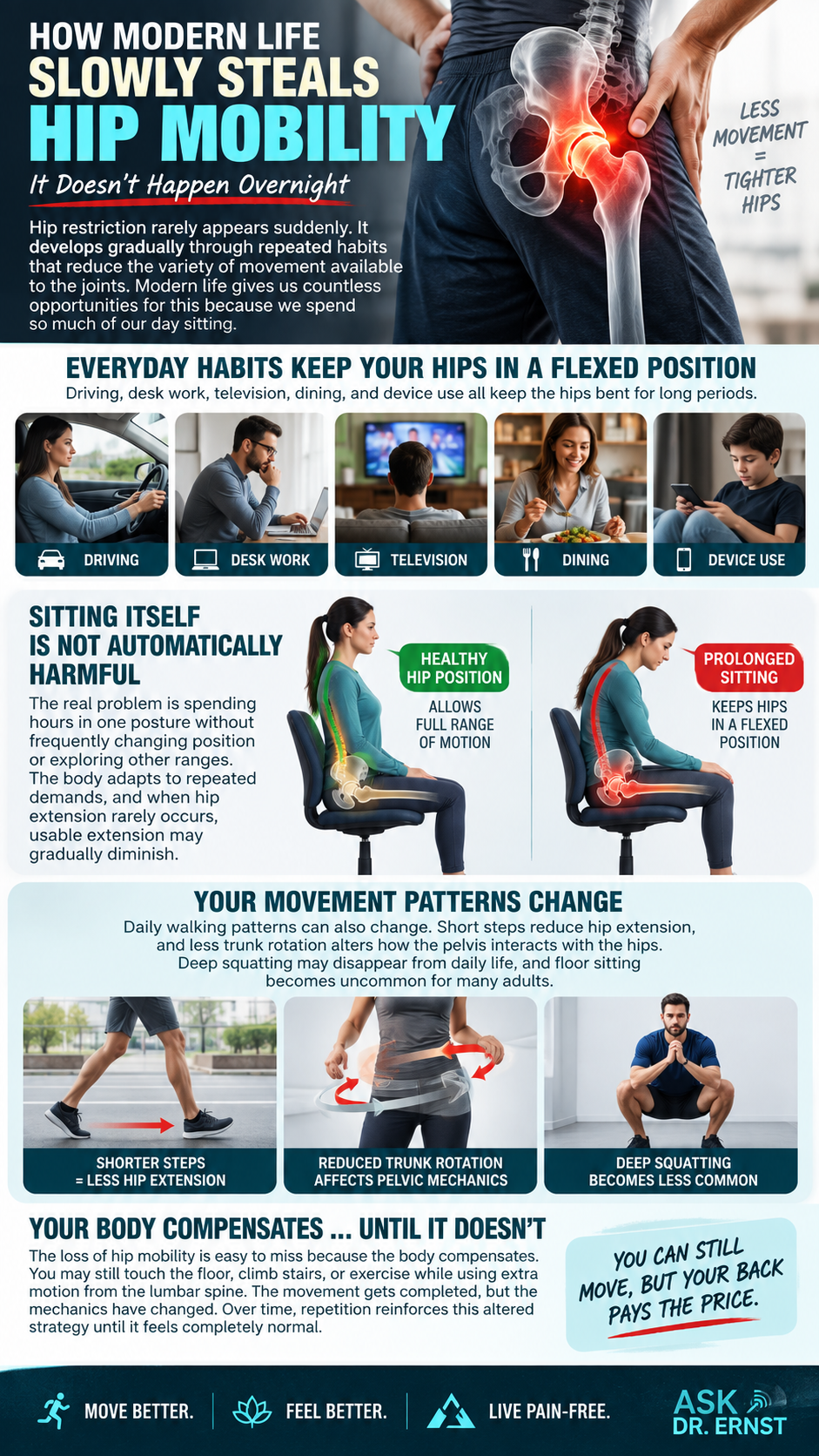
Daily walking patterns can also change. Short steps reduce hip extension, while reduced trunk rotation alters how the pelvis interacts with the hips. Deep squatting may disappear from daily life, and floor sitting becomes uncommon for many adults. Over time, the hips may retain enough motion for basic tasks but lose the broader mobility needed for efficient movement.
That loss is easy to miss because the body compensates beautifully. Someone may still touch the floor, climb stairs, or exercise while using extra motion from the lumbar spine. The movement gets completed, but the mechanics behind it have changed. Repetition then reinforces that altered strategy until it feels completely normal.
The Hip Flexor Story Is More Complex Than Tightness
Hip flexors frequently receive blame for low back pain, especially in people who sit for long periods. That explanation contains some truth, but the situation is more complicated than simply labeling a muscle tight. The iliopsoas deserves special attention because it connects the lumbar region, pelvis, and femur. This anatomical relationship means changes in hip mechanics can directly influence forces around the lower spine.
A muscle may feel tight for several different reasons. It can truly lack extensibility, but it may also be working excessively to stabilize an area that feels vulnerable. Protective muscle tension can also increase when the nervous system perceives poor control. In those cases, aggressive stretching may not solve the underlying problem.
Limited hip extension can coexist with weak gluteal muscles, altered pelvic control, reduced joint mobility, and poor coordination. Stretching one muscle while ignoring those factors may provide only short-term relief. The body may restore the same tension because the original reason for that tension still exists. Effective improvement requires restoring a movement pattern rather than attacking a single tissue.
The goal should therefore be broader than simply making the hips feel loose. Healthy movement requires range, strength, coordination, and neurological confidence. A joint that moves farther without control does not necessarily function better. Useful mobility means the body can enter a position, control that position, and generate force from it.
What Happens When the Glutes Stop Doing Their Share
The gluteal muscles play a major role in hip extension, rotation, pelvic stability, and force production. Gluteus maximus helps drive the body forward during climbing, running, standing, and lifting. Gluteus medius helps stabilize the pelvis when body weight shifts onto one leg. These muscles should absorb and generate substantial forces throughout everyday life.
When gluteal contribution decreases, other muscles must compensate. The hamstrings may work harder, while the spinal extensor muscles may increase their activity during movements that should primarily involve the hips. A person can still stand from a chair or climb stairs, so the compensation may remain invisible. The movement succeeds, but the workload becomes redistributed.
Walking highlights this problem clearly. Each step places the body briefly over one leg, which requires strong lateral hip control. If the gluteus medius does not stabilize the pelvis effectively, the trunk may shift and the pelvis may drop or rotate. Those changes alter the forces traveling into the lumbar spine.
This explains why a painful lower-back muscle may not actually be weak. It may be overworked because it has spent years assisting movements that other muscles should handle. Massaging that tissue can temporarily reduce discomfort, but the relief may disappear when normal activity resumes. Until the hip muscles resume their responsibilities, the back may remain trapped in the same pattern.
The Pelvis Is the Mechanical Bridge Between the Hips and Spine
The pelvis connects the lower extremities to the spine and transfers force in both directions. Every step sends force upward from the ground through the legs and pelvis. At the same time, forces generated by the trunk travel downward through the pelvis toward the legs. Healthy movement requires the pelvis to coordinate both stability and motion.
Restricted hip movement changes how the pelvis behaves. Limited extension can encourage compensatory pelvic tilt, while reduced hip rotation can change pelvic rotation during walking. Weak lateral hip muscles may reduce frontal-plane control. Each of these changes can influence the movement requirements placed on the lumbar spine.
This does not mean one specific pelvic position automatically causes low back pain. Human bodies tolerate many postures and movement patterns without difficulty. The greater concern appears when someone loses movement options and repeatedly uses the same compensation. Limited movement variability increases the chance that certain tissues will receive excessive demand.
Healthy movement requires choices, and strong mobile hips provide those choices. Restricted hips remove options from the system. Once the body loses alternatives, the lumbar spine may become the default region for extra movement. That repeated demand can contribute to irritation, guarding, and persistent discomfort.
Walking Reveals the Hip-Back Relationship
Walking appears effortless because the nervous system handles the process automatically. Mechanically, however, walking requires precise coordination between the feet, knees, hips, pelvis, spine, and upper body. The hips must extend and rotate while the pelvis turns and the trunk counter-rotates. The arms then swing in coordination with the lower body.
Restricted hip extension disrupts this sequence. Someone may compensate by shortening stride length, rotating the pelvis differently, or increasing lumbar extension. These changes can appear subtle because the person continues moving forward. Over thousands of daily steps, however, even small compensations can become significant.
A person walking 6,000 steps daily accumulates more than two million steps each year. If each step includes unnecessary lumbar movement, the total mechanical demand becomes enormous. This helps explain why low back pain can develop without one dramatic injury. Repetitive compensation can become the injury mechanism.
The same principle applies to running, hiking, climbing stairs, and prolonged standing. When the hips fail to provide sufficient movement or strength, another region must handle the missing work. The lower back is often one of the first regions recruited. Pain can therefore represent the end result of a long compensation process.
Hip Rotation May Be the Missing Piece
Hip rotation receives far less attention than hamstring flexibility, yet it plays a major role in efficient movement. Internal and external rotation allow the femur and pelvis to interact properly during walking, squatting, turning, and directional changes. Restricted rotation can influence the knees, pelvis, and lumbar spine simultaneously.
Many people discover rotational limitations only when comparing sides. One hip may rotate freely while the other feels blocked. Sitting cross-legged may feel easy on one side and awkward on the other. Those differences do not automatically cause pain, but significant asymmetry can affect whole-body movement.
Athletes often expose this problem quickly. Golfers, tennis players, and rotational athletes require substantial hip rotation. When the hips cannot provide that motion, the lumbar spine may rotate more aggressively. Everyday activities can create the same issue on a smaller scale.
Turning while carrying groceries requires rotation. Reaching behind a car seat requires rotation, and yardwork requires rotation repeatedly. If the hips refuse to participate, the body finds another strategy. Repetition can eventually make that substitute strategy painful.
Why Stretching the Lower Back May Keep Missing the Cause
People naturally stretch whatever feels tight. A stiff lower back therefore gets pulled, twisted, and bent repeatedly in an attempt to relieve discomfort. That strategy often feels good temporarily because movement can decrease guarding and improve circulation. Unfortunately, temporary relief does not always indicate the correct tissue received treatment.
A tight lower back may already be moving too much. If restricted hips force extra lumbar movement during walking or bending, additional lumbar stretching may increase movement in the region already compensating. The hips remain unchanged, so the body soon recreates the original pattern. Tightness returns because the system still needs stability.
This can create a frustrating cycle. The person stretches, feels better, becomes tight again, and concludes that even more stretching is necessary. Meanwhile, the underlying hip restriction remains untouched. The painful area receives repeated treatment while the movement source remains invisible.
A better approach asks two separate questions. Which region needs more movement, and which region needs better control? For many people with hip-related low back pain, the hips require greater mobility while the lumbar spine requires improved stability and coordination.
Pain Is Often the Final Warning, Not the Beginning
Movement dysfunction often develops long before pain appears. Someone may first lose deep squat capacity, shorten stride length, or become asymmetrical during walking. Another person may begin shifting weight toward one side when standing. These changes can remain unnoticed because they do not immediately hurt.
The nervous system adapts continuously to these restrictions. Muscles work harder, joints move differently, and the body develops new strategies. Eventually, the system may reach a point where compensation becomes inefficient or irritating. Muscles can become chronically overworked, while joints and connective tissues experience repetitive stress.
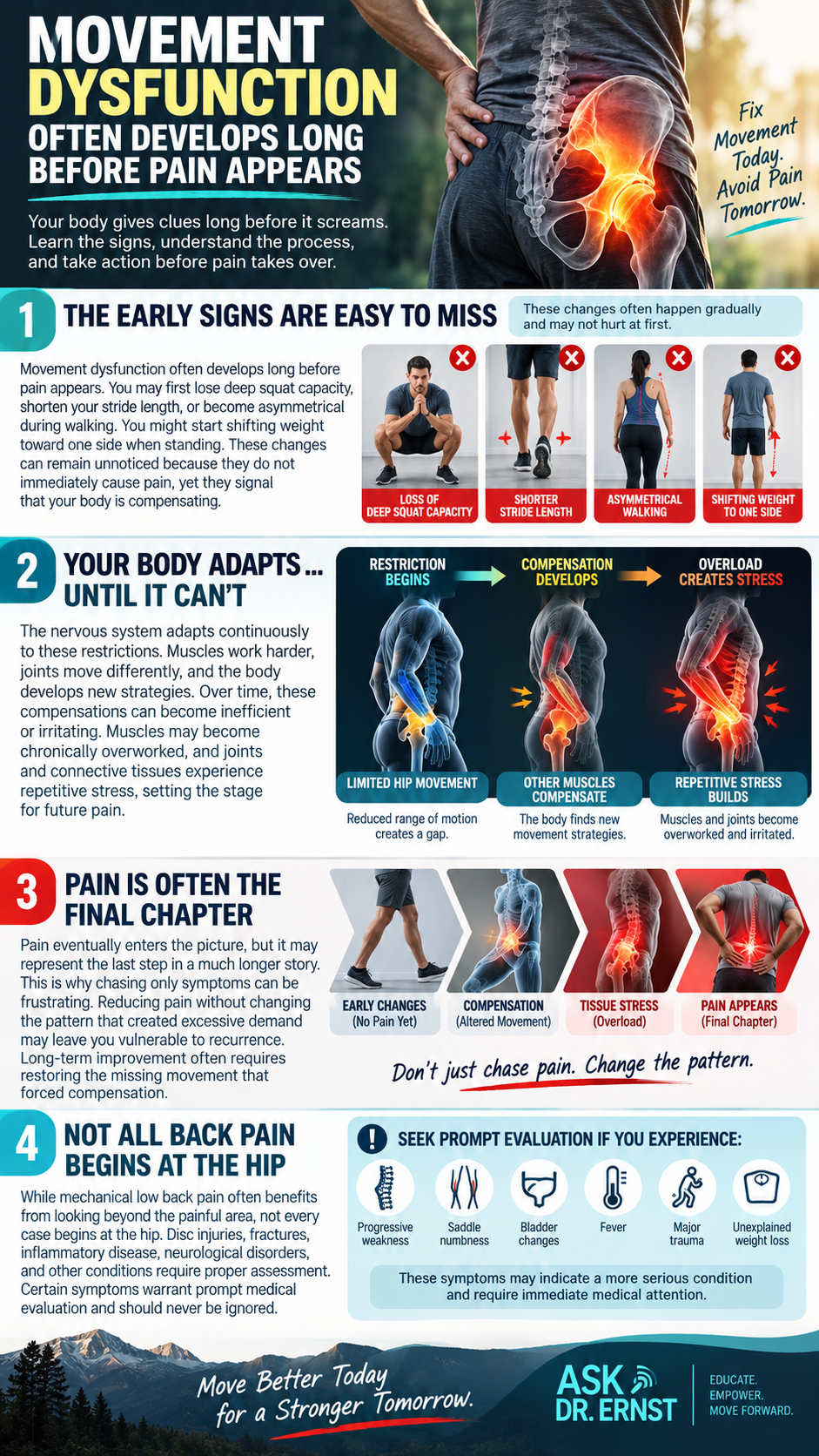
Pain then enters the picture, but it may represent the final chapter of a much longer story. That is why chasing only symptoms can become frustrating. Reducing pain without changing the pattern that created excessive demand may leave the system vulnerable to recurrence. Long-term improvement often requires restoring the missing movement that forced compensation.
Not every case of back pain begins at the hip. Disc injuries, fractures, inflammatory disease, neurological disorders, and other conditions require proper assessment. Symptoms such as progressive weakness, saddle numbness, bladder changes, fever, major trauma, or unexplained weight loss warrant prompt evaluation. Mechanical low back pain, however, often benefits from looking beyond the painful area.
Stop Chasing Symptoms and Start Rebuilding Capacity
Lasting improvement requires more than temporary symptom relief. The larger goal involves restoring the body’s ability to move, stabilize, absorb force, and adapt to daily demands. That means addressing mobility, strength, control, and movement habits together. No single stretch or exercise can replace a complete strategy.
Hip mobility comes first because the nervous system needs movement options. Strength then allows the body to control those positions under load. Trunk stability helps the lumbar spine transfer force without constantly compensating. Finally, everyday movement teaches the body to use these improvements outside exercise.
The sequence matters because mobility without control can create instability. Strength without adequate mobility can reinforce restricted patterns. Trunk exercises performed without improved hip function may simply strengthen compensation. A complete approach gradually reconnects all of these pieces.
Improvement should also focus on function rather than pain alone. Pain levels can fluctuate from sleep, stress, activity, and nervous-system sensitivity. Better walking, easier standing, improved rotation, and stronger hip control often provide more reliable signs of progress. Function tells you whether the body is truly gaining capacity.
Change the Movement Environment First
A fifteen-minute mobility routine cannot completely overcome ten hours of uninterrupted sitting. Exercise still matters, but daily movement habits influence how the body adapts. Small changes throughout the day can reinforce hip mobility more effectively than one intense session. Frequency often matters as much as duration.
Stand and change positions regularly when possible. Walking during phone calls, taking brief movement breaks, and avoiding prolonged static postures can help restore variety. These habits do not need to become complicated. Their purpose is simply to remind the body that the hips can occupy more than one position.
Walking deserves special attention because it integrates the entire kinetic chain. Allow the arms to swing naturally and let the trunk rotate comfortably. Avoid artificially forcing a longer stride before hip extension improves. A forced stride can simply create more lumbar compensation.
Consistency produces the greatest benefit. Gentle movement repeated throughout the day can accumulate into hundreds of additional mobility opportunities each week. That repeated exposure helps the nervous system become comfortable with movement again. Over time, the hips may begin reclaiming ranges that sedentary habits gradually removed.
Restore Hip Extension Without Arching the Back
Hip extension deserves attention for anyone who spends large amounts of time sitting. The goal, however, is not simply pushing the pelvis forward aggressively. True hip extension should occur through the hip joint without excessive lumbar arching. That distinction protects the back while restoring missing motion.
A half-kneeling hip flexor position offers a practical starting point. Place one knee on a padded surface with the opposite foot forward. Keep the torso tall and gently contract the glute on the kneeling side. This glute contraction helps stabilize the pelvis before movement begins.
Move the pelvis forward only slightly while keeping the lower back controlled. The stretch should appear across the front of the hip or upper thigh. If the lower back arches dramatically, the body is likely substituting lumbar extension for hip extension. Reduce the range and focus on control.
Slow breathing can help reduce unnecessary guarding during the movement. Hold the position comfortably, then repeat on the opposite side. Frequent gentle practice usually works better than forcing a deep stretch occasionally. The nervous system must learn that the new range feels safe and controllable.
Reintroduce Hip Rotation Gradually
Rotational mobility can improve through slow, controlled floor movements. One useful option involves sitting with both knees bent and moving them gently from side to side. This allows both hips to explore internal and external rotation. The movement should remain smooth rather than forced.
A 90/90 hip position can also help restore rotational awareness. One leg rests in front while the other remains angled behind the body. From there, the hips can gradually move between sides while the torso stays controlled. Range should increase naturally rather than through aggressive pressure.
Rotation often exposes side-to-side differences quickly. One hip may feel stiff while the other moves easily. Instead of forcing the restricted side to match immediately, use controlled repetitions and patient progress. The goal involves increasing usable motion rather than chasing symmetrical appearances.
Improved hip rotation can eventually influence walking, squatting, turning, and athletic movement. The body gains another option for distributing rotational force. That reduces the need for the lumbar spine to absorb every twisting demand. Better rotation therefore becomes both a mobility and load-management strategy.
Strengthen the Glutes After Mobility Improves
New mobility becomes more useful when the muscles can control it. The gluteal muscles should therefore receive focused strength training once hip movement begins improving. A simple glute bridge can teach hip extension without requiring complex equipment. Quality should always take priority over repetition count.
Lie on your back with the knees bent and feet on the floor. Gently brace the trunk and press through the feet while contracting the glutes. Lift the pelvis without allowing the lumbar spine to arch aggressively. The movement should feel driven by the hips rather than the lower back.
Slowly lower the pelvis and repeat with control. If the hamstrings dominate or cramp, reduce the range and focus on glute contraction. Poor glute awareness often improves with practice. The nervous system may simply need time to relearn a pattern that became neglected.
Progress can eventually include standing hip-extension movements, squats, hinges, and step-based exercises. Daily life occurs mostly upright, so rehabilitation should ultimately become upright as well. The objective is not merely activating muscles on the floor. The goal involves making the hips stronger during real movement.
Strengthen the Side of the Hip for Pelvic Control
Lateral hip strength plays a major role in stabilizing the pelvis during walking. Every step briefly places most body weight over one leg. Gluteus medius and neighboring muscles help keep the pelvis controlled during that transition. Weakness can increase trunk shifting and alter lumbar mechanics.
Side-lying hip abduction offers a simple starting exercise. Keep the pelvis stacked and lift the upper leg slowly without rolling backward. The movement should stay controlled and relatively small. Larger motion is not useful if the pelvis rotates to create it.
Standing lateral movements can gradually increase the challenge. Controlled step-downs, side steps, and single-leg exercises can further improve pelvic stability. Technique remains essential because compensation defeats the purpose. If the trunk leans excessively, reduce the difficulty.
Better lateral hip strength allows the pelvis to remain more stable during gait and stair climbing. That improved control can reduce unnecessary movement through the lower back. The entire kinetic chain becomes more efficient when the hips absorb and control force properly. Stability then becomes a shared responsibility rather than a lumbar burden.
Learn the Hip Hinge for Daily Life
The hip hinge may be one of the most useful movement patterns for protecting the lower back during everyday tasks. People bend repeatedly to lift groceries, children, boxes, tools, laundry, and countless other objects. Without a good hinge, bending may occur primarily through the lumbar spine. Repetition can increase fatigue and mechanical stress.
Stand several inches in front of a wall with your back facing it. Soften the knees and push the hips backward until the buttocks gently touch the wall. Keep the trunk controlled while allowing the movement to originate from the hips. Then return to standing by driving the hips forward.
This pattern teaches the pelvis to travel backward while the trunk remains organized. The lumbar spine can still move naturally, but it no longer has to provide the majority of the motion. Once the pattern feels comfortable, practice it during real lifting tasks. Gradual integration makes the movement more automatic.
A strong hinge also improves gluteal recruitment and posterior-chain strength. These changes increase the body’s ability to generate force through the hips. The lower back then becomes part of a coordinated system instead of the primary mover. Efficient movement distributes work across multiple regions.
Train the Core for Stability Rather Than Rigidity
Core training should improve coordination rather than create permanent abdominal tension. The trunk needs to stabilize during certain tasks and relax during others. Constant bracing can create unnecessary stiffness and reduce natural movement. Functional stability adapts to the demands of the moment.
Dead-bug variations provide a useful way to train trunk control while the limbs move. Lie on your back with the hips and knees bent. Maintain gentle abdominal tension while slowly moving one arm or leg. The lower back should remain controlled without being aggressively pressed into the floor.
Bird-dog variations can progress this concept by adding hip movement in a hands-and-knees position. Extend one limb while keeping the pelvis and trunk stable. The movement should remain slow and deliberate. Excessive rotation suggests the exercise difficulty needs adjustment.
These exercises teach the nervous system to separate hip motion from unnecessary lumbar motion. That ability becomes important during walking, lifting, and athletic activity. Strong hips work better when the trunk provides an efficient base. Stability and mobility should always develop together.
A Practical At-Home Routine for Hip Mobility and Low Back Pain
An effective home routine does not require complicated equipment or lengthy workouts. Fifteen to twenty minutes performed consistently can create meaningful change. Start with several minutes of easy walking to increase circulation and reduce stiffness. Gentle movement prepares the hips for deeper mobility work.
Next, perform controlled half-kneeling hip-extension work on both sides. Follow that with slow seated hip rotations or 90/90 transitions. Move within comfortable ranges and avoid forcing the joints. The objective is to create smoother movement rather than extreme flexibility.
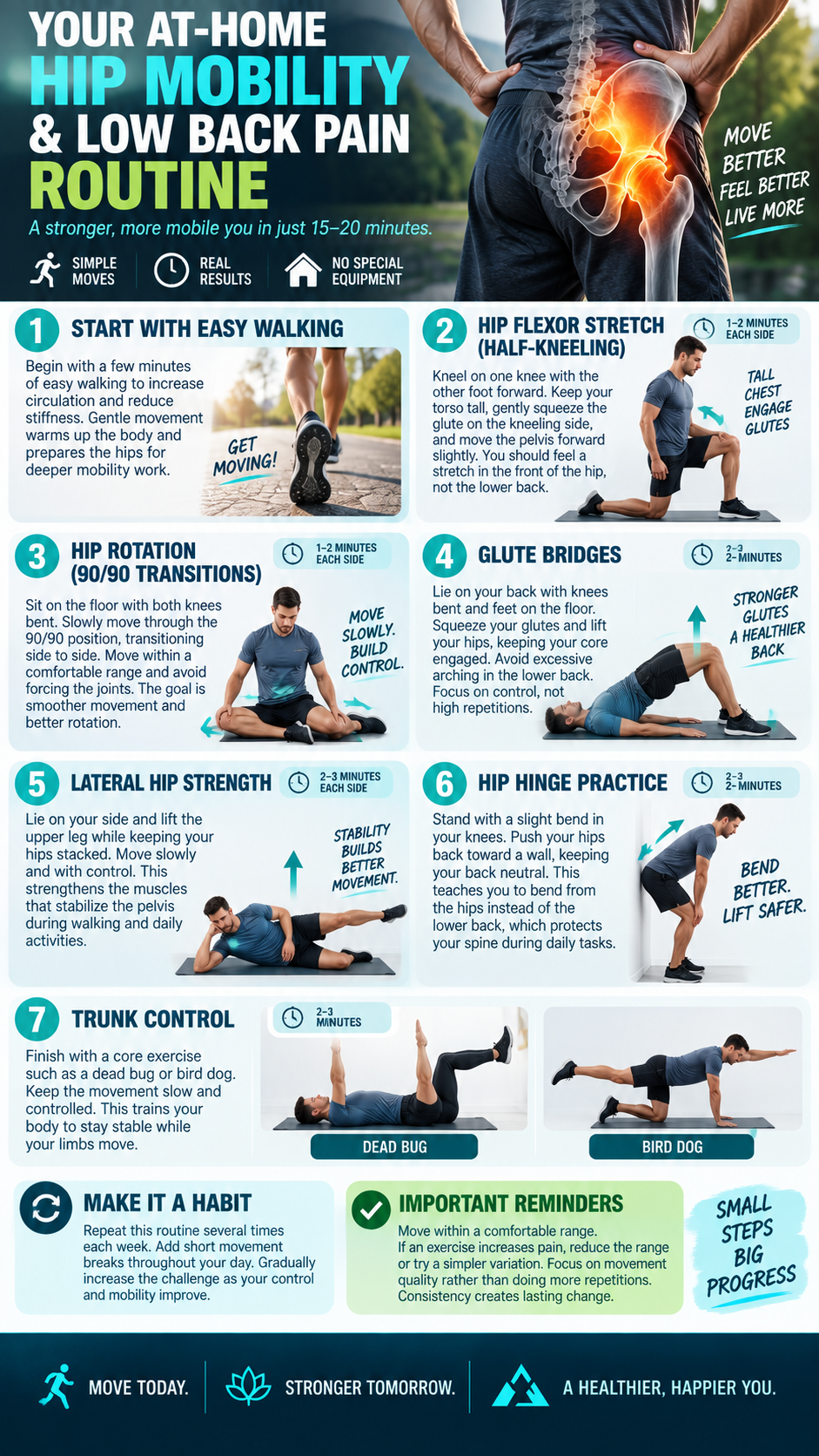
After mobility work, perform controlled glute bridges and a lateral hip-strengthening exercise. Focus on muscle control rather than completing large numbers of repetitions. Then practice the hip hinge until the movement feels natural. Finish with a trunk-control exercise such as a dead bug or bird dog.
Repeat the routine several times each week while adding regular movement breaks throughout the day. Gradually increase the challenge as control improves. If an exercise consistently increases pain, reduce the range or choose a simpler variation. Progress should improve movement quality rather than simply create fatigue.
Mobility Must Eventually Become Strength
One of the most important principles involves converting new mobility into usable strength. A joint that moves farther but cannot control that range may remain vulnerable. The nervous system needs confidence that the body can generate and absorb force in newly restored positions. Strength provides that confidence.
Hip extension gained through stretching should eventually appear during walking, hinging, and climbing stairs. Improved rotation should show up during turning and squatting. Better hip flexion should make sitting and bending more comfortable. Exercise becomes meaningful when it changes daily movement.
Loaded movement can gradually reinforce these new patterns. Squats, hinges, step-ups, and carries can eventually become valuable tools. The difficulty should match the individual’s current ability. Progressive loading works best when mobility and technique remain intact.
The ultimate goal is not to become unusually flexible. It is to develop enough movement, strength, and control for real life. Functional mobility gives the nervous system more options. More options reduce the need for repetitive compensation.
Why Recovery Requires More Than One Perfect Exercise
People often search for the one exercise that will fix their back. That desire is understandable because simple solutions feel appealing. Persistent movement problems, however, usually develop from multiple interacting factors. Mobility, strength, coordination, habits, recovery, and previous injuries all influence the final picture.
Sleep can affect pain sensitivity and tissue recovery. Stress can increase muscular tension and nervous-system reactivity. Physical inactivity reduces conditioning, while excessive training can overload tissues. Nutrition and general health also influence recovery capacity. The body responds to the total environment rather than one isolated variable.
This is why a comprehensive strategy generally outperforms a single intervention. Improving hip mobility helps, but strength must follow. Better strength helps, but poor movement habits can still reinforce compensation. Trunk control matters, but it cannot replace functional hips.
For some people, chiropractic assessment can also help identify restrictions involving the spine, pelvis, or extremities. Movement training can then reinforce better mechanics and muscular control. The larger objective involves examining the entire kinetic chain. Pain should start the investigation rather than limit it.
When the Hips Are Not the Entire Problem
Hip dysfunction can contribute strongly to mechanical low back pain, but it does not explain every case. Some people have restricted hips without discomfort, while others experience significant back pain despite excellent mobility. Pain reflects interactions among tissues, loading, nervous-system sensitivity, sleep, stress, conditioning, and previous injury. Responsible care must consider the entire clinical picture.
Certain symptoms also require prompt evaluation rather than a home mobility program. Progressive weakness, severe numbness, bladder or bowel changes, saddle-region numbness, fever, unexplained weight loss, or major trauma deserve medical attention. Severe night pain or rapidly worsening symptoms also warrant investigation. These warning signs should not be ignored.
For ordinary mechanical low back discomfort, however, hip assessment remains highly valuable. The hips sit directly beneath the pelvis and influence nearly every lower-body movement. Their mobility and strength affect walking, squatting, lifting, standing, and turning. Ignoring them can leave a major contributor unaddressed.
The most useful perspective avoids oversimplification. The hips may not be the only problem, but they may be an important part of the problem. Looking beyond the painful area often reveals movement deficits that standard symptom-focused approaches miss. That broader view can lead to more durable improvement.
The Goal Is Better Capacity, Not Just More Flexibility
Flexibility and mobility are not the same concept. Flexibility describes how far tissues can lengthen, while mobility describes usable movement through a joint’s range. Someone can become more flexible without becoming substantially better at moving. Useful mobility requires strength, coordination, and control.
This distinction explains why endless stretching can disappoint people with chronic low back discomfort. The body may temporarily gain range but lack stability inside that range. The nervous system then returns to familiar movement strategies. New motion becomes temporary rather than functional.
Strength turns mobility into capacity. Controlled movement teaches the nervous system how to use the range during real tasks. Walking, squatting, lifting, and climbing provide opportunities to integrate those improvements. The body gradually learns that it no longer needs old compensations.
Recovery therefore becomes a process of rebuilding options. Better hip extension offers one option, while improved rotation offers another. Stronger glutes add force capacity, and better trunk control adds stability. A body with more movement choices usually handles daily demands more efficiently.
Your Back May Be the Messenger
Low back pain naturally directs attention toward the place that hurts. That instinct makes sense, yet pain location does not always identify the original dysfunction. The lumbar spine may simply be carrying a workload created elsewhere. Restricted hips can force that region to move more, stabilize harder, and absorb greater repetitive stress.
A better investigation asks what the body has lost. Hip extension may have disappeared, rotation may have become asymmetrical, and the glutes may no longer contribute effectively. Sedentary habits can reduce movement variety, while poor pelvic control can alter force transfer. Each factor adds another layer to the problem.
The body functions as an interconnected system rather than a collection of separate parts. Hip movement influences the pelvis, and pelvic mechanics influence the spine. Changes in one region affect demands placed on another. This relationship explains why treating only the painful area can sometimes produce temporary results.
Restoring hip mobility, strength, and control can give the entire movement system more options. The lower back no longer needs to compensate for every missing motion. Daily movements can become smoother, and force can distribute more evenly throughout the kinetic chain. That is the deeper goal of addressing hip mobility and low back pain.
The real lesson is simple but powerful. Do not assume the painful area is always the place where the problem began. Investigate the movement system that created the complaint, restore what has been lost, and strengthen the body where it has become dependent on compensation. When the hips start doing their job again, the lower back may finally stop doing everyone else’s.