YOUR HANDS MAY REVEAL HOW YOUR BODY IS AGING
Aging rarely arrives with an announcement. Instead, it often appears through small physical changes that are easy to dismiss. A jar lid suddenly requires more effort. Grocery bags feel heavier during the walk from the car. Luggage that once moved easily now demands both hands. Yard work exhausts your forearms faster, while getting off the floor takes greater concentration. Most people accept these changes as inevitable signs of getting older. Yet your hands may be revealing something more important than the number of candles on your birthday cake.
Grip strength has become an important measurement in research on aging, physical function, frailty, and longevity. Researchers have repeatedly found associations between lower grip strength and poorer health outcomes. These include disability, reduced mobility, cardiovascular problems, cognitive decline, and increased mortality risk. That does not mean weak hands directly cause these conditions. Instead, grip strength may reflect the condition of several biological systems working together. Your hands can become a visible endpoint of changes occurring throughout your body.
Grip Strength Is Much More Than Hand Strength
When you squeeze a handgrip dynamometer, the device produces a simple number. However, your body must perform an extraordinarily complicated sequence to create that number. Your brain first organizes the movement and sends neurological instructions toward the spinal cord. Peripheral nerves then transmit those instructions into the muscles controlling your wrist, hand, and fingers. Muscle fibers contract while tendons transfer force toward the bones. Sensory receptors continuously provide feedback about pressure, joint position, and movement.
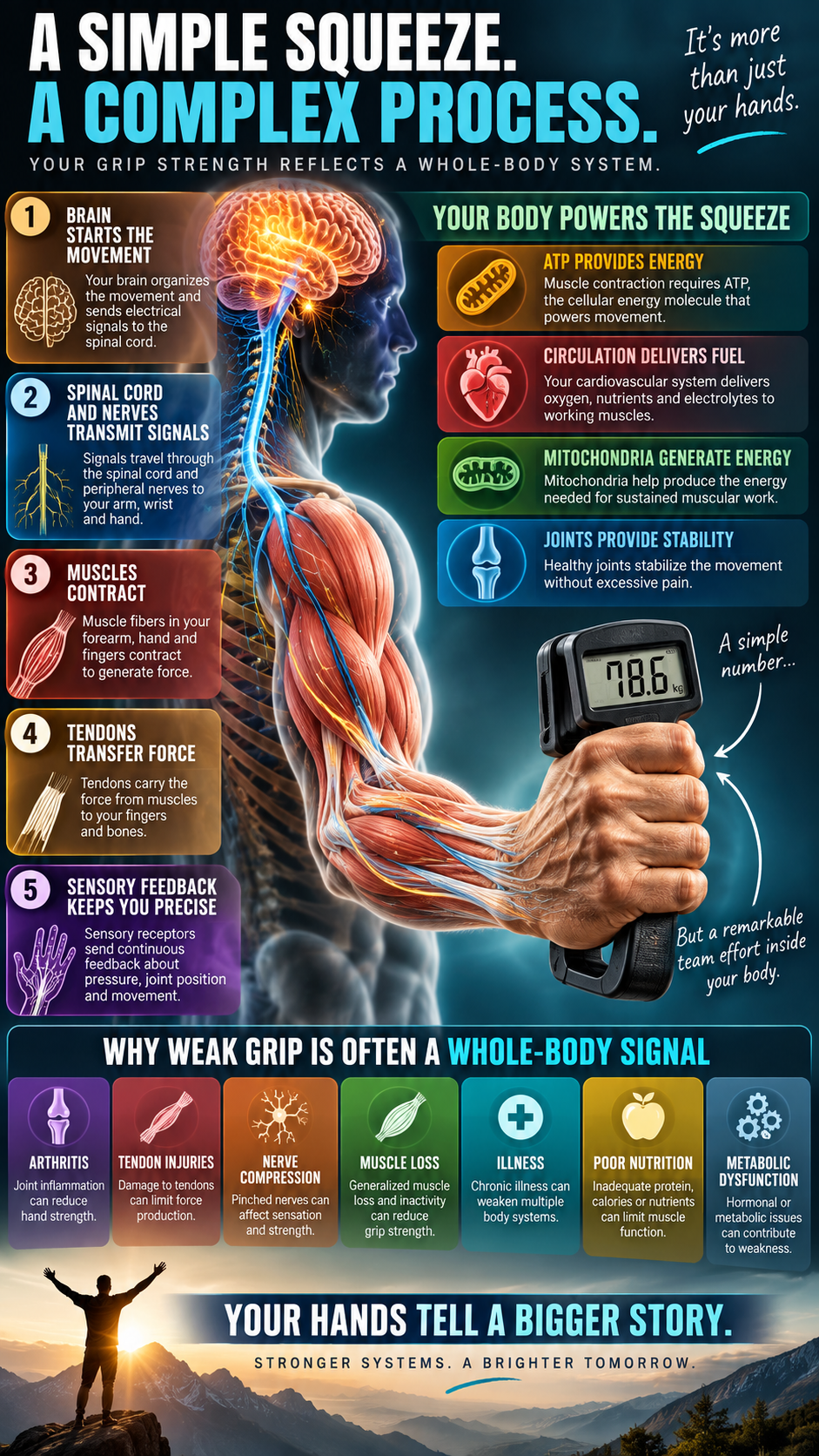
Energy production also plays an essential role. Muscle contraction requires ATP, the cellular energy molecule that powers countless biological processes. Your cardiovascular system must deliver oxygen, nutrients, and electrolytes to working tissues. Mitochondria help generate the energy required for sustained muscular work. Meanwhile, healthy joints must stabilize the movement without excessive pain. Grip strength therefore represents the final output of your neurological, muscular, cardiovascular, and metabolic systems working together.
This explains why weak grip should not automatically be treated as a hand problem. Arthritis, tendon injuries, nerve compression, and previous trauma can certainly reduce hand strength. However, weakness can also accompany generalized muscle loss, inactivity, neurological problems, illness, inadequate nutrition, or metabolic dysfunction. The location of the weakness does not always reveal its origin. Sometimes the hands simply expose a larger problem occurring throughout the body.
The Real Problem Is Loss of Physical Reserve
The deeper concern behind declining grip strength involves something called physiological reserve. Your body maintains extra capacity that becomes available when life demands more from you. Walking across a parking lot uses some reserve. Climbing stairs requires more. Carrying luggage through an airport demands even more. Recovering from an infection, injury, hospitalization, or surgery can place enormous demands on that reserve.
You rarely notice physiological reserve when you have plenty available. Its importance becomes obvious when that reserve disappears. Consider two people who are both 70 years old. One regularly lifts weights, walks, gardens, travels, and carries groceries. Another struggles to rise from a chair and rarely performs resistance exercise. Their chronological ages are identical, yet their functional capacities can differ dramatically. One has built a larger buffer between everyday life and physical failure.
Grip strength offers one practical glimpse into that reserve. It cannot measure everything happening inside the body. However, declining grip combined with slower walking or reduced mobility deserves attention. Difficulty rising from chairs can provide another important clue. Unexplained weight loss or shrinking muscle mass can strengthen the concern further. These changes should create curiosity rather than automatic surrender to aging.
Muscle Loss Begins More Quietly Than Most People Realize
One major contributor to declining strength is the progressive deterioration of skeletal muscle. Significant age-related losses of muscle strength and mass can contribute to sarcopenia. Importantly, modern definitions increasingly emphasize muscle strength instead of muscle size alone. A person may still appear muscular while producing less force than expected. Muscle quality, neurological recruitment, metabolic health, nutrition, and physical activity all influence functional strength.
Muscle loss can remain hidden because bathroom scales tell an incomplete story. Someone might weigh 180 pounds for twenty years while undergoing major changes in body composition. Muscle can gradually disappear while body fat increases, leaving total body weight almost unchanged. Clothing may still fit, and routine medical visits may never measure muscular performance. By the time weakness becomes obvious, years of decline may have already occurred.
Physical inactivity accelerates this process because the human body adapts relentlessly to demand. Regular lifting tells the body that muscle remains necessary. Carrying, pulling, pushing, climbing, and squatting deliver similar signals. Remove those demands, and the biological reason to preserve expensive muscle tissue becomes weaker. The body becomes exceptionally efficient at adapting downward when physical challenges disappear.
Modern Life Has Engineered Strength Out of the Day
Previous generations encountered resistance throughout ordinary life. People walked farther, carried more objects, climbed stairs, worked manually, and performed demanding household tasks. Modern technology has removed much of that workload. Cars replace walking, elevators replace stairs, and delivery services replace carrying groceries. Power tools reduce manual labor, while desk jobs can keep adults seated for eight hours daily.
Convenience saves time, but human biology does not interpret convenience as progress. Your muscles respond primarily to the demands placed upon them. When strength becomes unnecessary, the body receives fewer signals to maintain it. Years of low muscular demand can slowly reduce strength, coordination, balance, and physical confidence. People then move even less because movement feels increasingly difficult.
That pattern can become a destructive cycle. Less movement contributes to weakness, while weakness makes movement harder. Reduced activity can encourage body-fat accumulation and poorer metabolic health. Those changes may further reduce energy and exercise tolerance. Eventually, someone may blame age for a decline that inactivity helped accelerate.
Muscle Is a Metabolic Organ
Skeletal muscle does far more than move your skeleton. It participates heavily in glucose regulation, energy metabolism, balance, temperature production, and amino-acid storage. After eating carbohydrates, skeletal muscle becomes a major destination for circulating glucose. Insulin helps move glucose into muscle cells, where it can support energy production or storage.
Regular muscular contraction creates demand for that fuel. Resistance exercise can also improve insulin sensitivity and support healthier glucose management. Problems can emerge when someone loses muscle while becoming increasingly sedentary. Less active muscle means reduced metabolic demand, while increasing body fat can worsen insulin resistance. Poor glucose regulation can then accompany declining physical capacity.
Muscle also provides valuable amino acids during periods of physiological stress. Serious illness, trauma, surgery, and prolonged inactivity can increase the body’s metabolic demands. Entering those situations with greater muscular reserve can provide an important biological buffer. Entering them already weak may leave considerably less reserve available.
Your Nervous System Controls the Strength You Possess
Strength is not simply determined by how much muscle sits beneath your skin. Every voluntary muscular contraction begins with the nervous system. Your brain creates the motor command, while the spinal cord helps transmit and organize it. Peripheral nerves deliver those instructions toward individual muscles. Motor units then recruit groups of muscle fibers to generate force.
Imagine an orchestra filled with talented musicians but lacking an effective conductor. The instruments remain present, yet the performance loses timing and coordination. Your neuromuscular system works similarly. Muscle fibers can only produce useful force when the nervous system recruits them effectively. This helps explain why resistance training often increases strength before dramatic muscle growth becomes visible.
Aging can alter this neuromuscular relationship. Motor units may change, reaction times can slow, and coordination may decline. Inactivity can compound those changes by reducing the demands placed upon the nervous system. Fortunately, resistance exercise continues challenging both muscle and neurological recruitment. Training strength therefore involves much more than making muscles larger.
The Brain-Hand Connection
Your hands require remarkable neurological precision. Writing, cooking, buttoning clothing, using tools, and catching objects require constant communication between sensory and motor systems. Researchers have therefore explored whether grip strength might provide clues about cognitive aging. Several observational studies have reported associations between weaker grip and greater risks of later cognitive decline.
These findings require careful interpretation. Weak grip does not diagnose dementia, while strong hands do not guarantee cognitive protection. Association cannot prove that one condition causes another. A more plausible explanation may involve biological systems shared by both physical and cognitive health. The brain and muscles both depend upon circulation, metabolism, neurological integrity, nutrition, movement, and cellular energy.
Physical activity also challenges the nervous system in ways that sedentary life cannot reproduce. Walking over uneven terrain requires balance and sensory processing. Carrying objects demands coordination and stabilization. Resistance exercise requires motor recruitment and positional awareness. Movement constantly forces the brain and body to communicate, making physical function inseparable from neurological function.
The Spine and Nerves Matter Too
The nerves controlling your hands do not begin at your wrists. Neurological pathways connect the upper extremities with nerve roots associated with the cervical spine. Problems along these pathways can influence sensation, coordination, pain, and strength. Cervical radiculopathy, peripheral nerve entrapment, previous injuries, and several neurological conditions can therefore alter grip performance.
This becomes especially important when weakness affects one hand more than the other. Generalized age-related weakness often looks different from a sudden or substantial unilateral change. Numbness, tingling, pain, dropping objects, or loss of coordination deserve additional attention. In these cases, focusing only on strengthening the hand could overlook the source of the problem.
Stop Blaming Everything on Aging
Perhaps the greatest mistake surrounding declining strength is assuming that every change becomes inevitable after a certain birthday. Aging certainly changes physiology, but aging and deconditioning are not identical. Poor nutrition can accelerate weakness. Chronic illness can reduce muscle. Neurological problems can impair force production. Extended inactivity can rapidly reduce physical capacity.
The better question is not simply, “How old are you?” Instead, ask what changed within the systems responsible for producing strength. Has muscle mass fallen? Has activity decreased? Is protein intake adequate? Has body composition changed? Are neurological symptoms present? Is pain preventing exercise? Did an illness cause prolonged inactivity? Those questions begin searching for causes rather than accepting the symptom.
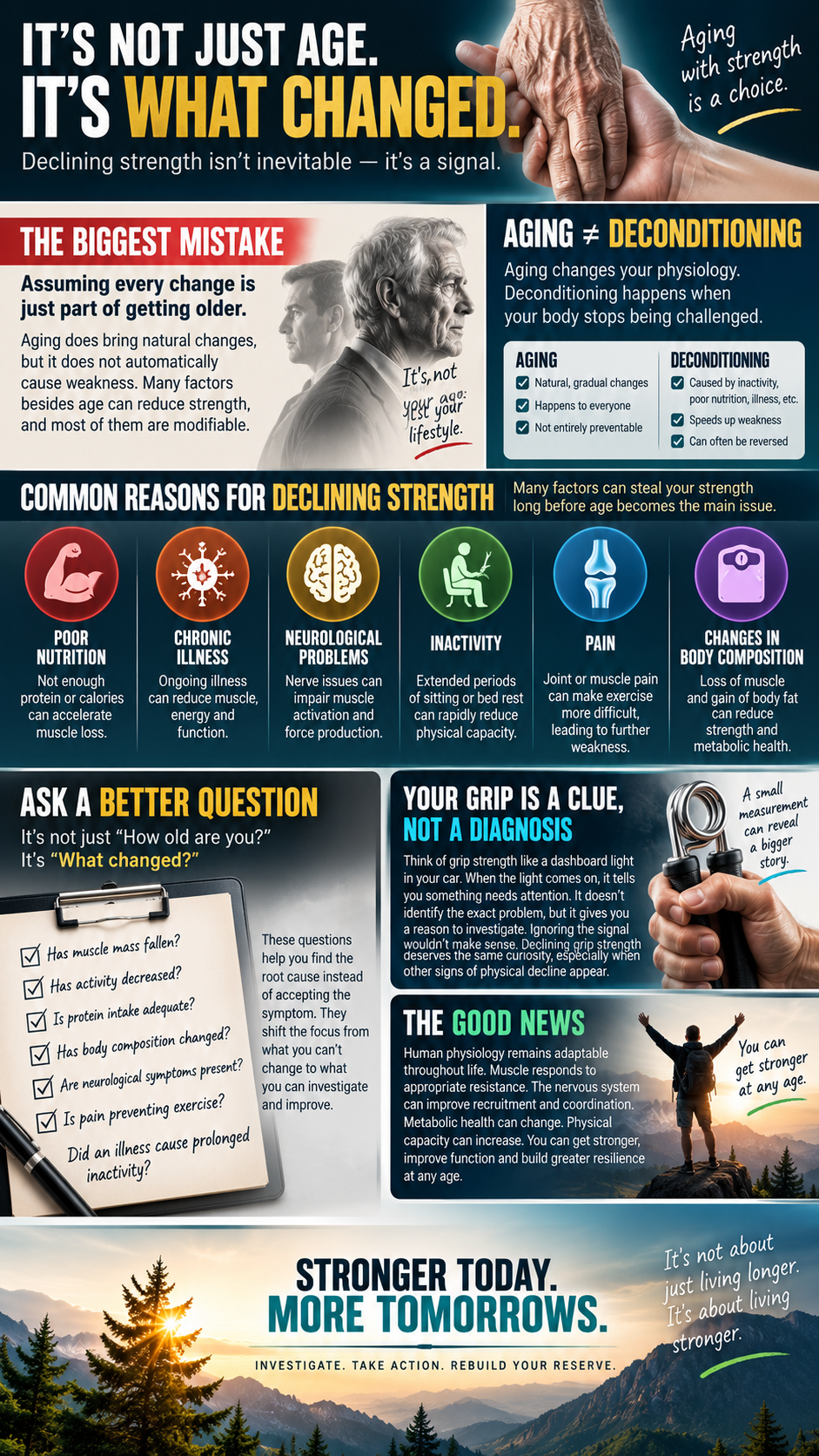
Your grip should therefore be viewed as a clue rather than a diagnosis. It resembles a dashboard light that tells you something deserves investigation. The light does not identify the broken component, but ignoring it would make little sense. Declining strength deserves the same curiosity, especially when other signs of physical decline appear.
The encouraging reality is that human physiology remains adaptable throughout life. Muscle responds to appropriate resistance, while the nervous system can improve recruitment and coordination. Metabolic health can change, and physical capacity can increase. The goal is not simply to build stronger hands. The real objective is rebuilding the whole-body reserve that those hands can reveal.
HOW TO REBUILD STRENGTH AND PROTECT YOUR PHYSICAL RESERVE
Understanding declining grip strength matters only if that knowledge changes what you do next. Fortunately, strength remains remarkably responsive to the environment you create for your body. Aging influences muscle, nerves, hormones, circulation, and recovery, but age does not eliminate adaptability. Older adults can still become stronger, improve balance, increase muscular function, and regain physical capacity. The goal should not be chasing an impressive handgrip number. Instead, use grip strength as one measurement within a larger strategy for rebuilding physical reserve.
That strategy begins by identifying what may be stealing strength. Inactivity remains an obvious contributor, but it is not the only possibility. Inadequate protein, insufficient calories, chronic illness, pain, neurological dysfunction, poor sleep, and prolonged bed rest can contribute. Certain medications or endocrine disorders may also influence strength and energy. Sudden weakness deserves particular attention because normal aging usually does not explain abrupt functional changes. New one-sided weakness, facial drooping, speech difficulty, or severe coordination problems requires urgent medical evaluation.
Establish Your Grip Strength Baseline
You cannot meaningfully improve something without knowing where you started. A handgrip dynamometer provides the most practical method for measuring grip strength at home. These devices measure the force generated when you squeeze their handles. Testing takes seconds, yet consistency matters if you want useful comparisons over time.
Use the same dynamometer whenever possible and test under similar conditions. Keep your body position consistent and record results from each hand separately. Perform several attempts with appropriate rest rather than repeatedly squeezing until your hands become fatigued. Record the date, hand, and result so future measurements can reveal a trend. Monthly testing usually provides more meaningful information than obsessively measuring strength every morning.
Avoid treating one number as a diagnosis. Age, sex, body size, arthritis, pain, previous injuries, testing technique, and equipment can influence results. More important information often comes from changes over time. A meaningful downward trend should encourage investigation, especially when walking speed, balance, endurance, or daily function also declines.
Train the Body Instead of Only Training the Hands
If grip strength reflects whole-body capacity, your exercise program should address the whole body. Squeezing a hand gripper can strengthen specific muscles, but it cannot replace comprehensive resistance training. Your legs, hips, back, chest, shoulders, arms, and hands all need appropriate mechanical demand.
Start with movements that resemble activities humans need throughout life. Squatting teaches the body to lower and raise itself. Hip-hinge movements strengthen muscles required for lifting objects safely. Rows develop pulling strength through the back and arms. Pressing movements strengthen the chest, shoulders, and triceps. Loaded carries challenge the hands while simultaneously training posture, trunk stability, legs, shoulders, and cardiovascular capacity.
Training intensity should match your current condition. Someone who has remained sedentary for years should not copy an advanced athlete’s program. Begin with resistance you can control through a comfortable range of motion. Gradually increase the challenge as movements become easier. Muscles require progressive demand, but joints and connective tissues also need time to adapt.
Two or three weekly resistance sessions can provide a practical starting framework for many adults. Recovery days between harder sessions allow tissues to rebuild and adapt. Consistency matters far more than occasional heroic workouts. Your body responds to signals repeated over months and years, not one exhausting Saturday morning.
Put Your Hands Back to Work
Modern life has removed countless opportunities to use grip strength. Reintroducing those demands can transform ordinary activities into small training opportunities. Carry grocery bags when appropriate rather than automatically pushing everything in a cart. Pick up household objects with intention and control. Garden, carry laundry, move light equipment, and perform other tasks requiring your hands to work.
Farmer’s carries provide an especially useful exercise because they combine grip strength with whole-body loading. Hold a manageable weight in each hand while walking with controlled posture. Your fingers and forearms must maintain the grip while your shoulders stabilize the load. Your trunk resists unwanted movement, while your hips and legs carry you forward.
Hanging from a secure bar can provide another grip challenge for people whose shoulders tolerate it comfortably. Rows, deadlift variations, and controlled pulling exercises naturally strengthen the hands because the grip connects your body with the resistance. These movements make grip training part of functional strength rather than an isolated forearm exercise.
Direct grip exercises can still have a place. Hand grippers, therapy putty, and controlled squeezing exercises provide convenient resistance. However, avoid assuming that more squeezing always produces better results. Tendons and joints can become irritated when training volume rises too quickly. Progressive training should challenge tissues without repeatedly aggravating them.
Give Muscle Enough Protein to Rebuild
Exercise provides the signal for adaptation, but nutrition supplies the raw materials. Skeletal muscle constantly undergoes protein breakdown and rebuilding. Resistance training increases the demand for repair, making adequate dietary protein particularly important as people grow older.
Protein quality matters because muscle protein synthesis requires essential amino acids that the body cannot manufacture adequately on its own. Eggs, fish, poultry, beef, and other complete protein sources provide these amino acids. The ideal amount varies according to body size, activity, age, goals, and medical history.
Distribution across the day also deserves attention. Many adults consume very little protein early, followed by one large serving at dinner. Providing meaningful protein at several meals may offer repeated opportunities to support muscle protein synthesis. That approach becomes increasingly relevant when older muscle responds less robustly to small protein servings.
People with kidney disease or other conditions affecting protein recommendations need individualized guidance. More protein is not automatically better for every person. The principle remains straightforward: muscle cannot rebuild efficiently without adequate nutritional resources.
Protect the Metabolism That Supports Your Muscles
Muscle and metabolic health continuously influence each other. Active skeletal muscle helps remove glucose from circulation and improves the body’s demand for fuel. Resistance exercise can improve insulin sensitivity while preserving metabolically active tissue. These effects make strength training relevant far beyond larger muscles.
Begin reducing the amount of time spent continuously sitting. A formal workout cannot completely replace an otherwise motionless day. Walk after meals when appropriate, take stairs when practical, perform household tasks, and break prolonged sitting with brief movement. These ordinary behaviors increase muscular activity without requiring another hour at the gym.
Food quality also influences the metabolic environment surrounding muscle. Build meals around nutrient-dense whole foods rather than heavily refined products. Prioritize adequate protein while choosing foods that support stable energy and satiety. Avoid allowing snacks, sweetened beverages, and ultra-processed foods to crowd out nutrient-rich meals.
The objective is not dietary perfection. The goal is creating a metabolic environment where muscle receives fuel, nutrients, and regular reasons to remain active.
Sleep Is Part of Strength Training
People often focus entirely on exercise while ignoring recovery. Muscle adaptation does not occur only while lifting weights. Training creates a physiological challenge, while recovery allows the body to respond to that challenge.
Sleep influences hormonal signaling, glucose regulation, appetite, neurological function, and physical performance. Chronic sleep deprivation can make exercise feel harder while reducing motivation to remain active. Poor sleep can also increase cravings and complicate metabolic health.
Create a consistent sleep schedule whenever possible. Keep the bedroom dark and cool, and reduce stimulating activities near bedtime. Morning daylight exposure can help reinforce circadian timing. Caffeine consumed late in the day can interfere with sleep in susceptible people.
Better sleep will not transform weak muscles without resistance training. However, repeatedly training while neglecting recovery can limit progress. Strength requires both stimulus and restoration.
Reduce the Inactivity That Accelerates Aging
One of the most powerful actions you can take at home costs nothing. Stop allowing hours to pass without meaningful movement. The human body needs frequent physical signals telling it that strength, balance, and mobility remain necessary.
Place movement throughout your day rather than depending entirely upon scheduled exercise. Stand regularly while working. Walk during phone calls. Carry objects when safe. Perform controlled chair squats between tasks. Take a short walk after eating. Use stairs when your physical condition permits.
These small actions should complement structured resistance training rather than replace it. Think of formal exercise as a concentrated signal and daily movement as background communication. Both tell the body that physical capacity remains valuable.
The opposite message comes from prolonged inactivity. When muscles repeatedly encounter no meaningful resistance, maintaining excess capacity becomes biologically unnecessary. Your body adapts to the life you repeatedly ask it to live.
Your At-Home Grip Strength Rebuilding Plan
Start your home strategy by recording your baseline grip strength, general activity level, and functional abilities. Notice whether you can rise from a chair without using your arms. Pay attention to stair climbing, carrying groceries, walking speed, and balance. These observations provide context that a dynamometer cannot capture alone.
During the first weeks, focus on consistency rather than intensity. Perform whole-body resistance exercise several times weekly at an appropriate level. Include squatting or chair-standing patterns, pulling movements, pushing movements, hip-dominant exercises, and loaded carries. Add direct grip work in modest amounts when your hands and joints tolerate it.
Build meals around adequate protein and nutrient-dense whole foods. Spread meaningful protein servings throughout the day instead of relying entirely upon dinner. Maintain hydration, because dehydration can impair physical performance. Address inadequate food intake when unintended weight loss accompanies weakness.
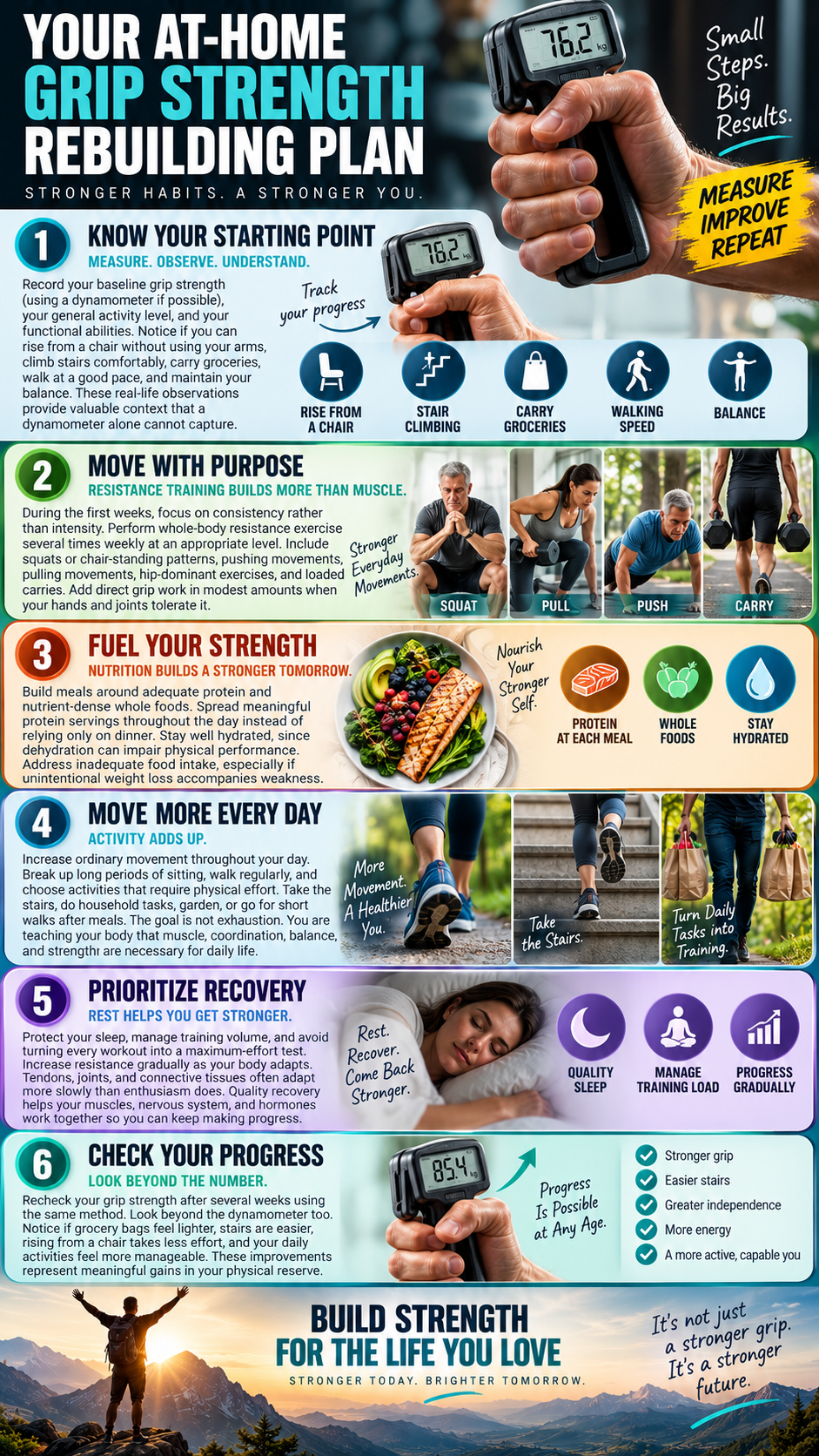
Next, increase ordinary movement. Break up long sitting periods, walk regularly, and deliberately choose activities that require physical effort. Your goal is not exhaustion. You are teaching your body that muscle, coordination, balance, and strength remain necessary for your daily environment.
Recovery completes the strategy. Protect sleep, manage training volume, and avoid turning every workout into a maximum-effort test. Increase resistance gradually as your body adapts. Tendons, joints, and connective tissues often adapt more slowly than enthusiasm does.
Recheck your grip under similar conditions after several weeks rather than several days. Look beyond the dynamometer as well. Grocery bags may feel lighter. Stairs may become easier. Rising from a chair may require less effort. Those improvements represent meaningful changes in physical reserve.
Stronger Hands Should Reflect a Stronger Body
The greatest mistake would be turning grip strength into another isolated health number. The objective is not winning a squeezing contest. Your goal is preserving enough strength to remain capable, independent, metabolically active, and physically resilient throughout aging.
Grip strength matters because the hands can reveal what is happening elsewhere. They depend upon functioning nerves, responsive muscles, adequate nutrition, healthy circulation, cellular energy, and regular physical demand. When grip declines, the body may be asking for investigation rather than resignation.
Aging will always change us, but decline does not have to proceed unchecked. Give muscle a reason to remain. Give the nervous system movements worth coordinating. Supply the body with adequate nutrition, sleep, and recovery. Challenge yourself progressively instead of surrendering physical demands to convenience.
Then watch what happens beyond your hands. A stronger grip can accompany stronger legs, improved carrying capacity, better confidence, and greater independence. That represents the real objective of training as you age. You are not merely trying to hold onto a heavier object. You are working to hold onto the physical reserve that allows you to keep participating fully in your own life.