
The Dark Side of Peptides: Why Synthetic Signals May Disrupt the Body’s Natural Intelligence
In recent years, peptides have moved from obscure biochemical compounds to headline-grabbing tools in the worlds of anti-aging medicine, athletic performance, and biohacking. Clinics across the United States now advertise peptide therapies promising faster injury recovery, accelerated fat loss, improved cognition, better sleep, and even age reversal. Online forums are filled with individuals sharing personal “protocols,” often involving injections of compounds with names like BPC-157, TB-500, CJC-1295, and Ipamorelin. For many people searching for better health, these compounds appear to represent a revolutionary breakthrough.
The enthusiasm surrounding peptides is understandable because peptides themselves are not foreign to human biology. In fact, the human body relies on thousands of peptides to regulate nearly every physiological process. These small chains of amino acids function as signaling molecules that instruct cells how to behave. Some peptides regulate metabolism, others control immune responses, and many influence growth, repair, and communication between organs. Because peptides are part of normal physiology, the idea of using them therapeutically sounds intuitive. If the body already uses peptides, introducing additional peptides seems, at first glance, like simply enhancing a natural system.
However, the growing popularity of synthetic peptides has raised serious questions among scientists who study endocrine signaling and cellular communication. The issue is not that peptides themselves are inherently dangerous. Rather, the concern lies in how synthetic peptides interact with systems that evolved to operate under extremely precise regulatory control. Biological signaling is governed by timing, location, concentration, and feedback mechanisms that maintain balance within the body. When synthetic peptides are introduced externally, those carefully tuned systems may receive signals that do not match the body’s normal regulatory patterns.
To understand why this matters, it is important to recognize that human physiology functions less like a simple machine and more like a complex orchestra. Every hormone, peptide, neurotransmitter, and cytokine plays a role in maintaining harmony within the system. When one signal changes, many others adjust in response. Introducing synthetic peptides into this network may create effects that extend far beyond the single pathway that users hope to influence.
The Rise of Synthetic Peptide Therapies

Many of the peptides currently circulating in medical clinics and online communities were originally developed for research purposes. Some were designed to investigate wound healing, others to study growth hormone regulation, and still others to explore neurological signaling. Over time, these compounds began appearing in performance medicine and longevity clinics, often marketed as regenerative therapies.
BPC-157
Among the most frequently discussed peptides today is BPC-157, a synthetic compound derived from a protein fragment believed to originate in gastric juice. It is widely promoted as a healing agent for ligaments, tendons, and intestinal tissue. Supporters claim that it accelerates recovery from injuries and reduces inflammation throughout the body. While some laboratory studies have explored its effects in animal models, it remains largely unapproved for human therapeutic use in many regulatory systems.
TB-500
Another compound that has gained attention is TB-500, a fragment related to the naturally occurring protein thymosin beta-4. This peptide has been promoted for its potential to support tissue repair and muscle regeneration. It became popular in veterinary medicine, particularly for treating injured racehorses, before eventually appearing in human performance circles.
CJC-1295 / Ipamorelin
A different category of peptides targets growth hormone regulation. CJC-1295 and Ipamorelin, for example, are frequently used together in protocols designed to stimulate the body’s production of growth hormone. These compounds act on receptors that influence the pituitary gland, which in turn signals the release of growth hormone into circulation. The goal of these protocols is often to improve body composition, increase muscle mass, or enhance recovery from exercise.
Semax / AOD-9604
Additional peptides have been promoted for cognitive performance and metabolic effects. Semax, originally developed in Russia, has been investigated for its influence on neuropeptides involved in learning and memory. AOD-9604, a fragment derived from human growth hormone, is often marketed specifically as a fat-loss peptide.
Although these compounds differ in their specific targets, they share a common theme: they attempt to manipulate biological signaling pathways that the body normally regulates with extraordinary precision.
How Peptide Signaling Actually Works in the Body
Within human physiology, peptides function as part of an intricate communication network. Cells constantly send chemical messages to one another, allowing organs to coordinate their activities and maintain stability. This process involves not only peptides but also hormones, neurotransmitters, and inflammatory mediators.
A key principle underlying these systems is feedback regulation. When one signal rises, other signals often adjust in response to maintain balance. For example, growth hormone production does not occur continuously throughout the day. Instead, it is released in pulses controlled by two opposing signals: growth hormone releasing hormone (GHRH), which stimulates production, and somatostatin, which suppresses it. These signals originate in the hypothalamus and influence the pituitary gland, creating a tightly controlled rhythm of hormone release.
The timing of these pulses matters greatly. Growth hormone secretion is strongly influenced by sleep cycles, particularly the deeper stages of sleep that occur shortly after falling asleep. Nutritional status, blood sugar levels, stress hormones, and exercise also influence the system. The body continually evaluates these factors and adjusts signaling accordingly.
When synthetic peptides are injected into the body, they may bypass these regulatory mechanisms. Instead of being released in small, carefully timed pulses from specific tissues, the peptide enters the bloodstream systemically. Receptors throughout the body may encounter the signal simultaneously, even in tissues where the signal would not normally appear.
This difference in context may influence how the body responds to the signal. In some cases, receptors may become overstimulated. In others, the body may activate compensatory mechanisms designed to restore balance.
Why the Body Responds Differently to Synthetic Signals
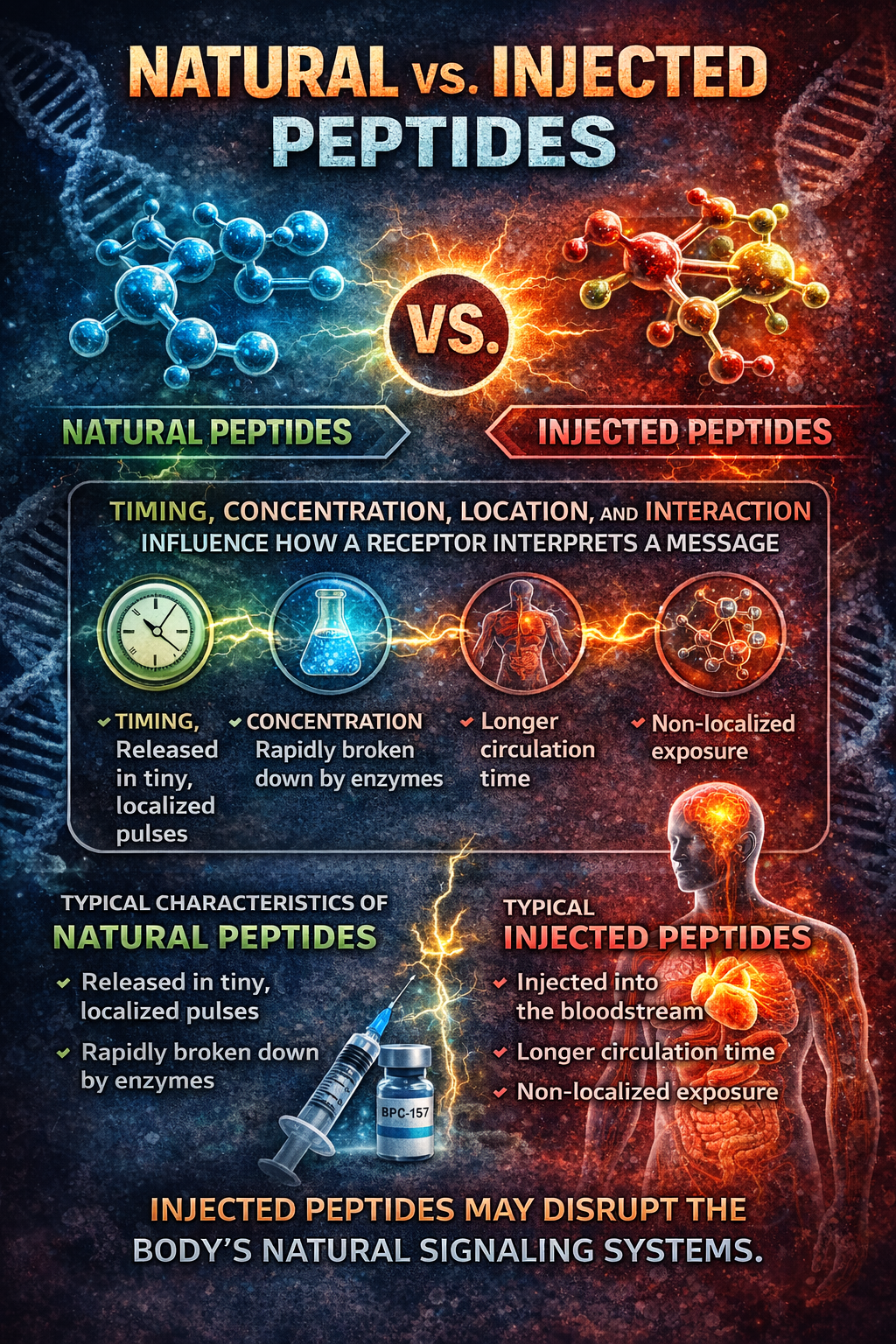
It is often assumed that if a synthetic peptide resembles a natural peptide structurally, the body will treat it the same way. While structural similarity certainly matters, biological signaling is not determined solely by molecular shape. Timing, concentration, location, and interaction with other signals all influence how a receptor interprets a message.
Natural peptides are typically released in extremely small amounts and often act locally within specific tissues. Their concentrations rise and fall rapidly as enzymes break them down. This rapid turnover allows the body to adjust signals quickly as conditions change.
Injected peptides, by contrast, may circulate longer and reach tissues that would not normally encounter that signal. Even when the dose is relatively small, the pattern of exposure differs from the body’s natural rhythm.
Endocrine systems are particularly sensitive to such changes because they rely on feedback loops. If a signaling pathway becomes chronically stimulated, the body may reduce its own production of that signal in order to restore balance. This phenomenon has been observed with many hormones, including testosterone and thyroid hormones, where external supplementation can suppress natural production over time.
Although peptide therapies often aim to stimulate endogenous hormone production rather than replace hormones directly, the potential for feedback disruption still exists.
The Appeal of Micro-Dosing
Many proponents of peptide use attempt to minimize potential risks by using extremely small doses, a practice often referred to as micro-dosing. The idea is that tiny amounts of a compound will gently nudge biological systems without overwhelming them.
While this concept sounds reasonable, endocrine signaling does not always respond to substances in a simple linear fashion. Some receptors respond strongly even to very small concentrations of a molecule. In other cases, repeated stimulation—even at low doses—may lead to receptor desensitization or changes in downstream signaling pathways.
In other words, the body does not simply measure the size of a signal; it also interprets the pattern and context in which the signal occurs. Repeated exposure to an artificial signal may lead to adaptations that researchers have not fully mapped.
The Lack of Long-Term Data
One of the most significant challenges surrounding peptide therapies is the relative lack of long-term safety data. Many peptides currently circulating in performance and longevity communities were originally developed for research purposes and have not undergone extensive clinical trials examining years or decades of use.
Some peptides sold online are explicitly labeled as “research chemicals,” indicating that they are intended for laboratory study rather than human consumption. Despite this, they have entered a growing marketplace of experimental health practices.
Because peptides influence fundamental processes such as cellular growth, immune activity, and metabolic signaling, scientists have raised questions about potential long-term consequences that may not yet be apparent. These concerns include possible alterations in endocrine regulation, immune responses, and tissue growth patterns.
The reality is that the scientific community is still in the early stages of understanding how chronic manipulation of peptide signaling might affect complex biological systems.
The Remarkable Peptides the Body Already Produces

While synthetic peptides receive considerable attention, the body itself already produces a vast array of powerful peptides that regulate health and healing. These molecules coordinate metabolism, immune responses, neurological function, and tissue repair.
Insulin is one of the most well-known peptides, responsible for allowing cells to absorb glucose and maintain stable blood sugar levels. Glucagon acts as a counterbalance, raising blood sugar when it falls too low.
Leptin and ghrelin work together to regulate hunger and satiety, helping the body manage long-term energy balance. Ghrelin also influences growth hormone secretion and plays a role in metabolic adaptation.
The brain produces peptides such as endorphins, which influence pain perception and mood, and oxytocin, which plays an important role in bonding, emotional regulation, and stress resilience.
Sleep regulation involves peptides such as melatonin, which coordinates circadian rhythms and supports restorative sleep cycles. Meanwhile, immune cells produce signaling peptides that orchestrate inflammatory responses and coordinate the body’s defense against pathogens.
Each of these peptides operates within a sophisticated network of signals and feedback loops that maintain equilibrium.
Supporting the Body’s Natural Peptide Production
Because peptides are constructed from amino acids and regulated by lifestyle factors, the body’s own production of these molecules can be influenced by everyday behaviors.
One of the most powerful regulators of peptide signaling is sleep quality. Deep sleep triggers the release of growth hormone and other restorative peptides involved in tissue repair. Maintaining consistent sleep patterns and minimizing nighttime light exposure can significantly influence these processes.
Physical activity, particularly resistance training, stimulates the release of peptides associated with muscle repair, metabolic regulation, and neurological health. Exercise also improves insulin sensitivity, enhancing metabolic signaling pathways.
Intermittent fasting has been shown to influence several peptides related to metabolism, including ghrelin and glucagon. Periods of fasting may encourage metabolic flexibility and stimulate cellular repair mechanisms.
Adequate protein intake provides the amino acid building blocks required for peptide synthesis. Minerals such as zinc and magnesium, along with vitamins involved in methylation and enzymatic reactions, also support the biochemical pathways involved in peptide production.
Sunlight exposure, stress management, and circadian rhythm alignment further influence the body’s complex signaling systems.
A Different Perspective on Regenerative Health
The growing interest in peptides reflects a broader desire to enhance healing, slow aging, and improve human performance. These goals are understandable, and scientific exploration of peptide biology may eventually yield valuable medical therapies.
However, the fascination with synthetic peptides sometimes overlooks a fundamental reality: the body already possesses extraordinarily sophisticated regenerative systems. When physiological balance is restored through sleep, nutrition, movement, and metabolic health, the body naturally produces many of the signaling molecules required for repair and adaptation.
Understanding and supporting those natural systems may ultimately prove to be one of the most powerful strategies for long-term health.
Rather than attempting to override the body’s signaling network with artificial inputs, the future of regenerative medicine may lie in learning how to work with the body’s inherent intelligence—encouraging it to produce the very molecules that evolution designed for healing.