
The Hidden Truth Behind Cortisone Injections and Why Millions Are Being Misled
A quiet crisis unfolds inside orthopedic offices, pain clinics, and medical centers across America every single day. Millions of people walk into appointments carrying swollen knees, burning shoulders, stiff hips, and inflamed backs, desperately searching for relief from relentless pain. Most leave with the same promise wrapped inside a syringe: a cortisone shot designed to reduce inflammation, relieve discomfort, and help them “heal.” For a brief period, many patients believe they finally discovered the answer. Pain fades quickly, mobility improves, and simple daily tasks suddenly feel manageable again. Hope returns almost immediately because the discomfort that dominated life for months or years finally becomes quieter.
Yet beneath that temporary relief, something far more dangerous often develops silently. While pain decreases on the surface, cartilage frequently continues deteriorating underneath. Tendons weaken gradually, ligaments lose stability, and joint surfaces become thinner, rougher, and more fragile over time. The patient feels better temporarily, but the joint itself often grows biologically weaker after each injection. Several years later, many patients hear devastating news they never expected. Their arthritis worsened dramatically, their joint collapsed further, and surgery suddenly became “necessary.”
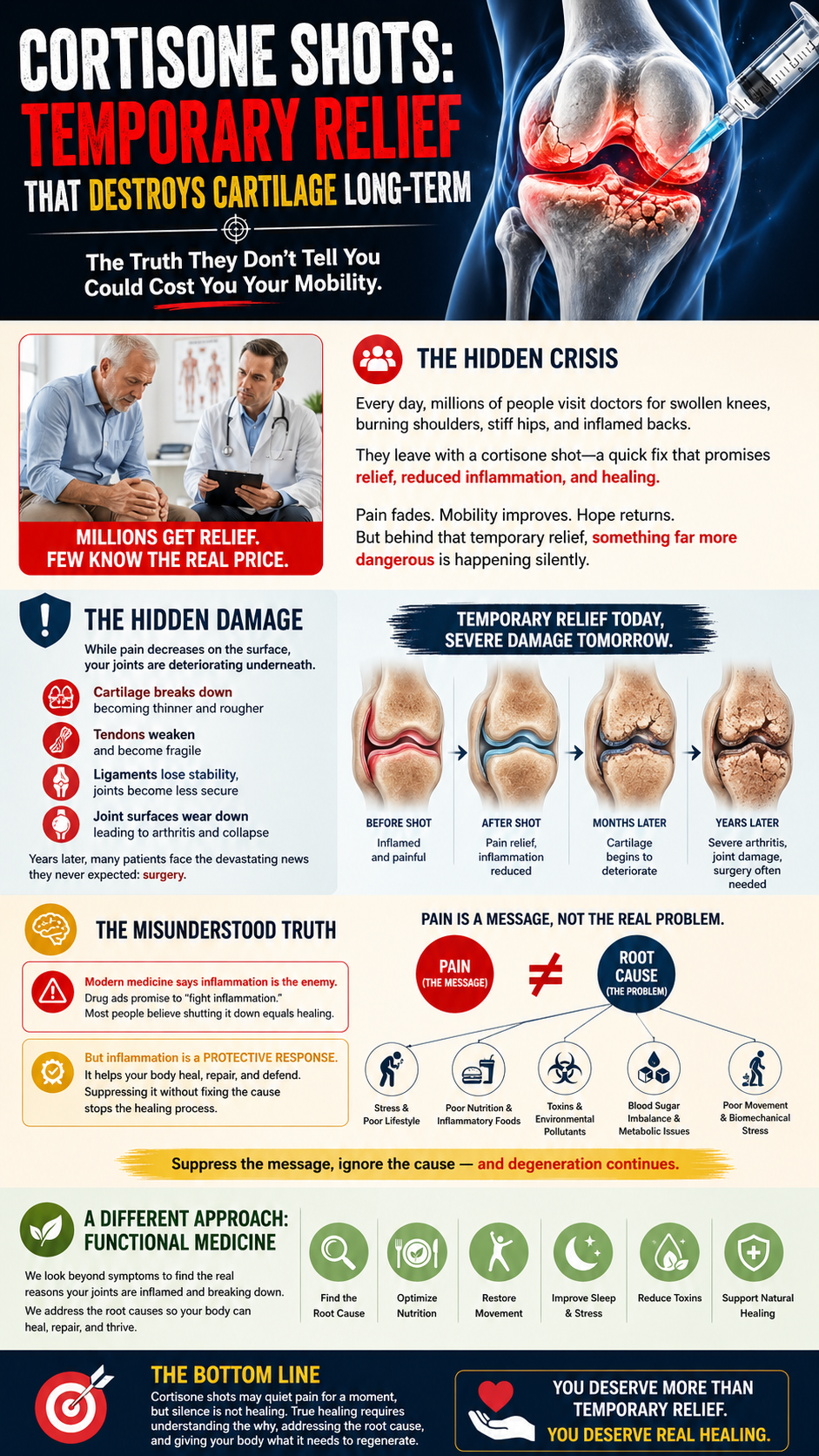
The tragedy lies in how few patients truly understand what cortisone does inside the body. Modern medicine largely trained the public to believe inflammation itself represents the enemy. Drug advertisements promise rapid relief by “fighting inflammation,” while television commercials reinforce the belief that shutting inflammation down quickly equals healing. Most patients now associate inflammation with disease instead of understanding its actual purpose within the body. That misunderstanding created an entire healthcare culture focused on suppressing symptoms rather than correcting causes.
Functional medicine views the body through an entirely different lens. Pain does not appear randomly, inflammation does not emerge without reason, and degeneration does not simply happen because birthdays pass. The body creates inflammation as a protective response against stress, instability, injury, toxicity, nutrient deficiency, metabolic dysfunction, or immune imbalance. When physicians suppress inflammation aggressively without correcting the underlying trigger, the body often loses its ability to repair damaged tissues properly. This explains why so many patients become trapped in endless cycles of temporary relief followed by worsening degeneration.
Cortisone injections may quiet pain briefly, but silence never equals healing. The body cannot rebuild healthy joints while destructive processes continue operating beneath the surface unnoticed. True healing requires understanding where degeneration originates, what accelerates tissue breakdown, and how natural repair mechanisms become disrupted over time. Patients deserve far more than temporary symptom suppression disguised as long-term care.
What Cortisone Actually Is and Why It Changes the Body So Dramatically
Cortisone belongs to a class of synthetic steroid medications called corticosteroids. These drugs imitate cortisol, which the adrenal glands naturally produce during stress. Cortisol helps regulate inflammation, blood sugar, immune function, metabolism, and survival responses. During emergencies, cortisol protects the body by preventing dangerous inflammatory reactions from spiraling out of control. Synthetic corticosteroids amplify those effects dramatically and create a much stronger suppression of inflammatory activity throughout the body.
Doctors commonly inject cortisone directly into painful joints, inflamed tendons, spinal spaces, or swollen bursae. The medication rapidly suppresses inflammatory chemicals within the area, reducing swelling and dulling pain signals sent to the brain. Most patients experience improvement within several days because the steroid interrupts inflammatory communication pathways aggressively. The reduction in pain often feels dramatic enough to convince people the damaged tissue healed completely.
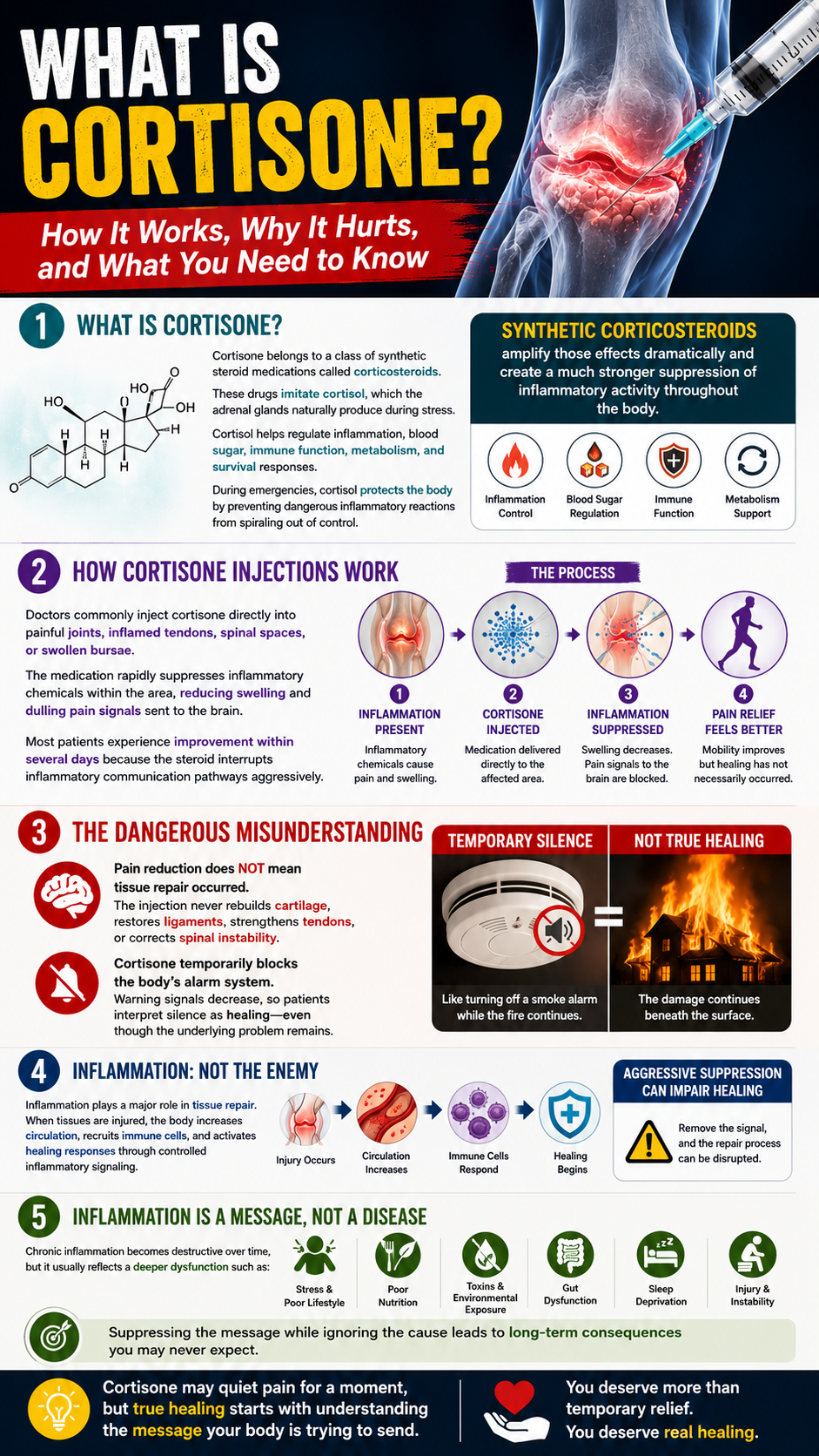
The public often misunderstands what that improvement truly represents. Pain reduction does not mean tissue repair occurred. The injection never rebuilds cartilage, restores damaged ligaments, strengthens weakened tendons, or corrects spinal instability and poor biomechanics. Instead, cortisone temporarily blocks the body’s alarm system. The warning signals decrease, so patients interpret silence as healing even though the underlying dysfunction frequently remains untouched.
Inflammation plays a major role in tissue repair despite the negative reputation modern medicine assigned to it. When tissues become injured, the body increases circulation, recruits immune cells, and activates healing responses through controlled inflammatory signaling. Removing that signaling aggressively can impair the body’s natural ability to rebuild damaged structures effectively. Functional medicine recognizes inflammation as a message rather than a disease itself. Chronic inflammation certainly becomes destructive over time, but inflammation usually reflects a deeper dysfunction demanding attention. Suppressing the message while ignoring the cause creates long-term biological consequences many patients never anticipate.
Why Cortisone Shots Feel Like Miracles at First
Many patients describe their first cortisone injection with remarkable enthusiasm because the initial relief often feels extraordinary. Someone struggling to walk comfortably suddenly climbs stairs without pain again. Another patient finally sleeps through the night after months of shoulder discomfort. Athletes frequently return to activity rapidly after injections because the joint suddenly feels stronger and less inflamed. That dramatic relief creates a powerful illusion that true healing occurred inside the joint.
The body uses pain as a warning system designed to protect tissues from further damage. Inflamed tissues release chemical messengers that stimulate nerve receptors and alert the brain about injury or instability. Cortisone interrupts those inflammatory chemicals aggressively, causing the alarm system to quiet down. Unfortunately, the underlying structural problem frequently remains unchanged despite the disappearance of pain.
Imagine disconnecting the fire alarm inside a burning building. The noise disappears immediately, creating temporary relief, but the fire continues spreading behind the walls. Cortisone often creates the same dangerous illusion within joints. Pain fades while degeneration silently continues progressing beneath the surface. Patients feel normal again even though cartilage cells continue deteriorating and connective tissues remain unstable.
This temporary numbness frequently encourages patients to return to stressful activity too quickly. Since the discomfort disappears, many people assume the tissue healed completely. They begin exercising harder, lifting heavier, walking longer distances, or resuming sports prematurely. Unfortunately, the joint often remains unstable and biologically compromised. Without pain signals warning the brain appropriately, additional damage accumulates quietly over time. Years later, many patients feel shocked when imaging studies reveal severe degeneration despite years of “successful” injections.
The Real Damage Happening Inside the Joint
Cartilage destruction represents one of the most concerning consequences associated with repeated cortisone injections. Cartilage functions as the body’s natural shock absorber. This smooth, rubber-like tissue covers the ends of bones and allows joints to glide effortlessly during movement. Healthy cartilage creates fluid motion without friction, grinding, or inflammation. Once cartilage deteriorates significantly, bones begin rubbing directly against each other and arthritis develops progressively.
Research increasingly demonstrates that corticosteroids harm cartilage cells called chondrocytes. These specialized cells maintain cartilage structure and produce the proteins necessary for cushioning and resilience. Corticosteroids impair chondrocyte metabolism, reduce collagen production, and interfere with normal tissue repair mechanisms. The longer the exposure continues, the greater the structural deterioration often becomes.
A groundbreaking study published in JAMA followed patients with knee arthritis over two years. Researchers discovered that individuals receiving regular cortisone injections experienced significantly greater cartilage loss compared to patients receiving placebo injections. Even more alarming, long-term pain relief remained minimal despite the increased degeneration. That study challenged decades of assumptions surrounding steroid safety and forced many physicians to reconsider the long-term consequences of repeated injections.
Functional medicine practitioners were not surprised by those findings because suppressing inflammation repeatedly rarely creates true regeneration. The body cannot rebuild tissue effectively while repair signaling pathways remain chemically interrupted. Many patients unknowingly trade short-term comfort for long-term structural destruction because they were never taught what these injections actually do at the cellular level.
Tendons and Ligaments Suffer Too
Cartilage damage tells only part of the story because cortisone also weakens tendons and ligaments throughout the body. Tendons attach muscles to bones, while ligaments stabilize joints during movement. Both structures depend heavily on collagen integrity for strength, flexibility, and resilience. Steroids interfere directly with collagen synthesis and gradually weaken connective tissue over time.
Repeated corticosteroid exposure reduces tensile strength within tendons and ligaments. Tendons become more vulnerable to tearing under stress, while ligaments lose stability and elasticity. Athletes receiving repeated injections often experience devastating tendon ruptures because the tissue becomes structurally fragile. The body may feel less pain temporarily, but the connective tissue underneath frequently becomes weaker after each exposure.
Rotator cuff injuries illustrate this problem clearly. Many patients receive shoulder injections repeatedly over several years because pain temporarily improves after each treatment. Meanwhile, the tendons continue weakening progressively beneath the surface. Eventually, small tears become massive ruptures requiring surgical repair. The patient often believes aging alone caused the deterioration, yet repeated steroid exposure frequently accelerated the process dramatically.
The same destructive pattern appears throughout the body. Achilles tendons rupture more easily after steroid exposure, knee ligaments lose stability gradually, and spinal tissues weaken progressively over time. Patients rarely receive warnings about these long-term consequences before agreeing to injections. The body cannot maintain strong connective tissue while collagen production remains chronically suppressed.
The Greatest Misconception About Inflammation
Modern medicine repeatedly teaches the public that inflammation represents the enemy in every circumstance. Drug advertisements constantly promote products designed to “fight inflammation,” while many healthcare providers speak about inflammation as though it serves no beneficial purpose. Patients hear endlessly that inflammation destroys the body and must disappear immediately. That narrative oversimplifies biology dangerously and ignores the body’s natural healing intelligence.
Acute inflammation actually protects the body during injury and stress. When tissues become injured, inflammation increases circulation, delivers nutrients, removes damaged cells, and activates repair mechanisms. Without controlled inflammation, wounds cannot heal properly, muscles cannot recover after exercise, and bones cannot repair after fractures. The immune system relies heavily on inflammatory signaling to coordinate healing and protection throughout the body.
Problems develop when inflammation becomes chronic and unresolved. Functional medicine recognizes chronic inflammation as a symptom of deeper dysfunction rather than an isolated disease itself. Poor nutrition, blood sugar instability, obesity, toxicity, stress, gut dysfunction, sleep deprivation, and biomechanical imbalance keep inflammatory pathways activated continuously. Suppressing inflammation aggressively while ignoring those triggers resembles covering a warning light on a car dashboard. The signal disappears temporarily, but the engine continues failing internally.
Modern healthcare often rewards rapid symptom suppression instead of root-cause investigation. Cortisone injections fit perfectly into that model because they provide fast temporary relief without demanding major lifestyle changes or deeper metabolic evaluation. Patients leave feeling better quickly, but the biological processes driving degeneration frequently continue progressing unchecked.
Where Joint Degeneration Really Comes From
Most people believe arthritis develops naturally with age, but functional medicine strongly challenges that assumption. Many older adults maintain excellent mobility because their tissues remain healthier metabolically, structurally, and neurologically. Joint degeneration rarely results from aging alone. Instead, chronic inflammation and tissue breakdown usually develop from several overlapping stressors operating simultaneously for years.
Blood sugar dysfunction represents one of the largest hidden drivers of arthritis. Elevated glucose damages cartilage through glycation, a destructive process where excess sugar binds to proteins and stiffens tissues throughout the body. Cartilage loses flexibility and shock absorption under chronic glycation stress. High insulin levels also increase inflammatory chemicals that accelerate degeneration aggressively. Many patients with severe arthritis unknowingly struggle with metabolic dysfunction long before their joints become symptomatic.
Processed foods contribute heavily to chronic inflammation as well. Refined sugar, industrial seed oils, preservatives, artificial additives, and ultra-processed carbohydrates create oxidative stress throughout the body. Cartilage cells struggle to regenerate inside an inflammatory biochemical environment fueled by poor nutrition. Nutrient deficiencies further impair tissue repair because cartilage requires amino acids, vitamin C, zinc, magnesium, sulfur compounds, and collagen-building nutrients consistently.
Biomechanical dysfunction also plays a massive role in degeneration. Poor posture, spinal misalignment, unstable hips, weak glutes, collapsed arches, and improper movement patterns overload joints repeatedly over time. Functional medicine and chiropractic care frequently focus on correcting those mechanical stress patterns before irreversible damage develops. Environmental toxins create another hidden burden because heavy metals, pesticides, mold toxins, plastics, and industrial chemicals disrupt mitochondrial function and immune regulation. The body struggles to repair tissues efficiently while fighting constant toxic stress.
Degeneration rarely emerges from one isolated factor. Most chronic joint conditions develop from multiple overlapping stressors operating silently for years before pain finally appears.
The Dangerous Cycle That Leads to Surgery
Many patients unknowingly enter a destructive cycle after their first cortisone injection. Pain develops because inflammation signals instability or tissue damage. The steroid injection suppresses symptoms quickly, allowing normal activity to resume. Since the underlying cause remains unresolved, degeneration continues progressing silently beneath the surface. The patient feels functional again, but the joint itself often becomes weaker biologically.
Pain eventually returns because the structural dysfunction never truly healed. Another injection follows, bringing temporary relief once again. More tissue breakdown accumulates quietly underneath, while joint instability worsens further. Additional injections become necessary more frequently because the degeneration continues progressing. Many patients notice that each injection seems to last a shorter period than the previous one.
Several years later, many patients hear devastating words from their physician: “Your joint has deteriorated too much. You now need replacement surgery.” The body rarely collapses overnight. Most severe arthritis develops through years of unresolved dysfunction combined with repeated symptom suppression strategies. Functional medicine seeks to interrupt that cycle entirely by restoring tissue health instead of masking warning signals repeatedly.
Patients deserve to understand that surgery often represents the final stage of years of progressive degeneration rather than an unavoidable consequence of aging alone. The body constantly attempts repair, but healing becomes impossible when underlying stressors remain unresolved and tissue damage continues accumulating silently.
Cortisone Affects the Entire Body, Not Just the Joint
Many patients believe steroid injections remain confined to the targeted area, but corticosteroids influence the entire body after entering circulation. Even localized injections can create widespread physiological effects. Blood sugar often rises dramatically after steroid exposure, which becomes especially dangerous for diabetic patients. Some individuals experience glucose spikes lasting several days after receiving injections.
Corticosteroids also suppress immune function, increasing vulnerability to infections temporarily. Hormonal balance frequently becomes disrupted after repeated injections. Many patients notice anxiety, irritability, mood swings, insomnia, fatigue, or brain fog afterward. These symptoms often confuse patients because they never expected a joint injection to influence mental and emotional health so significantly.
Bone density may decline gradually under chronic steroid exposure, increasing fracture risk later in life. Adrenal function can suffer as well because synthetic steroids imitate cortisol. The body may reduce its own natural cortisol production over time, contributing to poor stress tolerance, fatigue, immune dysfunction, and metabolic instability. The body operates as an interconnected system, which means no injection affects only one isolated tissue.
Functional medicine recognizes these systemic consequences and evaluates the entire person rather than focusing solely on one painful joint. True healing requires understanding how inflammation, hormones, metabolism, immunity, and biomechanics interact together continuously.
Why Functional Medicine Rejects the “Quick Fix” Model
Functional medicine asks different questions than conventional medicine. Instead of asking how to suppress symptoms rapidly, functional medicine investigates why dysfunction developed initially. Why did the inflammation appear? Why did cartilage begin breaking down? Why does the body struggle to repair itself properly? Why does instability continue progressing over time?
Those questions lead to entirely different treatment strategies. Functional medicine evaluates blood sugar balance, gut integrity, toxic burden, nutritional deficiencies, hormone health, biomechanics, nervous system function, sleep quality, and inflammatory triggers. Healing becomes the goal rather than symptom suppression.
When patients stabilize blood sugar, improve nutrition, restore movement mechanics, reduce toxicity, strengthen muscles, improve sleep, and heal gut dysfunction, inflammation often decreases naturally. The body begins functioning more efficiently because the underlying stressors finally receive proper attention. Pain reduction becomes the result of healing rather than chemical suppression.
True healing requires restoring the internal environment where regeneration becomes possible. The body possesses extraordinary healing intelligence when interference disappears and proper support returns consistently.
Natural Strategies That Protect Cartilage and Restore Joint Health
Healing joints naturally requires consistent daily action rather than temporary symptom suppression. Food becomes one of the most powerful tools available because nutrition influences inflammation continuously. Eliminating processed foods, refined sugars, industrial oils, and artificial additives dramatically reduces inflammatory stress throughout the body. Replacing those foods with grass-fed meats, wild-caught fish, bone broth, healthy fats, vegetables, herbs, and mineral-rich foods supplies the body with the nutrients necessary for repair.
Protein intake matters tremendously for cartilage health because connective tissues require amino acids constantly for maintenance and rebuilding. Many people with chronic degeneration consume insufficient protein daily. Increasing collagen-rich foods and amino acid intake provides the raw materials necessary for connective tissue repair and joint resilience.
Blood sugar stabilization also changes inflammation profoundly. Elevated insulin accelerates arthritis aggressively and impairs healing mechanisms throughout the body. Patients often notice major reductions in joint pain after lowering processed carbohydrates and improving metabolic health. Walking after meals, prioritizing protein intake, avoiding sugary beverages, and improving sleep quality help stabilize glucose naturally.

Movement patterns must improve as well because weak muscles force joints to absorb excessive stress repeatedly. Strengthening glutes, stabilizing the core, improving balance, restoring hip mobility, and correcting posture dramatically reduce abnormal joint loading. Functional chiropractic care often helps restore proper biomechanics before degeneration becomes irreversible.
Sleep represents another overlooked healing tool. Deep sleep controls growth hormone production, immune regulation, tissue repair, and inflammatory balance. Poor sleep accelerates degeneration throughout the body while impairing recovery mechanisms continuously. Restoring healthy sleep patterns improves healing capacity dramatically and reduces inflammatory burden naturally.
Reducing toxic exposure also matters greatly. Filtering water, avoiding plastics, improving indoor air quality, choosing organic produce, and sweating regularly help lower toxic burden. The body repairs itself more effectively when environmental stress decreases. Gut health influences joint health profoundly as well because leaky gut and microbiome imbalance contribute to chronic immune activation and inflammation throughout the body. Many patients experience dramatic improvements in pain after restoring gut integrity through nutrition, stress management, and digestive support.
Healing occurs when the body finally receives the conditions necessary for repair instead of constant interference from inflammatory stressors.
Final Thoughts: Temporary Relief Is Not Healing
Cortisone shots may reduce pain temporarily, but temporary relief often carries devastating long-term consequences. Cartilage destruction, tendon weakening, ligament instability, hormonal disruption, and accelerated degeneration frequently follow repeated steroid exposure. Patients deserve more than symptom suppression disguised as treatment. They deserve honest answers about why their joints deteriorate and how true healing occurs.
Functional medicine recognizes chronic inflammation as a signal rather than an isolated disease. The body does not attack itself randomly. Joint degeneration reflects deeper dysfunction involving nutrition, blood sugar, biomechanics, toxicity, stress, sleep, and inflammation. Every meal influences repair, every hour of sleep affects healing, and every movement pattern shapes joint stress. Daily choices either accelerate degeneration or support regeneration.
The human body possesses remarkable healing intelligence when given the right environment. Protecting cartilage and preserving mobility require supporting that healing process rather than silencing it repeatedly. Pain relief should never come at the cost of destroying the very tissues responsible for movement, strength, and long-term freedom.