The Hidden Stress Rhythm Behind the Sleepless Night
At 2:17 each morning, the bedroom becomes an interrogation room. The darkness feels heavier, while every unresolved problem demands an immediate answer. Tomorrow’s responsibilities march through the mind with remarkable precision. Meanwhile, the exhausted body remains trapped beneath the sheets, unable to surrender.
Morning eventually arrives, but it brings no restoration. The alarm sounds like an assault rather than an invitation. Coffee creates temporary movement, although clear thinking remains difficult. By afternoon, concentration collapses, cravings intensify, and patience disappears. Then evening arrives, and the exhausted person becomes strangely alert again.
This pattern often gets labeled insomnia, anxiety, depression, menopause, or poor sleep hygiene. Sometimes those labels identify important contributors. However, they may also describe the symptoms without explaining the physiology beneath them. For many people, the missing investigation involves the body’s daily cortisol rhythm.
Cortisol should not remain static throughout the day. Healthy secretion follows a carefully timed curve. Levels usually rise around awakening, support daytime activity, and decline toward bedtime. That downward evening movement helps create the biological permission required for sleep.
A single morning blood test cannot reveal this entire rhythm. It only captures one hormonal moment. Therefore, a normal result may coexist with elevated evening cortisol or an abnormally flattened daily curve. This limitation matters when insomnia appears beside fatigue, cravings, irritability, brain fog, and nighttime alertness.
Many people call this cluster “adrenal fatigue.” Yet that phrase can create an inaccurate picture. The adrenal glands do not simply become tired like overworked batteries. A more defensible explanation involves disrupted communication across the hypothalamic-pituitary-adrenal axis, often shortened to the HPA axis.
The distinction matters because accurate language produces better investigation. Researchers have not established “adrenal fatigue” as a recognized medical diagnosis. However, chronic stress, insomnia, circadian disruption, and altered HPA-axis activity remain measurable physiological realities. The symptoms deserve investigation, even when the popular label oversimplifies their cause.
The Cortisol Curve: Your Body’s Internal Sunrise and Sunset
Cortisol is a steroid hormone produced within the adrenal cortex. Its release begins with signals originating inside the brain. The hypothalamus releases corticotropin-releasing hormone, which stimulates the pituitary gland. The pituitary then releases adrenocorticotropic hormone, which signals the adrenal glands.
This network operates as a feedback system rather than an isolated glandular switch. Cortisol travels throughout the body and influences metabolism, circulation, immunity, inflammation, cognition, and stress adaptation. Rising cortisol also communicates back to the brain, helping regulate further production.
Healthy cortisol secretion follows both circadian and ultradian rhythms. The circadian rhythm describes the broad pattern across 24 hours. Ultradian rhythms describe smaller pulses occurring throughout that larger cycle. These coordinated pulses support alertness during daylight and quieter physiology during sleep.
Cortisol normally begins rising before a person awakens. Levels often increase further during the first 30 to 45 minutes after awakening. Researchers call this increase the cortisol awakening response. The response helps mobilize energy and prepares the body for anticipated demands.
After the morning rise, cortisol should gradually decline. Levels generally become lower during the evening and early sleep period. Sleep onset itself exerts an inhibitory influence upon cortisol secretion. Awakenings and final sleep termination create renewed stimulation.
This rhythm resembles a controlled sunrise followed by a gradual sunset. Morning cortisol helps the body engage with daylight. Lower evening cortisol supports disengagement, melatonin activity, reduced vigilance, and deeper sleep. Trouble develops when the hormonal sunrise arrives at night.
The Real Problem Is Often Timing, Not Hormone Quantity
Cortisol becomes harmful when its timing, intensity, or duration no longer matches the body’s needs. A person may produce an acceptable total amount across 24 hours. Yet excessive evening secretion can still disrupt sleep and nighttime recovery.
Imagine a town receiving its daily electricity during sleeping hours. The total supply might remain technically adequate. However, stores would lose power during business hours, while empty buildings remained illuminated overnight. Quantity appears normal, but timing destroys function.
The same principle applies to cortisol. A standard morning blood test may detect severe cortisol deficiency or excess. It can support investigations for Addison’s disease, Cushing syndrome, or other endocrine disorders. However, it cannot reliably map every daytime rise, decline, or nighttime elevation.
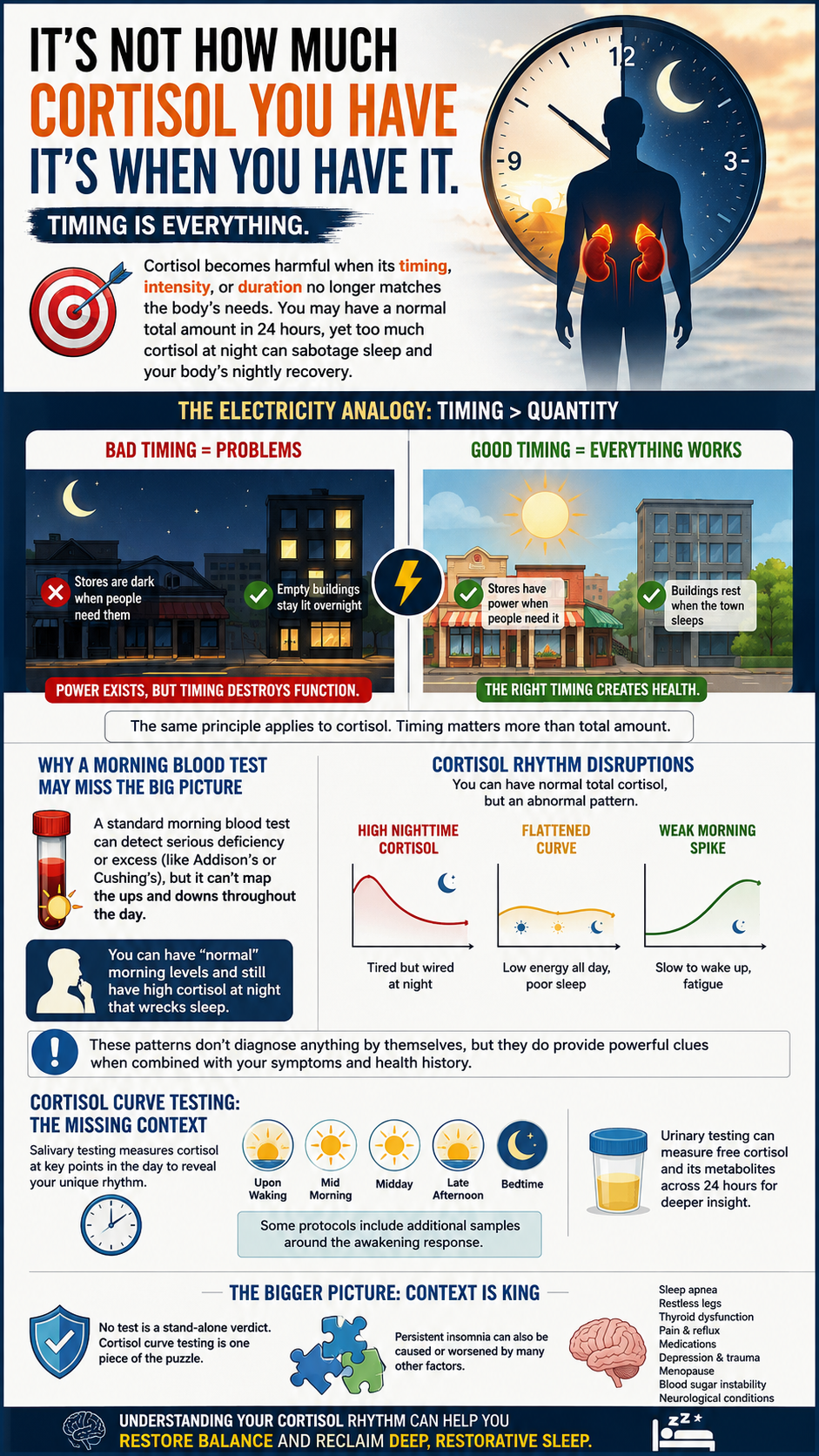
Consequently, someone may receive a normal laboratory result despite experiencing a clinically meaningful rhythm disturbance. Morning cortisol could appear ordinary, while bedtime cortisol remains inappropriately elevated. Another person may show a weak awakening response followed by a flattened curve.
These patterns do not automatically establish a diagnosis. Cortisol varies with awakening time, illness, medications, nicotine, exercise, food, psychological stress, and collection errors. However, properly collected measurements can provide useful context when interpreted beside symptoms and medical history.
A cortisol curve attempts to examine that missing context. Salivary testing commonly measures cortisol after awakening, around midday, during late afternoon, and near bedtime. Certain protocols include additional samples around the awakening response. Urinary testing can provide different information about free cortisol and cortisol metabolites.
No test should become a stand-alone verdict. Instead, the curve should serve as one part of a broader investigation. Persistent insomnia may also involve sleep apnea, restless legs, thyroid dysfunction, pain, reflux, medication effects, depression, trauma, menopause, blood sugar instability, or neurological disease.
Hyperarousal: When the Brain Treats Bedtime Like an Emergency
Chronic insomnia often involves hyperarousal, which means the nervous system remains unusually activated. The person may feel exhausted, yet the brain continues monitoring for threats. Thoughts accelerate, muscles tighten, breathing becomes shallow, and ordinary sounds feel intrusive.
This state does not require a visible emergency. The danger may exist as an unfinished deadline, financial uncertainty, relationship conflict, chronic pain, or accumulated sleep anxiety. Once repeated often enough, the bedroom itself can become a conditioned signal for vigilance.
The HPA axis participates in this biological alarm system. Increased corticotropin-releasing hormone and cortisol promote alertness when survival requires action. That response becomes useful during genuine danger. However, nighttime activation directly conflicts with the neurological conditions required for restorative sleep.
Research has associated chronic insomnia with moderately increased cortisol levels. Elevated evening cortisol has also been linked with sleep fragmentation. Abnormal nighttime cortisol pulses may reinforce wakefulness and shorten periods of consolidated sleep.
The relationship also moves in both directions. Stress chemistry can disturb sleep, while disturbed sleep can increase future stress reactivity. Poor sleep quality may intensify HPA-axis responses during subsequent challenges. Therefore, insomnia can become both the result and producer of physiological stress.
One difficult night may begin with a legitimate crisis. The following night brings anxiety about repeating the experience. Soon, the person watches the clock, calculates remaining sleep, and anticipates tomorrow’s collapse. That expectation generates more arousal, strengthening the cycle.
Eventually, the original trigger may disappear while the conditioned response remains. Bedtime no longer represents safety, darkness, and recovery. Instead, it predicts frustration, effort, calculation, and failure. Cortisol becomes one participant within this larger learned and physiological pattern.
Where the Cortisol Curve Becomes Distorted
No single cause explains every abnormal cortisol pattern. The disturbance usually develops through accumulated signals rather than one dramatic event. Modern life supplies those signals with extraordinary consistency.
Artificial light extends daytime far beyond sunset. Bright indoor lighting, televisions, tablets, and phones send timing information through the eyes. That exposure can delay melatonin secretion and reinforce nighttime alertness. Irregular bedtimes further confuse the brain’s internal clock.
Morning behavior also matters. Many people awaken indoors, avoid natural light, and immediately consume caffeine. They receive little environmental confirmation that morning has arrived. Hours later, they encounter brighter light from offices, stores, screens, and evening entertainment.
Work stress adds another powerful signal. Deadlines, electronic messages, financial pressure, and constant availability prevent neurological closure. The body receives no clear boundary between danger and recovery. Even leisure becomes performance-driven, measured, photographed, and shared.
Blood sugar instability can intensify this stress pattern. Highly refined evening foods may produce rapid glucose changes. Alcohol can create sedation initially, yet it often fragments later sleep. Restrictive dieting may also provoke nighttime awakenings when energy availability becomes inadequate.
Excessive caffeine extends far beyond the morning cup. Its metabolism varies considerably between individuals. Afternoon caffeine may remain active at bedtime, especially among slower metabolizers. People then interpret their chemically sustained alertness as mysterious insomnia.
Overtraining creates another overlooked burden. Exercise usually supports sleep and stress resilience. However, intense evening training may delay physiological downshifting. High training volume without adequate nutrition or recovery can also worsen fatigue and sleep disruption.
Inflammation, infections, pain, and environmental disturbances add further strain. Noise, heat, breathing difficulty, and reflux repeatedly activate protective responses. Each awakening may stimulate cortisol and sympathetic activity. The sleeper may forget these events, although the body still experiences them.
Shift work can produce even deeper disruption. Human physiology expects predictable relationships between light, food, movement, and sleep. Rotating schedules continually change those relationships. The body cannot easily decide when cortisol should rise or when melatonin should dominate.
The “Tired but Wired” Pattern Is a Biological Contradiction
People with disrupted stress rhythms often describe themselves as tired but wired. That phrase captures a profound biological contradiction. Energy production feels inadequate during daylight, while nervous-system activation rises during the expected recovery period.
Morning may begin with heaviness, dizziness, nausea, or mental fog. Several alarms become necessary. Appetite may remain absent initially, yet sugar cravings appear later. Caffeine temporarily improves function, although it may also borrow alertness from the coming night.
Afternoon often brings a pronounced crash. Concentration weakens, motivation drops, and irritability increases. Some people require another stimulant, creating the next stage of the cycle. Others reach for sugar, which provides brief relief followed by another decline.
Evening produces an unexpected second wind. The person suddenly feels productive, creative, hungry, or socially engaged. Tasks postponed throughout the day become strangely appealing. That alertness often gets mistaken for a natural nighttime personality.
Bedtime then becomes an exhausting negotiation. The body aches for rest, while the mind accelerates. Sleep may take hours, or it may arrive quickly before breaking apart around 1:00 a.m. Others awaken near 3:00 a.m. with pounding thoughts or an inexplicable sense of danger.
These symptoms do not prove abnormal cortisol. Sleep apnea, medications, hormonal transitions, trauma, and glucose disturbances can create similar experiences. Nevertheless, the pattern should encourage a broader investigation rather than another reflexive sedative prescription.
What Chronic Cortisol Disruption Does to the Body
Sleep represents active biological repair rather than simple unconsciousness. During healthy sleep, the brain reorganizes memories, clears metabolic waste, and regulates emotion. Tissues perform maintenance, immune signals change, and metabolic systems recalibrate for the coming day.
Repeated nighttime cortisol elevation interferes with this recovery environment. HPA-axis activation promotes arousal and can reduce sleep continuity. Deep sleep normally restrains HPA activity. When stress signaling remains active, that natural inhibitory relationship becomes weakened.
The brain experiences some of the earliest consequences. Attention weakens, memory becomes unreliable, and emotional regulation deteriorates. Minor frustrations feel disproportionately threatening. Decision-making becomes less precise because the prefrontal cortex operates under sleep debt.
Metabolic function also begins changing. Sleep loss can impair glucose regulation and increase hunger signals. Cravings often shift toward fast energy sources. Elevated stress chemistry can further encourage glucose mobilization, making stable energy more difficult.
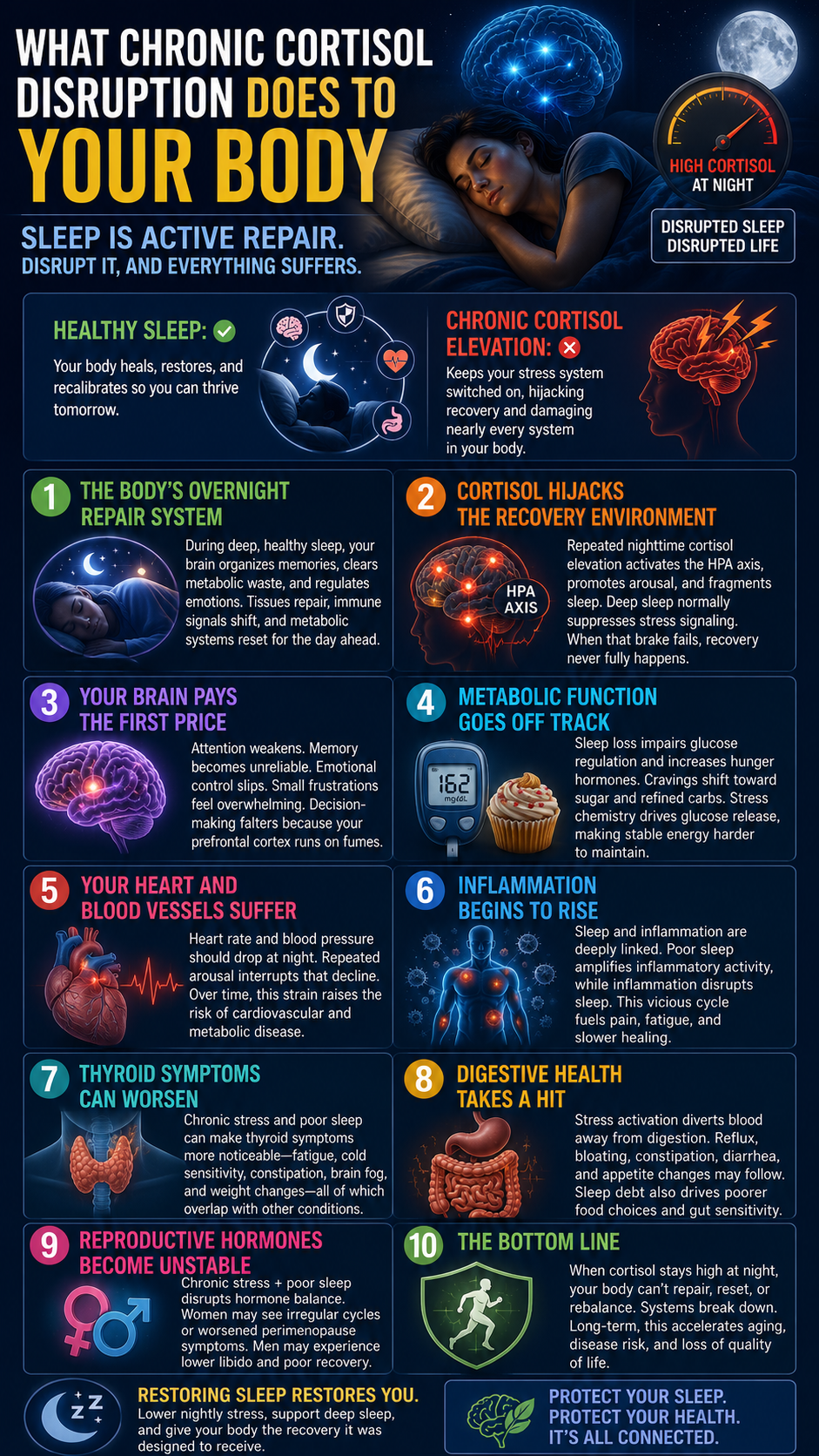
Cardiovascular systems lose valuable nighttime recovery. Heart rate and blood pressure should decline during restful sleep. Repeated arousal interrupts that descent. Over time, insomnia becomes associated with broader cardiovascular and metabolic concerns, although individual risk varies.
Immune regulation also suffers. Sleep and inflammatory signaling remain closely connected. Inadequate sleep can amplify inflammatory activity, while inflammation can disturb sleep. This feedback loop may intensify pain, fatigue, and impaired recovery.
Thyroid symptoms may appear more pronounced, even without primary thyroid disease. Fatigue, cold sensitivity, constipation, weight changes, and brain fog can overlap across several conditions. Therefore, clinicians should investigate rather than assuming every symptom comes from the adrenal glands.
The digestive system often becomes another casualty. Sympathetic activation diverts resources away from digestion. Reflux, bloating, appetite changes, constipation, and loose stools may follow. Poor sleep can also alter food choices, meal timing, and gastrointestinal sensitivity.
Reproductive hormones may become disrupted when chronic stress combines with insufficient sleep. Women may notice cycle irregularity or worsened perimenopausal symptoms. Men may experience reduced libido or impaired recovery. These changes require comprehensive assessment rather than hormonal guesswork.
The Naming Dispute Should Not Silence the Patient
Conventional endocrinology correctly warns that “adrenal fatigue” lacks a standardized diagnostic definition. The concept also risks confusing HPA-axis dysregulation with true adrenal insufficiency. Addison’s disease requires medical evaluation and can become life-threatening.
However, dismissing the label should never mean dismissing the person. Patients using that term usually describe a recognizable collection of symptoms. They feel exhausted, overstimulated, unrefreshed, cognitively impaired, and unable to recover.
The strongest position avoids both extremes. It should not claim that adrenal glands simply wear out from stress. It also should not pretend that chronic stress leaves cortisol rhythms, autonomic function, sleep, and metabolism untouched.
A more accurate framework examines HPA-axis regulation, circadian timing, autonomic balance, sleep behavior, metabolic stability, and underlying disease. This language honors scientific uncertainty without abandoning clinical curiosity. It also produces better questions.
The critical question becomes larger than “Are the adrenals tired?” A stronger investigation asks whether the person’s entire stress-response network has lost its timing. That question opens the door to meaningful testing, safer interpretation, and more effective recovery.
Testing the Whole Day Instead of One Moment
Cortisol curve testing can reveal patterns that a single measurement cannot capture. However, testing quality depends heavily upon timing and collection accuracy. A poorly collected curve may create more confusion than clarity.
Salivary cortisol reflects free cortisol at specific collection times. Common protocols include awakening, midday, late afternoon, and bedtime samples. More detailed protocols assess the awakening response with samples immediately after waking and again afterward.
Collection timing must follow actual awakening rather than an arbitrary clock time. Food, brushing teeth, nicotine, caffeine, exercise, illness, bleeding gums, and medications may affect results. Therefore, every laboratory’s collection instructions deserve careful attention.
A flattened curve may show little difference between morning and evening. Another curve may reveal low morning cortisol with elevated nighttime secretion. Some patterns show an exaggerated morning response followed by a steep afternoon collapse.
These findings should never be interpreted through pattern charts alone. Symptoms, medications, sleep timing, medical history, and collection conditions must shape interpretation. Abnormal results may require conventional endocrine testing before lifestyle experimentation.
Anyone experiencing unexplained weight loss, vomiting, fainting, severe weakness, very low blood pressure, or skin darkening needs medical evaluation. Those signs may indicate true adrenal insufficiency. Cortisol supplements or glandular products should not replace appropriate diagnosis.
Likewise, weight gain, easy bruising, purple stretch marks, muscle weakness, or uncontrolled hypertension deserve investigation. Those findings may suggest pathological cortisol excess. A wellness protocol cannot safely manage a serious endocrine disorder.
Begin With Morning Light, Not a Morning Screen
The most powerful reset begins after awakening. Natural outdoor light provides the brain with a strong daytime signal. Morning light helps anchor the circadian clock, which influences cortisol timing, melatonin release, appetite, temperature, and alertness.
Go outdoors shortly after waking whenever conditions allow. Remain outside for several minutes on bright mornings. Cloudy conditions often require longer exposure because indoor light remains much weaker than daylight.
Windows reduce portions of the light signal, so outdoor exposure works better. Sunglasses may also reduce retinal light input. Eye protection remains appropriate when medically necessary, although routine morning light should reach the eyes indirectly.
Never stare directly into the sun. Simply face the general direction of daylight while walking, stretching, or drinking water. Consistency matters more than perfection because the brain learns timing through repeated environmental signals.
Morning movement strengthens that message. A relaxed walk raises body temperature and supports daytime alertness. Exercise also creates a clean distinction between active daylight hours and the coming night.
Keep the wake time relatively consistent, including weekends. Sleeping several hours later creates social jet lag. The body experiences that shift like repeated travel across time zones, even when the person never leaves home.
Create a Predictable Cortisol Descent
Healthy sleep begins long before entering bed. The nervous system needs a gradual descent rather than an abrupt shutdown. A person cannot remain stimulated until 10:59 p.m. and demand unconsciousness at 11:00 p.m.
Establish an evening transition lasting approximately 60 to 90 minutes. Lower household lighting and reduce unnecessary screen exposure. Finish demanding work before this period whenever possible. Unresolved tasks should move onto paper rather than remaining inside working memory.
A written shutdown ritual can reduce cognitive vigilance. Record unfinished responsibilities, tomorrow’s priorities, and any important concerns. Then assign each concern a future action time. This practice tells the brain that forgetting is no longer necessary.
Choose quiet activities that repeat nightly. Reading, gentle stretching, prayer, calm conversation, or warm bathing can become conditioned safety signals. Repetition teaches the nervous system what happens next.
Keep the bedroom dark, cool, and quiet. Remove visible clocks when clock-watching fuels anxiety. Silence phone notifications and charge devices outside the room. The sleeping environment should communicate one unmistakable message.
Rebuild Blood Sugar Stability Without Constant Snacking
Nighttime awakenings sometimes occur beside unstable glucose regulation. However, the solution does not require eating every two hours. Constant grazing may disrupt appetite signals and encourage metabolic dependence upon frequent fuel.
Begin with balanced daytime meals containing adequate protein, healthy fats, and fiber-rich whole foods. Protein supports satiety and tissue repair. Healthy fats slow digestion, while appropriate fiber helps moderate glucose absorption.
Avoid making refined carbohydrates the center of dinner. Sugary desserts, sweetened drinks, and processed snacks can create rapid glucose changes. Alcohol may cause sleepiness initially, yet later metabolism often fragments sleep.
Meal timing should remain reasonably consistent. Large meals immediately before bed can worsen reflux and body temperature. Conversely, severe caloric restriction may increase nighttime hunger and physiological stress.
People following low-carbohydrate or fasting plans should monitor sleep carefully. Some thrive with those approaches, while others develop nighttime alertness or early awakenings. Nutrition should support recovery rather than become another stress contest.
A small evening snack may help selected individuals, especially after inadequate daytime intake. Choose a simple combination of protein and fat rather than sugar alone. The goal involves stability, not repeated nocturnal feeding.
Use Caffeine Strategically Instead of Medicinally
Caffeine often becomes self-prescribed treatment for an abnormal energy curve. Morning fatigue demands coffee, while afternoon exhaustion demands another dose. Nighttime sleep then deteriorates, creating greater dependence the following morning.
Track total caffeine from coffee, tea, energy drinks, chocolate, workout products, and medications. Many people underestimate their actual intake. Energy drinks may contain several stimulants, making the total effect difficult to predict.
Move caffeine earlier during the day. A practical experiment involves stopping by late morning for two weeks. Sensitive individuals may need complete removal during the reset period.
Withdrawal can cause headaches, irritability, and fatigue. Gradual reduction often feels easier than abrupt elimination. Replace the ritual with decaffeinated beverages, herbal tea, mineral water, or a brief outdoor walk.
Do not mistake withdrawal fatigue for proof that caffeine remains necessary. The brain needs time to recalibrate adenosine signaling. Sleep quality may improve after the adjustment period passes.
Exercise Hard Enough to Adapt, Not Collapse
Movement supports circadian alignment, insulin sensitivity, mood, and sleep quality. Physical activity can also influence cortisol regulation. The correct dose creates adaptation, while excessive training creates another stressor.
Begin with daily walking and two or three weekly strength sessions. Resistance training supports metabolic health and preserves muscle. Sessions do not need extreme volume to produce meaningful benefits.
Schedule intense exercise earlier when late sessions create alertness. Gentle evening walking may support digestion and glucose control without excessive stimulation. Individual responses matter more than universal rules.
Watch for declining performance, elevated resting pulse, irritability, soreness, and reduced motivation. Those signs may indicate inadequate recovery. More exercise will not repair an overreached nervous system.
Include at least one lower-demand day each week. Recovery remains part of training rather than evidence of weakness. Sleep often improves when the exercise plan stops competing with the body’s repair needs.
Train the Nervous System to Recognize Safety
Stress reduction must move beyond vague instructions to relax. The nervous system requires specific, repeated experiences of safety. Those experiences gradually reduce unnecessary vigilance and improve physiological flexibility.
Slow breathing offers one accessible starting point. Inhale comfortably through the nose, then make the exhale slightly longer. Continue for five minutes without forcing unusually deep breaths.
A longer exhale may support parasympathetic activity and reduce respiratory overdrive. Dizziness means the breathing pattern has become too aggressive. Effective breathing should feel quiet, comfortable, and sustainable.
Progressive muscle relaxation can also reduce hidden tension. Tighten one muscle group gently, then release it fully. Move gradually from the feet toward the face while noticing the difference between effort and relaxation.
Cognitive behavioral therapy for insomnia remains a leading evidence-based treatment for chronic insomnia. It addresses conditioned arousal, sleep scheduling, unhelpful beliefs, and time spent awake in bed. Sleep hygiene alone rarely provides the same depth.
Stress-management interventions can influence cortisol measurements, although responses vary across individuals. The goal should involve improved regulation rather than forcing cortisol lower at every moment. Healthy cortisol must rise when activity and genuine stress require it.
Stop Fighting the Bed
People with insomnia often increase their effort as sleep worsens. They go to bed earlier, remain there longer, cancel activities, and chase supplements. Unfortunately, excessive sleep effort can strengthen the association between bed and frustration.
Enter bed when genuinely sleepy rather than merely exhausted. Sleepiness includes heavy eyelids, slowed thinking, and repeated yawning. Fatigue alone may feel depleted without producing sleep readiness.
When wakefulness becomes prolonged, leave the bed temporarily. Sit somewhere dim and complete a quiet activity. Return when sleepiness reappears.
This approach helps retrain the brain’s association with the bed. The mattress should predict sleep rather than worry, work, scrolling, or argument. Consistency gradually rebuilds that relationship.
Avoid calculating remaining sleep after every awakening. Those calculations create threat and urgency. The body sleeps poorly when every passing minute feels dangerous.
Investigate the Root Causes That Lifestyle Cannot Correct
Home strategies create a strong foundation, but they cannot correct every cause. Persistent insomnia deserves a complete evaluation, especially when symptoms continue beyond three months. Chronic insomnia generally involves repeated sleep difficulty with meaningful daytime impairment.
Loud snoring, witnessed breathing pauses, morning headaches, and daytime sleepiness may indicate sleep apnea. Crawling leg sensations may suggest restless legs syndrome. Pain, reflux, urinary symptoms, hot flashes, and breathing problems also require targeted care.
Laboratory investigation may include thyroid markers, glucose regulation, iron status, blood counts, nutrient markers, and appropriate hormonal testing. The exact selection should follow the person’s history rather than a universal panel.
Medication review remains essential. Stimulants, corticosteroids, decongestants, thyroid medication, certain antidepressants, and other drugs may affect sleep. Never discontinue prescribed medication without professional guidance.
Mental health and trauma also deserve compassionate attention. Hypervigilance may reflect experiences that cannot be solved through supplements. Skilled therapy can help the brain distinguish current safety from remembered danger.
Cortisol curve testing becomes most useful when it answers a defined clinical question. It should not function as an expensive wellness ornament. Results must change the investigation, treatment plan, or monitoring strategy.
A Seven-Day Home Reset for the Cortisol Curve
Spend one week creating clearer signals rather than chasing perfect sleep. Wake at the same time daily and obtain outdoor light soon afterward. Add a short morning walk to strengthen the daytime message.
Eat structured meals with adequate protein and avoid using sugar as emergency energy. Stop caffeine before noon and remove alcohol during the experiment. Record energy, cravings, mood, and sleep without judging the results.
Dim lights during the final 90 minutes before bed. Write tomorrow’s tasks on paper and close the workday deliberately. Keep the bedroom cool, dark, quiet, and free from visible clocks.
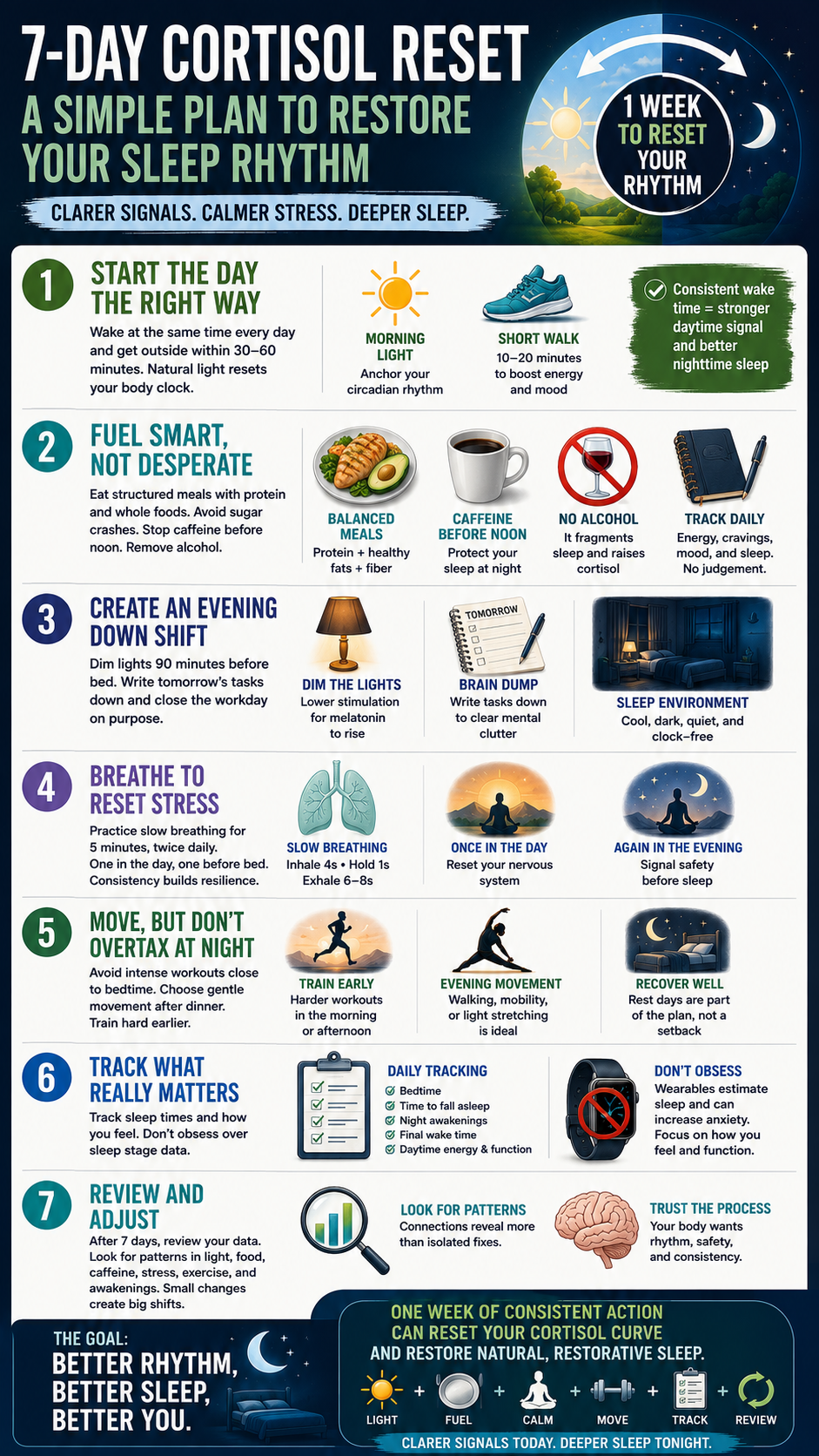
Practice five minutes of slow breathing twice daily. One session can occur during daylight, while another belongs inside the evening transition. Regular practice works better than emergency breathing during panic.
Avoid intense nighttime training during the reset. Choose walking, mobility exercises, or gentle stretching instead. Schedule harder exercise earlier and include adequate recovery.
Track bedtime, estimated sleep onset, awakenings, final waking, and daytime function. Do not obsess over wearable sleep stages. Consumer devices estimate sleep and may increase anxiety when treated as diagnostic instruments.
After seven days, review the pattern. Look for relationships among caffeine, light, food, stress, exercise, and awakenings. Those connections often reveal more than isolated supplement experiments.
Sleep Returns When the Body Receives Clearer Instructions
Insomnia rarely begins because the body has forgotten how to sleep. More often, competing signals have overwhelmed the ancient system controlling wakefulness and recovery. Light says daytime, caffeine says perform, anxiety says danger, and exhaustion says collapse.
Cortisol stands near the center of that conflict, but it never acts alone. The hormone responds to the brain, environment, metabolism, immune system, and daily behavior. Therefore, lasting improvement requires more than forcing one laboratory number into range.
The cortisol curve can expose mistimed stress signaling that a single blood test misses. It may reveal an elevated evening pattern, a weak morning rise, or a flattened daily rhythm. Yet the test becomes meaningful only when connected to the patient’s complete story.
“Adrenal fatigue” may remain an imperfect term. Still, the exhaustion, nighttime alertness, and impaired recovery remain real. Better language should sharpen the search for answers rather than silence the person asking for help.
Restoration begins by rebuilding rhythm. Morning light must become brighter, while evening light becomes softer. Daytime movement must become consistent, while nighttime stimulation becomes quieter. Meals must support stability, and stress must finally receive an exit.
Sleep cannot be commanded through force. It emerges when the brain senses darkness, timing, safety, and physiological readiness. Once those signals align, the bed stops becoming a battlefield. It becomes what biology always intended: a place where the body remembers how to heal.