
The idea that the human body is a “temple” is often quoted, frequently admired, and rarely explored in its full depth. For many, it remains a poetic phrase—something inspirational but abstract, meaningful but disconnected from daily life and real physiology. Yet when you begin to unpack this concept through both a biblical lens and a biological one, something remarkable emerges. The metaphor is not shallow. It is not symbolic in a casual sense. It is layered, architectural, and surprisingly precise.
In the Bible, specifically in 1 Corinthians 6:19, the statement is made that your body is a temple of the Holy Spirit. To the modern reader, this might sound like encouragement toward moral behavior or personal responsibility. But to the original audience—people deeply familiar with the structure and sacred function of the Temple in Jerusalem—this was a profoundly specific comparison. A temple was not merely a building. It was a carefully designed system with layers, boundaries, roles, and sacred purpose. It was a place where order, access, and function were intentionally structured.
When you begin to examine the human body through that same lens, the parallels are not forced. They are striking.
Architecture of the Temple: Order, Layers, and Access
Ancient temples were not random collections of rooms. They were organized with intention, built in layers that reflected increasing levels of restriction and significance. There was the outer court, where general interaction occurred. There was the inner court, where more specific functions were carried out by designated individuals. And then there was the Holy of Holies, the most sacred and protected space, where access was extremely limited and carefully controlled.
This structure was not arbitrary. It represented hierarchy, protection, and purpose. The closer one moved toward the center, the more guarded and significant the space became.
Now consider the human body.
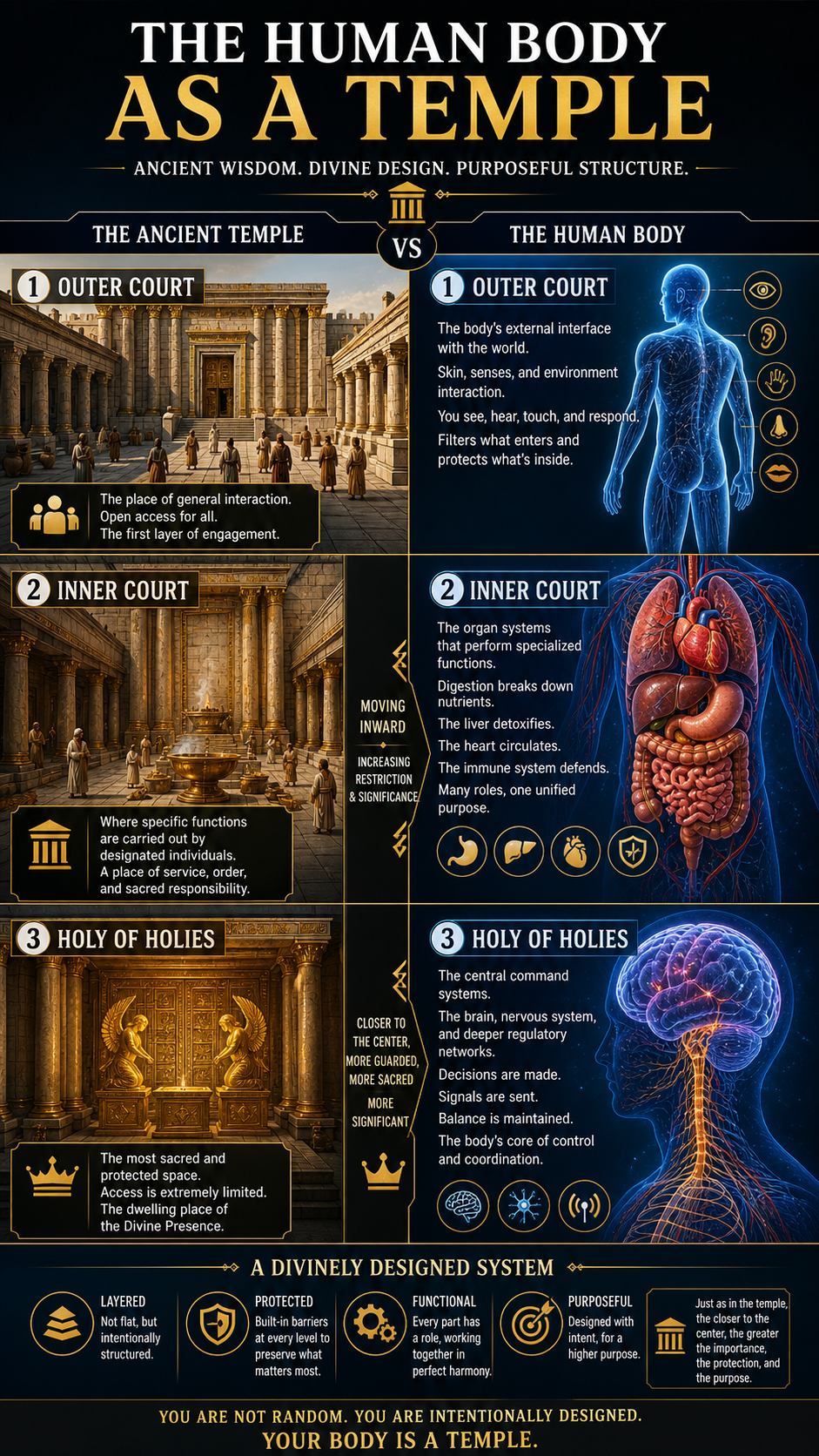
At the most external level, the body interfaces with the world through the skin and sensory systems. This is your “outer court,” where interaction with the environment takes place. You see, hear, touch, and respond. This layer is constantly processing information and filtering what is allowed further in.
Moving inward, you encounter the organ systems—the digestive system, circulatory system, immune system, and others. These are your “inner courts,” where specialized functions occur. Each system has a role, and each works in coordination with the others. Digestion breaks down nutrients. The liver detoxifies. The heart circulates. The immune system defends. There is division of labor, yet unity of purpose.
At the core lies the central command systems—the brain, the nervous system, and the deeper regulatory networks that coordinate every function in the body. This is where decisions are made, signals are sent, and balance is maintained. If we extend the temple analogy, this is akin to the Holy of Holies—not in a mystical sense, but in terms of importance, protection, and central control.
What becomes evident is that the body is not a flat system. It is layered, hierarchical, and intentionally organized.
The Cell: A Temple Within the Temple
If the body reflects the structure of a temple, the story becomes even more compelling when you zoom in to the cellular level. Every cell in your body—of which there are trillions—follows a similar architectural pattern.
This is where the analogy stops being philosophical and starts becoming almost undeniable in its structural parallels.
Each cell has a membrane, a boundary that separates the internal environment from the external world. This membrane is not passive. It is selective, intelligent in function, and highly regulated. It determines what enters and what is kept out. Nutrients are allowed in. Waste is expelled. Harmful substances are blocked or neutralized when possible.

This is your cellular “outer wall,” functioning much like the gates of a temple.
Inside the cell, you find a complex environment filled with organelles—specialized structures that perform distinct functions. Mitochondria generate energy. Ribosomes build proteins. The endoplasmic reticulum processes and transports molecules. The Golgi apparatus packages and distributes them. Each component has a role, and together they maintain the life of the cell.
This is your “inner court,” where the daily work is carried out.
At the very center lies the nucleus, which contains DNA—the blueprint for the entire organism. This is the most protected and controlled region of the cell. It is shielded by multiple layers, and access to it is tightly regulated. The information stored here determines how the cell functions, how it replicates, and how it responds to its environment.
This is the cellular equivalent of the Holy of Holies.
The pattern is unmistakable: boundary, function, and core identity.
The Blueprint: DNA as Instruction and Identity
DNA is often described in purely mechanical terms—as a code, a sequence, a set of instructions. While this is accurate, it is incomplete. DNA is not just data. It is organized information with purpose. It directs the construction of proteins, the regulation of processes, and the adaptation of the organism.
Within the nucleus, DNA is tightly coiled and carefully managed. It is not left exposed or vulnerable. It is protected, preserved, and accessed only when needed. This level of control reflects the importance of the information it contains.
From a structural standpoint, this reinforces the idea of a protected core. Just as the innermost chamber of a temple held the most sacred elements, the nucleus holds the most critical information for life.
What is fascinating is that this pattern repeats at multiple levels. The body is structured in layers. Each organ is composed of tissues. Each tissue is made of cells. Each cell contains a nucleus. Each nucleus houses DNA. At every level, there is organization, protection, and purpose.
This is not chaos. It is order.
Communication: The Silent Language of the Body
One of the most overlooked aspects of the body’s design is its communication system. Cells do not operate in isolation. They are constantly sending and receiving signals, adjusting their behavior based on internal and external cues.
Hormones travel through the bloodstream, delivering messages from one part of the body to another. Neurotransmitters transmit signals across the nervous system with incredible speed. Immune cells communicate to coordinate defense responses. Even at the cellular level, chemical signals regulate activity, growth, and repair.
This level of coordination is not accidental. It requires precise timing, accurate signaling, and responsive systems.
In the context of the temple analogy, this can be compared to the organized roles within the temple structure. There were specific duties, coordinated actions, and clear lines of responsibility. Everything functioned within a system of order.
The body reflects that same principle. It is not just a collection of parts. It is an integrated system.
Protection: Guarding the Inner Environment
A temple was designed to protect what was sacred. There were walls, gates, and layers of access control. Not everyone could enter every space, and not everything was allowed inside.
The body operates in a similar way.
The skin acts as a physical barrier, protecting against environmental threats. The immune system identifies and neutralizes harmful invaders. The blood-brain barrier protects the central nervous system from potentially damaging substances. At the cellular level, membranes regulate entry and exit.
These protective mechanisms are essential. When they are compromised, problems arise.
For example, when the intestinal barrier becomes permeable—a condition often referred to as “leaky gut”—substances that should remain contained begin to enter the bloodstream. This can trigger immune responses, inflammation, and a cascade of dysfunction throughout the body.
From a structural perspective, this is akin to a breach in the outer wall of a temple. Once the boundary is compromised, the inner systems are exposed to disruption.
Function: Daily Work Within the System
Inside a temple, there were daily activities—rituals, maintenance, and responsibilities that kept the system functioning. These tasks were carried out with precision and consistency.
The body mirrors this through its metabolic processes.
Every second, countless reactions are taking place. Nutrients are being broken down and converted into energy. Waste products are being processed and eliminated. Cells are being repaired or replaced. Systems are being regulated to maintain balance.
This is not occasional. It is continuous.
The liver detoxifies. The kidneys filter. The lungs exchange gases. The heart circulates blood. The brain coordinates everything. Each system contributes to the overall function of the body.
When these processes are supported, the body maintains health. When they are overwhelmed or disrupted, dysfunction begins to appear.
Balance: The Principle of Homeostasis
One of the defining characteristics of the body is its ability to maintain internal balance, a concept known as homeostasis. This involves regulating temperature, pH levels, fluid balance, and countless other variables.
This balance is not static. It is dynamic, constantly adjusting to changes in the environment and the internal state of the body.
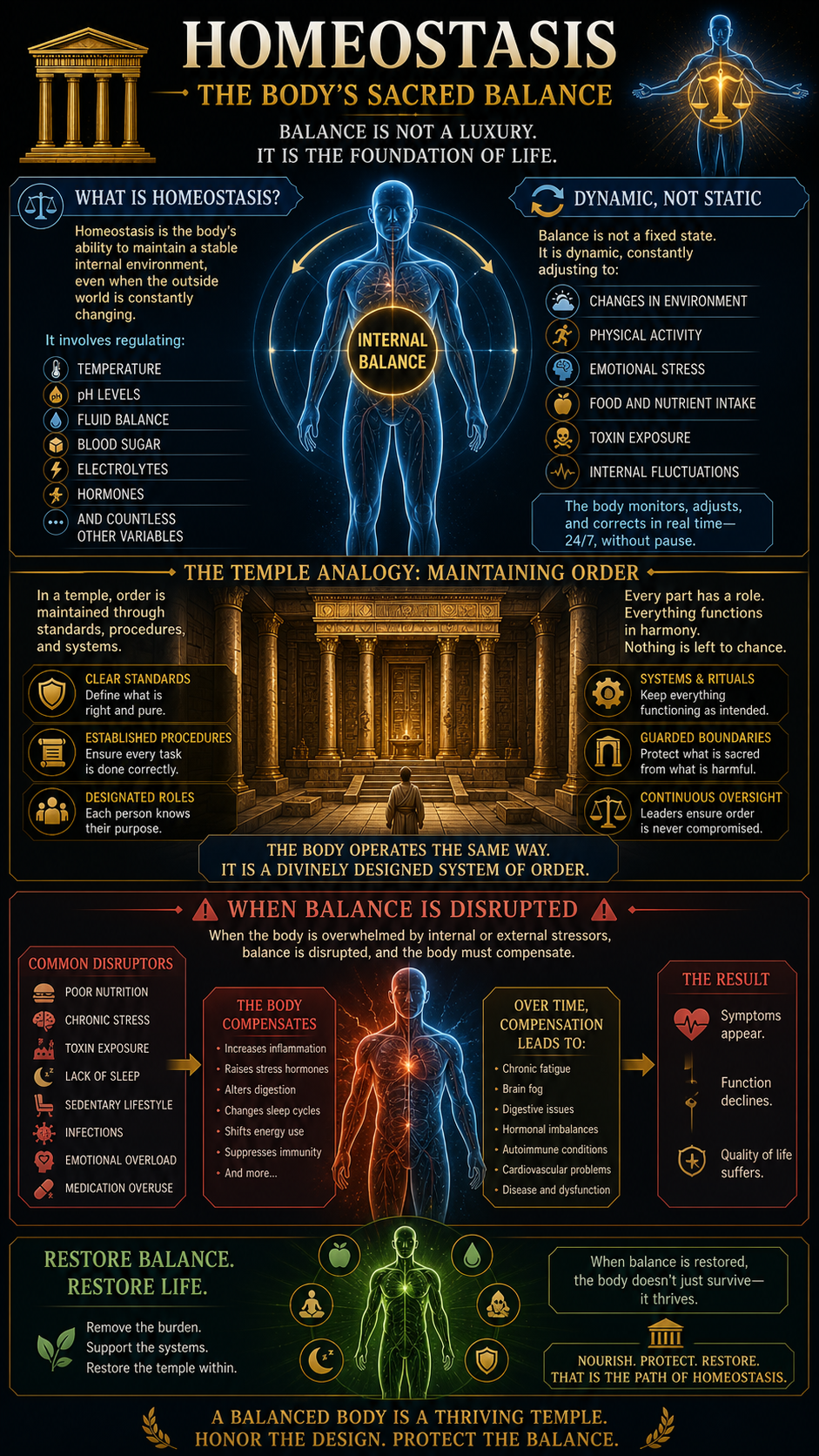
In the context of a temple, this can be compared to the maintenance of order. There were standards, procedures, and systems in place to ensure that everything functioned as intended.
The body does the same. It monitors, adjusts, and corrects in real time.
When balance is disrupted—whether through poor nutrition, chronic stress, toxin exposure, or other factors—the body attempts to compensate. Over time, these compensations can lead to symptoms and disease.
Interference: When the System Is Disrupted
If the body is designed with such precision, why does dysfunction occur?
The answer often lies in interference.
Interference can take many forms: toxins, inflammation, chronic stress, poor diet, lack of movement, and more. These factors disrupt the normal function of the body’s systems, creating imbalances and impairing communication.
At the cellular level, toxins can damage membranes, interfere with energy production, and disrupt signaling pathways. Inflammation can alter the behavior of cells and tissues, leading to dysfunction. Stress can affect hormonal balance and nervous system regulation.
When interference accumulates, the body’s ability to maintain balance is compromised.
In the temple analogy, this is similar to introducing disorder into a structured environment. If the boundaries are breached, if the roles are disrupted, if the system is overwhelmed, the integrity of the temple is affected.
Healing: Removing Interference and Supporting Function
The body has an inherent ability to heal. This is not a vague concept. It is observable in processes such as wound healing, immune responses, and cellular repair.
However, healing does not occur in isolation. It requires the removal of interference and the support of the body’s natural processes.
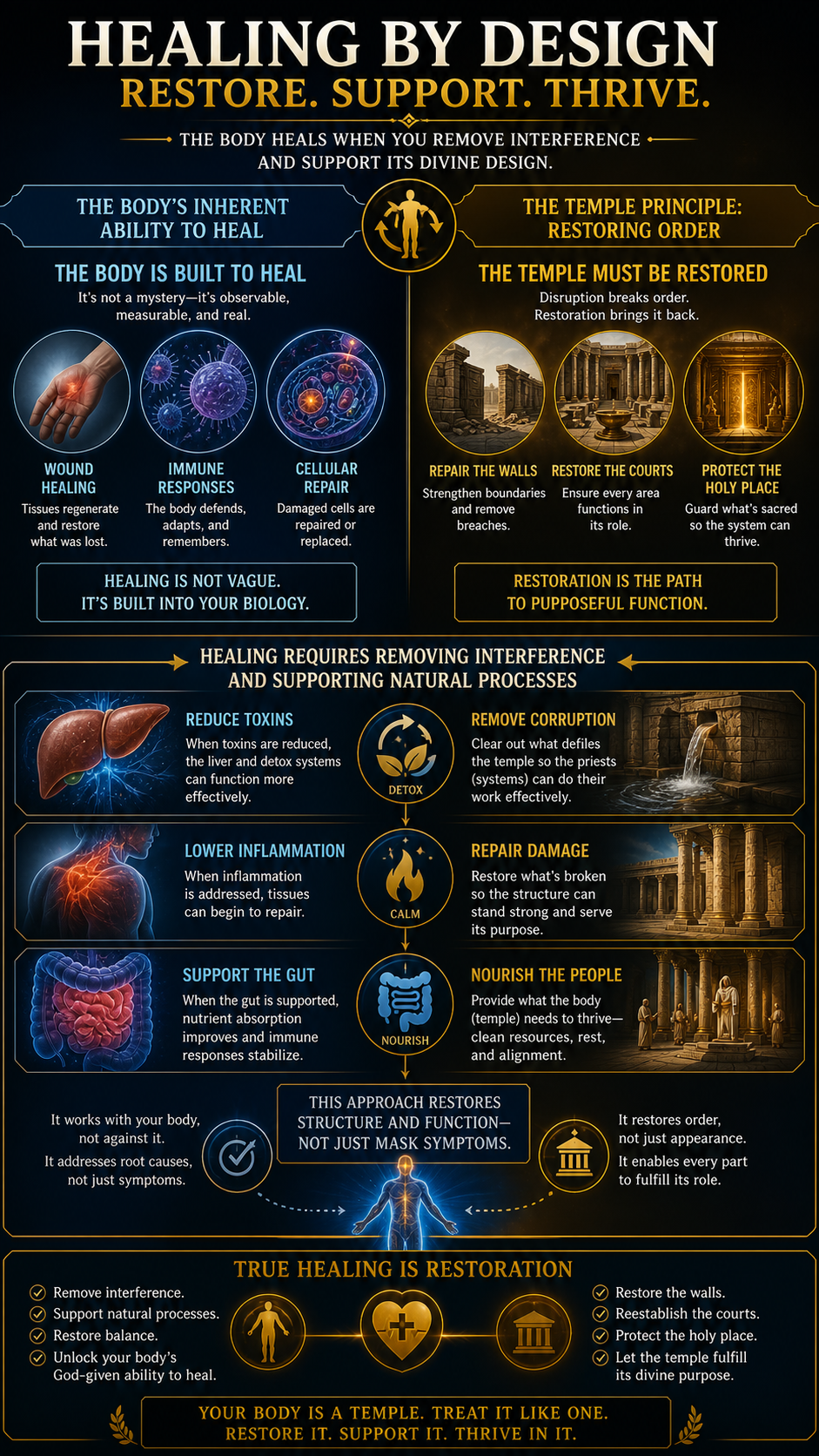
When toxins are reduced, the liver and detoxification systems can function more effectively. When inflammation is addressed, tissues can begin to repair. When the gut is supported, nutrient absorption improves and immune responses stabilize.
This approach focuses on restoring the structure and function of the body, rather than simply addressing symptoms.
In the temple analogy, this is equivalent to restoring order, repairing boundaries, and ensuring that each part of the system can fulfill its role.
A Fractal Design: Repeating Patterns Across Scales
One of the most compelling aspects of this concept is the repetition of patterns across different levels of organization.
The temple has layers: outer court, inner court, and sacred center. The body has layers: skin, organs, and central systems. The cell has layers: membrane, cytoplasm, and nucleus.
This repeating structure suggests a consistent design principle.
In mathematics and nature, this is often referred to as a fractal—a pattern that repeats at different scales. While the term is not necessary to understand the concept, it helps illustrate the idea that the same structural logic appears in multiple contexts.
This consistency reinforces the notion of intentional design.
A Perspective on Purpose
Understanding the body as a temple is not just an intellectual exercise. It has practical implications.
If the body is structured with intention, then how it is treated matters.
What is allowed into the body—through food, air, and environment—affects the outer boundaries. How the body is supported—through nutrition, movement, and rest—affects the inner systems. How stress is managed and how the nervous system is regulated affects the central control.
This perspective encourages a more comprehensive approach to health. It shifts the focus from isolated symptoms to the overall structure and function of the body.
Conclusion: Structure, Design, and Responsibility
The comparison of the human body to a temple is more than metaphor. It reflects a pattern of organization, protection, and purpose that can be observed at multiple levels.
From the layered structure of the body to the intricate design of the cell, there is a consistent theme: boundaries, function, and a protected core.
This does not require blind belief. It can be observed, studied, and understood.
The real question is what is done with that understanding.
If the body is a structured, integrated system designed to maintain balance and function, then supporting that system becomes a matter of respecting its design.
And when that design is respected, the body often does what it was built to do—maintain, repair, and sustain life.