
The Dangerous Myth That Has Defined Arthritis for Generations
For decades, millions of people have been told the same story about arthritis. The explanation sounds simple, logical, and scientific. Years of movement supposedly wear down cartilage. Joints slowly deteriorate. Bones begin rubbing together. Pain eventually becomes unavoidable. According to this narrative, arthritis represents little more than accumulated mileage on the human body.
The problem is that this explanation leaves countless questions unanswered. If arthritis results only from wear-and-tear, why do some people remain active and mobile into their eighties while others struggle in middle age? Why do many individuals with severe degeneration on imaging experience little discomfort? Why do some patients suffer debilitating pain despite relatively minor structural changes? Why does arthritis often worsen after periods of stress, poor sleep, illness, or dietary indulgence? Mechanical deterioration alone cannot adequately explain these observations.
Human joints do not behave like machine parts. A worn bearing does not become inflamed after eating sugar. A rusty hinge does not swell after a stressful week. An aging engine does not experience flare-ups because of immune dysfunction. Biological systems respond differently because they are alive. Every tissue inside the body constantly communicates with the immune system, nervous system, endocrine system, digestive tract, and metabolic machinery. Arthritis develops within this network of interactions rather than in isolation.
Modern science continues revealing that arthritis is often driven by chronic inflammation, immune dysregulation, metabolic dysfunction, impaired tissue repair, neurological stress, and poor biomechanics. Cartilage breakdown frequently represents the final visible outcome of a much deeper process. By the time symptoms emerge, the underlying drivers may have been active for years. Understanding these root causes transforms the way we think about arthritis and opens the door to strategies that address the source rather than merely suppressing symptoms.
Arthritis Begins Long Before the Joint Starts Hurting
Most people assume arthritis begins when pain appears. Reality tells a different story. Joint degeneration often develops quietly over many years before symptoms become noticeable. During this silent phase, inflammation gradually alters tissue function. Repair mechanisms become less effective. Mechanical stress accumulates. The body compensates in ways that mask the problem until a threshold is reached.
Healthy joints exist in a constant state of renewal. Cartilage cells remove damaged material and replace it with healthy tissue. Synovial fluid nourishes structures and reduces friction. Ligaments stabilize movement while muscles absorb mechanical stress. Every step, bend, and twist stimulates circulation and supports tissue maintenance. The body performs countless repair tasks each day without conscious awareness.

Trouble begins when the balance between damage and repair shifts. Inflammatory cytokines start accumulating within joint tissues. Oxidative stress increases. Nutrient delivery becomes less efficient. Cartilage-producing cells lose effectiveness. Connective tissue becomes less resilient. The joint enters a state where breakdown gradually exceeds regeneration.
Pain does not appear immediately because the body possesses remarkable compensatory abilities. Muscles adapt. Movement patterns change. Neighboring joints absorb additional stress. These adaptations delay symptoms but often worsen the underlying problem. Eventually the body’s ability to compensate becomes overwhelmed. At that point, stiffness, swelling, discomfort, and restricted mobility emerge.
The painful joint often represents the final warning signal rather than the beginning of the disease. Looking only at the symptom ignores the biological events that created the problem. True understanding requires examining what happened long before the first ache appeared.
The Autoimmune Root Behind Many Cases of Arthritis
The immune system serves as the body’s defense network. It identifies threats, coordinates repair, and maintains order throughout the organism. Under healthy circumstances, this system protects tissues while distinguishing self from non-self with remarkable precision. Autoimmune disease develops when that recognition process breaks down.
Rheumatoid arthritis offers a classic example. Instead of protecting the joints, immune cells begin attacking the synovial lining surrounding them. Swelling develops. Inflammatory chemicals flood the area. Cartilage deteriorates. Bone erosion follows. Over time, permanent structural damage may occur.
Many people view autoimmune disease as a random event. Emerging evidence suggests a more complicated reality. Autoimmune dysfunction often develops after years of cumulative stress affecting the body’s regulatory systems. Chronic infections, environmental toxins, nutrient deficiencies, digestive dysfunction, poor sleep, psychological stress, and blood sugar instability all influence immune behavior. When these factors persist long enough, the immune system may lose its ability to regulate itself appropriately.
Research increasingly demonstrates that inflammatory and immune mechanisms also contribute to osteoarthritis. Scientists once described osteoarthritis as a purely mechanical disease. That description no longer reflects current understanding. Inflammatory cytokines, immune-cell activation, oxidative stress, and synovial inflammation all play important roles in degenerative joint disease. The distinction between inflammatory arthritis and degenerative arthritis has become far less clear than once believed.
This shift in understanding changes the central question. Instead of asking why cartilage wore out, we begin asking why the immune system created an environment that accelerated tissue destruction. The answer often leads far beyond the joint itself.
The Gut-Joint Axis: Where Arthritis Often Begins
Few people associate digestive health with joint pain. Yet the connection between the gut and the immune system may be one of the most important discoveries in modern health science. The digestive tract performs far more than nutrient absorption. It acts as a major immune organ that constantly communicates with the rest of the body.
Approximately seventy percent of immune activity occurs in tissues associated with the gastrointestinal tract. Every meal influences immune signaling. Every bacterial population affects inflammatory balance. Every disruption in intestinal integrity changes how the immune system responds to the environment. The gut essentially functions as a training ground where immune cells learn what deserves a response and what should be tolerated.
Problems arise when the intestinal barrier becomes compromised. Stress, processed foods, medications, infections, toxins, alcohol, and poor nutrition may contribute to increased intestinal permeability. When this barrier weakens, substances enter circulation that should remain confined within the digestive tract. Food proteins, bacterial fragments, toxins, and inflammatory compounds begin interacting directly with immune cells.
Over time, this exposure can contribute to immune dysregulation. Chronic activation becomes the norm rather than the exception. Inflammatory chemicals circulate throughout the body. Some individuals develop food sensitivities. Others experience autoimmune conditions. Many begin noticing joint pain, fatigue, brain fog, skin issues, or digestive symptoms.
The knee that hurts may not be the true origin of the problem. The painful hand may simply represent the location where systemic inflammation has become visible. Addressing gut health therefore becomes an essential component of any comprehensive arthritis strategy.
Chronic Inflammation Is the Engine Driving Joint Destruction
Inflammation is often misunderstood. Many people view it as the enemy. In reality, inflammation serves a vital purpose when properly regulated. It eliminates harmful invaders, repairs damaged tissue, and protects the body during periods of injury or infection. Problems emerge when inflammation remains active long after its useful purpose has ended.
Chronic inflammation behaves like a fire that never completely goes out. Instead of producing healing, it gradually damages healthy tissue. Within joints, inflammatory cytokines stimulate destructive enzymes that break down cartilage. Oxidative stress damages cellular structures. Synovial tissues become irritated. Bone remodeling changes. Pain receptors become increasingly sensitive.
The consequences extend beyond the musculoskeletal system. Chronic inflammation affects blood vessels, hormones, metabolism, digestion, and brain function. Energy production declines. Sleep quality suffers. Cognitive performance decreases. Recovery becomes slower. The entire body enters a state of physiological stress that favors degeneration over repair.
Patients often describe feeling exhausted, stiff, and older than their chronological age. These symptoms reflect systemic dysfunction rather than isolated joint damage. Arthritis rarely stays confined to a single location because inflammation influences nearly every tissue in the body.
Reducing inflammatory burden therefore becomes one of the most important objectives in restoring joint health. The goal is not merely symptom reduction. The goal is creating a biological environment where healing once again becomes possible.
What Arthritis Is Doing to the Body Right Now
Every day that chronic arthritis remains active, subtle but important changes occur throughout the body. Cartilage loses resilience because inflammatory chemicals interfere with normal repair mechanisms. Synovial fluid becomes less effective at protecting joint surfaces. Ligaments and tendons experience greater stress because altered mechanics place abnormal loads on surrounding tissues.
Muscle function also changes. Protective tension develops around painful joints. Certain muscles become overactive while others weaken. Movement patterns become less efficient. Posture changes. Balance declines. These adaptations increase stress on neighboring joints and accelerate degeneration elsewhere in the body.
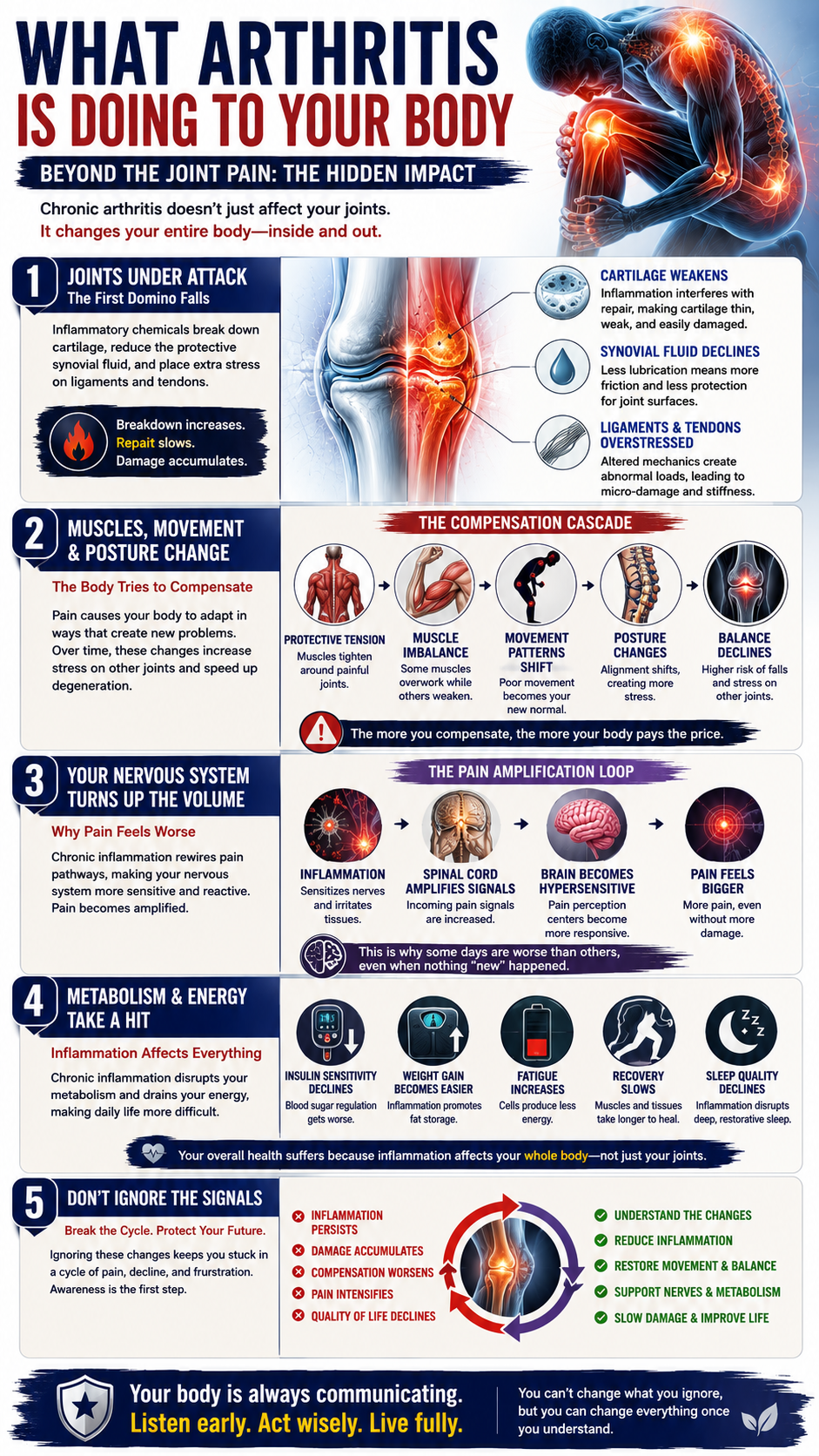
The nervous system becomes involved as well. Chronic inflammation sensitizes pain pathways. Nerves become more reactive. The spinal cord amplifies incoming signals. Brain regions associated with pain perception become increasingly responsive. This process helps explain why arthritis can feel worse even when structural damage has not significantly changed.
Metabolism often suffers during chronic inflammatory states. Insulin sensitivity declines. Fatigue increases. Weight gain becomes easier. Recovery after exercise slows. Sleep becomes less restorative. Many patients notice that their overall health deteriorates alongside their joint symptoms because the same inflammatory processes affect multiple systems simultaneously.
Ignoring these changes allows the cycle to continue. Understanding them creates opportunities to intervene before further damage occurs.
Why Chiropractic Mobility Matters
Movement is one of the most powerful healing tools available to the human body. Every healthy joint depends on motion for nourishment, circulation, and maintenance. Unfortunately, arthritis often creates a cycle where pain reduces movement and reduced movement accelerates degeneration.
Cartilage relies heavily on movement because it lacks a direct blood supply. Nutrients reach cartilage through pressure changes created during motion. Walking, bending, stretching, and normal activity help distribute synovial fluid throughout the joint. When movement decreases, nutrient delivery becomes less effective and waste removal slows.
Restricted mobility creates additional challenges. Muscles tighten around painful joints. Posture shifts. Weight distribution changes. Neighboring structures compensate for lost movement. Over time, these compensations increase mechanical stress and contribute to further degeneration.
Chiropractic care focuses on restoring motion throughout the musculoskeletal system. Improved mobility helps normalize joint mechanics, reduce abnormal stress, enhance circulation, and improve neurological communication. When joints move more efficiently, tissues receive better support and function becomes more coordinated.
The nervous system also benefits from restored mobility. Every joint contains sensory receptors that constantly communicate with the brain. Restricted joints send altered information that may contribute to pain and dysfunction. Improved movement enhances this communication and supports healthier neurological regulation.
Chiropractic mobility does not simply address symptoms. It addresses one of the underlying factors contributing to ongoing joint stress. When combined with anti-inflammatory lifestyle strategies, restored movement becomes a critical component of long-term joint health.
The Blood Sugar and Arthritis Connection
Few people realize that blood sugar levels influence arthritis progression. Excess sugar does far more than affect weight. It creates a biochemical environment that promotes inflammation and tissue damage.
Elevated glucose leads to the formation of compounds known as advanced glycation end products. These molecules damage proteins throughout the body, including collagen and cartilage. Connective tissue becomes stiffer and less resilient. Recovery slows. Joint function declines.
High insulin levels contribute additional problems. Inflammatory pathways become activated. Fat storage increases. Oxidative stress rises. Mitochondrial function declines. Together, these changes create conditions that favor degeneration rather than repair.
Excess body fat compounds the issue because fat tissue produces inflammatory chemicals. The more inflammation circulating through the body, the more stress the joints experience. This relationship helps explain why metabolic health and joint health are closely connected.
Improving blood sugar regulation often produces noticeable improvements in pain, energy, mobility, and overall well-being. Better metabolic function supports healthier tissues throughout the body.
How to Begin Fixing Arthritis at Home
The first step involves reducing inflammatory inputs. Whole foods provide nutrients necessary for tissue repair while minimizing inflammatory burden. High-quality protein supplies amino acids required for rebuilding connective tissue. Healthy fats support cell membranes and help regulate inflammatory pathways. Colorful vegetables provide antioxidants that combat oxidative stress.
Daily movement should become non-negotiable. Walking improves circulation, supports lymphatic drainage, and nourishes cartilage. Mobility exercises help maintain range of motion. Resistance training strengthens muscles that protect vulnerable joints. Consistency produces better results than occasional intense effort.

Supporting digestive health remains equally important. Improving the microbiome, addressing food sensitivities, and reducing intestinal inflammation may help calm immune activity. A healthier gut often translates into healthier joints because both systems remain closely connected.
Sleep deserves serious attention. Deep sleep supports tissue repair, hormone balance, immune regulation, and neurological recovery. Chronic sleep deprivation fuels inflammation and slows healing. Creating consistent sleep habits can dramatically improve recovery capacity.
Stress management influences arthritis more than most people realize. Chronic stress activates inflammatory pathways and disrupts immune regulation. Activities that calm the nervous system help create a physiological environment that supports healing rather than degeneration.
Finally, restoring mobility through chiropractic care and corrective movement addresses the biomechanical component of arthritis. Better movement patterns reduce unnecessary stress and improve overall function.
The Future of Arthritis Care
The future of arthritis care lies beyond the outdated wear-and-tear model. Modern understanding recognizes arthritis as a complex condition influenced by immunity, inflammation, digestion, metabolism, nervous system function, and biomechanics. Each factor contributes to the environment in which joints either heal or deteriorate.
This perspective offers something many arthritis sufferers desperately need: hope. The body is not a machine destined to break down. It is a dynamic biological system capable of adaptation and repair. When inflammation decreases, immune regulation improves, movement is restored, and metabolic health strengthens, meaningful improvements often occur.
The painful joint should not be viewed as the enemy. It should be viewed as a messenger. Symptoms frequently reveal deeper dysfunction that deserves attention. Listening to those signals may provide the opportunity to address the true causes before further damage develops.
Arthritis Is Not Simply Wear-and-Tear
The phrase wear-and-tear has survived because it sounds reasonable. Unfortunately, it oversimplifies one of the most complex chronic conditions affecting modern society. Arthritis involves far more than aging cartilage. It reflects the cumulative effects of inflammation, immune dysfunction, digestive imbalance, metabolic stress, neurological sensitization, and impaired mobility.
When these factors remain unaddressed, degeneration accelerates. When they improve, the body often responds in remarkable ways. Better movement becomes possible. Pain may decrease. Energy can return. Function frequently improves.
Arthritis is not simply a story about joints wearing out. Arthritis is often a story about the immune system becoming confused, inflammation remaining unchecked, movement becoming restricted, and the body’s repair mechanisms losing ground. Understanding that truth creates a path forward. The goal is no longer merely surviving arthritis. The goal becomes restoring the conditions that allow the body to move, function, and heal more effectively for years to come.