
The Hidden Problem Behind Years of Neck and Shoulder Pain
The human body has a remarkable ability to compensate for dysfunction. A stiff ankle changes the way the knee moves. A restricted hip alters the mechanics of the lower back. A shoulder that cannot rotate properly forces surrounding muscles to work harder. These adaptations often happen so gradually that we never recognize them, until one morning we wake up with pain that seemingly appeared out of nowhere. Yet the location of that pain may tell only part of the story.
Consider a 48-year-old executive who has spent the past decade struggling with recurring neck pain and tension across his shoulders. His mornings begin with stiffness, his afternoons bring a familiar burning sensation between his shoulder blades, and his evenings often end with headaches. He has purchased ergonomic chairs, experimented with expensive pillows, received massages, and stretched his neck until the muscles feel temporarily relaxed. Despite these efforts, the discomfort continues returning, sometimes within hours of treatment.
During a comprehensive spinal examination, an unexpected finding emerges. His cervical spine demonstrates relatively normal movement, and his shoulders retain much of their strength. However, his upper back barely rotates, and extending his thoracic spine requires substantial compensation from his neck and lower back. The twelve vertebrae between his shoulders and lower ribs have become so restricted in their available movement that neighboring regions must perform more of the work. His neck may be painful, but the movement problem is not confined to his neck.
This hypothetical clinical scenario illustrates one of the most overlooked relationships in musculoskeletal health. The thoracic spine, located between the cervical and lumbar regions, serves as a mechanical foundation for the head, neck, shoulders, and rib cage. When this region loses mobility, the body may redistribute movement through surrounding joints and muscles. These compensations are not automatically harmful, but they can contribute to discomfort when combined with repetitive activity, inadequate strength, previous injury, or heightened tissue sensitivity.
Conventional approaches to neck and shoulder pain often concentrate on the location of symptoms. Patients may receive cervical imaging, medication, injections, massage, or exercises directed primarily toward the painful area. These interventions can be appropriate and effective, particularly when they address a clearly identified condition. However, a treatment strategy that never evaluates the thoracic spine may overlook an important mechanical contributor. Understanding this connection requires examining how the spine actually functions rather than assuming that every painful body part operates independently.
The Forgotten Twelve Vertebrae That Support Your Entire Upper Body
The thoracic spine consists of twelve vertebrae, labeled T1 through T12, extending from the base of the neck to the beginning of the lumbar spine. Unlike the cervical vertebrae, which provide extensive mobility for the head, thoracic vertebrae connect with the ribs to create a stable but adaptable framework. This arrangement protects vital organs, supports respiratory movement, and provides attachment points for muscles controlling the trunk and shoulder girdle. Its structural complexity explains why thoracic function influences far more than the sensation of stiffness between the shoulder blades.
Each thoracic vertebra interacts with neighboring vertebrae through intervertebral discs and facet joints. Most also connect with the ribs through costovertebral and costotransverse articulations, allowing the rib cage to expand and move during breathing. These joints are surrounded by ligaments, connective tissues, and muscles that contribute to both stability and motion. The resulting system must accomplish two seemingly competing objectives: protecting the chest while allowing enough movement for daily activities.
Thoracic extension allows the upper back to straighten and gently arch backward. Rotation enables the trunk to turn during walking, driving, throwing, and athletic activities. Lateral flexion allows side bending and contributes to reaching and balance. Although each movement can be examined separately, normal activities usually require several motions to occur together. Reaching overhead, for example, involves coordinated contributions from the thoracic spine, scapula, clavicle, shoulder joint, and sometimes the lumbar spine.
The thoracic spine also possesses a natural outward curvature called kyphosis. This curvature is essential to normal spinal anatomy and should not automatically be viewed as a deformity. Problems may develop when movement becomes unusually restricted, when curvature changes substantially, or when muscular capacity fails to meet physical demands. However, spinal appearance alone cannot reliably predict pain, because many people with pronounced thoracic curvature remain symptom-free.
What matters clinically is whether the thoracic spine possesses sufficient movement and muscular control for the activities an individual needs to perform. A competitive swimmer may require greater comfortable thoracic extension and rotation than someone whose primary activities involve walking and household tasks. An individual recovering from injury may need progressive movement training before returning to demanding overhead exercises. Healthy spinal function therefore involves adaptable movement capacity rather than achieving one supposedly perfect posture.
How Thoracic Stiffness Creates a Chain Reaction Through the Neck
Imagine trying to turn your head while wearing a rigid brace around your upper back. Your cervical spine can still rotate, but the trunk contributes less movement to the overall task. If you need to look farther behind you, you may compensate by turning your shoulders differently, shifting your pelvis, or approaching the end of your available cervical rotation. This simple example illustrates how movement restrictions in one region can influence the demands placed on neighboring structures.
The cervical spine contains seven vertebrae designed to support the head while allowing substantial movement. Its muscles must coordinate head positioning, visual orientation, balance, and responses to external forces. When thoracic movement becomes limited, certain activities may require altered cervical mechanics or additional muscular effort. Over time, these changes can become relevant for individuals already experiencing neck pain, particularly when repetitive tasks or prolonged positions reduce opportunities for movement.
Consider the familiar posture of someone working at a computer for eight hours. Their upper back may remain relatively motionless while the head gradually moves forward toward the screen. The cervical extensors, upper trapezius, levator scapulae, and other stabilizing muscles continue supporting the head throughout the workday. Although this position is not inherently damaging, prolonged muscular activity without sufficient variation can contribute to fatigue and discomfort. The problem may involve not only how someone sits but how rarely they change positions.
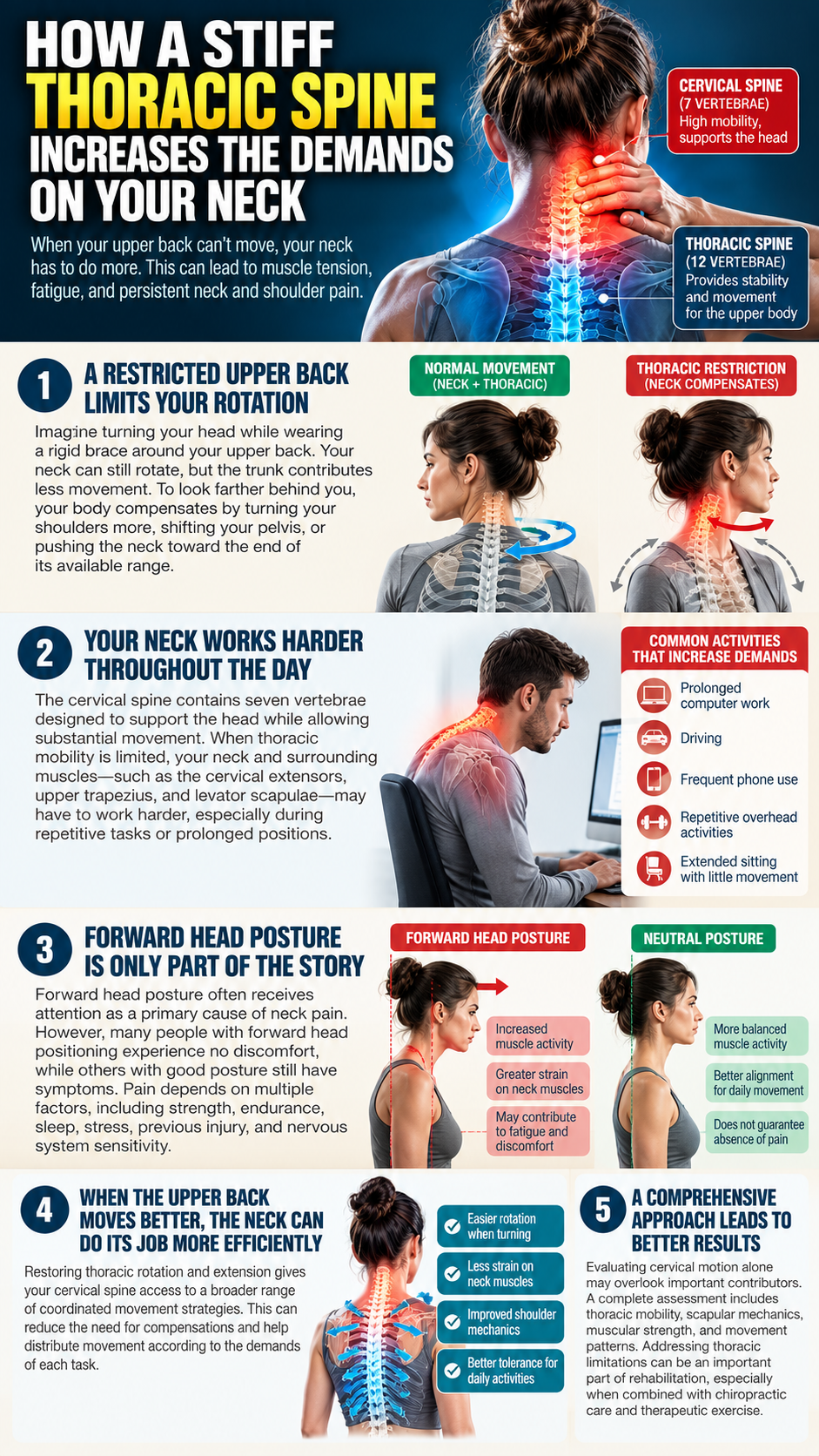
Forward head posture frequently receives attention as a primary cause of neck pain. However, scientific research paints a more complicated picture. Many individuals with forward head positioning experience no discomfort, while others with apparently ideal alignment report persistent symptoms. Posture can influence muscular loading, but pain depends on additional factors such as strength, endurance, sleep, stress, previous injury, and nervous system sensitivity. Consequently, attempting to force the head backward into an artificially rigid position is not necessarily an effective long-term solution.
Thoracic mobility provides another opportunity for investigation. When the upper back can rotate and extend comfortably, the cervical spine has access to a broader range of coordinated movement strategies. This may reduce the need for certain compensations during reaching, turning, and overhead activity. The goal is not to immobilize the neck or eliminate natural cervical movement, but to improve the body’s ability to distribute movement according to the demands of each task.
Research supports the clinical relevance of this relationship. Randomized trials and systematic reviews have found that thoracic spinal manipulation can produce short-term improvements in pain and disability for some individuals with mechanical neck pain. These findings suggest that treatment directed outside the painful cervical region can be beneficial, especially when combined with therapeutic exercise. However, they do not prove that thoracic stiffness causes every case of neck pain or that manipulation permanently corrects a particular spinal alignment.
The more important lesson involves the value of a comprehensive examination. When someone experiences recurring neck discomfort, evaluating cervical motion alone may leave useful information undiscovered. Thoracic rotation, extension, scapular mechanics, and muscular endurance can reveal limitations that influence everyday movement. Addressing those limitations may become an important component of rehabilitation rather than another temporary attempt to quiet symptoms.
Your Shoulder Blades Depend on a Moving Thoracic Spine
The shoulder is one of the most mobile regions of the human body, but that mobility requires extraordinary coordination. Most people imagine shoulder movement occurring entirely within the ball-and-socket joint connecting the humerus to the scapula. In reality, raising an arm overhead involves several articulations working together, including the glenohumeral, acromioclavicular, sternoclavicular, and functional scapulothoracic relationships. The thoracic spine provides the underlying structure that helps position the scapula during these movements.
As the arm rises, the scapula rotates upward, tilts posteriorly, and adjusts its orientation along the rib cage. The clavicle moves to accommodate these changes, while muscles such as the serratus anterior and trapezius coordinate scapular control. The rotator cuff simultaneously helps stabilize the humeral head within the shoulder socket. These coordinated movements allow the arm to reach overhead without relying exclusively on the glenohumeral joint.
Thoracic position can influence this process. When the upper back remains excessively flexed during a reaching task, the scapula may begin from a different orientation, and some individuals experience reduced overhead range of motion. Allowing the thoracic spine to extend can improve the available movement in certain circumstances. This relationship becomes particularly relevant during swimming, overhead lifting, throwing, and repetitive occupational reaching.
A simple movement comparison illustrates the connection. Sit upright and deliberately round the upper back while raising both arms overhead. Notice how far the arms travel and whether the movement feels restricted. Next, allow the upper back to straighten naturally without aggressively arching the lower back, then repeat the movement. Some people immediately experience easier arm elevation, demonstrating how trunk positioning can influence shoulder mechanics without changing the shoulder joint itself.
Research examining thoracic posture and scapular movement has documented measurable changes in shoulder range of motion and scapular orientation. However, these mechanical differences do not automatically establish injury or explain every episode of shoulder pain. Many people demonstrate variations in scapular movement without symptoms, and shoulder pain can arise from multiple interacting factors. Tendon capacity, rotator cuff strength, training volume, previous injuries, and nervous system sensitivity all influence whether a movement becomes painful.
For individuals with persistent shoulder discomfort, the practical implication is significant. Repeatedly stretching the shoulder capsule or massaging the rotator cuff may provide limited improvement if a meaningful thoracic movement restriction remains unaddressed. Conversely, improving thoracic mobility alone will not repair a substantial rotator cuff tear or resolve every shoulder condition. Effective rehabilitation requires identifying the actual contributors rather than assuming that one anatomical structure explains all symptoms.
The Breathing Connection That Links Your Ribs, Neck, and Upper Back
Every breath involves movement through the thoracic region. As the diaphragm contracts during inhalation, the chest cavity expands and the ribs move through coordinated rotations and elevations. The sternum, intercostal muscles, thoracic vertebrae, and rib joints participate in this process, allowing air to enter the lungs. Although breathing feels automatic, its mechanics depend on a sophisticated interaction between the respiratory system and musculoskeletal structures.
The ribs connect directly to the thoracic spine through specialized articulations. These connections permit small but important movements that contribute to chest expansion. When the thoracic region becomes unusually stiff, rib cage mobility may also become limited, particularly in individuals with painful joints, inflammatory conditions, or significant structural restrictions. Ordinary thoracic stiffness does not necessarily impair breathing, but examining chest wall movement can provide useful information when respiratory mechanics appear altered.
The relationship becomes especially interesting when considering accessory breathing muscles. During relaxed breathing, the diaphragm performs most of the inspiratory work. When breathing demands increase, muscles such as the scalenes and sternocleidomastoid can contribute more actively. These muscles also participate in cervical stabilization and movement, creating a functional connection between respiratory activity and neck mechanics.
Some individuals habitually breathe predominantly through the upper chest, especially during stress, anxiety, or demanding physical activity. This pattern may involve greater accessory muscle activity and can coincide with tension across the neck and shoulders. However, breathing patterns vary naturally, and upper-chest movement is not inherently pathological. The relevant clinical question is whether a person’s respiratory strategy contributes to discomfort, fatigue, or inefficient movement during specific activities.
Studies investigating breathing exercises for chronic neck pain have reported improvements in certain measures of pain, disability, and respiratory function. Although the evidence remains limited, these findings suggest that respiratory training may complement other rehabilitation approaches. Encouraging comfortable lower-rib expansion, improving respiratory muscle coordination, and reducing unnecessary muscular guarding may benefit selected individuals. These interventions should supplement appropriate assessment and treatment rather than replace investigation of significant respiratory symptoms.
This relationship illustrates why thoracic mobility deserves attention beyond conventional stretching routines. The upper back participates in breathing, shoulder positioning, and cervical movement through interconnected anatomical structures. When evaluating persistent upper-body discomfort, considering these relationships can reveal opportunities for rehabilitation that might otherwise remain overlooked.
The Nervous System Connection: Movement, Proprioception, and Chronic Pain
The spinal column does far more than support body weight. Its muscles, joints, ligaments, and surrounding connective tissues contain sensory receptors that provide continuous information about movement and position. The nervous system integrates these signals with visual and vestibular information to coordinate balance, muscular activity, and movement. This process, called sensorimotor integration, allows the body to respond rapidly to changing physical demands.
When pain develops, the nervous system may alter its movement strategies. Some muscles become more guarded, while others demonstrate changes in activation timing or endurance. Individuals may begin avoiding movements associated with discomfort, gradually reducing the variety of positions they use throughout the day. These protective responses can be useful immediately after injury, but persistent avoidance may contribute to reduced strength, confidence, and movement tolerance.
Thoracic stiffness can become part of this broader pattern. Someone who rarely rotates through the upper back may gradually become less comfortable performing rotational activities. As movement decreases, muscular capacity may decline, making previously familiar tasks feel more demanding. The nervous system may respond with additional guarding, particularly when the individual anticipates discomfort. Over time, the interaction between physical limitation and pain-related behavior can reinforce the perception of stiffness.
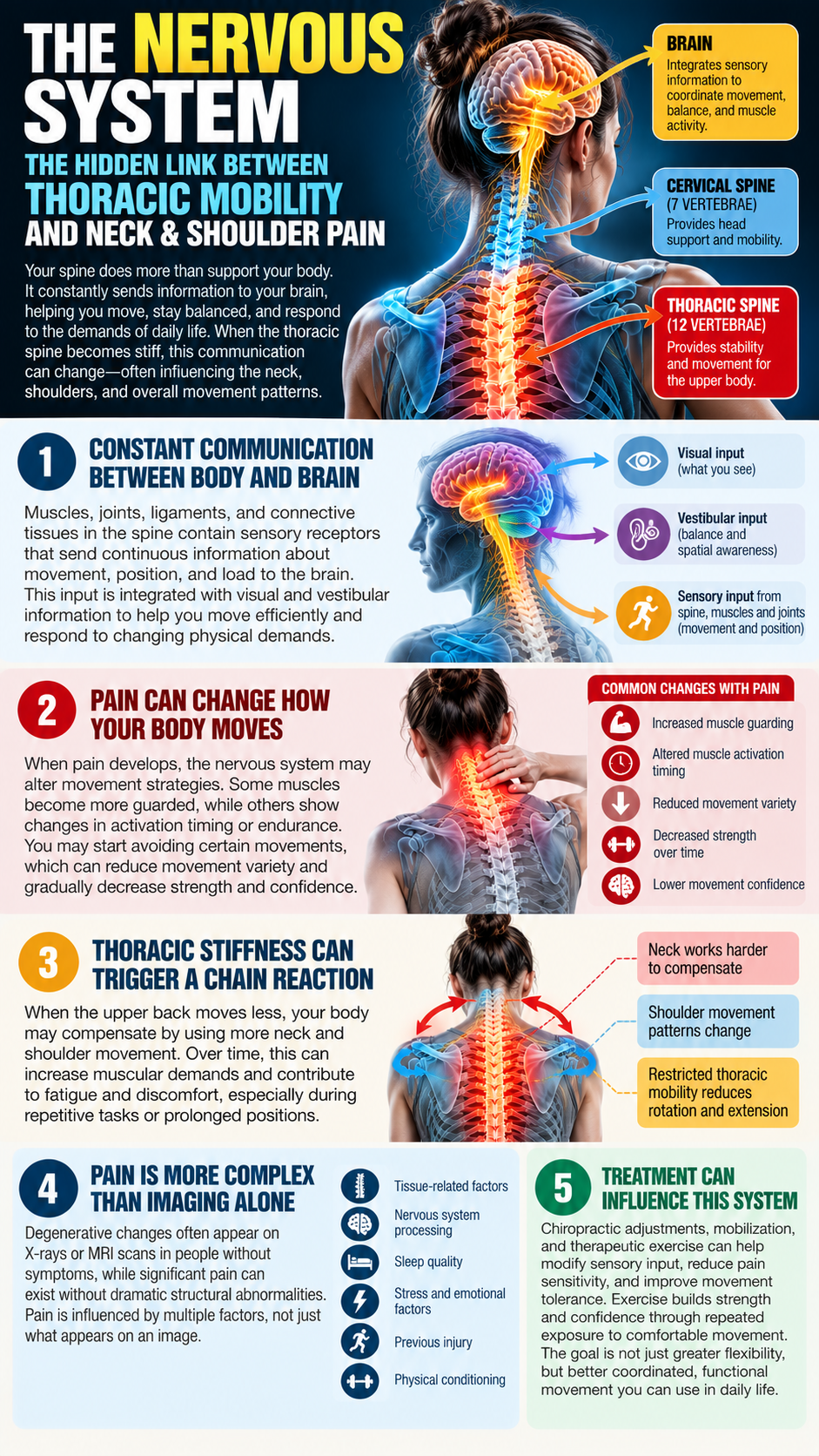
This helps explain why persistent neck and shoulder pain cannot always be understood through imaging alone. Degenerative changes commonly appear in people without symptoms, while significant pain may occur without dramatic structural abnormalities. Pain reflects tissue-related signals alongside nervous system processing, sleep quality, stress, previous experiences, and physical conditioning. Recognizing these influences does not minimize the reality of pain; it provides a more complete biological explanation for why symptoms sometimes persist.
Chiropractic adjustments, mobilization, and therapeutic exercise can influence this system through several mechanisms. Manual treatment may temporarily modify sensory input, pain processing, and movement tolerance, while exercise builds strength and confidence through repeated exposure to comfortable movement. These effects offer plausible explanations for why treatment directed at the thoracic spine sometimes improves symptoms elsewhere. However, claims that a specific thoracic restriction directly blocks communication to distant organs or prevents cellular healing have not been established by scientific evidence.
A functional approach to spinal health can therefore emphasize the relationship between movement quality, sensory information, muscular capacity, and nervous system adaptation. The objective is not merely to create greater flexibility but to restore comfortable, coordinated movement that patients can use in daily life. This distinction is essential because an individual may possess adequate passive range of motion yet lack the strength or confidence to use it effectively.
The Real Reason Temporary Relief Often Fails to Become Lasting Improvement
One of the most discouraging experiences for patients with chronic neck and shoulder discomfort is the recurring cycle of improvement followed by relapse. A massage reduces muscular tension, stretching temporarily improves flexibility, and manual treatment provides several days of relief. Yet the familiar discomfort returns when the individual resumes prolonged computer work, overhead lifting, or other demanding activities. The recurrence often leads patients to believe that their bodies are deteriorating or that they require increasingly aggressive treatment.
In many cases, the explanation is more complicated than a single damaged structure. Short-term pain relief does not necessarily improve muscular endurance, movement confidence, or the physical capacity required for daily activities. Someone who spends most of the day sitting may benefit from manual therapy, but continued inactivity and limited movement variation can contribute to recurring discomfort. A patient with restricted thoracic rotation may need progressive mobility training, while someone with shoulder weakness may require strengthening and carefully managed loading.
This is where comprehensive functional assessment becomes particularly valuable. Evaluating the cervical spine, thoracic region, shoulder complex, and surrounding musculature allows clinicians to identify limitations that might otherwise remain hidden. The examination should distinguish between restricted movement, weakness, pain sensitivity, neurological involvement, and structural conditions requiring specific treatment. Rather than prescribing the same exercises to everyone, rehabilitation can then address the findings most relevant to each patient’s symptoms and goals.
It is equally important to recognize that not every episode of neck or shoulder pain originates from mechanical dysfunction. Progressive weakness, significant neurological changes, major trauma, unexplained fever, or signs of spinal cord involvement require appropriate medical evaluation. A comprehensive approach does not dismiss conventional diagnostic tools or necessary medical care. Instead, it combines accurate diagnosis with attention to the movement, strength, and lifestyle factors that influence recovery.
The thoracic spine deserves a place in this assessment because it contributes to several functions commonly associated with neck and shoulder health. Its ability to extend, rotate, and coordinate with the rib cage can influence the mechanical demands placed on surrounding structures. When meaningful limitations exist, improving thoracic mobility may help patients regain comfortable movement and reduce unnecessary compensation. When thoracic mobility is already adequate, rehabilitation should focus on other identified contributors rather than forcing an intervention that offers little additional benefit.
The Missing Link Is Understanding How the Entire Upper Body Works Together
The human body does not divide movement into separate categories labeled neck, shoulder, and upper back. Every time someone reaches overhead, turns while driving, lifts a child, or takes a deep breath, multiple regions coordinate their activity. The thoracic spine occupies a central position within this system, connecting cervical movement, shoulder mechanics, trunk stability, and rib cage function. Its contribution may be subtle during ordinary activities, but limitations can become more apparent when physical demands increase.
This interconnected relationship offers an important perspective for individuals who have spent years treating only the location of their pain. Persistent neck discomfort may involve more than cervical muscles, just as shoulder pain may involve more than the rotator cuff. Examining thoracic movement can reveal limitations that influence how the upper body performs familiar tasks. Addressing those limitations through individualized exercise and appropriate clinical care may improve function, particularly when rehabilitation also strengthens the surrounding muscles and restores confidence in movement.
The most important shift involves moving beyond the assumption that pain always identifies the complete source of dysfunction. A comprehensive examination asks how the body distributes movement, which structures possess adequate capacity, and where meaningful limitations exist. This perspective does not promise that thoracic mobility will resolve every neck or shoulder condition, but it recognizes an important anatomical relationship that deserves consideration. For patients whose symptoms repeatedly return despite local treatment, that broader investigation may provide valuable answers.
Restoring the Movement Your Neck and Shoulders Have Been Missing
The human body possesses an extraordinary capacity to adapt, but adaptation does not always produce optimal movement. When the thoracic spine gradually loses mobility, the neck, shoulders, and lower back may compensate for movements the upper back no longer performs comfortably. These changes often develop over years, making them difficult to recognize until persistent stiffness, muscular fatigue, or discomfort begins interfering with daily life. Fortunately, many movement restrictions associated with inactivity, muscular guarding, and reduced physical conditioning can improve through targeted rehabilitation.
Restoring thoracic mobility involves more than stretching tight muscles or attempting to force the spine into perfect alignment. Effective rehabilitation requires improving joint movement, strengthening surrounding muscles, and retraining the nervous system to coordinate movement comfortably. Chiropractic care, therapeutic exercise, breathing techniques, and lifestyle changes can each contribute when selected according to individual needs. The objective is not simply temporary pain relief but greater movement capacity that supports everyday activities without unnecessary discomfort.
The Modern Lifestyle That Gradually Steals Thoracic Mobility
Modern life encourages extended periods of physical inactivity. Office workers spend hours sitting at computers, commuters remain relatively motionless behind steering wheels, and recreational screen time often replaces activities requiring trunk rotation and extension. Sitting itself does not damage the spine, but prolonged inactivity can reduce muscular endurance and limit exposure to varied movements. Over time, individuals may become less comfortable performing activities that require their upper backs to rotate, extend, or coordinate with their shoulders.
Age-related changes can compound these limitations. Intervertebral discs gradually change in hydration and composition, while spinal joints may develop degenerative changes that influence movement. Reduced muscular strength and declining physical activity can further restrict functional capacity. However, age alone does not determine mobility, and many older adults maintain excellent spinal function through regular exercise. The important distinction involves whether a restriction results from modifiable movement habits, muscular weakness, or structural conditions requiring individualized management.
Previous injuries also influence thoracic movement. Following a fall, shoulder injury, or episode of severe back pain, individuals may unconsciously avoid certain movements. These protective patterns sometimes persist after tissues have healed, contributing to stiffness and reduced confidence. Gradually restoring comfortable movement can help reverse some of these adaptations, provided rehabilitation respects pain tolerance and underlying medical conditions.
Chiropractic Care and the Role of Thoracic Spinal Mobilization
Chiropractic assessment can help identify meaningful restrictions within the thoracic spine and determine how they interact with cervical and shoulder movement. Examination may include thoracic rotation, extension, rib cage mobility, scapular mechanics, muscular strength, and neurological screening when indicated. These findings help distinguish movement limitations that may respond to rehabilitation from conditions requiring further medical investigation.
Thoracic spinal manipulation and mobilization may provide short-term improvements in pain and disability for selected patients with mechanical neck pain. Research suggests that these treatments can influence movement tolerance and pain processing through mechanical and neurophysiological mechanisms. However, lasting improvement generally requires more than passive treatment. Exercise helps patients develop the muscular capacity and confidence necessary to maintain comfortable movement during daily activities.
For patients with osteoporosis, fractures, spinal instability, or certain inflammatory conditions, high-force manipulation may be inappropriate. Lower-force mobilization and individualized exercise may offer alternatives when clinically suitable. Effective chiropractic care should therefore integrate careful assessment, appropriate manual techniques, and active rehabilitation rather than relying exclusively on repeated adjustments.
Your At-Home Thoracic Mobility Restoration Plan
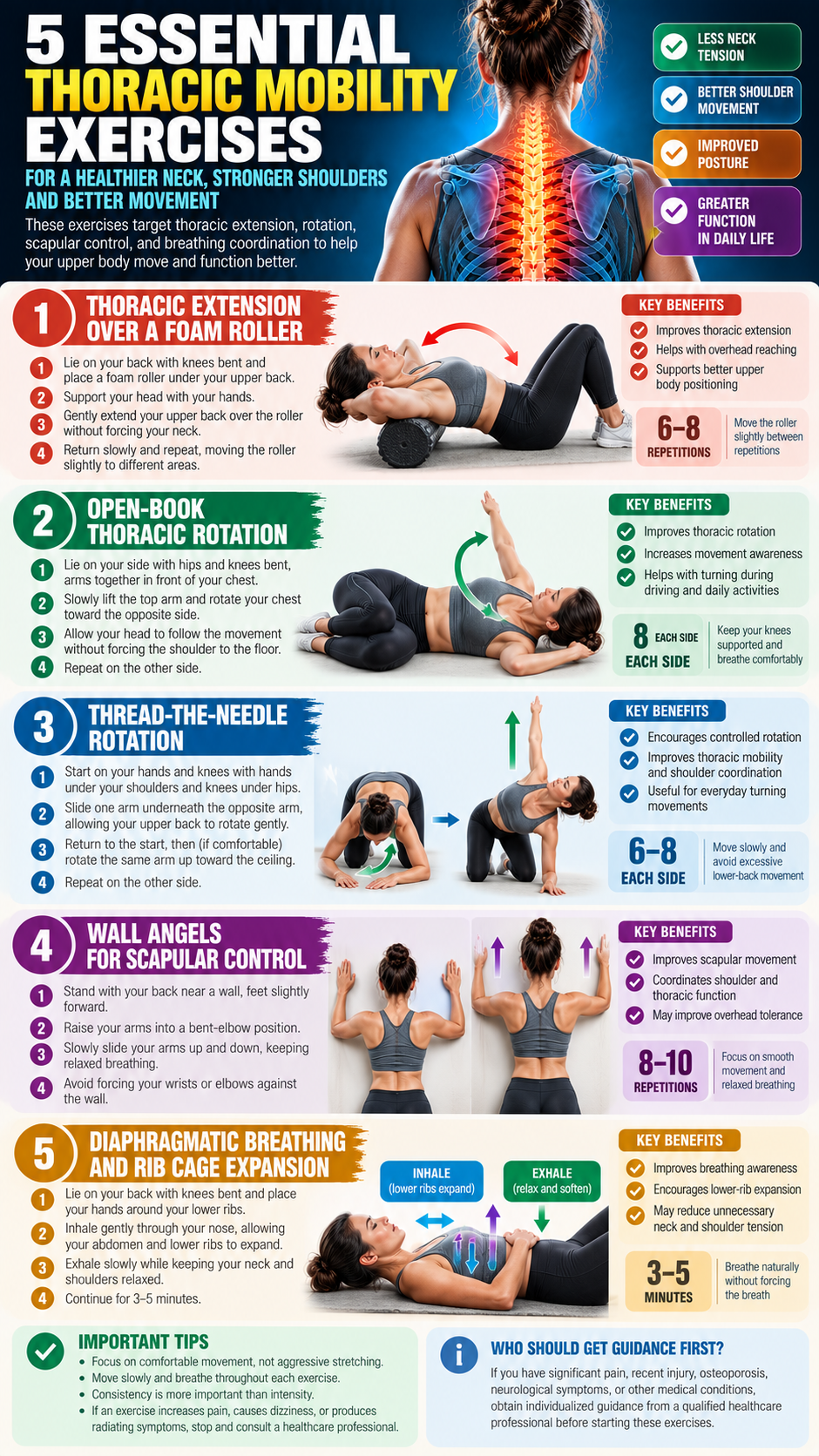
A practical thoracic mobility routine should address extension, rotation, scapular control, and breathing coordination. Consistency matters more than aggressive stretching, particularly for individuals who have spent years moving through limited ranges. The following exercises can provide a starting point for uncomplicated stiffness, although anyone with significant pain, recent injury, osteoporosis, or neurological symptoms should obtain individualized guidance. Movements should remain comfortable, and sharp pain, dizziness, or radiating neurological symptoms warrant stopping the exercise.
Thoracic Extension Over a Foam Roller
Lie on your back with your knees bent and position a foam roller horizontally beneath the upper back. Support your head with your hands and gently extend the thoracic spine over the roller without forcing the neck backward. Return slowly to the starting position and repeat six to eight times, repositioning the roller slightly to explore different comfortable areas. This movement encourages thoracic extension, which contributes to overhead reaching and upper-body positioning. A rolled towel provides a gentler alternative when a foam roller feels uncomfortable.
Open-Book Thoracic Rotation
Lie on your side with your hips and knees comfortably bent, extending both arms in front of your chest. Slowly lift the upper arm and rotate your trunk toward the opposite side while keeping the knees supported. Allow your head to follow the movement without forcing the shoulder toward the floor. Perform eight repetitions on each side, breathing comfortably throughout the exercise. This movement helps restore awareness and tolerance of thoracic rotation, particularly for individuals who experience stiffness while turning during driving or daily activities.
Thread-the-Needle Rotation
Begin on your hands and knees, positioning your hands beneath your shoulders and knees beneath your hips. Slide one arm underneath the opposite arm, allowing the upper back to rotate gently as the shoulder approaches the floor. Return to the starting position and, if comfortable, rotate the same arm upward toward the ceiling. Complete six to eight repetitions on each side while avoiding excessive lower-back movement. This exercise encourages controlled rotation and can be modified for individuals with wrist or shoulder discomfort.
Wall Angels for Shoulder Blade Coordination
Stand with your back near a wall and your feet slightly forward. Raise your arms into a comfortable bent-elbow position and slowly slide them upward and downward while maintaining relaxed breathing. Avoid forcing your wrists or elbows against the wall or compensating through excessive lumbar extension. Perform eight to ten repetitions, concentrating on smooth scapular movement. This exercise helps coordinate shoulder elevation with thoracic positioning and may improve tolerance for overhead activities.
Diaphragmatic Breathing and Rib Cage Expansion
Lie comfortably on your back with your knees bent and place your hands around the lower ribs. Inhale gently through your nose, allowing the abdomen and lower rib cage to expand naturally. Exhale slowly while keeping the neck and shoulders relaxed, avoiding exaggerated or forceful breathing. Continue for three to five minutes. This practice may improve breathing awareness and reduce unnecessary accessory respiratory muscle tension in selected individuals, complementing the mechanical benefits of thoracic mobility exercises.
Strengthening the Muscles That Maintain Thoracic Mobility
Mobility without muscular control may provide only limited functional improvement. The thoracic extensors, trapezius, rhomboids, serratus anterior, and surrounding trunk muscles contribute to spinal stability and coordinated shoulder movement. Resistance exercises such as rows, modified reverse fly movements, and controlled pulling exercises can help improve strength and endurance. These activities should emphasize comfortable movement rather than forcing the shoulder blades into a permanently retracted position.
For many adults, two or three weekly strengthening sessions provide a reasonable starting point. Resistance can increase gradually as movement becomes more comfortable and muscular capacity improves. Combining strengthening with mobility exercises helps develop the ability to use newly available movement during everyday activities. The objective is to create a resilient upper body capable of reaching, lifting, rotating, and maintaining comfortable positions without excessive fatigue.
Daily Habits That Help Preserve Healthy Thoracic Movement
A mobility routine becomes more effective when supported by regular movement throughout the day. Individuals who work at computers can periodically stand, walk, rotate their trunks, or perform gentle shoulder movements. These brief changes reduce prolonged exposure to one position and encourage greater movement variety. There is no universally required interval for movement breaks, so frequency should reflect individual comfort and work demands.
Workstation adjustments may also improve tolerance for prolonged tasks. Positioning the monitor comfortably, supporting the arms when appropriate, and keeping frequently used objects within easy reach can reduce unnecessary muscular effort. However, maintaining rigidly perfect posture is not the goal. Healthy spinal function involves adapting to different positions rather than attempting to remain upright and motionless throughout the day.
Sleep quality, physical activity, and stress management further influence recovery. Poor sleep can increase pain sensitivity, while prolonged stress may contribute to muscular guarding. Regular walking, resistance training, and enjoyable recreational activities support general conditioning. These habits complement targeted thoracic exercises by improving the body’s overall capacity to tolerate physical demands.
Moving Beyond Temporary Relief Toward Lasting Function
Persistent neck and shoulder discomfort rarely responds to a single universal solution. Some individuals benefit from improving thoracic rotation, while others require cervical strengthening, rotator cuff rehabilitation, or treatment directed at a specific medical condition. A comprehensive examination helps determine which limitations actually contribute to symptoms and which interventions offer the greatest opportunity for improvement.
Progress should be measured through meaningful activities rather than pain intensity alone. Turning comfortably while driving, reaching overhead with greater ease, completing workdays with less muscular fatigue, and returning confidently to exercise all represent valuable outcomes. When symptoms worsen, neurological changes develop, or improvement remains absent despite appropriate rehabilitation, further assessment becomes important.
The thoracic spine deserves attention because it connects several essential components of upper-body movement. Its relationship with the neck, shoulders, ribs, and nervous system makes it an important consideration when investigating persistent discomfort. By combining individualized chiropractic care when appropriate, progressive mobility exercises, strengthening, and healthier movement habits, patients can pursue more than temporary symptom relief. They can develop the physical capacity and movement confidence necessary to support healthier neck and shoulder function for years to come.