
The Chemical Mystery Hiding in Plain Sight
Walk through almost any American home and you will encounter an invisible chemical signature before noticing the furniture. Laundry carries the smell of artificial spring air. Bathrooms smell like lavender, citrus, or an invented version of ocean mist. Shampoo leaves tropical aromas in the hair, while deodorant adds another layer beneath clothing. Candles, plug-ins, cleaning sprays, dryer sheets, cosmetics, lotions, and garbage bags contribute their own scents. Modern life has become so saturated with fragrance that many people no longer recognize it as an exposure. We simply call it clean.
Behind this scented environment sits one deceptively simple word: fragrance. Consumers often interpret that word as one ingredient added to make a product smell pleasant. In reality, fragrance can describe a formulated mixture containing numerous aromatic and functional substances. The International Fragrance Association maintains a transparency list containing thousands of materials used throughout global fragrance creation. No single perfume, lotion, or detergent contains all those substances. However, the enormous catalog reveals how sophisticated modern fragrance chemistry has become.
The concern is not that everything producing an aroma must therefore be poisonous. Such a conclusion would ignore basic toxicology and weaken legitimate questions surrounding fragrance exposure. The deeper issue involves transparency, frequency, mixtures, and biological individuality. People deserve to know what repeatedly touches their skin and enters their indoor air. They should also understand why modern fragrance exposure looks dramatically different from anything previous generations experienced.
How Fragrance Became an Everyday Chemical Exposure
Human beings have pursued pleasant aromas for thousands of years. Ancient Egyptians incorporated aromatic oils, flowers, herbs, and resins into cosmetics, religious ceremonies, and burial practices. Frankincense and myrrh traveled through ancient trade routes and became culturally valuable commodities. Greeks and Romans infused oils with flowers and spices, while many traditional cultures used aromatic plants medicinally. These early fragrances remained closely connected to recognizable botanical materials and relatively limited patterns of exposure.
Industrial chemistry eventually changed the relationship between humans and scent. During the nineteenth century, chemists learned to isolate aroma molecules and manufacture compounds that reproduced desirable smells. Synthetic fragrance materials offered remarkable commercial advantages because manufacturers could produce consistent aromas without depending entirely upon weather, harvests, geography, or expensive botanical extracts. Perfumers gained an expanding molecular palette, and scent gradually became something laboratories could engineer with extraordinary precision.
The transformation did not remain inside perfume bottles. Manufacturers discovered that fragrance could influence memory, emotion, purchasing behavior, and perceptions of cleanliness. Soon, scent appeared in soap, shampoo, detergent, cosmetics, household cleaners, tissues, diapers, dryer sheets, air fresheners, and personal-care products. A substance once deliberately applied as perfume became an environmental background exposure. People could now spend an entire day surrounded by fragrance without intentionally wearing perfume.
That cultural shift created an important biological question. Human bodies did not suddenly acquire separate processing systems for shampoo fragrance, detergent fragrance, air freshener fragrance, and cologne. Skin, lungs, liver, kidneys, immune tissues, and endocrine systems encounter chemicals according to their molecular properties. Product categories exist for marketing and regulation, but human physiology experiences the total exposure.
What Does “Fragrance” Actually Mean on a Label?
Pick up a scented cosmetic and study its ingredient panel carefully. You might find water, oils, emulsifiers, preservatives, botanical extracts, and dozens of other ingredients. Then one surprisingly broad term appears: fragrance. European labels often use the word “parfum,” but the underlying transparency question remains similar. That single declaration may represent a mixture rather than one individual substance.
Current FDA cosmetic labeling rules generally allow fragrance ingredients to appear collectively under the term “fragrance.” Manufacturers can voluntarily disclose individual fragrance components, but complete component-level disclosure does not always appear on American cosmetic labels. Fragrance labeling should not be confused with every legal concept surrounding trade secrets, because those rules contain important distinctions. Nevertheless, the practical consequence remains obvious: consumers may not know every substance producing a product’s scent.
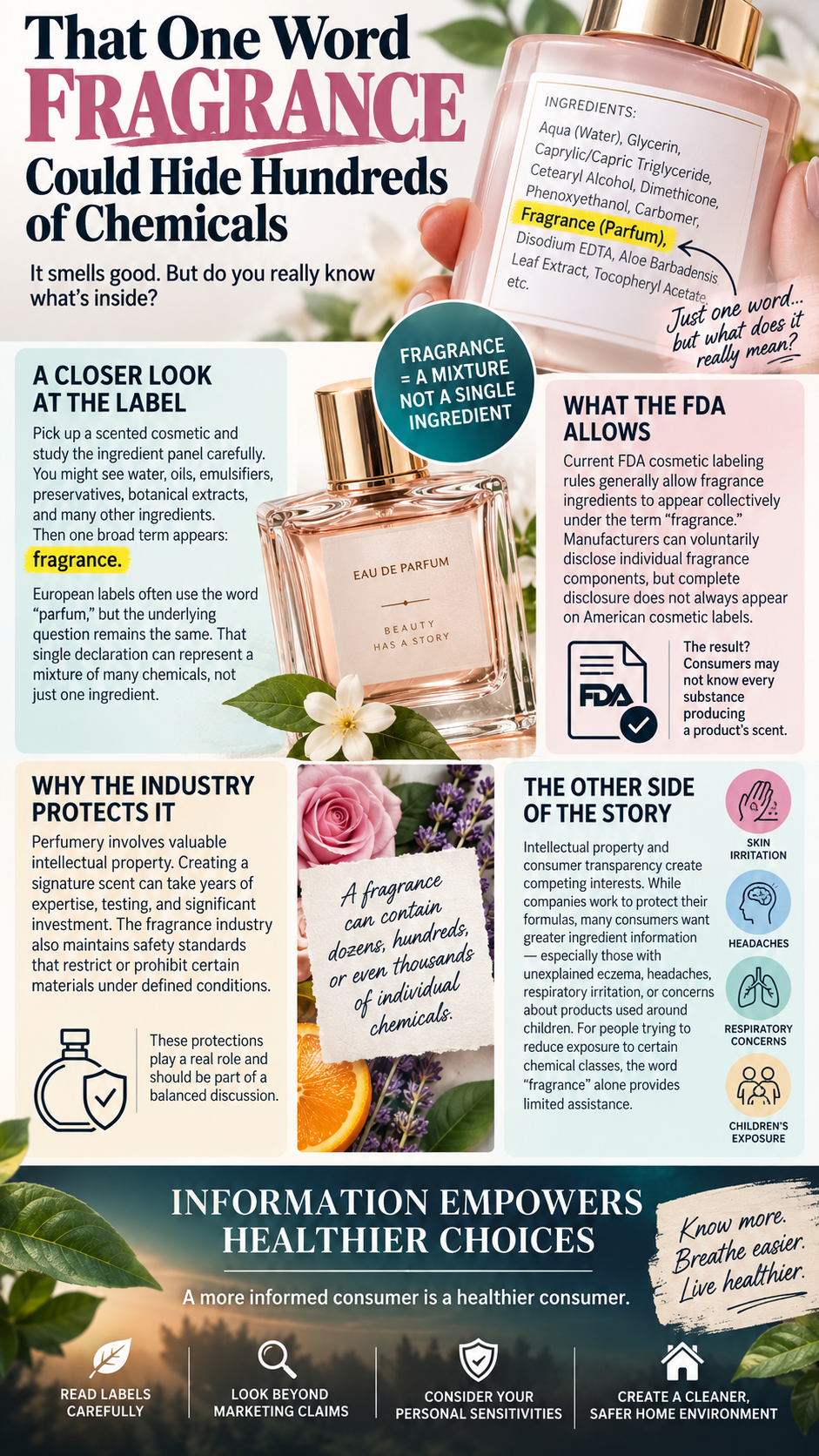
Industry representatives offer a legitimate reason for protecting fragrance formulas. Perfumery involves valuable intellectual property, and successful formulas can take considerable expertise and investment to develop. The fragrance industry also maintains safety standards that restrict or prohibit particular materials under defined conditions. Those protections should form part of any balanced discussion rather than disappearing beneath sensational claims.
However, intellectual property and consumer transparency create competing interests. Someone with unexplained eczema may need to identify a sensitizing ingredient. Another person might experience headaches or respiratory irritation around particular scented products. Parents may want greater knowledge about products used repeatedly around children. Consumers trying to reduce exposure to selected chemical classes may face similar obstacles. The word “fragrance” alone provides limited assistance during those investigations.
A Fragrance Formula Does More Than Smell Good
Fragrance chemistry involves far more than combining several pleasant-smelling molecules. Commercial products must survive manufacturing, shipping, storage, temperature changes, oxygen exposure, and months on store shelves. The aroma must also perform predictably after someone opens the bottle. Chemists therefore formulate fragrance systems with stability, evaporation, compatibility, preservation, and longevity in mind.
Functional ingredients can help accomplish those goals. Solvents may carry aromatic substances through a formulation. Antioxidants can protect vulnerable compounds from oxidation. Stabilizing materials may preserve performance during storage, while other substances influence how quickly aromas evaporate. Some fragrance molecules disappear rapidly and create the first impression. Others remain longer and form the scent consumers notice hours later.
This chemistry explains why reducing the entire discussion to “synthetic chemicals are toxic” misses the point. Water is a chemical, lavender contains chemicals, and the human brain operates through chemistry. Toxicology instead examines identity, dose, duration, exposure route, metabolism, susceptibility, and biological activity. A substance can behave differently when inhaled than when applied to intact skin. Concentration also matters enormously when scientists evaluate risk.
The more important concern involves repeated exposure to complicated mixtures whose exact composition may remain unclear to the consumer. One application might represent a very small exposure. Yet modern life rarely involves one fragranced product used once. The real-world pattern often involves multiple products layered across the entire day.
The Fragrance Exposure Stack Begins Before Breakfast
Consider a typical morning. Someone showers with fragranced shampoo, conditioner, body wash, facial cleanser, and shaving products. Afterward, they apply lotion, deodorant, hair products, cosmetics, sunscreen, and perhaps cologne or perfume. Their towel contains detergent residues, while freshly washed clothing may carry detergent, fabric softener, dryer-sheet chemicals, or scent boosters. Several exposures have already occurred before that person reaches the kitchen.
The surrounding environment adds another layer. A plug-in air freshener releases volatile compounds into the home. Yesterday’s cleaning spray remains on bathroom surfaces. A fragranced candle burns near the living room. The vehicle contains another scent product, while the workplace uses fragranced soap and cleaning supplies. Bedding, furniture sprays, floor cleaners, and trash bags can contribute still more sources.
This accumulation matters because researchers cannot understand real life by imagining every product exists inside its own sealed laboratory. Toxicology often studies individual compounds because controlled experiments require precision. Human beings, however, encounter mixtures. Scientists increasingly investigate aggregate and cumulative exposures because biology receives the combined chemical environment rather than one ingredient at a time.
None of this proves that everyday fragrance exposure automatically causes chronic disease. That conclusion would exceed current evidence. It does reveal why exposure assessment deserves greater sophistication. Frequency, concentration, ventilation, skin contact, inhalation, age, genetics, metabolism, and existing sensitivities can change how different people respond to the same environment.
When Fragrance Meets the Skin
One of the clearest established health concerns surrounding fragrance involves allergic contact dermatitis. Certain fragrance substances can sensitize susceptible individuals after exposure. Once sensitization develops, later contact may provoke itching, redness, scaling, swelling, or eczema-like inflammation. For affected people, a beautifully scented product can become an unexpected source of persistent skin trouble.
Limonene and linalool provide useful examples because both occur naturally in many plants and appear widely in fragranced products. Oxygen can transform these compounds into oxidation products with stronger allergenic potential. Therefore, the biological behavior of a fragrance ingredient may change after exposure to air. Storage conditions and product age can matter alongside the original formulation.
This also challenges the assumption that “natural fragrance” automatically means harmless fragrance. Essential oils contain concentrated biologically active molecules produced by plants. Those molecules can have desirable properties, yet some can irritate tissue or trigger allergic reactions. Natural origin describes where something came from; it does not provide a complete toxicological evaluation.
The Endocrine Question Behind Fragrance
Another major concern involves chemicals with potential endocrine activity. Phthalates frequently enter this discussion because certain members of this chemical family have been used in personal-care applications. Researchers have investigated selected phthalates for possible effects involving reproductive development, hormone biology, metabolism, and other physiological systems. Importantly, phthalates differ from one another, so treating them as one identical substance creates scientific confusion.
Endocrine disruption deserves serious attention because hormones regulate physiology at remarkably small concentrations. Thyroid hormones influence metabolism and development. Sex hormones coordinate reproductive function and numerous tissues. Cortisol helps organize stress responses, while insulin governs crucial aspects of energy metabolism. Chemicals capable of altering hormone production, transport, metabolism, receptors, or elimination therefore warrant careful investigation.
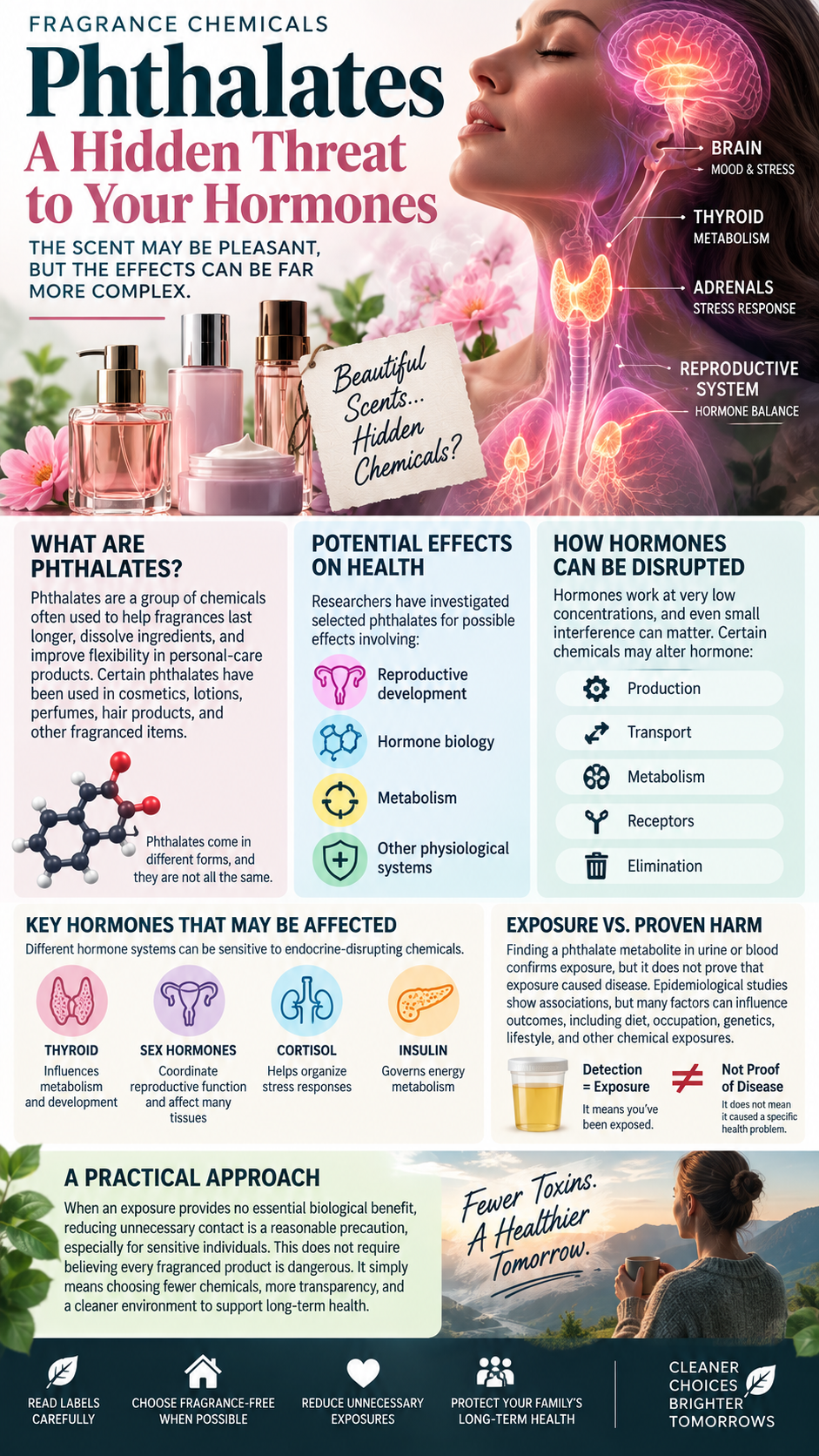
Scientists must still distinguish exposure from demonstrated harm. Detecting a metabolite in urine confirms that exposure occurred, but it does not prove that exposure caused disease. Epidemiological associations also require careful interpretation because diet, occupation, genetics, lifestyle, and simultaneous chemical exposures can influence outcomes. Strong health writing should neither dismiss these concerns nor exaggerate them beyond available evidence.
A sensible principle emerges from that uncertainty. When an exposure provides no essential biological benefit, reducing unnecessary contact can represent a reasonable precaution, especially for sensitive individuals. That approach does not require believing every fragranced product is dangerous. It simply recognizes that reducing avoidable chemical complexity can make personal exposure easier to understand.
Synthetic Musks and the Engineering of a Lingering Scent
Synthetic musks reveal another fascinating chapter in fragrance chemistry. Traditional musk historically came from animals, creating obvious ethical and ecological problems. Chemists developed synthetic alternatives that could reproduce warm, persistent aromas without depending upon animal harvesting. Different generations of synthetic musks subsequently entered perfumes and scented consumer products.
Researchers later began investigating certain musk compounds because some demonstrated environmental persistence and appeared in human biomonitoring research. Their detection shows that environmental chemicals can enter human biological systems, although detection alone does not establish disease. The scientifically important questions involve concentration, metabolism, elimination, persistence, developmental vulnerability, and measurable biological effects.
Those questions become increasingly relevant when exposure occurs repeatedly. A chemical that disappears quickly may create a different biological situation than one that persists. Likewise, an adult may process an exposure differently than a developing child. Toxicology becomes far more meaningful when researchers examine these differences rather than merely asking whether a chemical exists.
Fragrance Also Enters Through the Air
Skin represents only one pathway. Perfumes, cleaning sprays, air fresheners, scented candles, diffusers, and fragranced household products can release volatile substances into indoor environments. People then inhale that air repeatedly, often without recognizing fragrance as part of their chemical environment.
The respiratory tract provides an enormous interface between the outside world and internal physiology. Strong fragrances can provoke headaches, coughing, nausea, dizziness, airway irritation, or other symptoms in susceptible people. These reactions do not always represent classical allergy, and multiple mechanisms may contribute. Individual responses also vary substantially.
Persistent symptoms should therefore trigger curiosity rather than automatic dismissal. Removing a suspected scented product and observing changes may reveal useful patterns. Serious or continuing respiratory symptoms still require appropriate evaluation because fragrance exposure represents only one possible contributor.
The Real Problem Is Bigger Than Perfume
The greatest misconception about fragrance is that the conversation concerns people wearing too much perfume. Modern fragrance exposure extends far beyond perfume counters. It follows people through bathrooms, bedrooms, laundry rooms, workplaces, vehicles, hotels, gyms, stores, and public spaces.
The central problem is not that every fragrance ingredient has been proven harmful. The evidence does not support that statement. The problem involves repeated exposure combined with incomplete ingredient knowledge, individual susceptibility, and unresolved questions surrounding certain chemical classes.
Modern consumers have become participants in an enormous fragrance experiment without consciously choosing it. Scent now surrounds the body from morning until night, while a single label term can conceal much of the formulation’s complexity. Understanding that exposure represents the first step toward changing it.
What Fragrance Exposure Does to the Body—and How to Reduce It at Home
Once you understand what can hide behind the word “fragrance,” the conversation must move beyond the ingredient label. The more important question concerns what happens after fragrance chemicals contact skin, enter the lungs, and circulate through our indoor environment. Human biology possesses remarkable systems for processing environmental compounds, yet those systems do not make exposure irrelevant. Frequency, concentration, chemical identity, exposure route, age, genetics, and individual susceptibility can all influence the body’s response.
Fragrance exposure deserves neither panic nor dismissal because both reactions prevent intelligent decision-making. Not every fragrance ingredient damages human health, and detecting a chemical does not prove that it caused disease. However, certain fragrance compounds can trigger allergic reactions, while other chemical classes remain under investigation for broader biological effects. Reducing unnecessary exposure therefore represents a practical strategy, especially when fragrance serves no essential physiological purpose.
The Skin Is a Living Barrier, Not Plastic Wrapping
Skin may look like a simple covering, but biologically it behaves more like an intelligent border. It contains immune cells, sensory nerves, blood vessels, glands, structural proteins, lipids, and a diverse microbial ecosystem. The outer barrier helps retain moisture while limiting penetration from the surrounding environment. When that barrier becomes irritated or damaged, substances that once caused little trouble may become increasingly problematic.
Fragrance represents a well-established cause of allergic contact dermatitis in susceptible individuals. Repeated exposure can sensitize the immune system to particular fragrance compounds. Later contact may then produce itching, redness, burning, scaling, swelling, or eczema-like inflammation. Someone may continue applying the same lotion or shampoo for months without realizing that a fragrance ingredient contributes to recurring skin problems.
Chemistry can also change after the product leaves the factory. Limonene and linalool, which occur naturally in many plants, can react with oxygen. Their oxidation products may possess stronger allergenic potential than the original compounds. Consequently, an older product exposed repeatedly to air may differ chemically from the freshly manufactured formulation.
Natural fragrance does not escape this biological reality. Essential oils contain concentrated mixtures of active plant chemicals, some of which can irritate or sensitize skin. Botanical origin describes where a substance came from, but it does not determine whether every concentration or application remains harmless.
Fragrance Changes the Indoor Air You Breathe
Skin represents only one doorway into the fragrance discussion. Plug-in air fresheners, aerosol sprays, cleaning products, perfume, candles, diffusers, and scented laundry products can release volatile compounds into indoor air. Room size, ventilation, temperature, formulation, and frequency of use influence the resulting exposure.
The respiratory tract constantly interacts with that indoor environment. Each breath brings surrounding gases, particles, moisture, microbes, and volatile chemicals across sensitive airway surfaces. Strong fragrances can trigger coughing, headaches, nausea, airway irritation, or other symptoms in susceptible individuals. People with asthma or fragrance sensitivity may notice symptoms more readily in heavily scented spaces.
Odor alone does not prove that a dangerous concentration exists because humans can detect some smells at extremely low levels. Likewise, every headache following fragrance exposure cannot automatically be assigned to one specific chemical. Nevertheless, symptoms that repeatedly appear in one scented environment deserve investigation rather than dismissal. Removing the suspected source and observing the response can provide useful information.
Indoor exposure becomes especially important because people spend enormous amounts of time inside homes, offices, schools, vehicles, and other enclosed environments. A fragrance product that continuously releases volatile substances creates a different exposure pattern than occasional perfume use. Improving indoor air should therefore become one of the first priorities when reducing unnecessary fragrance exposure.
The Endocrine Question Requires Serious Attention
Concerns about fragrance frequently involve endocrine-disrupting chemicals, particularly selected phthalates associated historically with some personal-care formulations. Researchers have studied certain phthalates for potential effects involving reproductive development, metabolism, and hormone signaling. These compounds should not be treated as identical because their structures, uses, exposure patterns, and toxicological profiles differ considerably.
Hormonal biology deserves particular respect because endocrine signaling operates at remarkably small concentrations. Thyroid hormones regulate metabolism, growth, and neurological development. Estrogen and androgen pathways influence reproduction while affecting many additional tissues. Insulin controls critical aspects of energy metabolism, while adrenal hormones help coordinate stress responses and physiological adaptation.
An endocrine-disrupting compound may potentially interfere with hormone synthesis, receptors, transport, metabolism, or elimination. However, finding a chemical metabolite in blood or urine demonstrates exposure rather than proving disease causation. Human studies must account for diet, occupation, genetics, medications, lifestyle, and simultaneous environmental exposures. Responsible health communication must preserve that distinction while still recognizing legitimate concerns.
Consumers do not need absolute scientific certainty before reducing an unnecessary exposure. Removing avoidable fragrance does not require believing that every scented product causes hormonal disease. It simply applies a precautionary principle to substances that provide sensory enjoyment rather than biological necessity. For many households, that tradeoff becomes surprisingly easy once fragrance stops representing cleanliness.
The Liver Cannot Protect You From Every Exposure Forever
The word “detoxification” has become so commercially abused that people sometimes forget detoxification represents legitimate human physiology. The liver continuously transforms endogenous substances and foreign compounds through complex enzymatic pathways. These processes can modify molecules and prepare many of them for further metabolism or elimination.
Kidneys filter blood and remove numerous water-soluble compounds through urine. The gastrointestinal system participates through bile and stool, while lungs eliminate carbon dioxide and certain volatile substances. Cellular antioxidant systems also help manage reactive molecules generated during normal metabolism and environmental exposure. These interconnected systems operate continuously without requiring a fashionable cleanse.
That does not mean every detoxification claim deserves acceptance. Drinking juice for three days cannot replace liver function, and excessive water does not wash every environmental chemical from the bloodstream. Sweating may eliminate measurable amounts of certain compounds, but it should not be portrayed as a universal pathway for removing every toxin.
The strongest environmental strategy begins before detoxification becomes necessary. Reducing avoidable exposure lowers what the body must encounter in the first place. Supporting normal physiology through nutritious food, hydration, movement, sleep, and regular bowel function then provides a rational foundation for health.
Begin Your Fragrance Reset With the Air
Start the home transformation by identifying products designed to release fragrance continuously. Walk through every room and locate plug-ins, automatic sprays, scented wax products, air fresheners, toilet deodorizers, room sprays, and heavily fragranced candles. Cars deserve the same inspection because enclosed cabins can contain hanging fresheners, vent clips, fragranced cleaners, and scented upholstery products.
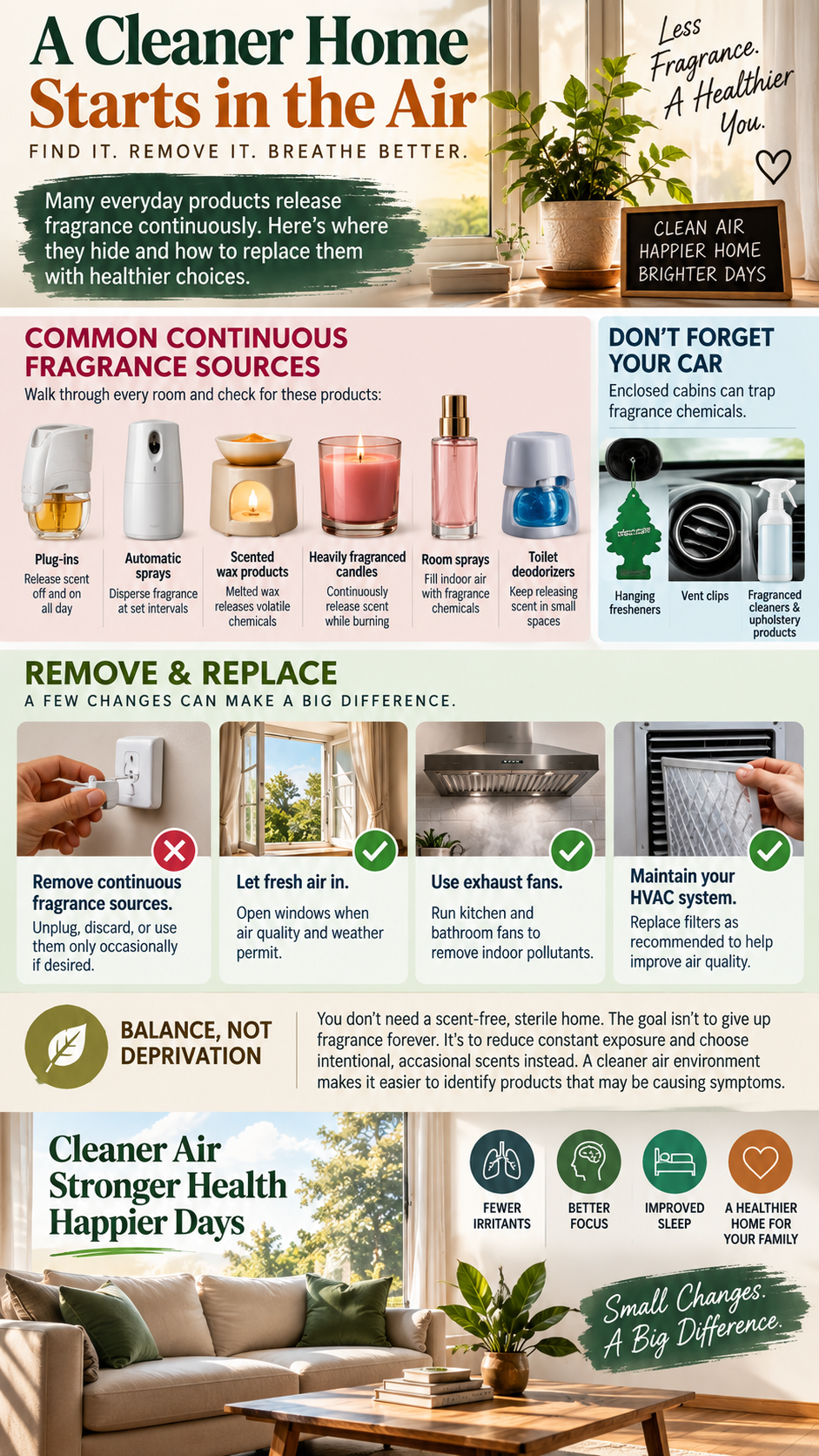
Removing continuous fragrance sources immediately simplifies the indoor environment. Open windows when outdoor air quality and weather permit, while using bathroom and kitchen exhaust fans appropriately. Maintain heating and cooling systems, and replace filtration media according to manufacturer recommendations. These changes improve air management without replacing one artificial scent with another.
People who enjoy fragrance do not need to transform their homes into sterile laboratories. The important distinction involves intentional, occasional scent versus continuous chemical release throughout every hour. Reducing background fragrance gives the household a cleaner exposure baseline and makes problematic products easier to identify.
Transform the Laundry Room Next
Laundry represents one of the most overlooked fragrance exposures because clothing remains against skin for hours. Sheets surround the body throughout the night, while towels repeatedly contact damp skin. Fragranced detergents, dryer sheets, fabric softeners, and scent boosters can therefore create prolonged exposure long after the washing machine stops.
Choose fragrance-free laundry detergent rather than assuming “unscented” always means fragrance-free. Some products marketed as unscented can contain fragrance materials intended to mask ingredient odors. Examine ingredient disclosures whenever manufacturers provide them and prioritize products that clearly state their fragrance status.
Remove scent boosters and fragranced dryer sheets during the transition. Their primary purpose involves scent persistence or fabric characteristics rather than improving human health. Reusable wool dryer balls can provide a simple alternative for households wanting help with fabric separation and drying without adding perfume.
Bedding deserves priority during this process because the face remains near sheets and pillowcases for several hours every night. Washing sheets, towels, sleepwear, and everyday clothing with fragrance-free products can significantly reduce prolonged skin contact. Several washes may be necessary before heavily fragranced fabrics lose their accumulated scent.
Rebuild the Bathroom Without Throwing Everything Away
Bathrooms often contain an extraordinary collection of fragrance sources. Shampoo, conditioner, facial cleanser, body wash, shaving cream, deodorant, lotion, cosmetics, hairspray, cologne, perfume, and cleaning products can create overlapping exposures before breakfast. Replacing every product simultaneously can become expensive and unnecessary for most people.
Instead, change products strategically as existing containers run out. Prioritize items covering large areas of skin or remaining on the body for long periods. Body lotion deserves particular attention because it may remain across extensive skin surfaces for hours. Deodorant, facial moisturizers, cosmetics, and hair products can also create repeated daily exposure.
Choose fragrance-free replacements with transparent ingredient information whenever possible. Avoid assuming that “clean,” “green,” “botanical,” or “natural” guarantees a simpler formulation. Marketing language describes a product’s positioning, while ingredient disclosure provides more useful information about exposure.
People experiencing persistent dermatitis should consider professional evaluation rather than endlessly switching products. Patch testing can sometimes identify specific fragrance allergens and make avoidance considerably more precise. Identifying the trigger often proves more useful than broadly fearing every chemical name on a label.
Do Not Replace Synthetic Fragrance With an Essential-Oil Cloud
One common mistake involves removing conventional air fresheners and immediately filling the house with essential-oil diffusers. Essential oils come from plants, but they still contain volatile biologically active compounds. Some constituents can irritate airways, trigger contact dermatitis, or cause problems when used improperly.
Use botanical fragrances selectively and with appropriate dilution rather than assuming more must be better. Avoid routine undiluted skin application unless a professionally formulated product specifically supports that use. Concentrated oils also require thoughtful storage and extra caution around children and pets.
Anyone conducting an exposure experiment should consider temporarily removing natural and synthetic fragrances together. A low-fragrance baseline provides cleaner information about symptom patterns. Fragrance can always be reintroduced selectively after the household understands which products appear well tolerated.
Support Detoxification by Supporting Normal Physiology
After reducing exposure, support the systems already responsible for metabolic processing and elimination. Adequate dietary protein supplies amino acids used throughout normal enzyme systems and tissue repair. Vegetables, herbs, berries, and other whole foods provide micronutrients and phytochemicals involved in antioxidant defenses and normal cellular metabolism.
Hydration supports kidney function, but excessive water offers no special detoxification advantage and can become dangerous. Regular bowel movements also matter because bile and stool participate in eliminating numerous metabolic products. Fiber-rich whole foods can support gastrointestinal function when tolerated by the individual.
Regular movement supports cardiovascular health, insulin sensitivity, circulation, and metabolic function. Sleep provides another overlooked foundation because inadequate sleep disrupts hormonal regulation, immune function, appetite signaling, and physiological recovery. None of these habits acts as an antidote to fragrance chemicals, but together they support the body’s normal resilience.
Run a 30-Day Fragrance-Free Home Experiment
A structured thirty-day experiment can transform vague suspicion into useful observation. Remove plug-in air fresheners, scented candles, room sprays, fragrance boosters, dryer sheets, and heavily fragranced personal-care products. Replace essential items with fragrance-free alternatives while keeping other lifestyle variables reasonably consistent.
Track skin irritation, headaches, nasal congestion, respiratory comfort, sleep quality, and other symptoms that previously seemed unpredictable. Record when symptoms improve and when they return. Patterns become easier to recognize when observations exist on paper rather than memory.
Improvement does not prove that one particular chemical caused every symptom. Multiple exposures changed simultaneously, and other environmental factors may contribute. However, a reproducible pattern following removal and re-exposure can provide useful information for further investigation.
Redefine What “Clean” Actually Smells Like
The final change may be psychological rather than chemical. Modern advertising has trained consumers to associate cleanliness with powerful scent. Fresh laundry supposedly needs to perfume the hallway, while a clean bathroom supposedly smells like artificial flowers for hours.
Real cleanliness has no requirement to smell like anything. Clean fabric can simply smell neutral, and healthy indoor air does not need perfume. Once people reduce fragrance for several weeks, heavily scented environments often become much more noticeable.
The goal is not to fear fragrance or attempt the impossible task of eliminating every environmental chemical. The goal involves identifying unnecessary exposures and taking control of the environment where control remains possible. Start with the air, simplify laundry, rebuild personal care, improve ventilation, and support normal physiology.
One small word on a label can conceal surprising chemical complexity, but consumers are not powerless before that uncertainty. Every fragranced product removed from continuous use reduces one source that the body must encounter. When the home becomes simpler, the exposure picture becomes clearer, and informed choices become considerably easier.