
The Forgotten Design of the Human Foot and the Modern Mistake That Changed Everything
There was a time when running required no expensive equipment, no motion analysis, and no debate over heel cushioning or carbon-fiber plates. A child simply ran because the body was designed to run. Across the African savannas, early humans covered miles in pursuit of food, crossed rocky riverbeds, climbed steep hillsides, and navigated forests with remarkable efficiency. Their feet served as shock absorbers, balance sensors, propulsion systems, and communication devices between the ground and the brain. Every stride strengthened the intricate structures beneath them. Every uneven surface refined their balance. Every mile reinforced a biological design perfected over millions of years.
Modern civilization quietly interrupted that relationship. Shoes became thicker. Roads became harder. Children spent less time barefoot. Daily movement shifted from uneven terrain to polished floors, sidewalks, and asphalt. Instead of strengthening the foot through natural use, modern life insulated it from the very challenges that built its resilience. Today, many adults possess feet that appear healthy on the outside but function more like dormant muscles wrapped inside fashionable footwear. This transformation has sparked one of the most passionate debates in sports medicine. Some believe barefoot running restores the body’s natural mechanics. Others argue it exposes runners to preventable injuries. The truth lies far deeper than footwear alone, because the real issue began long before anyone laced up a modern running shoe.
Evolution Built the Foot to Do More Than Carry Body Weight
Few structures in the human body rival the complexity of the foot. Each foot contains twenty-six bones, thirty-three joints, and more than one hundred muscles, tendons, and ligaments. Together, these structures create an engineering masterpiece capable of absorbing impact, storing elastic energy, maintaining balance, and generating forward propulsion. The arches behave like suspension bridges, compressing under load before springing back to conserve energy with each step. Every tendon and ligament contributes to a carefully orchestrated movement that allows humans to travel extraordinary distances with remarkable efficiency.
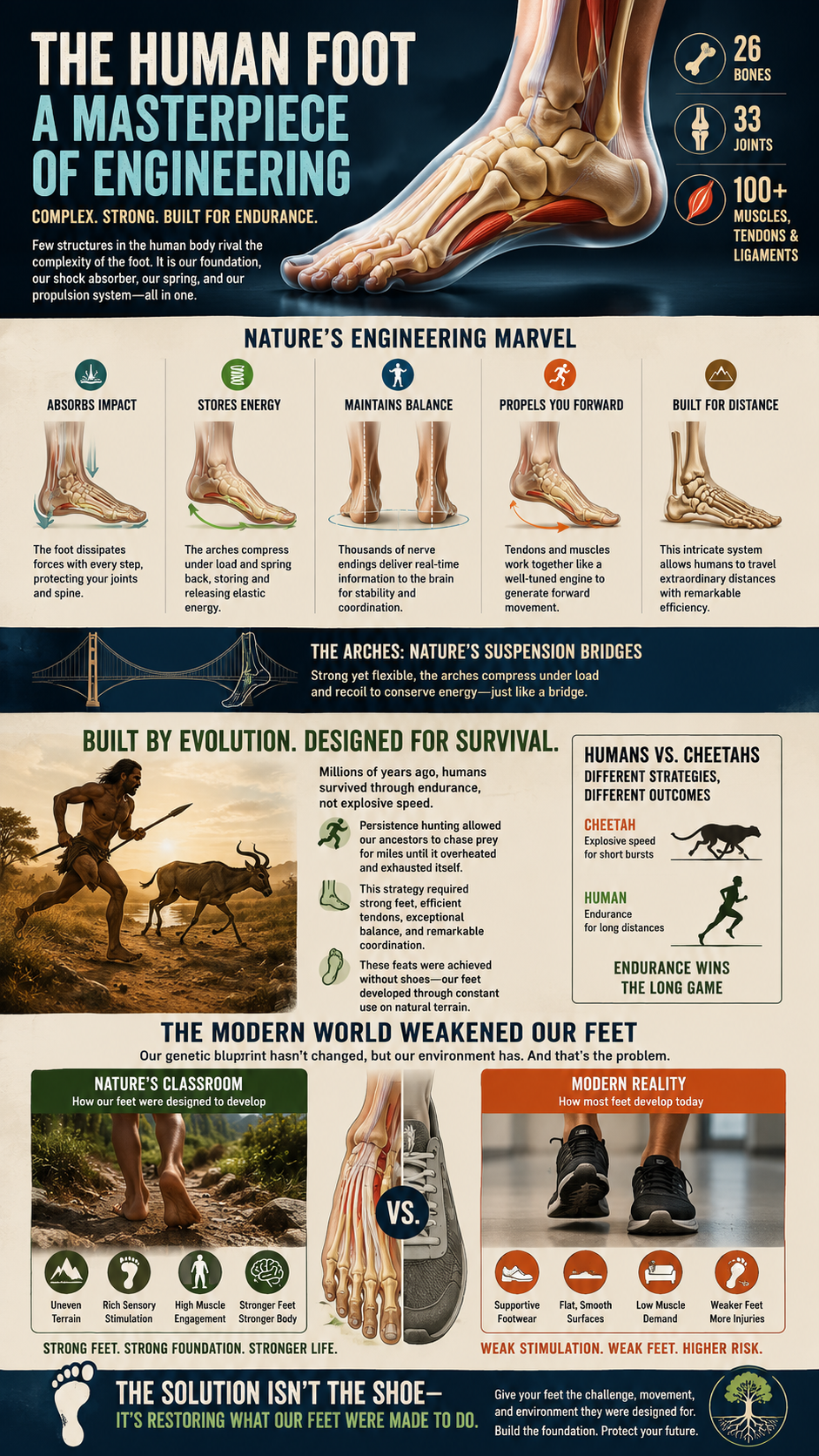
Evolution did not create this system for comfort. It created it for survival. Anthropologists studying early human ancestors believe endurance running helped secure food long before the invention of agriculture. Rather than relying on explosive speed like a cheetah, humans excelled through persistence. They chased prey over many miles until the animal overheated and exhausted itself. This strategy demanded strong feet, efficient tendons, exceptional balance, and remarkable coordination between the brain and every joint below the waist. Our ancestors accomplished these feats without cushioned shoes because their feet developed under constant mechanical challenge from childhood onward.
That evolutionary history still exists inside every person today. The genetic blueprint has not changed significantly over the past several thousand years. Modern lifestyles, however, have dramatically altered how those genes express themselves. Most children now spend their earliest years inside supportive footwear. They walk across flat indoor surfaces rather than natural landscapes filled with rocks, roots, slopes, and loose soil. The foot receives less sensory stimulation, performs less muscular work, and gradually loses the strength that once defined human locomotion. The problem, therefore, may not be shoes themselves. The problem begins when the foot never receives the opportunity to develop as nature intended.
The Hidden Epidemic of Weak Feet
Weak feet rarely receive the attention given to weak hearts or weak bones, yet they influence nearly every movement the body performs. Many adults unknowingly possess underdeveloped intrinsic foot muscles, reduced arch stability, limited toe mobility, and diminished balance. These deficits often remain silent until running, hiking, or prolonged standing exposes them. Instead of recognizing weakened foot function, many people assume pain simply represents aging or overuse.
Researchers have increasingly identified foot muscle weakness as a contributor to several common orthopedic conditions. The plantar fascia loses its ability to distribute force efficiently. The Achilles tendon absorbs greater mechanical stress. Small stabilizing muscles fatigue quickly, allowing larger muscles to compensate. Over time, compensation alters gait mechanics and changes how force travels through the ankle, knee, hip, pelvis, and lower back. The body rarely confines dysfunction to one location. Instead, it redistributes mechanical stress until another structure reaches its breaking point.
This chain reaction resembles a suspension bridge with one weakened cable. The bridge continues functioning, but neighboring cables shoulder additional tension. Eventually, another cable begins to fail. Human movement follows a similar principle. Weak foot muscles encourage altered mechanics throughout the kinetic chain, increasing stress on joints that never caused the original problem. Knee pain, hip discomfort, chronic calf tightness, and recurring lower back pain may all reflect compensation for diminished foot function rather than isolated injuries.
Modern Running Shoes Solved One Problem While Creating Another
The running shoe industry deserves credit for remarkable technological innovation. Advances in cushioning, stability, and material science have helped countless athletes train comfortably across long distances. Modern footwear protects the sole from sharp objects, extreme temperatures, and repetitive impact against unforgiving surfaces. These benefits remain important, particularly for individuals recovering from injury or running on concrete for extended periods.
Problems arise when protection evolves into permanent dependence. Thick midsoles reduce the mechanical demands placed upon many small muscles inside the foot. Motion-control features often limit natural joint movement. Elevated heels subtly alter posture and shift body weight forward. Toe boxes frequently compress the forefoot, limiting natural toe splay during walking and running. Individually, these changes appear insignificant. Collectively, they reshape how the nervous system interprets movement and how muscles respond to mechanical load.
Scientists frequently describe this process using the principle of adaptation. Muscles strengthen when challenged consistently. They weaken when external support performs their work. The same principle governs the foot. Continuous reliance on highly supportive footwear may reduce opportunities for intrinsic muscles to maintain optimal strength. This concept does not suggest that every supportive shoe causes harm. Instead, it highlights the importance of balancing protection with functional movement. The body thrives when tissues perform the jobs they evolved to accomplish.
Your Brain Depends on Information From Your Feet
Most people think of the foot as a mechanical structure. Neuroscientists recognize it as an extraordinary sensory organ. The soles contain thousands of specialized nerve endings that continuously report pressure, vibration, texture, and joint position to the brain. This information allows the nervous system to calculate balance, coordinate posture, and prepare muscles for the next movement before conscious thought occurs.
Imagine walking across a sandy beach. Every grain shifts beneath the foot, forcing constant adjustments throughout the ankle, knee, hip, and spine. Those subtle corrections strengthen neural pathways responsible for coordination and stability. Walking across smooth concrete produces far fewer sensory challenges. Thick footwear filters even more information before it reaches the brain. Over months and years, reduced sensory stimulation may contribute to diminished proprioception, the body’s awareness of where each limb exists in space.
Proprioception influences far more than athletic performance. It affects fall prevention, joint stability, reaction time, and overall movement quality. Aging adults with impaired balance often demonstrate reduced sensory feedback from the feet. Athletes recovering from ankle sprains frequently lose proprioceptive accuracy long after pain disappears. These observations remind us that healthy feet contribute to neurological health as much as orthopedic health. Running barefoot temporarily restores direct communication between the ground and the nervous system, although that benefit depends upon gradual adaptation rather than sudden exposure.
Barefoot Running Changes the Entire Kinetic Chain
Running without shoes immediately alters movement patterns, even among experienced athletes. Most runners wearing cushioned shoes naturally strike the ground with their heels. Barefoot runners usually transition toward a midfoot or forefoot landing because heel striking becomes uncomfortable without substantial cushioning. That single adjustment redistributes force throughout the lower body.
Heel striking often transfers greater loading through the knee during initial ground contact. Forefoot striking shifts more responsibility toward the calf muscles, Achilles tendon, and forefoot. Neither pattern represents perfection. Each simply emphasizes different tissues. The body responds by strengthening structures that receive repeated mechanical demand, provided progression occurs gradually enough for adaptation.
Unfortunately, many runners misunderstand this principle. They assume removing shoes automatically improves running mechanics. Biomechanics seldom reward sudden change. Tendons remodel slowly. Bones require months to increase density under new loading patterns. Muscles strengthen faster than connective tissue, creating a dangerous mismatch during rapid transitions. Enthusiasm frequently outpaces biology. As a result, runners abandon supportive shoes, dramatically increase barefoot mileage, and develop stress fractures or Achilles injuries before their skeleton adapts.
The lesson extends beyond barefoot running. Every tissue within the body follows biological timelines that cannot be rushed. Healthy adaptation requires progressive exposure, adequate recovery, balanced nutrition, and consistent movement. Attempting to shortcut those processes often transforms promising ideas into painful experiences.
The Real Problem Is Not Bare Feet
Public discussion often frames barefoot running as a choice between two extremes. One side celebrates it as the cure for modern running injuries. The other portrays it as reckless and dangerous. Scientific evidence supports neither absolute position. Large reviews have found no universal reduction in injury rates among barefoot runners. Instead, researchers observe different injury patterns depending upon training history, tissue capacity, footwear, terrain, and transition speed.
This finding points toward a more important conclusion. Footwear itself rarely serves as the primary problem. Dysfunction develops when tissue capacity fails to match mechanical demand. Weak muscles struggle under heavy loads. Stiff joints alter movement efficiency. Poor balance increases instability. Reduced ankle mobility changes force distribution throughout the leg. Shoes may influence these variables, but they seldom create them independently.
Many runners searching for the perfect shoe overlook this fundamental reality. No amount of cushioning can compensate indefinitely for weak intrinsic foot muscles. Motion-control technology cannot permanently replace healthy joint mobility. Expensive footwear cannot retrain a nervous system deprived of sensory stimulation. These devices may provide temporary assistance, but long-term resilience depends upon restoring the body’s natural capacity to manage movement.
The Modern Environment Changed More Than Our Shoes
The barefoot running debate cannot be separated from the world humans now inhabit. Our ancestors developed strong feet while walking across varied landscapes from sunrise until sunset. Contemporary adults spend much of the day seated, then suddenly expect their bodies to tolerate recreational running several times each week. Daily movement volume has declined dramatically while body weight has increased in many populations. At the same time, chronic inflammation, obesity, diabetes, and metabolic dysfunction have become increasingly common. Each of these conditions influences connective tissue health, nerve function, circulation, and recovery capacity.
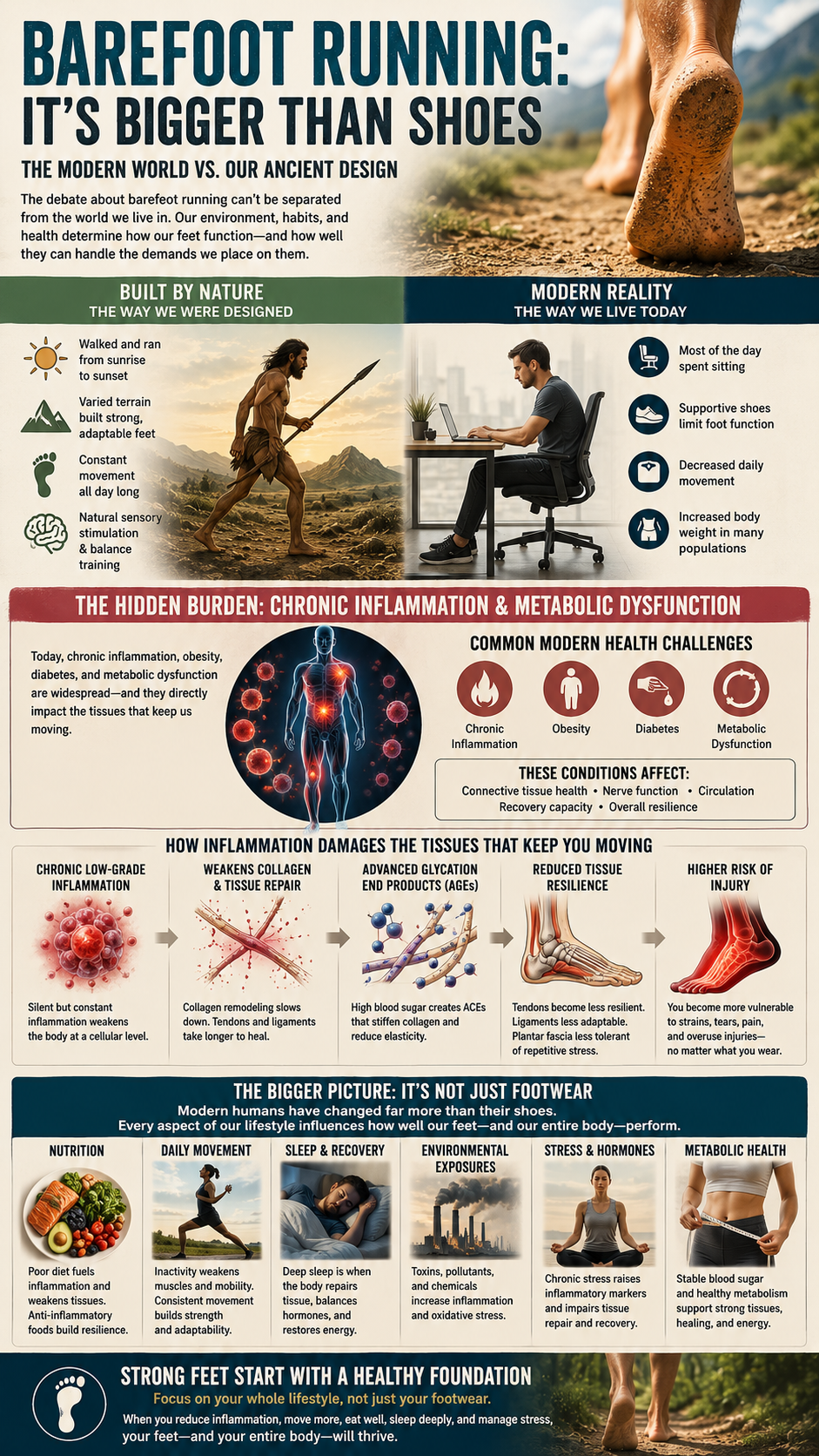
Inflammation deserves particular attention because it quietly affects nearly every structure involved in running. Chronic low-grade inflammation weakens collagen remodeling, delays tendon repair, and alters muscle recovery following exercise. Elevated blood glucose promotes the formation of advanced glycation end products, compounds that stiffen collagen fibers and reduce tissue elasticity. Tendons lose some of their natural resilience. Ligaments become less adaptable under mechanical stress. The plantar fascia may tolerate repetitive loading less effectively than it once did. These biological changes increase injury susceptibility regardless of footwear choice.
Viewed through this broader lens, barefoot running becomes part of a much larger conversation. Modern humans have not merely changed shoes. They have changed nutrition, daily movement, sleep patterns, environmental exposures, and metabolic health. Each factor influences how well the foot performs its remarkable responsibilities. Focusing exclusively on footwear risks overlooking the deeper physiological landscape that determines resilience.
Looking Beyond the Sole
Perhaps the greatest misunderstanding surrounding barefoot running involves expecting one intervention to solve a multifaceted problem. Healthy movement depends upon muscular strength, neurological coordination, joint mobility, tissue integrity, metabolic health, and intelligent training progression. Shoes influence each of these variables, but they do not govern them completely. Barefoot running may strengthen some individuals while injuring others because every body arrives with a different history of adaptation.
Understanding this distinction transforms the debate. Instead of asking whether barefoot running is inherently good or bad, a more meaningful question emerges. Is the body prepared for the demands that barefoot running places upon it? That single question shifts attention away from footwear and toward functional health, where lasting answers usually reside.
Rebuilding the Foundation Beneath Your Feet and Protecting Every Step You Take
If the modern foot has a silent enemy, it is not the running shoe resting beside the front door. The true enemy is decades of disuse disguised as comfort. Muscles weaken when they remain idle. Tendons lose resilience when they face little challenge. Nerves become less responsive when sensory input disappears. Bones remodel according to the stresses placed upon them, and without regular stimulation they gradually surrender strength. The human foot follows every one of these biological rules. Barefoot running simply exposes weaknesses that often developed years before the first shoe came off.
This distinction explains why barefoot running produces dramatically different experiences from one person to another. A lifelong soccer player who spent childhood running across fields may transition with little difficulty because years of varied movement prepared the tissues for natural loading. An office worker who spends ten hours each day seated, wears supportive shoes from sunrise until bedtime, and rarely walks on uneven ground enters the same experiment with a completely different foundation. The difference lies not in genetics but in tissue readiness. Biology always rewards preparation and punishes abrupt change.
The Body Keeps Score Long Before Pain Appears
Pain rarely marks the beginning of an injury. It usually signals the final chapter of a process that unfolded quietly over weeks, months, or even years. Small mechanical faults accumulate beneath the threshold of awareness until connective tissue reaches its limit. By the time discomfort develops, muscles have already compensated, tendons have endured excessive strain, and joints have altered their movement patterns to protect vulnerable structures.
The foot often begins this cascade without attracting attention. Restricted motion in the big toe changes how weight transfers during walking. Weak intrinsic muscles allow the arch to collapse more than intended. Reduced ankle mobility forces the knee to rotate differently during each stride. Tight calf muscles shorten the Achilles tendon and increase forefoot pressure. Every compensation appears modest in isolation, yet together they reshape movement throughout the entire kinetic chain. The brain adapts remarkably well to these changes, masking dysfunction until repetitive stress finally overwhelms the body’s capacity to recover.
Scientists describe this process as cumulative loading. Every step represents a small mechanical event. Running thousands of steps magnifies those events dramatically. Healthy tissue tolerates this workload because it continually repairs microscopic damage. Compromised tissue struggles to keep pace. The gap between damage and repair gradually widens until inflammation, degeneration, or structural injury develops. Understanding this principle helps explain why barefoot running neither causes nor cures every injury. Instead, it reveals whether the body’s foundation can support the demands placed upon it.
Modern Feet Often Forget How to Move Naturally
Observe a toddler learning to walk. The child instinctively spreads the toes, grips the ground, shifts weight fluidly, and constantly adjusts balance. Those movements strengthen the foot while simultaneously teaching the nervous system how to coordinate the entire body. Every stumble becomes a neurological lesson. Every uneven surface expands the brain’s movement library. Childhood offers countless opportunities for natural development when feet encounter diverse environments.
Many adults gradually lose these abilities. Narrow footwear compresses the toes and limits their natural spread. Elevated heels shorten the calf muscles and alter posture. Years of walking across perfectly level surfaces reduce the need for constant balance corrections. The nervous system receives fewer opportunities to refine movement, while the muscles responsible for stability receive less work. Eventually the foot functions more like a rigid platform than the dynamic spring it evolved to become.
This decline influences far more than athletic performance. Poor toe mobility reduces balance during ordinary walking. Limited ankle flexibility increases fall risk in older adults. Weak arches allow excessive inward motion that stresses the knees and hips. Even spinal posture may change because the body constantly adjusts above the feet to preserve balance. The consequences extend well beyond the sole of the foot, reinforcing the idea that healthy movement begins from the ground upward.
Connective Tissue Needs Time, Not Motivation
Modern culture celebrates rapid transformation. Fitness programs promise dramatic changes within weeks. Social media rewards dramatic before-and-after stories. Biology follows a slower timetable. Muscles may become noticeably stronger within several weeks of training, but tendons and ligaments remodel much more gradually. Bone density often requires months of consistent loading before measurable adaptation occurs. Cartilage changes even more slowly because it receives limited blood supply.
This reality explains many barefoot running injuries. Motivated runners often feel stronger after only a few weeks because muscular adaptation occurs relatively quickly. Meanwhile, their metatarsal bones, Achilles tendons, and plantar fascia remain early in the remodeling process. The body appears ready on the surface while deeper structures continue strengthening beneath the threshold of awareness. Increasing mileage too aggressively during this vulnerable period frequently produces stress fractures or tendon irritation despite improving fitness.
Patience therefore becomes a biological requirement rather than a personality trait. Every successful transition depends upon respecting the pace of tissue adaptation. The body rewards gradual progress because each layer of connective tissue gains sufficient time to remodel before facing greater demand. Ignoring those timelines transforms enthusiasm into mechanical overload.
Restoring Foot Strength Begins Inside Your Home
Many people assume rebuilding foot health requires expensive equipment or specialized training facilities. In reality, the process often begins with ordinary daily habits. Spending carefully supervised time barefoot inside the home allows the nervous system to experience natural sensory input again. Hardwood floors, tile, and carpet each provide unique feedback that encourages subtle muscular activation throughout the foot and ankle. These seemingly insignificant adjustments gradually awaken muscles that have remained underused for years.
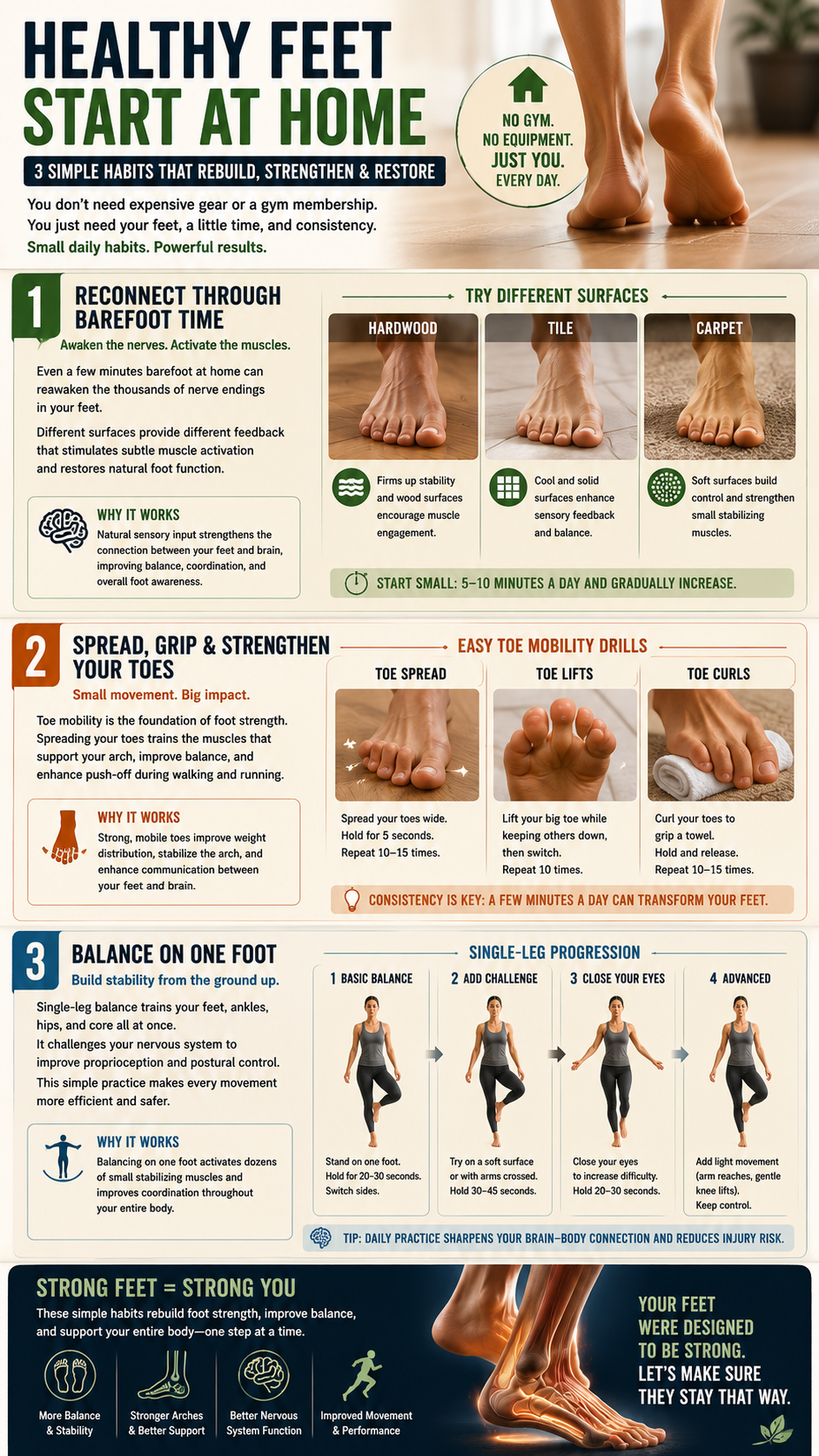
Walking slowly while consciously spreading the toes represents another powerful exercise. Most adults cannot fully separate their toes because years of restrictive footwear have limited independent movement. Practicing toe control strengthens intrinsic muscles while improving communication between the feet and the brain. Over time, greater toe mobility enhances balance, stabilizes the arch, and promotes more efficient weight transfer during walking. These improvements emerge gradually through repetition rather than intensity.
Single-leg standing offers another remarkable opportunity for restoration. Balancing on one foot forces dozens of small muscles throughout the foot, ankle, hip, and core to coordinate continuously. The nervous system responds by sharpening proprioception and improving postural control. Closing the eyes during later stages increases the challenge because visual information no longer compensates for reduced sensory feedback from the feet. This progression trains the brain to trust information originating from muscles and joints instead of relying exclusively on vision.
Natural Terrain Becomes a Powerful Teacher
The human foot evolved across constantly changing landscapes rather than perfectly engineered sidewalks. Grass compresses beneath body weight. Sand shifts unpredictably. Forest trails challenge balance with roots, rocks, and uneven surfaces. Each environment stimulates unique patterns of muscle activation while teaching the nervous system to respond efficiently to changing conditions. This diversity strengthens the foot without requiring high-impact activity.
Walking barefoot across safe natural terrain introduces gentle variability that modern environments often lack. A grassy backyard encourages different muscular responses than a sandy beach. Smooth river stones require careful weight distribution. Soft woodland paths improve coordination through subtle balance challenges. These environments teach movement rather than forcing it. Every step delivers information to the brain while strengthening tissues naturally through low-intensity exposure.
Safety remains essential throughout this process. Natural surfaces should remain free from sharp objects, broken glass, and hazardous debris. Individuals with peripheral neuropathy, advanced diabetes, severe vascular disease, or diminished protective sensation should consult their healthcare provider before walking barefoot outdoors. Healthy tissue benefits from sensory stimulation, but compromised tissue requires additional protection.
Nutrition Shapes the Strength of Every Step
Movement alone cannot rebuild resilient connective tissue. Every tendon, ligament, muscle, and bone depends upon proper nutrition to repair microscopic damage created through daily activity. Collagen synthesis requires adequate protein along with nutrients such as vitamin C, copper, zinc, and manganese. Bone remodeling depends upon sufficient calcium, magnesium, vitamin D, and vitamin K. Without these raw materials, adaptation slows regardless of training quality.
Chronic inflammation presents another obstacle to healthy tissue remodeling. Diets dominated by highly processed foods, refined sugars, and industrial seed oils may contribute to persistent low-grade inflammation in susceptible individuals. This inflammatory environment interferes with collagen turnover, delays recovery, and alters the mechanical properties of connective tissue. Although nutrition alone cannot eliminate running injuries, it strongly influences the body’s capacity to repair itself after repetitive loading.
Hydration deserves equal attention because connective tissue relies upon proper water content to maintain flexibility and resilience. Dehydrated fascia becomes less pliable. Cartilage functions less efficiently when hydration declines. Even small reductions in fluid balance may influence endurance, recovery, and muscular performance during prolonged activity. Healthy feet therefore depend upon the same nutritional foundation that supports every other organ within the body.
The Nervous System Controls More Than Muscles
Most discussions about barefoot running focus on muscles, bones, and tendons. The nervous system quietly orchestrates every movement behind the scenes. It determines muscle timing, joint stability, reaction speed, and balance before conscious thought occurs. Every step generates enormous amounts of sensory information that travel from the feet to the spinal cord and brain within fractions of a second. The brain interprets that information and immediately adjusts muscle activity throughout the body.
Improving this communication represents one of the greatest potential advantages of progressive barefoot training. Increased sensory input challenges the nervous system to refine movement patterns continuously. Better coordination often follows because muscles activate more efficiently rather than simply becoming stronger. Many athletes describe this sensation as feeling lighter, quicker, or more connected to the ground. Those perceptions reflect neurological adaptation as much as mechanical improvement.
Chiropractic care may also influence this neurological process by addressing joint dysfunction that interferes with normal movement. Restricted motion within the foot, ankle, pelvis, or spine alters sensory input reaching the central nervous system. Restoring healthy joint motion helps normalize proprioceptive feedback and may improve movement quality when combined with strengthening exercises and progressive training. Functional rehabilitation works best when mechanical alignment and muscular control improve together rather than independently.
Barefoot Running Is Not for Everyone
Despite its potential benefits, barefoot running does not represent the ideal choice for every individual. People recovering from recent fractures, advanced plantar fasciitis, severe Achilles tendinopathy, peripheral neuropathy, or significant structural deformities require individualized assessment before considering a transition. Existing tissue damage changes how forces distribute throughout the foot and may increase injury risk during early adaptation.
Age alone should not discourage exploration of natural movement, but biological readiness should guide every decision. An active seventy-year-old with excellent balance, strong muscles, and healthy connective tissue may adapt more successfully than a sedentary thirty-year-old with chronic inflammation and poor mobility. Functional capacity consistently predicts resilience better than chronological age. Listening to the body’s response remains more valuable than following rigid timelines or online challenges.
The goal therefore should never revolve around proving that barefoot running is superior. Instead, the objective involves creating feet capable of functioning well regardless of footwear. Strong feet improve walking, hiking, recreational sports, balance, and overall quality of life even for individuals who never intend to run without shoes.
Rediscovering the Foundation Beneath Us
Perhaps the greatest lesson barefoot running offers has little to do with footwear itself. It reminds us that human health often depends upon restoring functions modern life quietly diminished. Comfortable environments have reduced many natural challenges that once strengthened our bodies automatically. The feet represent only one example of this broader pattern. Muscles weaken without use. Bones lose density without loading. Balance declines without practice. The nervous system becomes less adaptable when movement grows repetitive.
Barefoot running did not create these realities. It merely exposed them. The debate surrounding shoes often distracts from the deeper issue that many modern bodies no longer possess the resilience they once enjoyed. Rebuilding that resilience requires patience, intelligent progression, proper nutrition, restorative sleep, varied movement, and consistent attention to the remarkable structures supporting every step we take.
The healthiest future may not belong to those who abandon shoes completely or those who depend upon maximum cushioning forever. Instead, it likely belongs to individuals who cultivate strong, mobile, neurologically responsive feet capable of adapting to changing environments. When the foot regains its natural strength, the ankle moves more freely, the knees absorb force more efficiently, the hips stabilize more effectively, and the spine benefits from improved mechanics. Every step becomes an expression of a body functioning closer to the way it was designed.
Barefoot running is therefore neither a revolutionary miracle nor a reckless trend destined to destroy feet. It is a powerful reminder that the foundation of human movement begins with structures many people have forgotten to train. When that foundation grows stronger, the entire body stands to benefit.