
The Hidden Mechanical Problem Turning a Healing Practice into a Source of Pain
A yoga studio rarely feels like the birthplace of an injury. Soft music drifts through the room while slow breathing replaces the noise of everyday life. Instructors encourage mindfulness, flexibility, and inner balance. Students arrive carrying hopes of stronger muscles, calmer minds, and healthier bodies. Few people expect that the very movements designed to restore health could instead aggravate aching backs, stiff necks, painful shoulders, or unstable hips. Yet chiropractic clinics routinely care for patients whose symptoms began shortly after starting yoga or intensified despite months of faithful practice. Their experiences raise an important question that deserves more attention than it often receives. If yoga promotes health, why do so many people leave the mat with new pain instead of lasting relief?
The answer rarely begins with yoga itself. Most yoga poses simply reveal problems that already existed beneath the surface. Every stretch, twist, and balance challenge exposes how the body truly moves under stress. When joints glide smoothly and muscles coordinate efficiently, those movements improve flexibility and strength together. When the spine has lost proper alignment, however, each pose magnifies mechanical faults that accumulated quietly over months or even decades. Pain becomes the final chapter of a much longer story. By the time discomfort appears, the body’s compensation patterns have often become deeply ingrained. Understanding that hidden progression changes the entire conversation surrounding yoga injuries.
The Silent Foundation Beneath Every Movement
Imagine constructing a beautiful cathedral on shifting soil. Craftsmen may carve flawless stone, install magnificent stained glass, and build soaring arches with remarkable precision. Despite their skill, the entire structure remains vulnerable because the foundation no longer supports it evenly. Tiny cracks emerge first. Doors stop closing correctly. Walls begin leaning ever so slightly until the entire building carries stress it was never designed to withstand. Repairing the roof alone cannot solve a failing foundation.
The human body follows remarkably similar engineering principles. Bones create the framework, muscles generate movement, ligaments provide stability, and the nervous system coordinates every action. Proper alignment allows these systems to work together with remarkable efficiency. Once that alignment changes, every movement requires compensation somewhere else in the body. One shoulder rises higher than the other. The pelvis rotates forward. A foot collapses inward during walking. The head drifts several inches in front of the shoulders. None of these changes may hurt immediately, yet each alteration redirects mechanical forces through joints that were never designed to absorb them repeatedly.
Yoga exposes these hidden weaknesses because it challenges balance, flexibility, strength, and coordination simultaneously. A healthy body distributes those forces evenly across the kinetic chain. An imbalanced body shifts excessive load into specific muscles, tendons, and joints. Instead of correcting dysfunction, repetitive practice often reinforces it because the nervous system continues using the same faulty movement strategies. The pose appears beautiful from the outside while the body quietly struggles beneath the surface.
Alignment Shapes Every Breath, Step, and Stretch
Most people think posture simply affects appearance. Standing taller may project confidence, but posture influences far more than outward image. Every inch of spinal alignment changes how muscles contract, how joints articulate, and how nerves communicate throughout the body. Small positional changes create surprisingly large physiological consequences.
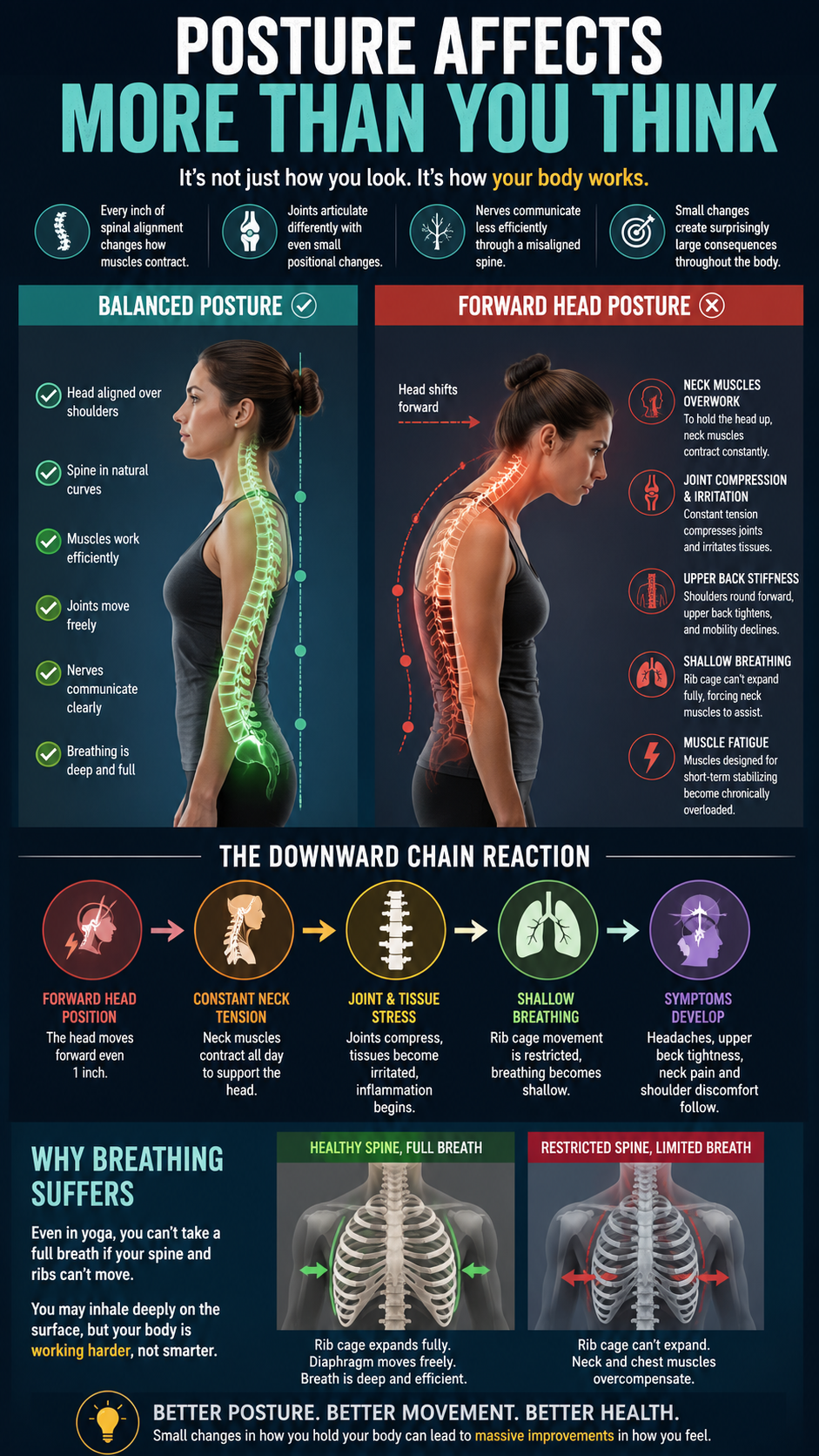
Consider the cervical spine, which supports the head throughout the day. When the head migrates forward, neck muscles contract continuously to prevent it from falling farther. That constant tension compresses joints, irritates surrounding tissues, and increases fatigue within muscles designed for brief stabilization rather than permanent workload. As the shoulders round forward, the upper back stiffens while breathing becomes increasingly shallow. The rib cage loses normal expansion, forcing accessory muscles of the neck to assist every breath. What began as poor posture gradually transforms into chronic muscular overload.
Yoga often encourages deeper breathing, yet restricted spinal motion can prevent full expansion of the rib cage. Students may focus intensely on inhalation without realizing that spinal stiffness physically limits chest mobility. Instead of improving breathing efficiency, the body recruits even more neck muscles to compensate. Headaches, upper back tightness, and shoulder discomfort frequently follow because the underlying mechanical restriction never changed.
Flexibility Without Stability Creates a Dangerous Illusion
Modern fitness culture celebrates flexibility almost as though it guarantees health. Social media rewards increasingly dramatic poses while advanced stretches collect millions of views. Touching the floor with straight knees, performing effortless splits, or balancing gracefully on one arm creates an impressive visual display. Unfortunately, appearance alone reveals very little about joint health.
Many injured yoga practitioners possess exceptional flexibility. Their ligaments stretch easily, allowing joints to travel beyond normal ranges of motion. While this ability appears advantageous, excessive mobility without muscular control creates instability rather than resilience. Every joint depends upon surrounding muscles to guide movement precisely. Ligaments should limit extreme motion rather than function as primary stabilizers. Once muscles fail to control movement effectively, passive tissues absorb increasing mechanical stress.
Researchers studying hypermobility have repeatedly observed higher injury rates among individuals whose joints move excessively without adequate stability. Shoulders slip slightly during weight-bearing poses. Knees rotate subtly during standing balances. The lower back bends farther because the hips lack coordinated control. These tiny deviations rarely cause immediate injury, yet repeated thousands of times they gradually overwhelm connective tissues. Pain develops slowly because degeneration almost always begins long before symptoms appear.
The Brain Learns Compensation Faster Than Healing
Every previous injury leaves behind more than scar tissue. The nervous system records movement patterns designed to protect injured areas, even after damaged tissues recover. A sprained ankle changes walking mechanics. A minor car accident alters neck movement. Years spent sitting behind a computer reshape spinal posture. Pregnancy changes pelvic stability. Carrying children consistently on one hip shifts muscular balance throughout the trunk.
These adaptations initially serve a protective purpose. The brain sacrifices efficiency to avoid pain. Over time, however, temporary compensation becomes permanent habit. Muscles strengthen according to abnormal movement patterns while weaker stabilizers gradually switch off. Eventually the original injury disappears, yet the altered mechanics remain active during every step, squat, lift, and yoga pose.
Few students recognize these hidden adaptations because compensation feels completely normal. The body rarely announces that it has adopted inefficient strategies. Instead, it quietly redistributes force elsewhere. One hip rotates farther during Warrior II. The lumbar spine twists excessively during seated spinal twists. The shoulders shrug during downward dog because the thoracic spine refuses to extend properly. Each repetition reinforces neurological pathways that favor compensation instead of correction.
The Spine Functions as One Continuous System
An old misconception treats spinal regions as separate structures. Neck pain seems unrelated to hip pain, while shoulder stiffness appears disconnected from foot mechanics. Modern biomechanics tells a very different story. Every spinal segment influences neighboring joints through muscles, fascia, ligaments, and neural communication. Restriction in one area often forces another region to become excessively mobile.
Suppose the middle back loses rotational movement after years of desk work. During twisting yoga poses, the body still seeks the desired range of motion. Since the thoracic spine refuses to rotate adequately, the lumbar spine accepts additional rotation instead. Unfortunately, lumbar vertebrae naturally allow very little rotational movement. Repeated twisting therefore overloads discs, facet joints, and surrounding ligaments that evolved primarily for stability rather than rotation.
The same principle affects shoulder movement. Healthy overhead motion requires coordinated extension through the thoracic spine. Without that extension, the shoulder joint compensates by elevating farther than intended. Rotator cuff tendons gradually become compressed beneath the acromion, producing irritation that many people mistakenly blame on yoga itself. The pose simply exposed mechanical limitations developing silently for years.
Pelvic Imbalance Alters the Entire Kinetic Chain
The pelvis serves as the body’s central transmission system. Forces generated by the legs travel upward through the pelvis before reaching the spine. At the same time, movements from the upper body transfer downward through the same structure during lifting, walking, and balancing. Even subtle pelvic asymmetry therefore influences virtually every athletic movement.
Modern lifestyles create numerous opportunities for pelvic imbalance. Long hours of sitting shorten hip flexors while weakening gluteal muscles. Crossing one leg repeatedly changes muscular tension around the hips. Previous falls, sports injuries, and pregnancy further alter pelvic mechanics. Although these adaptations initially remain painless, they influence every yoga posture involving standing balance or hip mobility.
One hip often begins moving farther than the other. The lumbar spine compensates during forward bends because true hip flexion remains restricted. Hamstrings appear unusually tight even though they simply protect an unstable pelvis. Students stretch those muscles repeatedly without realizing the real problem originates higher within the kinetic chain. Temporary relief follows each class because muscles briefly relax before returning to their protective state.
The Modern Lifestyle Creates the Perfect Setup for Yoga Injuries
Human bodies evolved for continuous movement across varied terrain. Walking, climbing, squatting, reaching, and carrying shaped musculoskeletal development for thousands of years. Modern society replaced much of that natural movement with prolonged sitting, repetitive computer work, and constant smartphone use. Daily habits now reshape posture long before anyone attends their first yoga class.
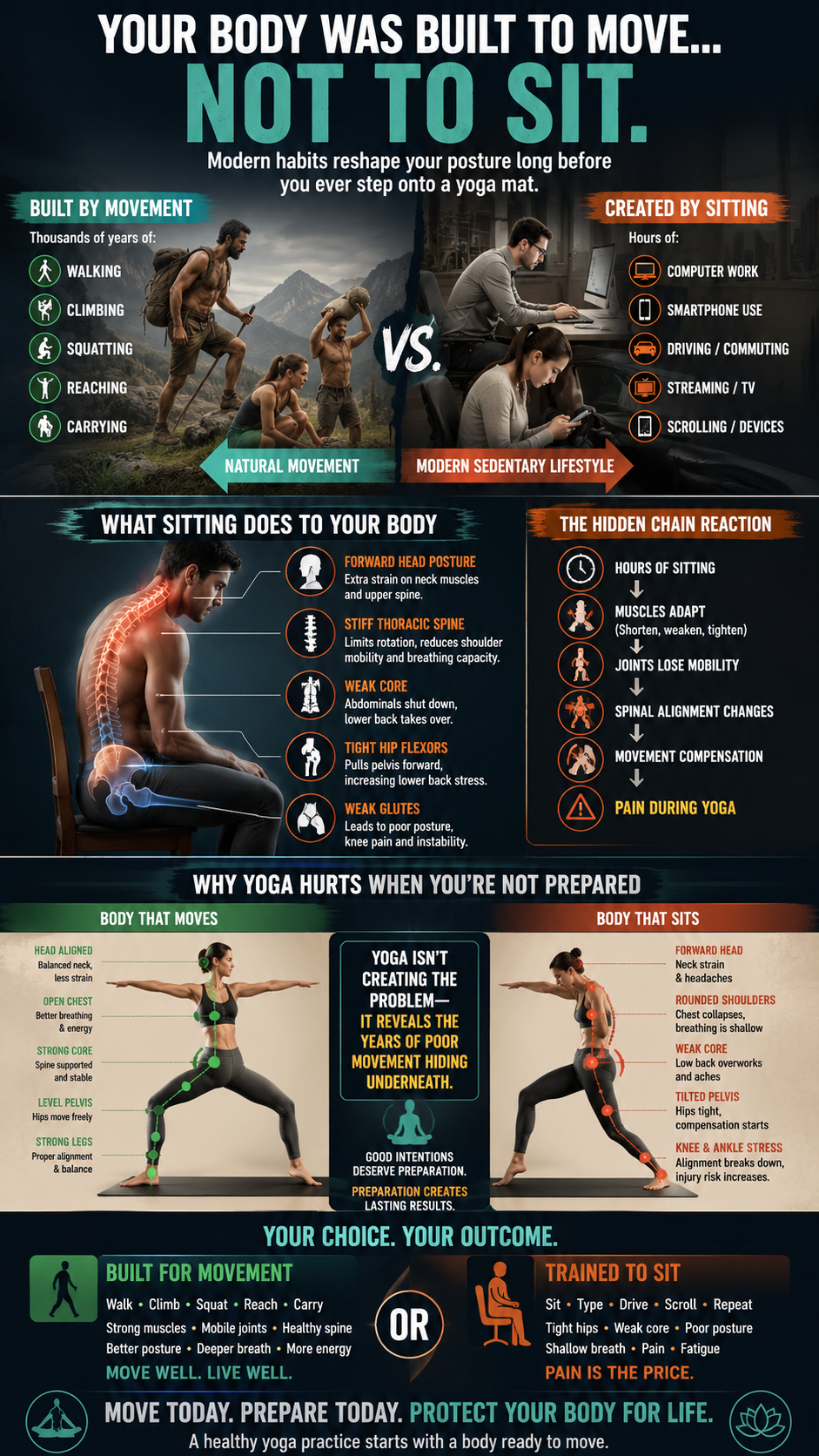
Desk workers frequently develop shortened hip flexors, weakened abdominal stabilizers, stiff thoracic spines, and forward head posture. Smartphone users spend countless hours with flexed necks and internally rotated shoulders. Drivers remain seated with minimal spinal variation during lengthy commutes. Even leisure time often involves additional sitting while streaming entertainment or browsing digital devices.
Yoga becomes the first meaningful movement many adults perform after years of sedentary living. Their intentions deserve admiration, yet the body cannot instantly erase decades of mechanical adaptation. Asking chronically restricted joints to perform advanced flexibility exercises resembles expecting an old rusted hinge to swing freely after years without lubrication. The desire may be healthy, but preparation determines the outcome.
Pain Represents the Final Warning, Not the First Problem
One of the greatest misunderstandings surrounding musculoskeletal health involves the timing of pain. Most people assume pain signals the beginning of an injury. Biology tells another story. The body usually compensates successfully for months or years before symptoms emerge. Muscles tighten to stabilize unstable joints. Other muscles weaken because they no longer participate normally. Connective tissues gradually thicken under chronic stress. Cartilage experiences uneven loading while inflammation quietly develops beneath conscious awareness.
Eventually those protective mechanisms reach their limit. Small movements suddenly produce discomfort that seems unrelated to any major trauma. Many yoga practitioners remember the exact pose during which pain first appeared, yet the true origin often predates that moment by years. The pose did not necessarily create dysfunction. Instead, it exposed compensation patterns that had silently progressed beyond the body’s ability to adapt.
Recognizing this distinction changes treatment priorities completely. Simply avoiding the painful pose rarely addresses the mechanical fault responsible for symptoms. Long-term improvement requires identifying the underlying alignment errors that redirected stress throughout the kinetic chain. Until those foundational problems improve, the body continues searching for compensation during every movement, whether performed inside a yoga studio or during ordinary daily life.
The encouraging reality is that the human body possesses remarkable capacity for adaptation when movement quality replaces movement quantity. Restoring spinal mechanics, improving joint stability, and retraining healthy movement patterns often allows flexibility to develop naturally without sacrificing structural integrity. That journey begins by understanding not merely where pain appears, but where dysfunction truly begins. In Part 2, we will explore practical strategies you can implement at home to improve alignment, restore healthier biomechanics, and reduce the mechanical stresses that frequently transform a restorative yoga practice into an unexpected source of pain.
Rebuilding Healthy Movement from the Ground Up
The body possesses an extraordinary ability to heal, but it cannot consistently repair itself while repeating the same faulty movement patterns every day. That simple reality explains why countless people spend months stretching painful muscles without experiencing lasting improvement. The temporary relief feels encouraging, yet the discomfort quietly returns because the underlying mechanics never changed. Every yoga session becomes another opportunity to reinforce compensation instead of restoring balance. Real recovery begins only when movement quality becomes more important than movement quantity.
Many people assume flexibility should always come first. In reality, healthy movement follows a different sequence. The nervous system first creates stability, then allows mobility to develop safely around that stable foundation. Infants demonstrate this beautifully. A child first develops trunk stability before crawling, then standing, and finally walking. Nature never sacrifices control for flexibility. Adults often reverse that process by chasing larger ranges of motion before establishing proper joint stability. The result frequently appears as chronic soreness, recurring injuries, and frustration despite consistent effort.
Understanding this sequence transforms the way yoga should be approached. Rather than asking, “How far can I stretch?” a healthier question becomes, “Can I control this movement with proper alignment?” That shift alone changes everything. The goal no longer involves forcing the body into impressive positions. Instead, every pose becomes an opportunity to teach the nervous system healthier movement patterns that protect joints instead of overloading them.
The Nervous System Controls Every Yoga Pose
Most people believe muscles create movement independently. Muscles certainly generate force, but the nervous system determines how and when those muscles fire. Every stretch, balance pose, and transition begins as an electrical command traveling from the brain through the spinal cord and into peripheral nerves. If those communication pathways become inefficient because of chronic stress, poor posture, or joint dysfunction, movement quality declines long before noticeable weakness appears.
The brain constantly receives information from tiny sensory receptors located within muscles, ligaments, tendons, joints, and skin. These receptors tell the brain where every body part exists in three-dimensional space, a process known as proprioception. Healthy proprioception allows smooth, coordinated movement without conscious thought. When spinal joints lose normal motion or muscles remain chronically tight, those sensory signals become less accurate. The brain responds by increasing muscular guarding around unstable areas. Ironically, the tightness many people stretch repeatedly often represents the nervous system’s attempt to create protection rather than a true flexibility problem.
This protective response explains why aggressive stretching frequently produces only temporary improvement. The muscles relax briefly, yet the nervous system quickly restores the previous tension because it still perceives instability underneath. Lasting change occurs only after the body feels mechanically secure again. Stability tells the brain it no longer needs excessive muscular guarding. Once that happens, flexibility often improves naturally without forcing the tissues beyond their comfort zone.
The Foot Often Starts the Entire Chain Reaction
Few yoga practitioners pay much attention to their feet beyond achieving balance during standing poses. Yet every step begins where the body contacts the ground. The feet contain twenty-six bones, thirty-three joints, and more than one hundred muscles, tendons, and ligaments working together to distribute force efficiently. Even subtle changes within this remarkable structure influence the knees, hips, pelvis, and spine above.
Collapsed arches represent one of the most overlooked contributors to poor alignment. As the arch falls inward, the lower leg rotates excessively. That rotation changes knee tracking, alters hip mechanics, and gradually twists the pelvis. The spine then compensates to keep the eyes level with the horizon. By the time discomfort reaches the neck or lower back, the original mechanical fault may have started years earlier at ground level.
Strengthening the feet provides an excellent starting point for improving overall alignment. Walking barefoot on safe natural surfaces encourages the small stabilizing muscles to become more active. Practicing controlled toe spreads, gentle arch lifts, and slow single-leg balance exercises teaches the nervous system to stabilize from the ground upward. These simple drills require only a few minutes each day, yet they often improve balance, posture, and lower-body control far more effectively than endless stretching alone.
Breathing Shapes the Spine More Than Most People Realize
Breathing appears automatic, yet poor breathing mechanics quietly reshape posture over time. The diaphragm functions as the body’s primary breathing muscle while also contributing significantly to spinal stability. Every healthy breath creates gentle pressure within the abdominal cavity that supports the lumbar spine much like an internal weightlifting belt.
Chronic stress disrupts this elegant system. Many adults develop shallow chest breathing that relies heavily on neck and shoulder muscles instead of the diaphragm. Those accessory muscles gradually become overworked while the diaphragm contributes less to spinal stabilization. The rib cage stiffens, the shoulders elevate, and the neck absorbs increasing mechanical stress with every breath.
Improving breathing mechanics requires surprisingly little equipment. Lying comfortably on the back with one hand resting on the chest and the other over the abdomen allows awareness to develop naturally. During slow inhalation, the lower hand should rise first while the chest remains relatively quiet. Gentle exhalation should feel relaxed rather than forced. Practicing this pattern for five to ten minutes daily helps restore diaphragmatic function while reducing unnecessary tension throughout the neck and upper back. Many people notice improved posture simply because the rib cage begins moving more efficiently again.
Mobility Should Follow Stability, Not Replace It
Stretching has earned tremendous popularity because it feels productive. Muscles temporarily lengthen, joints seem looser, and movement often becomes easier immediately afterward. Those sensations can be helpful when combined with proper stability training. Unfortunately, stretching alone rarely solves chronic movement dysfunction.
Healthy mobility depends upon controlled joint motion rather than maximum range. Consider the shoulder. A flexible shoulder lacking muscular control behaves much like a loose trailer hitch attached to a moving vehicle. Excessive movement develops where stability should exist. Nearby muscles then contract continuously to compensate, creating fatigue and irritation despite impressive flexibility.
Home exercises should therefore emphasize controlled movement rather than passive stretching alone. Slow bodyweight squats performed with excellent alignment strengthen hips while reinforcing proper movement patterns. Controlled hip hinges teach the pelvis to move independently from the lumbar spine. Gentle bird-dog exercises improve coordination between the trunk and limbs without placing excessive stress on vulnerable joints. Each repetition teaches the nervous system greater precision instead of simply increasing flexibility.
Daily Habits Shape the Body More Than Weekly Yoga Classes
One hour of excellent movement cannot erase fifteen hours of poor posture. Modern lifestyles repeatedly expose the spine to positions that gradually reshape muscle balance and joint mechanics. Sitting for prolonged periods shortens hip flexors, weakens gluteal muscles, and encourages forward head posture. Smartphones further reinforce rounded shoulders and flexed neck positions throughout the day.
Many yoga enthusiasts unknowingly spend far more time practicing poor posture than healthy movement. Their weekly classes provide temporary correction before daily habits gradually restore previous dysfunction. Sustainable improvement therefore requires attention beyond the yoga mat.
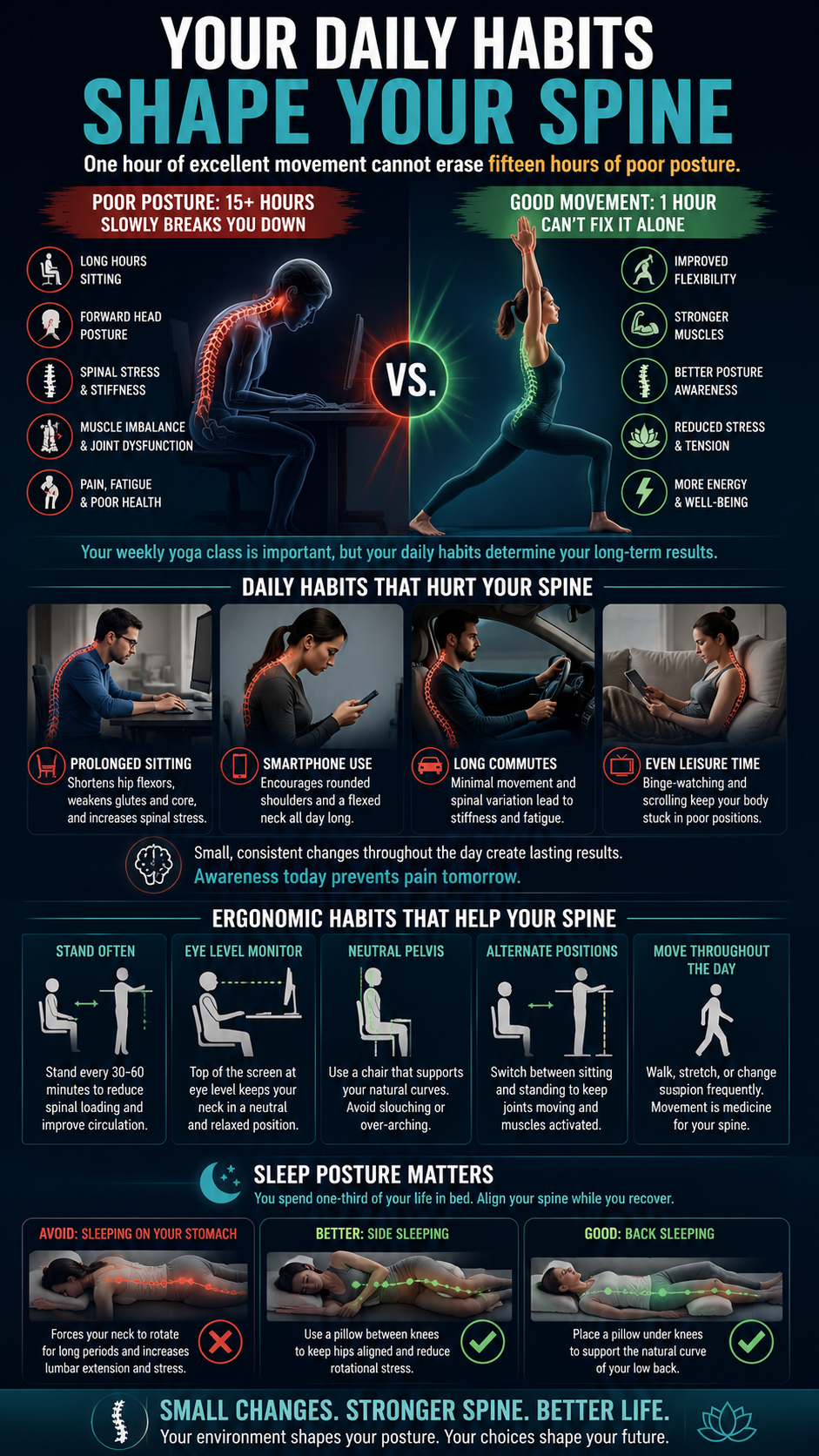
Standing every thirty to sixty minutes interrupts prolonged spinal loading while encouraging healthier circulation and muscular activation. Computer monitors positioned at eye level reduce unnecessary neck flexion. Chairs supporting a neutral pelvis minimize excessive lumbar stress. Alternating sitting with standing whenever possible prevents joints from remaining locked into one position for hours. These simple environmental changes quietly reinforce healthier biomechanics throughout the day.
Sleep also deserves careful consideration because the body spends roughly one-third of life recovering overnight. Sleeping face down forces prolonged neck rotation while increasing lumbar extension. Side sleeping with proper support between the knees often reduces rotational stress through the pelvis and lower back. Back sleeping with gentle knee support may also improve spinal comfort for many individuals. The ideal sleeping position ultimately depends upon individual anatomy, yet maintaining neutral alignment remains the guiding principle.
Strength Protects Joints Better Than Flexibility Alone
Muscles serve as the body’s natural shock absorbers. Strong, coordinated muscles distribute force efficiently before it reaches passive structures such as ligaments, discs, cartilage, and tendons. Weak stabilizers shift that workload toward tissues poorly equipped to absorb repetitive stress. Over time those structures begin producing inflammation, stiffness, and eventually pain.
Many yoga practitioners underestimate the importance of strength because yoga itself often emphasizes graceful movement over progressive resistance. Yet healthy muscles protect every pose. Strong gluteal muscles stabilize the pelvis during standing balances. Deep abdominal muscles support spinal alignment during forward bends. Healthy scapular stabilizers maintain shoulder position throughout weight-bearing poses. Each muscle contributes to the body’s overall mechanical integrity.
Bodyweight resistance exercises performed consistently at home build this protective foundation. Slow step-ups strengthen hip stability during functional movement. Wall sits improve lower-body endurance without excessive spinal loading. Modified side planks enhance lateral trunk stability while supporting healthier pelvic alignment. These exercises need not become exhausting workouts. Their greatest value lies in improving movement quality and joint control.
Pain Should Guide Curiosity, Not Fear
Pain often frightens people into abandoning movement entirely. Others respond by pushing through discomfort, believing perseverance alone guarantees improvement. Neither extreme serves the body particularly well. Pain functions as valuable information rather than an enemy to ignore or fear.
Persistent discomfort often signals that movement strategy deserves attention. Sharp pain, numbness, progressive weakness, or symptoms radiating into the arms or legs warrant prompt professional evaluation because they may indicate conditions requiring individualized assessment. Mild muscular fatigue following exercise differs greatly from joint pain that steadily worsens despite rest. Learning to recognize these distinctions empowers individuals to make wiser decisions regarding activity and recovery.
Modifying a pose should never feel like failure. Skilled yoga instructors frequently encourage the use of props, shorter ranges of motion, or alternative positions that better respect individual anatomy. Every body possesses unique structural characteristics. Hip sockets vary in orientation. Femurs differ in shape. Spinal curves naturally display individual variation. Safe movement therefore depends upon respecting anatomical differences rather than forcing identical positions for every student.
How Chiropractic Fits into Healthy Yoga Practice
Chiropractic care focuses on restoring healthy joint motion, improving biomechanics, and supporting efficient nervous system function. Rather than replacing yoga, thoughtful chiropractic care may complement it by addressing mechanical restrictions that limit healthy movement. Many chiropractors evaluate spinal alignment, pelvic mechanics, joint mobility, posture, muscular balance, and functional movement patterns before recommending individualized treatment strategies.
Research suggests that spinal manipulation can help certain patients with conditions such as acute and chronic low back pain, neck pain, and some types of headache when used appropriately as part of a broader management plan. Chiropractic care is not a cure-all, and treatment should always be tailored to the individual’s diagnosis, health history, and goals. When combined with exercise, education, and healthy daily habits, it may help some people move more comfortably and efficiently.
Many patients discover that yoga feels completely different after restoring healthier mechanics. Poses requiring tremendous effort suddenly become easier because joints move more naturally. Breathing deepens without conscious struggle. Balance improves as proprioception becomes more accurate. Stretching finally targets the intended muscles instead of reinforcing compensation. The practice itself has not changed. The body’s ability to perform it has.
Healing Begins Long Before the Next Yoga Class
The greatest lesson hidden beneath most yoga injuries has little to do with yoga itself. Pain rarely develops because the body moved. More often, it develops because the body moved repeatedly upon an unstable mechanical foundation. Every stretch, twist, and balance challenge simply revealed patterns that had quietly accumulated through years of poor posture, previous injuries, sedentary living, and unconscious compensation.
Fortunately, the same remarkable adaptability that allowed dysfunction to develop also allows healthier movement to emerge. Small improvements practiced consistently often outperform dramatic interventions pursued briefly. Better breathing gradually improves spinal stability. Stronger feet enhance whole-body balance. Improved posture reduces chronic muscular overload. Greater core control protects vulnerable joints before flexibility increases further. Each healthy habit reinforces the next until movement becomes smoother, stronger, and more efficient.
Yoga remains one of the world’s most valuable movement practices when performed upon a stable foundation. Chiropractic principles remind us that movement quality begins with alignment, balance, and efficient biomechanics rather than extreme flexibility alone. Together they offer a powerful reminder that lasting health does not come from forcing the body into impressive positions. It comes from restoring the foundation that allows every movement to unfold with strength, precision, and confidence. When that foundation improves, the body often demonstrates an extraordinary ability to heal itself through the simple act of moving as it was designed to move.