
Modern medicine has never known more about the digestive tract, yet millions of people continue suffering from chronic digestive symptoms without clear answers. Every year, countless individuals develop bloating after meals, unpredictable bowel habits, excessive gas, abdominal discomfort, acid reflux, food sensitivities, fatigue, and brain fog. They visit specialists, undergo expensive testing, and wait anxiously for explanations. Colonoscopies appear normal. Endoscopies reveal little. Blood work often falls within reference ranges. Imaging studies fail to identify anything alarming. Despite experiencing symptoms that disrupt nearly every aspect of daily life, patients are frequently told that nothing serious is wrong.
Eventually, many receive a diagnosis of Irritable Bowel Syndrome, commonly known as IBS. For some, the diagnosis provides temporary relief because it finally gives a name to their suffering. Unfortunately, names do not always provide answers. IBS does not explain why symptoms developed, what mechanism is driving them, or how the underlying dysfunction began. Instead, IBS often functions as a descriptive label applied when more obvious diseases have been excluded. The diagnosis tells patients they have digestive symptoms, but it rarely explains why those symptoms continue worsening despite dietary changes, medications, and repeated medical evaluations.

What if the bloating is not simply bloating? What if the constipation is not merely constipation? What if the gas, abdominal distention, diarrhea, fatigue, brain fog, anxiety, food sensitivities, and unexplained inflammation all originate from a single process occurring deep within the digestive tract? Emerging research suggests that many individuals diagnosed with IBS may actually be suffering from a condition called Small Intestinal Bacterial Overgrowth, or SIBO. Unlike IBS, SIBO identifies a measurable physiological disturbance. It provides a potential explanation for symptoms that often appear unrelated on the surface but become remarkably connected once the underlying biology is understood.
The implications are profound. If bacterial overgrowth exists within the small intestine, the consequences extend far beyond digestion. Nutrient absorption becomes compromised. Inflammatory pathways become activated. The intestinal barrier begins to weaken. Immune responses become dysregulated. Signals traveling between the gut and the brain become altered. Over time, what started as occasional bloating after meals can evolve into a complex health challenge affecting energy levels, metabolism, cognitive performance, mood, immune function, and overall quality of life.
Understanding SIBO requires looking beyond symptom management and examining how the digestive system was designed to function in the first place. Once that foundation becomes clear, the connection between IBS, bacterial overgrowth, intestinal permeability, chronic inflammation, and whole-body health becomes impossible to ignore. More importantly, it reveals why so many people continue searching for answers while the true source of their symptoms remains hidden in plain sight.
How IBS Became One of the Most Common Diagnoses in Digestive Medicine
Few diagnoses have become as common and as controversial as IBS. For decades, gastroenterologists have used the term to describe patients experiencing chronic digestive symptoms in the absence of visible disease. The diagnosis emerged largely because many patients experienced real suffering despite normal imaging studies, laboratory testing, and endoscopic procedures. Physicians needed a way to classify these symptoms, and IBS became the category that filled that gap.
While the diagnosis helped create a framework for research and treatment, it also created an unintended problem. Many patients stopped searching for answers once they received the label. Instead of investigating what was causing the bloating, constipation, diarrhea, and abdominal discomfort, healthcare systems often focused on managing symptoms. Medications were prescribed to control bowel habits. Antacids were given for reflux. Antispasmodics were used to reduce discomfort. Yet the underlying cause frequently remained unidentified.
Over the last two decades, advances in microbiome research have challenged the traditional understanding of IBS. Scientists began discovering that many patients diagnosed with IBS shared common patterns involving bacterial imbalances, impaired motility, intestinal permeability, and chronic inflammation. As researchers looked deeper into these mechanisms, one condition repeatedly emerged as a major contributor to digestive dysfunction. That condition was SIBO.
The significance of this discovery cannot be overstated. If a large percentage of IBS patients actually suffer from bacterial overgrowth, then IBS may not represent the final diagnosis at all. Instead, it may simply be the visible manifestation of a deeper biological process that can be identified and addressed more directly.
The Forgotten Role of the Small Intestine
Most conversations about gut health focus on the colon and the microbiome. While these topics are important, they often overshadow the critical role played by the small intestine. This twenty-foot section of the digestive tract serves as the primary gateway between food and the bloodstream. Nearly every nutrient required for life must pass through the small intestine before reaching the body’s tissues.
The inner surface of the small intestine contains millions of microscopic finger-like projections called villi. Each villus contains even smaller structures known as microvilli. Together, they create an enormous surface area designed to maximize nutrient absorption. If these structures were flattened and spread out, they would cover an area roughly equivalent to a tennis court. This extraordinary design allows the body to efficiently absorb amino acids, fatty acids, vitamins, minerals, and carbohydrates.
Because nutrient absorption is the primary responsibility of the small intestine, nature designed this environment differently from the colon. Large bacterial populations would interfere with nutrient uptake, damage the intestinal lining, and create unnecessary inflammation. As a result, several defense systems evolved to maintain relatively low microbial populations within this region. Stomach acid, digestive enzymes, bile acids, immune defenses, and the migrating motor complex work together to prevent excessive bacterial growth.
When these protective systems begin failing, bacteria gain the opportunity to colonize an area where they do not belong. What follows is not simply a digestive inconvenience. It represents a disruption of one of the body’s most important biological systems.
What SIBO Is Actually Doing Inside the Human Body
Many people assume that bacterial overgrowth simply means there are too many bacteria present. The reality is far more complex. SIBO fundamentally changes how the digestive system processes food. Every meal becomes a battleground between the body’s need for nutrients and the bacteria’s desire for fuel.
As carbohydrates enter the small intestine, bacterial populations begin fermenting them. This fermentation process produces hydrogen, methane, and hydrogen sulfide gases. Unlike digestion, which extracts nutrients for human use, fermentation generates metabolic byproducts that primarily benefit microbes. These gases accumulate within the digestive tract, creating pressure, bloating, and discomfort. For some individuals, abdominal distention becomes so severe that clothing sizes fluctuate throughout the day.
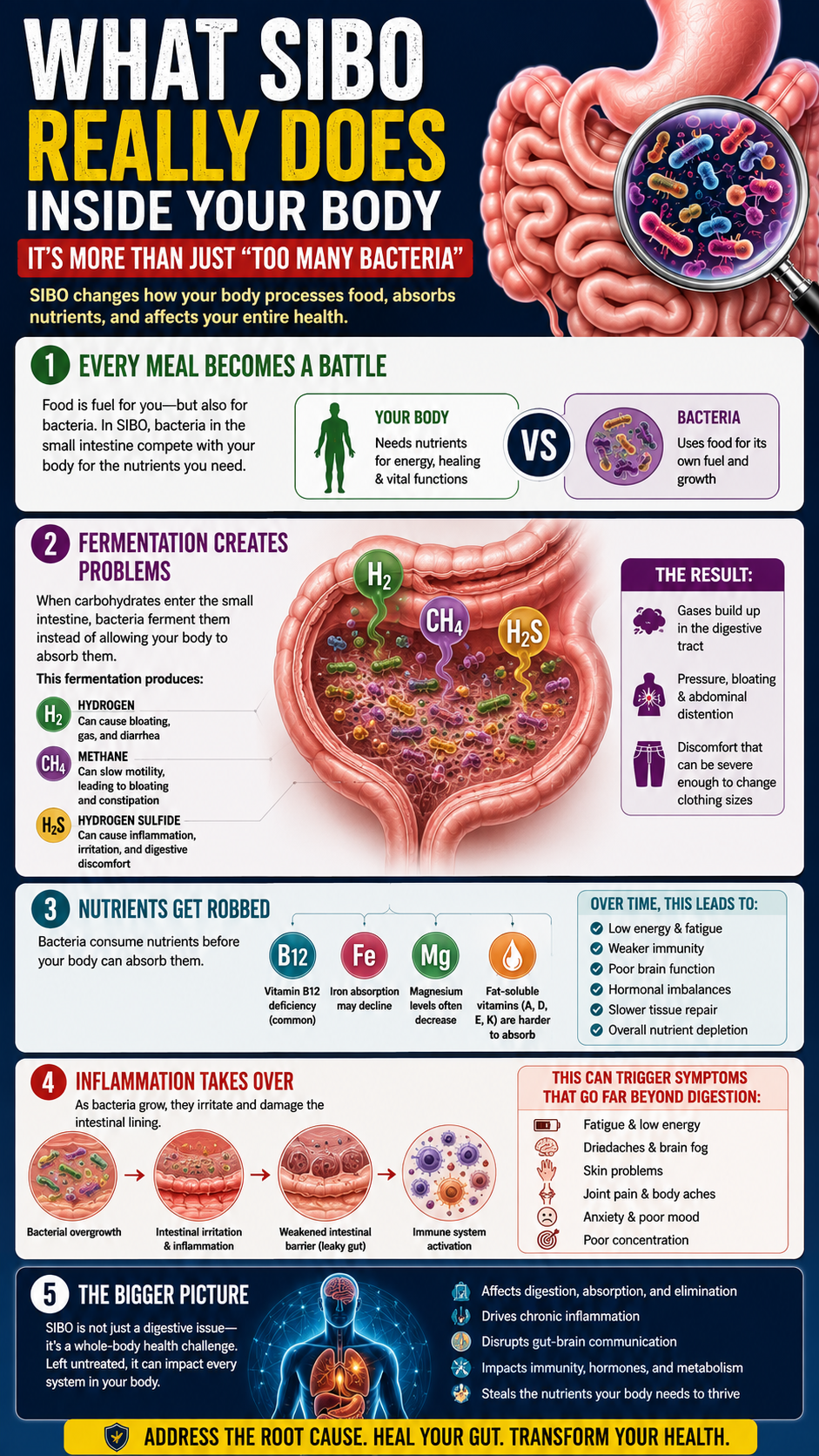
The effects extend beyond gas production. Bacteria consume nutrients before they can be absorbed. Vitamin B12 deficiencies frequently develop because certain microorganisms utilize this vitamin for their own metabolic needs. Iron absorption may decline. Magnesium levels often decrease. Fat-soluble vitamins become more difficult to absorb. Over time, nutrient depletion affects energy production, immune function, cognitive performance, hormone regulation, and tissue repair.
Inflammation also increases as bacterial populations expand. The intestinal lining becomes irritated. Cellular integrity begins weakening. Immune activity intensifies. Many patients develop symptoms that seem completely unrelated to digestion, including fatigue, headaches, skin issues, joint discomfort, anxiety, and poor concentration. What began as bacterial overgrowth gradually evolves into a whole-body health challenge.
The Root Causes Behind Bacterial Overgrowth
One of the most important lessons patients can learn about SIBO is that bacteria are rarely the original problem. Bacterial overgrowth typically develops because another dysfunction creates an opportunity for microbes to thrive. Understanding these root causes often determines whether someone experiences temporary relief or lasting improvement.
Food poisoning remains one of the most extensively studied triggers. Certain bacterial toxins can damage nerves that regulate intestinal motility. The migrating motor complex, which normally sweeps excess bacteria out of the small intestine between meals, becomes impaired. Without this cleaning mechanism, bacterial populations accumulate gradually over time. Many individuals who develop chronic digestive symptoms can trace their problems back to a severe bout of food poisoning years earlier.
Low stomach acid represents another major contributor. Healthy stomach acid acts as a powerful defense against microbial invasion. When acid production declines, bacteria survive passage through the stomach more easily and gain access to the small intestine. Aging, nutrient deficiencies, chronic stress, and long-term use of acid-suppressing medications can all contribute to this problem.
Hypothyroidism frequently plays a role as well. Thyroid hormones influence digestive movement throughout the gastrointestinal tract. Reduced thyroid activity slows motility, creating an environment where bacteria remain in contact with food for longer periods. This extended exposure promotes fermentation and microbial expansion. Chronic stress further compounds the problem by disrupting nervous system regulation, reducing digestive secretions, and impairing normal motility patterns.
Why SIBO Often Leads to Leaky Gut
One of the most damaging consequences of bacterial overgrowth involves its effect on the intestinal barrier. The digestive tract serves as both a digestive organ and a protective barrier separating the external environment from the internal body. Every day, this barrier decides which substances gain access to the bloodstream and which remain confined to the digestive tract.
Healthy intestinal cells connect through structures known as tight junctions. These junctions function like highly selective security gates, allowing nutrients to pass while blocking toxins, pathogens, and partially digested food particles. Chronic bacterial fermentation disrupts this system by increasing inflammation and damaging the intestinal lining. Over time, the tight junctions begin loosening, allowing substances to cross into circulation that would normally remain contained.
As intestinal permeability increases, the immune system encounters proteins and microbial fragments it was never intended to see. This exposure triggers inflammatory responses that can spread throughout the body. Food sensitivities become increasingly common because immune cells begin reacting to proteins that escape through the compromised barrier. Joint pain, skin conditions, headaches, fatigue, and autoimmune activity may all intensify as a result.
The connection between SIBO and leaky gut helps explain why digestive symptoms often coincide with seemingly unrelated health complaints. Patients frequently focus on bloating and bowel habits while overlooking the fact that bacterial overgrowth may be influencing their immune system, skin, joints, brain, and energy levels simultaneously.
The Breath Test That May Change Everything
Traditional testing excels at identifying structural abnormalities but often struggles to detect functional disturbances. Colonoscopies can reveal tumors, polyps, and inflammatory bowel disease. Endoscopies visualize portions of the upper digestive tract. Imaging studies provide detailed anatomical information. Yet none of these tests directly measure bacterial fermentation occurring within the small intestine.
Breath testing offers a different approach. After consuming a sugar solution, patients provide breath samples over a period of several hours. Laboratories analyze these samples for hydrogen and methane gases. Because human cells do not naturally produce these gases, elevated levels indicate microbial fermentation. The timing of gas production provides valuable clues regarding where fermentation is occurring and whether bacterial overgrowth may be present.
For many patients, breath testing represents the missing link between symptoms and understanding. Years of unexplained bloating, constipation, diarrhea, and discomfort suddenly acquire a biological explanation. Rather than accepting symptoms as mysterious or unavoidable, individuals gain insight into a measurable physiological process that may be contributing to their suffering.
What You Can Do at Home to Support Recovery
Although comprehensive treatment often requires individualized care, several foundational strategies support digestive health and may help reduce the conditions that encourage bacterial overgrowth. One of the most overlooked interventions involves meal spacing. Constant snacking prevents activation of the migrating motor complex. Allowing several hours between meals gives the digestive tract an opportunity to perform its natural cleansing cycles and move residual bacteria toward the colon.

Dietary choices also influence symptom severity. Highly fermentable foods may provide fuel for bacterial populations already residing within the small intestine. Temporarily reducing these foods can decrease gas production and improve comfort while deeper healing occurs. The goal is not lifelong restriction but creating an environment that supports digestive recovery.
Sleep quality plays a critical role in repair and regeneration. During sleep, the body coordinates immune activity, tissue healing, hormone regulation, and nervous system recovery. Chronic sleep deprivation increases inflammation and disrupts digestive physiology. Managing stress remains equally important because stress hormones impair digestion, reduce stomach acid production, and alter intestinal motility. Activities such as walking, prayer, breathing exercises, and mindfulness practices can help restore nervous system balance and support healthy digestive function.
Looking Beyond the IBS Label
The future of digestive medicine will likely focus less on symptom classification and more on identifying root causes. IBS may remain a useful description of symptoms, but growing evidence suggests many patients deserve a deeper investigation into the mechanisms driving those symptoms. SIBO offers one potential explanation for why so many individuals struggle with bloating, constipation, diarrhea, fatigue, food sensitivities, and chronic inflammation despite normal conventional testing.
When bacterial overgrowth develops within the small intestine, the consequences extend far beyond digestion. Nutrient absorption declines. Immune activity becomes dysregulated. The intestinal barrier weakens. Inflammation spreads throughout the body. Brain function, energy production, and metabolic health all suffer. What appears to be a simple digestive complaint often reflects a much broader physiological disturbance.
For millions of people, the question is no longer whether IBS exists. The more important question is whether IBS represents the true diagnosis or merely a label applied to symptoms whose deeper causes remain undiscovered. As understanding of the microbiome, intestinal permeability, and bacterial overgrowth continues expanding, more patients may finally discover that the answers they have been searching for were not hidden in the colon, but within the small intestine all along.