
How Smartphones Created One of the Largest Health Experiments in Human History
Human beings have accomplished extraordinary feats over the last century. We landed on the moon, connected the world through the internet, and placed a supercomputer into nearly every pocket on the planet. Yet alongside these remarkable advancements, a silent epidemic has emerged. Unlike infectious diseases, this epidemic spreads through daily habits. Unlike dramatic injuries, it develops slowly over years. Unlike many health problems, it hides in plain sight. The condition is known as Forward Head Posture, and smartphones have become one of its most powerful drivers.
Walk through any airport, shopping mall, school hallway, coffee shop, or office building and the pattern appears immediately. Heads tilt downward. Shoulders roll forward. Upper backs round excessively. Eyes remain fixed on screens positioned far below eye level. What was once considered poor posture has become society’s default position. Millions of people now spend several hours every day with their necks bent forward, exposing the spine to forces it was never designed to handle.
Most individuals dismiss the issue as a cosmetic concern. They assume poor posture only affects appearance. Others believe neck pain and headaches represent unavoidable consequences of aging. Many healthcare providers focus exclusively on symptom management rather than structural correction. Unfortunately, these misconceptions allow the problem to worsen year after year. Forward Head Posture affects far more than the neck. It influences breathing, nervous system function, muscle balance, joint health, circulation, energy production, and long-term spinal integrity.
The human body functions as an integrated system. Every structure influences another. When the head shifts forward, the entire body must compensate. These compensations often trigger a cascade of dysfunction that extends far beyond the cervical spine. Understanding how this process develops provides the first step toward reversing it. More importantly, understanding the true causes allows individuals to take control before permanent damage occurs.
What Is Forward Head Posture?
Forward Head Posture occurs when the head migrates in front of the shoulders instead of balancing directly over them. In a healthy posture, the ears align closely with the shoulders when viewed from the side. This alignment allows the skeletal system to support the weight of the head efficiently. Muscles remain balanced, joints move properly, and the nervous system operates under minimal mechanical stress.
Problems begin when the head moves forward. Even a small shift creates significant biomechanical consequences. The farther the head travels in front of the shoulders, the harder the surrounding muscles must work to prevent it from falling. Over time, these muscles become chronically overactive, while opposing muscle groups weaken. The body gradually remodels itself around this distorted position.
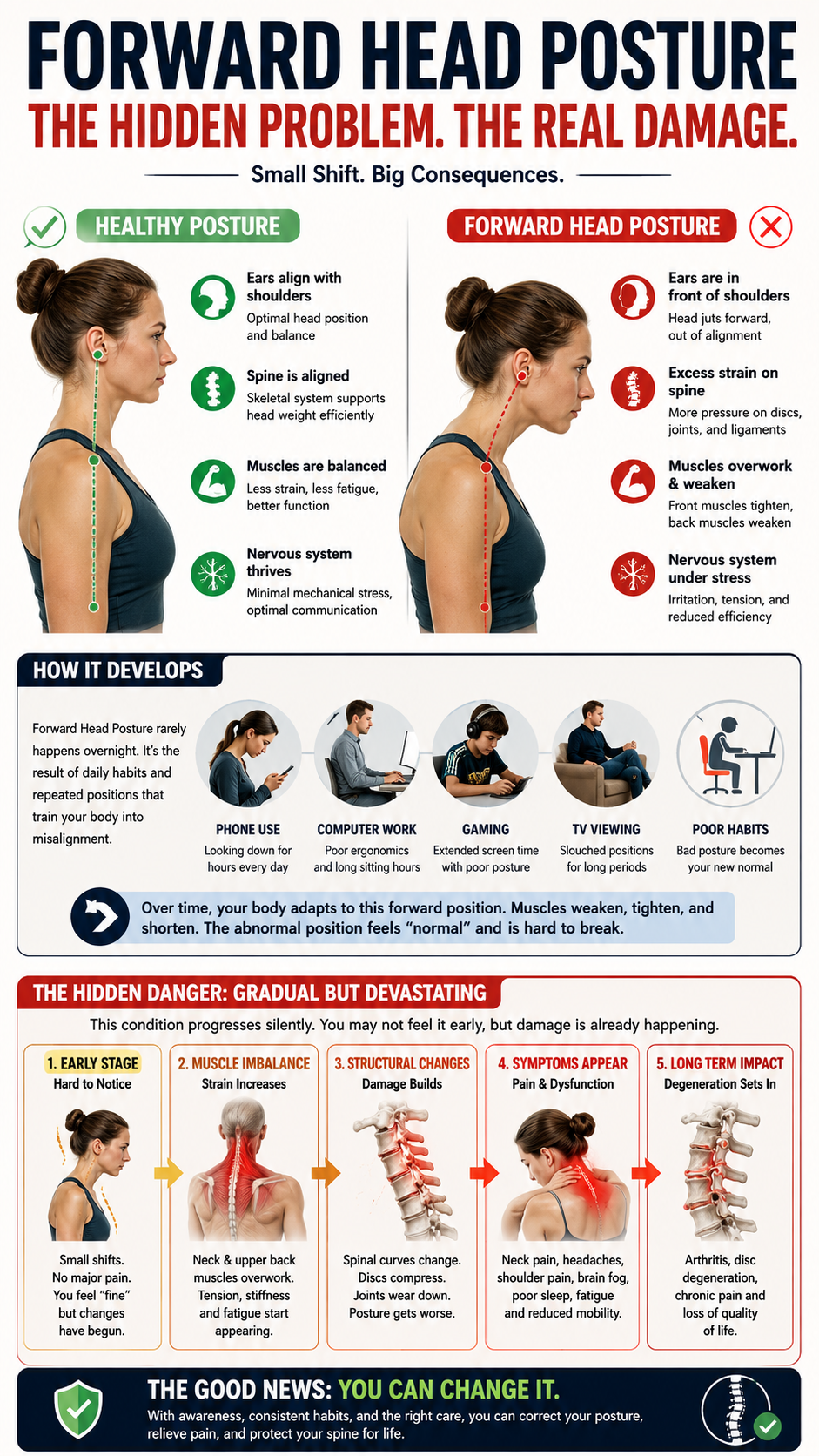
Forward Head Posture rarely develops overnight. Most people spend years reinforcing the pattern through phone use, computer work, gaming, television viewing, and poor ergonomic habits. Eventually the body accepts the abnormal position as normal. Once that adaptation occurs, maintaining proper posture feels difficult because the muscles responsible for healthy alignment have become weak and deconditioned.
What makes this condition particularly dangerous is its gradual progression. Most individuals do not notice significant symptoms during the early stages. Structural changes accumulate silently until the body’s ability to compensate begins to fail. By that point, chronic pain, headaches, fatigue, and degenerative changes may already be present.
The Evolutionary Mismatch Behind the Problem
The human body evolved under conditions dramatically different from modern life. For thousands of years, people spent most of their days walking, gathering food, hunting, farming, carrying supplies, and performing physical labor. Movement occurred constantly. Position changes happened frequently. The spine experienced a wide variety of mechanical stresses that promoted balanced development and healthy function.
Technology altered this pattern dramatically. Industrialization introduced prolonged sitting. Computerization expanded sedentary behavior. Smartphones completed the transformation by placing screens directly into people’s hands. For the first time in history, individuals could spend nearly every waking hour looking downward while remaining physically inactive.
The human spine never adapted to this environment. Evolution operates over thousands of generations. Smartphones appeared only recently. The body still expects movement, variation, and upright positioning. Instead, modern lifestyles deliver prolonged flexion, repetitive strain, and sustained postural stress.
Children now encounter these forces during critical developmental years. Many develop poor posture before their skeletal systems finish growing. Teenagers spend hours each day using devices for education, entertainment, and social interaction. Adults continue reinforcing these patterns throughout their careers. The result is a global experiment affecting nearly every age group simultaneously.
Unlike previous generations, today’s population spends unprecedented amounts of time with the head positioned in front of the body. This reality explains why neck pain, headaches, spinal degeneration, and postural disorders continue rising despite advances in healthcare.
Why Looking Down Is So Destructive
The average human head weighs approximately ten to twelve pounds. When positioned correctly, the cervical spine supports this weight efficiently. Muscles contribute minimal effort because the skeletal system bears most of the load. Proper alignment allows the body to conserve energy while maintaining stability.
The situation changes dramatically when the head moves forward. Gravity immediately increases the force placed upon the cervical spine. As the angle of flexion increases, the effective weight of the head rises substantially. Research suggests that severe neck flexion may expose the cervical spine to forces approaching sixty pounds.
Imagine carrying a large bag of dog food around your neck for several hours every day. Most people would quickly develop fatigue, soreness, and muscle strain. Yet many unknowingly create similar mechanical loads through prolonged smartphone use. The body attempts to manage this stress by recruiting additional muscles, altering joint positions, and changing movement patterns.
Over time, these compensations become permanent adaptations. Muscles shorten where they should lengthen. Ligaments stretch beyond their ideal range. Joint mechanics deteriorate. Discs absorb abnormal pressure. Eventually the entire structure of the spine begins changing in response to chronic overload.
The body always adapts to repeated stress. Unfortunately, adaptation does not always improve function. Sometimes adaptation simply allows dysfunction to continue.
The Hidden Effects on the Nervous System
Most discussions about Forward Head Posture focus exclusively on muscles and bones. This narrow perspective overlooks one of the most important systems involved. The spine protects the nervous system, which controls every function within the body.
The brain communicates with muscles, organs, glands, blood vessels, and tissues through an intricate network of nerves. These nerves travel through and around the spinal column. Healthy spinal movement and alignment help create an environment that supports efficient neurological communication.
Chronic postural distortion places abnormal mechanical stress upon the structures surrounding the nervous system. Joint dysfunction, muscular tension, inflammation, and disc degeneration may all contribute to irritation within these tissues. While posture does not explain every neurological symptom, poor spinal mechanics often influence how efficiently the body functions.
Individuals with significant Forward Head Posture frequently report symptoms extending beyond neck discomfort. Many experience brain fog, reduced concentration, chronic fatigue, dizziness, poor sleep, and decreased exercise tolerance. Although multiple factors contribute to these issues, structural stress often plays a larger role than most people realize.
Functional medicine practitioners frequently examine the relationship between structure and function because the body operates as an interconnected system. When one area becomes dysfunctional, other systems often compensate.
The Headache Connection Nobody Talks About
Millions of people suffer from headaches every year. Many rely on pain relievers without investigating why the headaches developed in the first place. Forward Head Posture represents one of the most overlooked contributors to chronic headache patterns.
The muscles located at the base of the skull become particularly vulnerable during prolonged forward positioning. These muscles remain under constant tension as they attempt to support the weight of the head against gravity. Chronic contraction reduces circulation, promotes inflammation, and creates trigger points capable of referring pain into the temples, forehead, and behind the eyes.
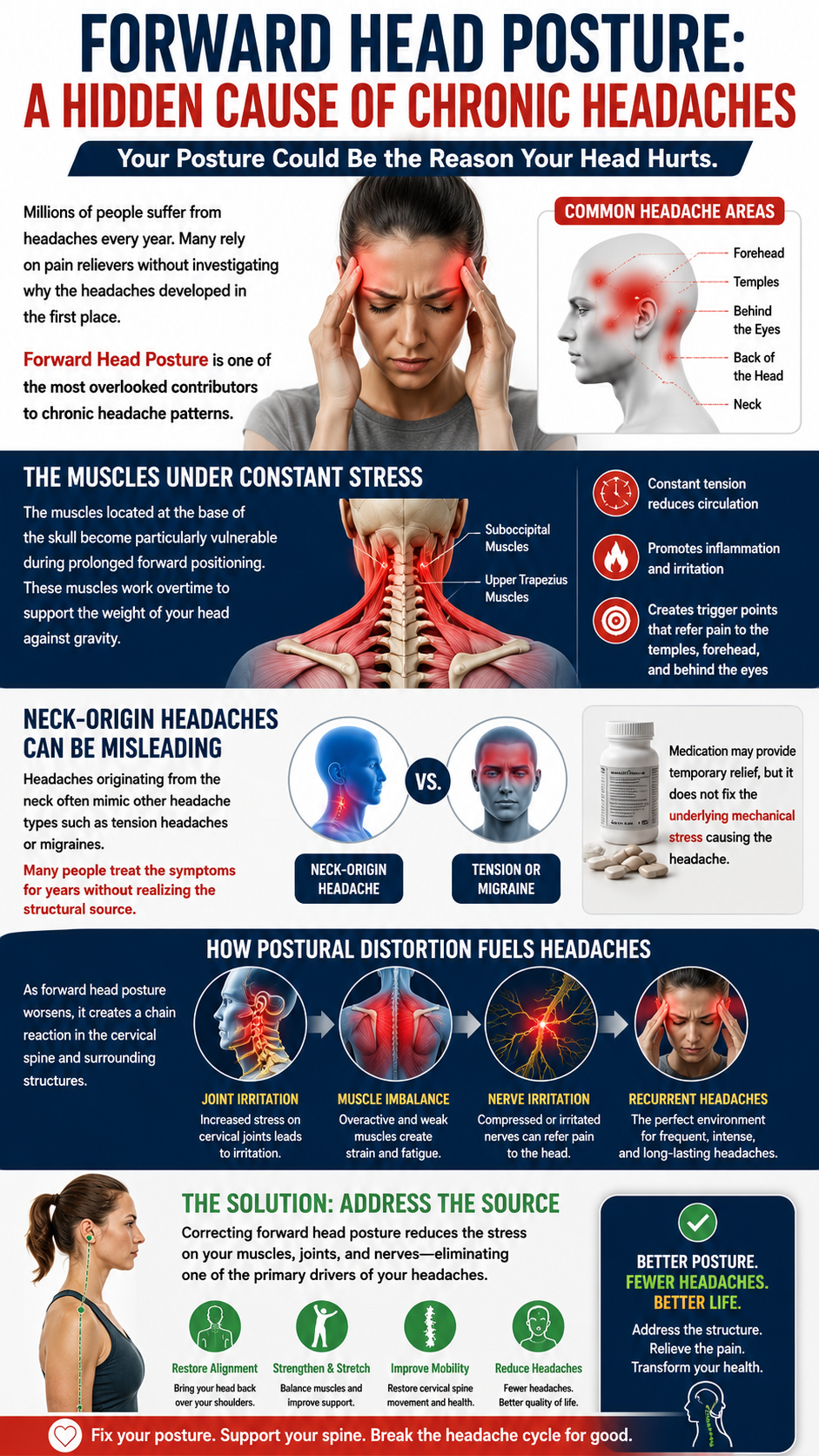
Headaches originating from the neck often mimic other headache types. Many individuals spend years treating symptoms without recognizing the structural source. Every medication may provide temporary relief, yet the underlying mechanical stress remains unchanged.
As postural distortion progresses, joint irritation within the cervical spine may further contribute to headache frequency and intensity. Restricted spinal movement, muscle imbalance, and nerve irritation create a perfect environment for recurring symptoms.
Addressing posture often reduces one of the primary drivers behind these headaches. This reality explains why many patients experience significant improvement when structural correction becomes part of their treatment strategy.
How Forward Head Posture Damages Breathing
Breathing may seem unrelated to posture, yet the two functions remain closely connected. The rib cage, diaphragm, spine, and surrounding muscles must work together to support efficient respiration.
Forward Head Posture disrupts this relationship. As the shoulders roll forward and the upper back rounds excessively, the chest cavity becomes compressed. The diaphragm loses mechanical advantage. Lung expansion decreases. Breathing gradually shifts from deep diaphragmatic patterns toward shallow chest breathing.
This transition creates several problems. Reduced oxygen delivery affects energy production throughout the body. Shallow breathing activates stress pathways within the nervous system. Chronic stress hormones may remain elevated. Recovery becomes more difficult. Fatigue becomes more common.
Many individuals blame aging, busy schedules, or poor sleep for declining energy levels. Few consider posture as a contributing factor. Yet the ability to breathe efficiently influences nearly every aspect of health.
Correcting posture often improves breathing mechanics. Better breathing supports better oxygenation. Better oxygenation supports improved cellular function. This relationship demonstrates why posture affects far more than appearance.
The Accelerated March Toward Arthritis
One of the most concerning consequences of Forward Head Posture involves long-term degeneration. Healthy joints depend upon balanced forces. When alignment remains optimal, stress distributes evenly across discs, vertebrae, ligaments, and surrounding tissues.
Poor posture changes this equation. Certain structures absorb excessive loads while others receive insufficient stimulation. The body attempts to adapt through structural remodeling. Unfortunately, these adaptations often accelerate wear and tear.
Intervertebral discs may experience uneven compression. Facet joints may absorb excessive pressure. Bone spurs may develop as the body seeks additional stability. The natural cervical curve may flatten or reverse entirely. Over time, these changes contribute to degenerative arthritis.
Many people view arthritis as an unavoidable consequence of aging. Structural mechanics tell a different story. Although aging influences degeneration, biomechanics strongly affect how rapidly degeneration develops. Poor posture acts like driving a car with severely misaligned wheels. Damage accumulates faster because forces distribute improperly.
Correcting posture early may help reduce these abnormal stresses and preserve spinal health over the long term.
Why Conventional Treatment Often Falls Short
Many healthcare approaches focus primarily on symptom reduction. Patients develop neck pain and receive medication. Muscle spasms appear and muscle relaxers follow. Headaches emerge and pain relievers become the solution.
While these interventions may provide temporary relief, they rarely address the underlying structural dysfunction. Symptoms often return because the mechanical stress remains unchanged. This cycle creates frustration for patients who wonder why their condition never truly improves.
Pain serves as information. It signals that something requires attention. Eliminating symptoms without correcting the cause often allows the problem to progress beneath the surface.
Forward Head Posture represents a structural challenge. Structural challenges require structural solutions. This reality explains why lasting improvement often depends upon addressing alignment, movement patterns, muscle balance, ergonomics, and daily habits simultaneously.
The goal should not simply involve feeling better. The goal should involve functioning better.
The Chiropractic Perspective on Forward Head Posture
Chiropractic care approaches the problem from a fundamentally different angle. Rather than chasing symptoms, chiropractic focuses on restoring proper spinal motion and alignment. The objective involves improving function while reducing mechanical stress throughout the body.
Restricted joints frequently accompany Forward Head Posture. These restrictions alter movement patterns and increase muscular compensation. Chiropractic adjustments help restore mobility to dysfunctional spinal segments. Improved mobility often allows surrounding muscles to function more efficiently.
Structural correction requires more than a single adjustment. Successful outcomes typically involve a comprehensive strategy that includes posture retraining, corrective exercises, ergonomic modifications, and lifestyle changes. Chiropractic care serves as one component within a larger framework designed to restore healthy biomechanics.
Patients often notice improvements in neck pain, headaches, mobility, and overall comfort because treatment targets the underlying mechanics rather than simply masking symptoms.
How to Fix Forward Head Posture at Home
Recovery begins with awareness. Most people cannot correct a problem they do not recognize. Taking a side-profile photograph often reveals postural distortions that remain hidden during daily life. Once identified, corrective action becomes possible.
The first step involves changing how devices are used. Raising phones to eye level immediately reduces stress upon the cervical spine. Although this adjustment seems simple, it removes thousands of repetitions of harmful neck flexion each week.
Consistent movement breaks create another powerful intervention. The body thrives on motion. Standing, stretching, and walking every thirty to sixty minutes interrupts harmful postural patterns before they become deeply ingrained.
Strengthening the upper back plays a critical role in correction. Muscles located between the shoulder blades help maintain upright posture. When strengthened consistently, they provide essential support for proper alignment. Exercises such as rows, reverse fly movements, and scapular retraction drills help restore balance.
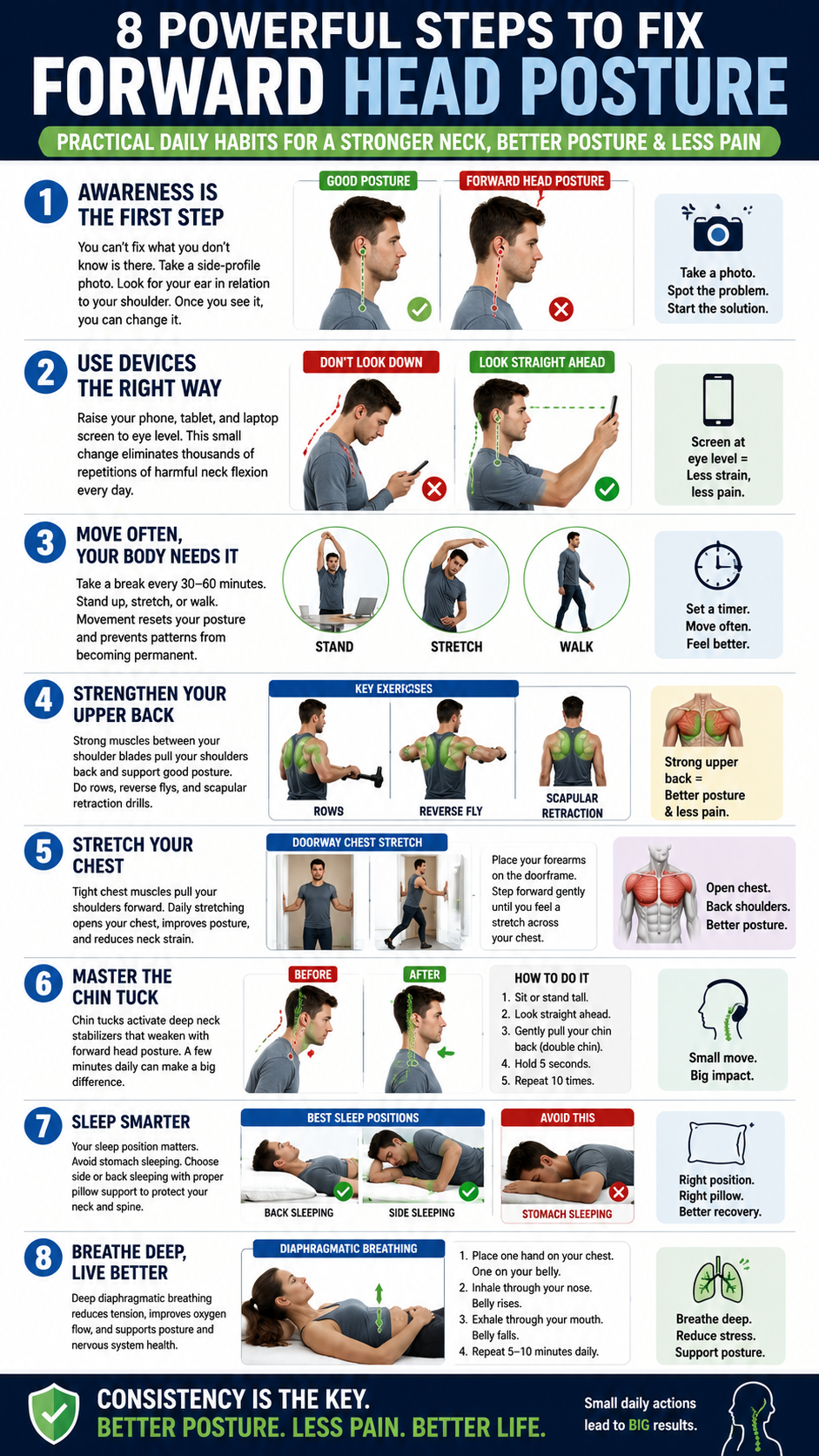
Stretching tight chest muscles also contributes significantly to improvement. Prolonged sitting often shortens the pectoral muscles, which pull the shoulders forward. Gentle stretching helps reverse this adaptation and creates space for healthier positioning.
Chin tuck exercises remain among the most effective strategies for activating deep cervical stabilizers. These muscles commonly weaken in individuals with Forward Head Posture. Daily practice retrains the neck to maintain proper alignment more naturally.
Sleep posture deserves attention as well. Stomach sleeping forces the neck into prolonged rotation and extension. Side sleeping or back sleeping generally places less stress upon the cervical spine. Proper pillow support further enhances recovery.
Breathing exercises provide another valuable tool. Deep diaphragmatic breathing helps restore rib cage mobility while reducing tension throughout the neck and shoulders. Practicing controlled breathing several times daily supports both posture and nervous system regulation.
Protecting the Next Generation
Children face unprecedented exposure to technology. Many spend hours daily using phones, tablets, computers, and gaming systems. Their developing bodies remain highly adaptable, which creates both risk and opportunity.
Poor habits established during childhood often persist into adulthood. Conversely, healthy habits learned early may protect spinal health for decades. Parents, educators, and healthcare providers must recognize the importance of posture before symptoms appear.
Teaching children to hold devices at eye level, take movement breaks, strengthen postural muscles, and maintain active lifestyles can significantly reduce future problems. Prevention remains easier than correction.
The next generation deserves more than symptom management. They deserve an understanding of how daily habits shape lifelong health.
The Road Back to Better Posture
Forward Head Posture represents one of the defining health challenges of the digital age. Smartphones did not create the problem entirely, but they accelerated it dramatically. Millions of people now spend their lives in positions that place enormous stress upon the spine, nervous system, muscles, and joints.
The encouraging news is that the body remains remarkably adaptable. Just as poor habits create dysfunction, healthy habits can drive recovery. Structural correction requires consistency rather than perfection. Small improvements repeated daily often produce profound long-term results.
Every text message, every social media session, every workday at a computer presents a choice. That choice either reinforces dysfunction or supports correction. The cumulative effect of those choices shapes the future of spinal health.
Technology will remain part of modern life. The solution does not involve abandoning smartphones. The solution involves learning to use technology without sacrificing the body that carries us through life. When posture improves, movement improves. When movement improves, function improves. When function improves, health often follows.
Forward Head Posture may be the modern plague, but it does not have to become your future.