
The Silent Rise of Sciatica in Modern Society
Sciatica has become one of the fastest growing chronic pain conditions in the modern world. Millions of people wake each morning with burning leg pain, numb feet, aching hips, and stabbing lower back discomfort. Many sufferers believe the condition appeared suddenly after lifting incorrectly or sleeping in a strange position. The truth runs far deeper than one isolated event. Sciatica often develops silently for years before symptoms finally explode into daily life.
Modern lifestyles create the perfect environment for spinal breakdown and nerve irritation. Human beings now spend most of the day sitting in cars, leaning over phones, working at computers, and avoiding physical movement. The body was never designed for this level of inactivity and structural collapse. Every hour spent hunched forward increases pressure on the lower spine. Weak muscles begin compensating for dormant muscles. Pelvic imbalance develops gradually. Spinal discs lose hydration. Inflammation quietly accumulates around sensitive nerve tissue.
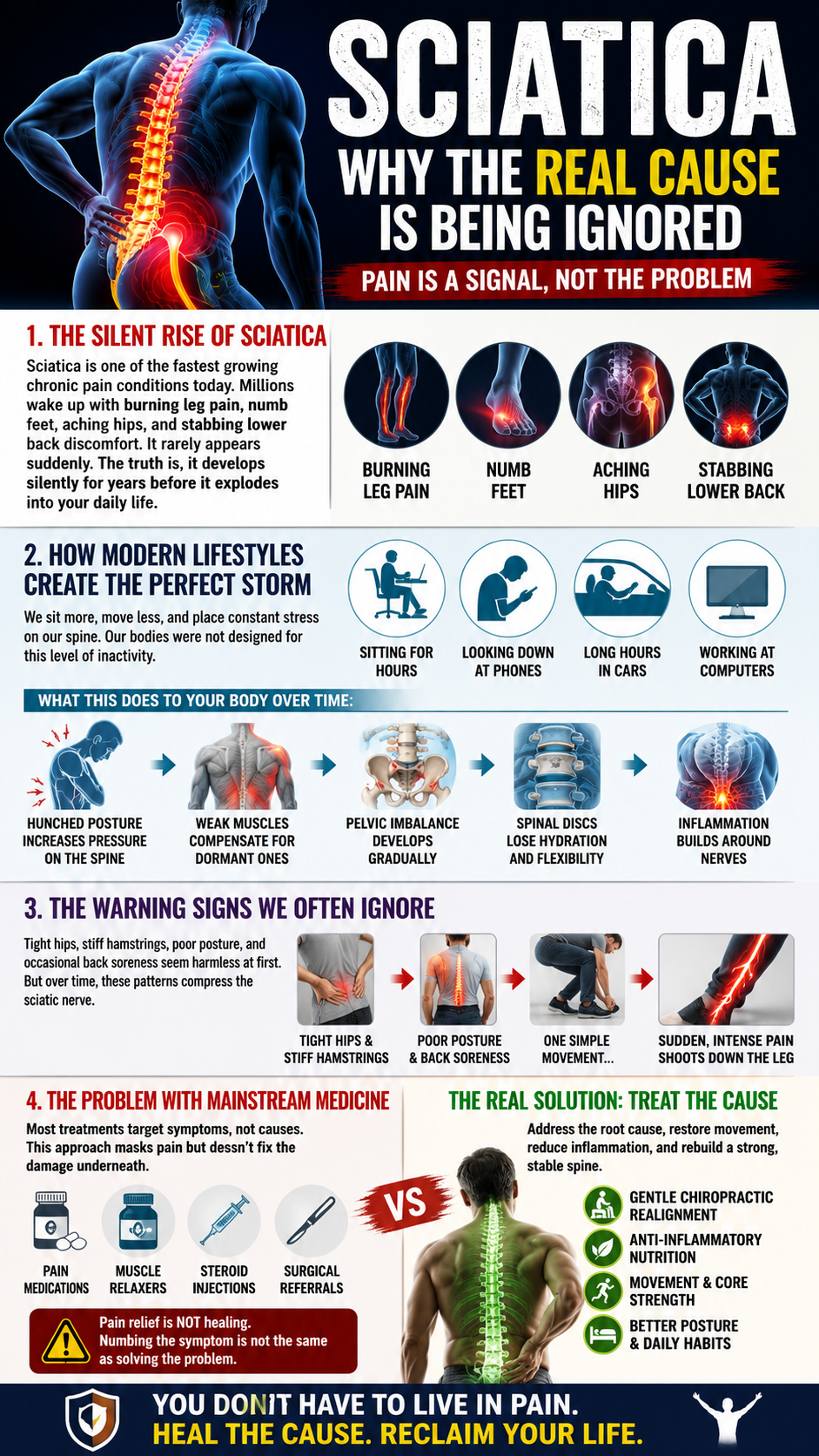
Most people ignore these early warning signs because the body adapts remarkably well to stress. Tight hips, stiff hamstrings, poor posture, and occasional lower back soreness often seem harmless initially. Over time, however, these dysfunctional patterns begin compressing the structures surrounding the sciatic nerve. One simple movement eventually becomes the final straw. A person bends over to tie a shoe, picks up a child, twists while gardening, or lifts a laundry basket. Suddenly, intense pain shoots down the leg like electricity.
Mainstream medicine usually responds to this crisis by targeting symptoms instead of causes. Patients receive pain medications, muscle relaxers, steroid injections, and surgical referrals before anyone investigates why the spine became unstable initially. That approach has conditioned the public to believe pain relief equals healing. Unfortunately, numbing symptoms rarely repairs the deeper dysfunction damaging the body beneath the surface.
Understanding the Sciatic Nerve and Why It Matters
The sciatic nerve stands as the largest nerve inside the human body. Several nerve roots from the lower lumbar spine combine and travel through the pelvis into the buttocks, legs, and feet. Every step, muscle contraction, and sensory signal depends upon this massive neurological pathway functioning correctly. When irritation develops anywhere along this route, the body responds with pain, tingling, numbness, burning sensations, weakness, or severe muscle tightness.
Most people hear the phrase “pinched nerve” and imagine one isolated structure causing the problem. Sciatica involves much more than simple compression. Inflammation, spinal instability, muscular imbalance, poor posture, pelvic distortion, disc stress, and nervous system dysfunction often work together simultaneously. The sciatic nerve becomes irritated because the surrounding environment inside the body has become unhealthy and mechanically unstable.
Conventional medicine frequently reduces sciatica to a disc problem alone. MRI scans often reveal bulging or herniated discs, leading patients to fear permanent damage immediately. Research tells a more complicated story. Many healthy people possess disc bulges without any pain whatsoever. Other individuals experience severe pain despite relatively minor imaging findings. These contradictions reveal an important truth. Structural abnormalities alone do not determine suffering. Inflammation and nervous system sensitivity often dictate symptom intensity more aggressively than imaging results.
How Modern Living Slowly Destroys the Lower Spine
Human beings once moved continuously throughout the day. Walking, climbing, lifting, squatting, and carrying objects kept the spine mobile and resilient. Modern culture has replaced movement with prolonged sitting and repetitive stress. Office workers remain seated for eight to ten hours daily. Drivers spend endless hours inside vehicles. Children stare downward at screens throughout the day. This sedentary lifestyle gradually weakens the muscles responsible for stabilizing the spine.
When stabilizing muscles weaken, the body begins relying on passive structures for support. Ligaments tighten excessively. Discs absorb abnormal pressure. Joint mechanics deteriorate. The pelvis starts tilting forward unnaturally while the lumbar curve collapses under constant strain. Over time, spinal discs experience uneven loading and begin degenerating prematurely.
Sitting also creates massive compression within the lumbar spine. Research has shown that prolonged sitting increases disc pressure significantly more than standing or walking. Poor posture worsens the problem even further. Slouching forward stretches spinal ligaments abnormally while forcing the discs backward toward sensitive nerve roots. This constant mechanical stress eventually irritates the sciatic nerve pathway.
Tight hip flexors create another layer of dysfunction. Sitting shortens these muscles continuously, pulling the pelvis into an imbalanced position. The lower back compensates aggressively for this distortion. Nearby muscles tighten defensively while inflammation accumulates throughout the region. Most patients never realize their daily habits created the perfect storm for chronic sciatic pain.
The Dangerous Myth That Sciatica Is “Normal Aging”
One of the most destructive phrases in healthcare involves telling patients their pain results from “normal aging.” That statement causes millions of people to accept chronic suffering unnecessarily. Aging alone does not destroy spinal health. Lifestyle habits damage the body far more aggressively than birthdays ever could.
The human body constantly adapts to repetitive stress. Poor posture repeated daily becomes permanent posture. Inflammation repeated daily becomes chronic disease. Sedentary behavior repeated daily weakens stabilizing muscles and accelerates degeneration throughout the spine. The body reflects accumulated habits over time.
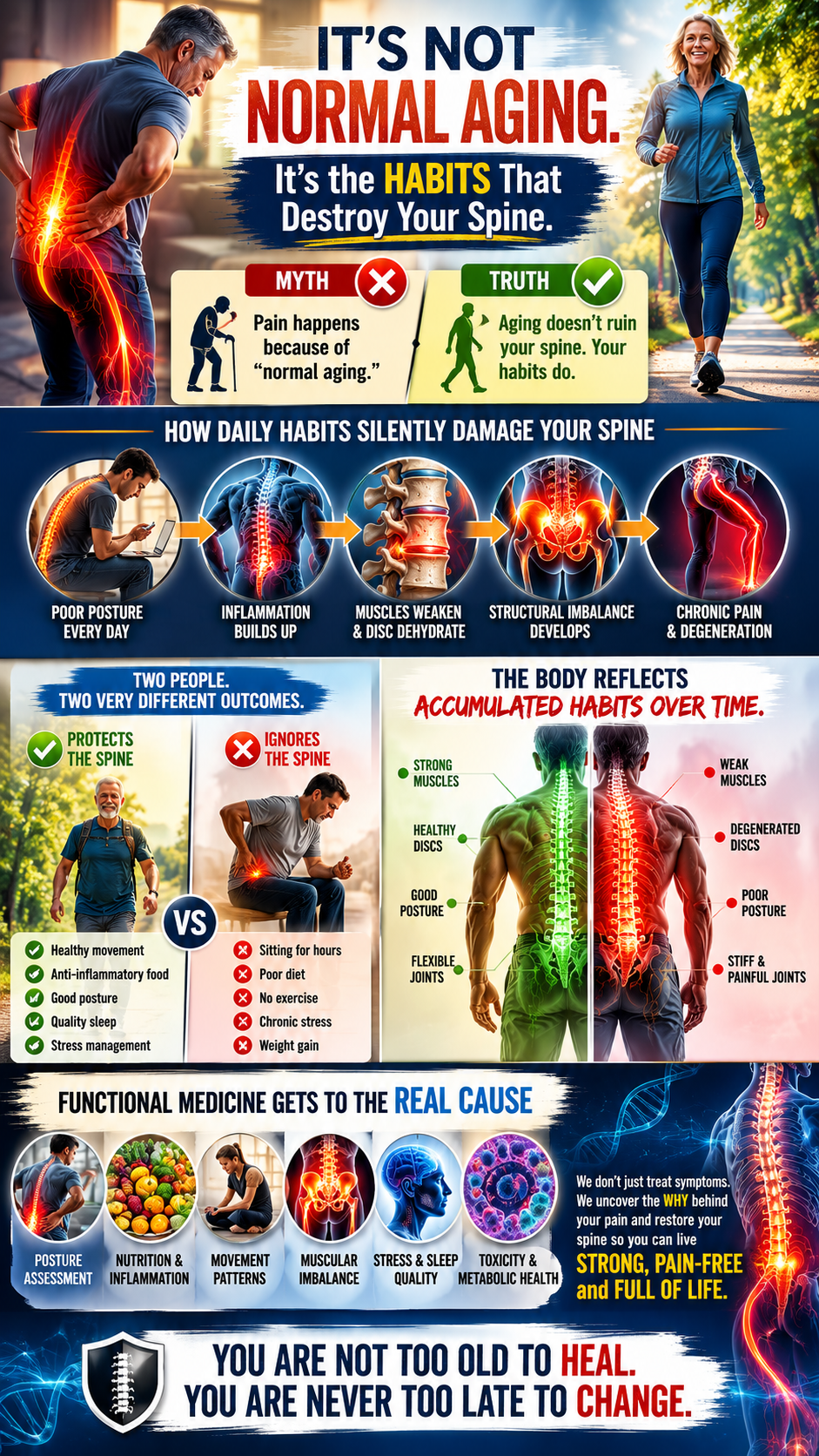
Many older adults maintain excellent mobility because they protect spinal function consistently. Others develop severe degeneration decades earlier because inflammation, obesity, inactivity, and structural imbalance overwhelm the body continuously. Genetics may influence vulnerability, but lifestyle determines expression in most cases.
Functional medicine approaches sciatica differently because it investigates why degeneration developed. Instead of blaming age automatically, functional practitioners evaluate posture, nutrition, movement patterns, inflammation levels, muscular imbalance, toxicity, stress, sleep quality, and metabolic health. That investigative mindset often reveals root causes hidden beneath the surface.
What Epidural Steroid Injections Actually Do
Epidural steroid injections have become one of the most common treatments for sciatica. Millions of procedures occur yearly across the United States. Most patients believe these injections heal the condition directly. The reality differs dramatically from public perception.
Steroid injections suppress inflammation chemically around irritated nerve roots. Corticosteroids reduce immune activity temporarily while decreasing inflammatory compounds near sensitive tissue. Pain may decrease because nerve irritation becomes chemically muted for a period of time. Unfortunately, the injection rarely corrects the structural dysfunction responsible for creating inflammation initially.
Imagine disconnecting a fire alarm while flames continue spreading throughout a building. The warning signal disappears temporarily, but the underlying danger remains active. Epidural injections often function the same way. Pain signals decrease while spinal instability, muscular imbalance, disc stress, and postural collapse continue damaging the body quietly.
Many patients experience temporary relief after injections because inflammation decreases briefly. Others feel little improvement whatsoever. Some individuals worsen afterward because tissue integrity declines further. Once the steroid effect fades, symptoms frequently return because the mechanical stress never changed.
The Hidden Damage Steroid Injections May Cause
Corticosteroids possess powerful anti-inflammatory properties, but they also create significant consequences inside the body. Repeated steroid exposure weakens connective tissue gradually. Ligaments, cartilage, tendons, and joint structures lose resilience over time. The body becomes more vulnerable to instability and degeneration with repeated use.
Steroids may also elevate blood sugar levels aggressively, especially in individuals already struggling with metabolic dysfunction. Chronic blood sugar elevation fuels inflammation throughout the body while damaging nerves and circulation. This process may worsen the very condition patients hope to improve.
Hormonal disruption represents another overlooked problem. Corticosteroids interfere with normal adrenal function and immune regulation. Sleep disturbances, mood changes, weight gain, tissue thinning, and weakened healing responses may develop with repeated exposure. Some patients enter a dangerous cycle involving temporary relief followed by recurring pain and additional injections.
Functional medicine questions whether suppressing inflammation repeatedly truly supports long-term healing. Inflammation often signals deeper dysfunction requiring correction. Eliminating symptoms without addressing root causes may delay genuine recovery while degeneration quietly progresses beneath the surface.
The Functional Medicine View of Sciatica
Functional medicine views sciatica as a whole-body problem rather than an isolated spinal condition. The body functions as an interconnected system where inflammation, posture, metabolism, stress, nutrition, movement, and nervous system balance influence one another continuously.
Instead of asking only how to eliminate pain, functional practitioners ask deeper questions. Why did inflammation develop around the nerve initially? Why did the spine become unstable? What weakened the supporting muscles? What dietary habits continue fueling inflammation? How has chronic stress affected nervous system function?
This investigative approach changes treatment dramatically. Functional medicine seeks restoration rather than suppression. The goal involves creating an environment where the body can heal naturally instead of chemically masking symptoms continuously.
Gentle chiropractic realignment often becomes an essential component within this model because spinal mechanics influence nerve function profoundly. When vertebrae lose healthy motion, surrounding muscles tighten defensively. Joints stiffen. Discs experience uneven pressure. Inflammation accumulates. Nerves become irritated. Correcting structural imbalance helps reduce abnormal stress throughout the system.
Why the Nervous System Controls More Than Pain
The spine protects the central nervous system, which controls every organ, tissue, and muscle inside the body. Every heartbeat, digestive process, muscle contraction, and hormonal signal depends upon proper neurological communication. Chronic spinal dysfunction interferes with these pathways continuously.
Many sciatica sufferers experience exhaustion, anxiety, sleep disturbances, muscle tension, and chronic inflammation simultaneously. These symptoms often develop because the nervous system remains trapped inside chronic stress physiology. Pain signals constantly activate the fight-or-flight response, elevating cortisol and adrenaline levels throughout the day.
When the nervous system remains hyperactive, healing slows dramatically. Blood flow decreases. Muscles tighten excessively. Inflammation rises. Recovery becomes increasingly difficult. Gentle chiropractic adjustments may help calm neurological stress by restoring healthier spinal movement and reducing abnormal mechanical tension around sensitive nerves.
The adjustment itself does not magically heal the body. Instead, proper alignment removes interference that may prevent healing from occurring efficiently. The body already possesses remarkable regenerative abilities when conditions support recovery.
How Inflammation Fuels Sciatic Nerve Pain
Inflammation plays a massive role in sciatic nerve irritation. Most patients never hear about the relationship between diet and chronic pain. Processed foods flood the bloodstream with inflammatory compounds daily. Refined sugar, industrial seed oils, artificial additives, excessive alcohol, and ultra-processed carbohydrates increase inflammation throughout the body aggressively.
Inflammation sensitizes nerves dramatically. Even mild structural irritation can become extremely painful when inflammatory chemicals surround the nerve roots continuously. The body essentially amplifies danger signals because the internal environment remains chronically inflamed.
Blood sugar dysfunction worsens this process substantially. Elevated insulin levels damage circulation while increasing inflammatory activity throughout the nervous system. Excess body fat also functions like an inflammatory organ, releasing harmful compounds continuously into the bloodstream.
Obesity creates both chemical and mechanical stress simultaneously. Excess abdominal weight shifts posture forward unnaturally while overloading the lumbar spine. Disc pressure rises significantly. Pelvic mechanics deteriorate further. The body becomes trapped inside a cycle involving inflammation, instability, and nerve irritation.
The Gut-Spine-Inflammation Connection
Functional medicine recognizes a powerful relationship between gut health and chronic inflammation. The digestive system influences immune regulation throughout the entire body. Poor gut health may increase inflammatory activity while worsening pain sensitivity significantly.
Many individuals consume foods daily that irritate the intestinal lining and disrupt healthy bacterial balance. Gluten, processed foods, excessive sugar, alcohol, and artificial ingredients often contribute to intestinal permeability, commonly called leaky gut. When this barrier weakens, inflammatory compounds may enter the bloodstream more aggressively.
Chronic inflammation originating inside the gut may worsen nerve sensitivity throughout the body. Some patients notice dramatic improvement in sciatic symptoms after removing inflammatory foods temporarily. Functional medicine frequently uses elimination strategies to identify hidden dietary triggers contributing to chronic pain.
Hydration also influences spinal health profoundly. Discs require water for shock absorption and flexibility. Chronic dehydration stiffens tissues while reducing disc resilience. Most people remain mildly dehydrated daily without realizing how strongly hydration affects recovery and inflammation.
Why Gentle Chiropractic Realignment Works Differently
Gentle chiropractic care focuses on restoring healthy movement patterns within the spine and pelvis. Many people still associate chiropractic treatment with aggressive twisting or forceful manipulation. Modern techniques often involve precise and controlled corrections tailored carefully to the individual patient.
The pelvis functions as the foundation of spinal balance. When pelvic alignment shifts abnormally, compensation patterns travel upward through the lumbar spine and surrounding musculature. One hip may tighten excessively while the opposite side weakens. The body adapts constantly to these distortions until nerve irritation eventually develops.
Gentle realignment helps restore symmetrical motion throughout the spine and pelvis. Proper movement reduces abnormal pressure on discs, joints, ligaments, and nerve roots. Muscles relax more naturally when structural stress decreases. Circulation improves. Inflammation often declines because the body no longer fights constant mechanical irritation.
Chiropractic care works best when combined with lifestyle changes addressing posture, movement, nutrition, stress, and inflammation simultaneously. Structural correction without lifestyle correction rarely creates lasting results.
The Home Recovery Strategies Most Patients Never Hear About
Walking remains one of the most effective natural therapies for sciatica. Gentle movement stimulates circulation while nourishing spinal discs through fluid exchange. Walking also activates stabilizing muscles without excessive compression. Many patients notice sitting worsens symptoms while walking provides relief. That pattern reveals how essential movement remains for spinal recovery.
Posture correction dramatically reduces stress on the lower spine. Most people collapse forward while sitting, driving, or using digital devices. The pelvis rolls backward while the lumbar curve flattens under constant pressure. Restoring healthy posture reduces unnecessary strain around the sciatic nerve pathway.
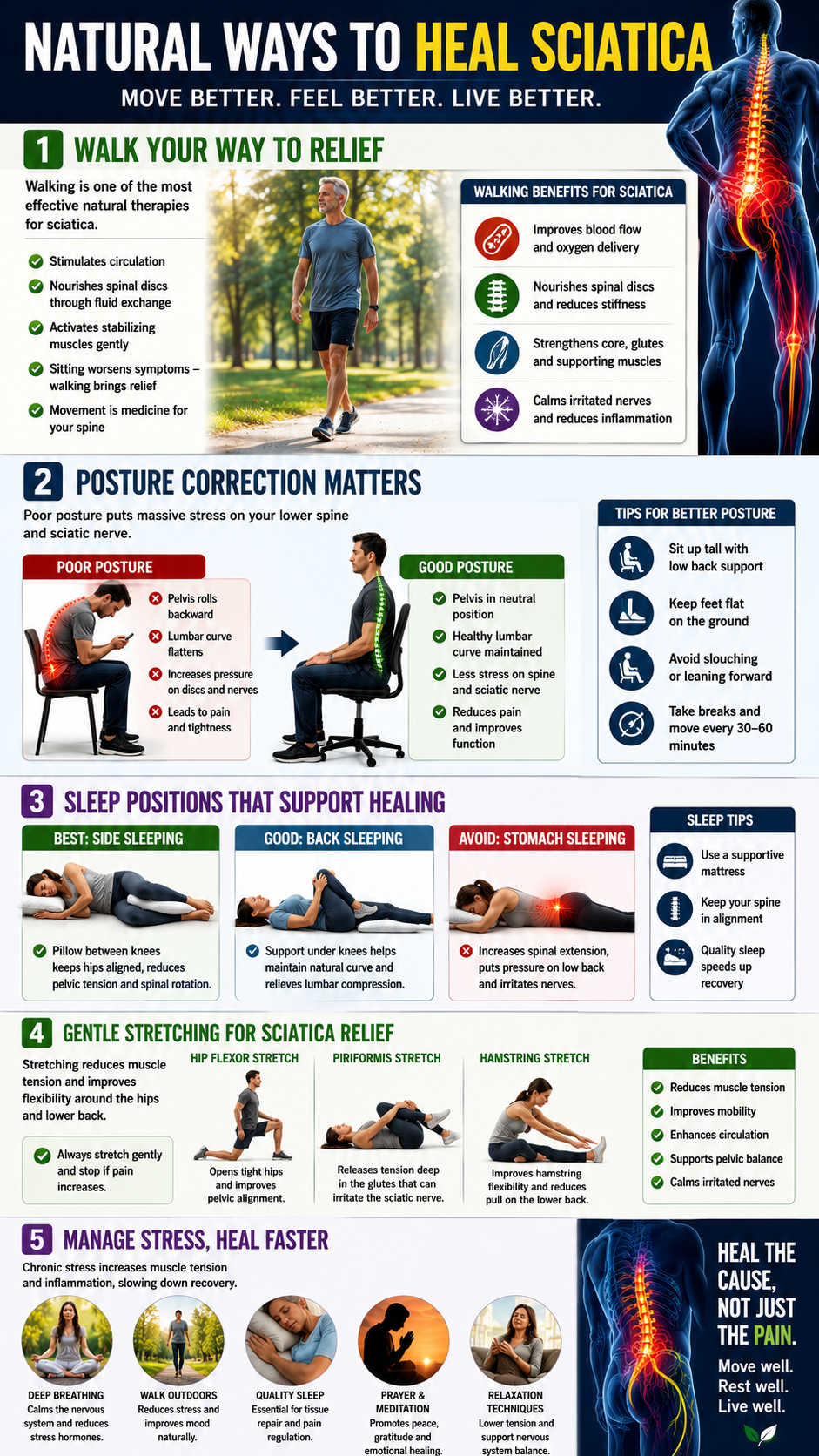
Sleeping position also influences recovery significantly. Side sleeping with a pillow between the knees often reduces pelvic tension and spinal rotation. Back sleeping with support beneath the knees may relieve lumbar compression. Stomach sleeping usually worsens lower back stress because it forces excessive spinal extension and neck rotation.
Gentle stretching helps reduce muscular tension surrounding the sciatic nerve. Hip flexor stretches, piriformis mobility work, and hamstring flexibility exercises often improve pelvic balance substantially. Aggressive stretching should remain avoided during acute flare-ups because excessive force may worsen nerve irritation.
Stress management becomes essential for long-term healing. Chronic stress keeps muscles tight while elevating inflammatory hormones continuously. Deep breathing exercises, walking outdoors, proper sleep, prayer, meditation, and nervous system calming techniques may help reduce physiological stress responses significantly.
Rebuilding the Spine Naturally Through Nutrition and Movement
True healing requires rebuilding the body from the inside outward. Anti-inflammatory nutrition provides essential support for tissue repair and nervous system recovery. Whole foods rich in minerals, antioxidants, healthy fats, and clean proteins nourish the body at the cellular level.
Leafy greens, grass-fed meats, wild fish, berries, avocados, turmeric, ginger, and mineral-rich vegetables support healthy inflammatory balance naturally. Processed foods create biochemical chaos throughout the bloodstream while accelerating degeneration and nerve sensitivity.
Core stabilization exercises also help rebuild spinal resilience gradually. Weak abdominal muscles force the lumbar spine to absorb excessive stress during movement. Gentle exercises such as pelvic tilts, bridges, bird dogs, and modified planks improve spinal support safely without excessive strain.
Consistency matters more than intensity during recovery. Small daily improvements often create profound long-term changes. The body responds remarkably well when given proper movement, hydration, nutrition, rest, and structural support consistently over time.
Final Thoughts: Restoration Versus Symptom Suppression
Sciatica rarely appears overnight. Years of inflammation, postural collapse, inactivity, muscular imbalance, stress, and structural dysfunction usually precede the first painful symptoms. Unfortunately, mainstream medicine often responds by suppressing symptoms instead of correcting causes. Epidural steroid injections may reduce inflammation temporarily, but they rarely restore healthy biomechanics or long-term spinal stability.
Gentle chiropractic realignment and functional medicine offer a different path forward. These approaches seek to restore movement, reduce inflammation naturally, improve nervous system function, and support the body’s built-in healing ability. The goal extends far beyond temporary pain relief. True healing involves restoring resilience, mobility, strength, and structural balance throughout the entire body.
The human body was designed for movement, adaptation, and recovery. Modern lifestyles often interfere with those natural processes continuously. Healing begins when patients stop asking only how to numb pain and start asking why the body created the pain signal initially.
Every lifestyle choice influences spinal health. Posture matters. Movement matters. Sleep matters. Nutrition matters. Stress management matters. Structural alignment matters. The body responds powerfully when healthy inputs replace destructive habits consistently over time.
Pain often serves as the body’s final warning before deeper breakdown occurs. Listening carefully to those signals may prevent years of unnecessary suffering. The future of sciatica care should focus less on suppressing symptoms and more on restoring true human function naturally.