
Water is not just something you drink. It is the primary medium through which your body operates. Every biochemical reaction, every electrical signal, and every cellular function depends on it. Unlike food, which varies from meal to meal, water is a constant input. It is consumed daily, used in cooking, absorbed through the skin, and integrated into nearly every system in the body. That makes the quality of your water one of the most underestimated yet powerful determinants of long-term health.
For decades, fluoride has been added to municipal water supplies under the banner of public health. It has been promoted as a simple, cost-effective way to reduce cavities and improve dental outcomes across entire populations. This message has been repeated so consistently that most people rarely question it. Fluoridated water is widely accepted as both safe and beneficial, and for many, it represents a non-negotiable part of modern infrastructure.
Yet as our understanding of human biology deepens, a more complex and less comfortable picture is emerging. Fluoride is not an inert substance. It is biologically active, capable of interacting with multiple systems in the body. When exposure is occasional, the body can often adapt. But when exposure is constant, as it is with tap water, the cumulative effects deserve closer examination.
The question is no longer whether fluoride can help teeth under certain conditions. The more important question is what happens when it is consumed daily, over years or decades, and how that exposure influences systems far beyond the mouth. When viewed through this broader lens, fluoride becomes not just a dental topic, but a metabolic, hormonal, and neurological one.
How Fluoride Became a Daily Habit Without Question
The widespread use of fluoride in drinking water did not begin with a full understanding of its long-term systemic effects. It began with observation. In the early twentieth century, researchers noticed that communities with naturally occurring fluoride in their water had lower rates of tooth decay. This correlation led to the assumption that fluoride was protective and that adding it to water supplies could replicate this benefit.
By the mid-1900s, water fluoridation programs were implemented in several countries, quickly gaining momentum. The intervention was simple, inexpensive, and scalable. It did not require behavior change, compliance, or education. It was delivered passively through a resource everyone used. From a public health perspective, it appeared to be an ideal solution.
However, the original premise contained an important assumption that was never fully challenged. It assumed that what benefits teeth topically would also be safe and beneficial when ingested systemically. It also assumed that a uniform dose would be appropriate for an entire population, regardless of age, body size, health status, or total exposure from other sources.
Over time, fluoride became embedded in daily life. It was no longer just in water, but also in toothpaste, mouth rinses, processed foods, and beverages. What began as a targeted intervention evolved into continuous exposure, often without awareness or consent. This shift from occasional to chronic exposure is where functional concerns begin to emerge.
Fluoride and the Thyroid: A Critical and Overlooked Relationship
The thyroid gland is one of the most sensitive and influential organs in the body. It regulates metabolism, energy production, body temperature, and hormonal balance. Even small disruptions in thyroid function can lead to wide-ranging symptoms, including fatigue, weight changes, brain fog, and mood disturbances.
At the center of thyroid function is iodine, a trace mineral required for the production of thyroid hormones. Fluoride, however, belongs to the same chemical family as iodine, which means it can compete with iodine for absorption and utilization in the body. This competition is not theoretical; it is a well-established chemical interaction.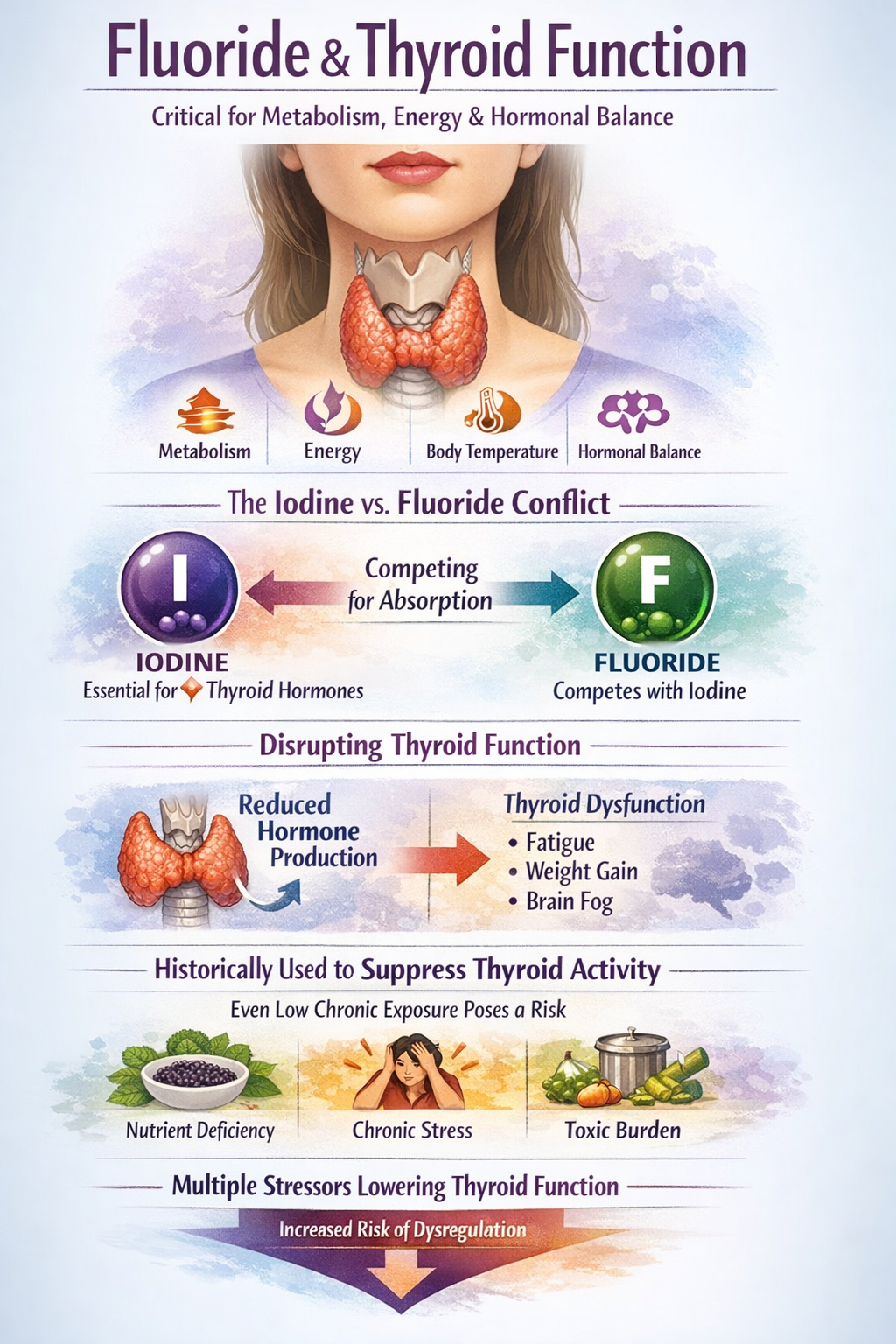
When fluoride displaces iodine, it can impair the thyroid’s ability to produce hormones efficiently. Over time, this can contribute to reduced thyroid function, particularly in individuals who are already borderline or deficient in iodine. The result is often subtle, developing gradually rather than suddenly, which makes it easy to overlook.
Historically, fluoride was even used in certain contexts to suppress thyroid activity. While modern exposure levels are lower, the biological effect remains relevant. Chronic, low-dose exposure may not produce immediate symptoms, but it can contribute to long-term dysregulation, especially when combined with other stressors.
From a functional perspective, this interaction is not viewed in isolation. It is considered alongside other factors such as nutrient status, stress levels, and overall toxic burden. When multiple stressors converge, the threshold for dysfunction becomes lower, and the impact of each individual factor becomes more significant.
Beyond Teeth: The Systemic Impact of Fluoride
Fluoride’s influence extends far beyond the oral cavity. Once ingested, it is distributed throughout the body, interacting with tissues and biochemical processes in ways that are not always immediately visible. Its effects are cumulative, meaning they build over time rather than presenting as acute reactions.
One area of concern is the nervous system. Emerging research has explored the relationship between fluoride exposure and cognitive function, particularly in developing children. While the data is still evolving, it raises important questions about how chronic exposure may influence brain development and neurological health.
Fluoride also accumulates in calcified tissues such as bones and teeth. While this is often cited as a benefit for dental strength, excessive accumulation can alter the structure and integrity of these tissues. Conditions such as dental fluorosis, characterized by discoloration and enamel changes, are visible indicators of this accumulation.
At a cellular level, fluoride has been shown to influence enzyme activity and mitochondrial function. Mitochondria are responsible for energy production, and disruptions in their function can affect everything from physical performance to mental clarity. These effects may be subtle at first but can contribute to a gradual decline in overall vitality.
Functional medicine emphasizes that the body does not experience exposures in isolation. Fluoride is just one of many inputs, and its impact must be considered in the context of the total load. When combined with other environmental toxins, poor nutrition, and chronic stress, its effects may be amplified.
The Divide: Conventional Assurance vs. Functional Awareness
Conventional medicine evaluates fluoride primarily through the lens of dental health. The reduction in cavities is seen as a measurable and meaningful benefit, and safety assessments are based on population averages. As long as exposure falls within established guidelines, it is generally considered acceptable.
However, this approach has inherent limitations. It assumes uniformity across individuals and does not account for variations in sensitivity, cumulative exposure, or interactions with other factors. It also focuses on avoiding acute toxicity rather than optimizing long-term health.
Functional medicine approaches the question differently. It asks whether a substance supports or disrupts the body’s ability to function optimally. It considers not just the absence of disease, but the presence of vitality, resilience, and balance.
From this perspective, fluoride is not automatically labeled as harmful, but its role is carefully evaluated. The focus shifts from whether it is “safe enough” to whether it is necessary, beneficial, or potentially disruptive in the context of the individual’s overall health.
Daily Exposure: The Hidden Accumulation Problem
One of the most important aspects of fluoride exposure is its consistency. Tap water is consumed daily, often multiple times per day, and is used in cooking, beverages, and hygiene. This creates a continuous stream of intake that accumulates over time.
Unlike medications, which are taken in defined doses, fluoride exposure is largely unregulated at the individual level. The amount consumed varies based on water intake, diet, and lifestyle, yet most people have little awareness of their total exposure.
Additional sources compound the issue. Processed foods and drinks often contain fluoridated water, and dental products contribute to incidental ingestion. Over time, these multiple sources can create a cumulative burden that exceeds what was originally intended.
This is where functional awareness becomes critical. It is not just about the concentration in water, but about the total load on the body. Recognizing this allows for more informed decisions and proactive management.
Practical, Safe Strategies to Reduce Exposure and Support Detoxification
The goal is not to create fear, but to create control. Addressing fluoride exposure can be done effectively with practical, manageable steps that fit into daily life.
The most impactful change is improving water quality. Standard filters such as carbon filters do not remove fluoride, so it is important to choose systems designed for this purpose. Reverse osmosis systems and specialized filtration units are among the most effective options. Using filtered water for both drinking and cooking significantly reduces daily intake.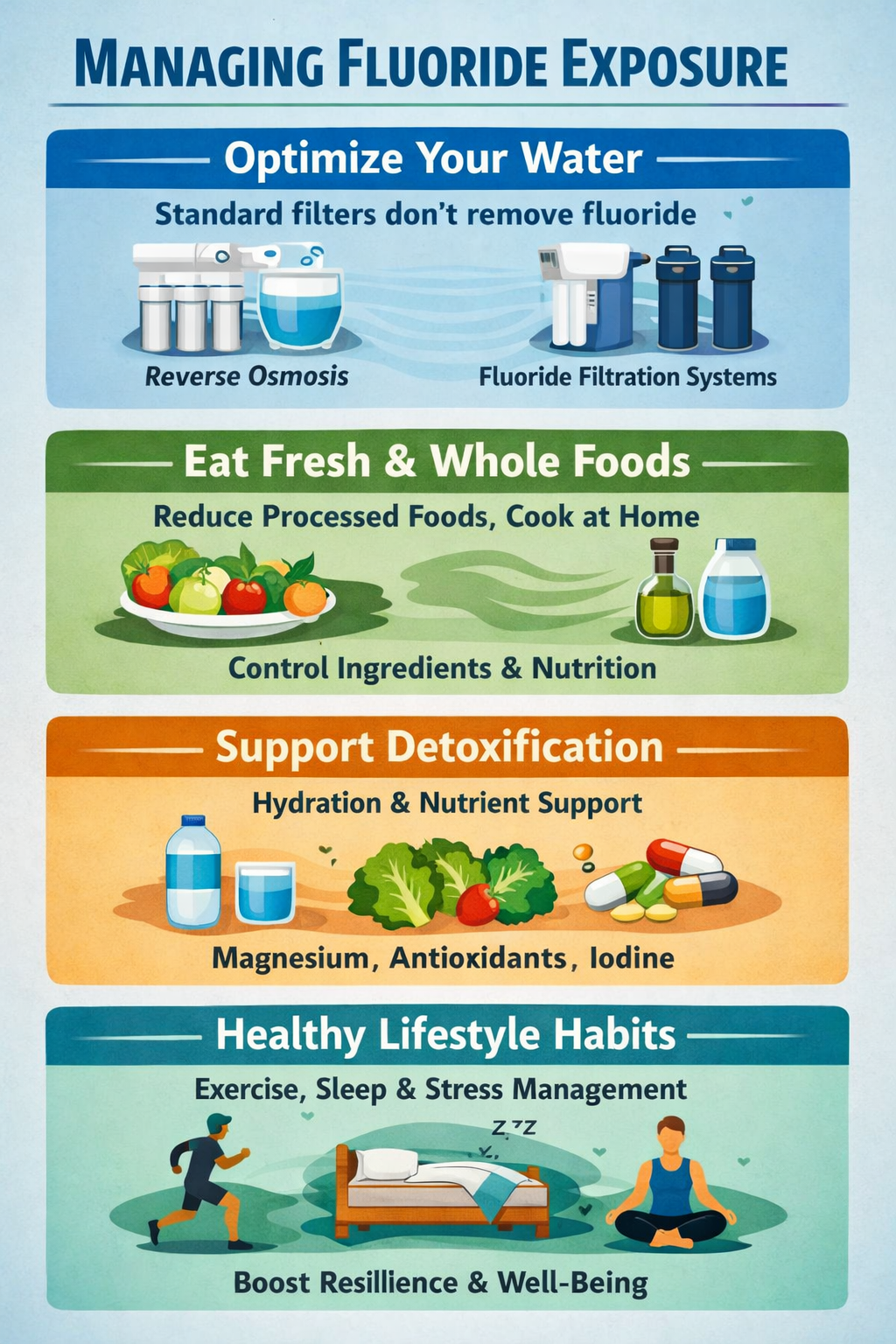
Reducing reliance on processed foods is another important step. Preparing meals at home with clean water allows for greater control over ingredients and exposure. This also aligns with broader health goals, as whole foods support overall metabolic function.
Supporting the body’s natural detoxification systems enhances resilience. Adequate hydration, nutrient-dense foods, and proper liver function all play a role in processing and eliminating environmental compounds. Nutrients such as magnesium, antioxidants, and trace minerals support these processes.
Iodine status should be considered carefully due to its relationship with the thyroid. Ensuring sufficient intake through food sources such as seafood can help maintain balance. However, supplementation should be approached thoughtfully and ideally guided by proper evaluation.
Lifestyle factors such as exercise, sleep, and stress management further strengthen the body’s ability to adapt. These foundational habits improve overall resilience, making the body better equipped to handle environmental exposures.
Reframing the Conversation Around Water and Health
Water is not just a utility. It is a biological input that shapes your internal environment every single day. Because of this, even small changes in water quality can have meaningful effects over time.
The conversation around fluoride is not about extremes or absolutes. It is about awareness, context, and informed choice. It is about recognizing that what is widely accepted is not always fully understood, and that deeper investigation can reveal opportunities for improvement.
By taking a proactive approach, you shift from passive consumption to intentional living. You begin to evaluate not just what is convenient, but what is optimal. This shift may seem small, but its impact can extend across every system in the body.
In the end, health is not determined by a single decision, but by the accumulation of daily choices. And when it comes to something as fundamental as water, those choices carry more weight than most people realize.