Why the Conventional Explanation Falls Short—and Why the Autonomic Nervous System Holds the Real Key
In recent years, Postural Orthostatic Tachycardia Syndrome (POTS) has exploded into public awareness. Once considered rare, it is now diagnosed in hundreds of thousands of Americans each year, especially among teenagers and young adults. Patients often report debilitating symptoms: dizziness upon standing, heart palpitations, fatigue, brain fog, anxiety, digestive problems, and sometimes fainting. For many, the condition is life-altering.
Yet despite the growing prevalence of POTS, conventional medicine remains remarkably uncertain about why it actually occurs. The most common explanation offered by cardiologists and neurologists is that POTS is a “dysautonomia”—a disorder of the autonomic nervous system—often attributed to genetics, autoimmune processes, viral infections, or simply “unknown causes.” Treatments typically revolve around symptom management: increasing salt intake, drinking more fluids, wearing compression stockings, prescribing beta blockers, or recommending exercise therapy.
But if we pause and look deeper, a glaring question emerges:
What actually caused the autonomic nervous system to malfunction in the first place?
To truly understand POTS, we must move beyond the symptom-based framework of modern medicine and examine the neurological control systems of the body, particularly the delicate balance of the autonomic nervous system and the spinal structures that protect it.
Understanding the Autonomic Nervous System
The autonomic nervous system (ANS) is the master regulator of the body’s involuntary processes. It controls heart rate, blood pressure, digestion, breathing patterns, temperature regulation, and even immune responses.
The ANS operates through two complementary branches:
The Sympathetic Nervous System
Often referred to as the “fight or flight” system, the sympathetic branch increases heart rate, constricts blood vessels, and prepares the body for action.
The Parasympathetic Nervous System
Known as the “rest and digest” system, this branch slows heart rate, promotes digestion, and restores balance after stress.
Under healthy circumstances, these two systems operate in precise coordination. When a person stands up from a seated or lying position, gravity pulls blood downward toward the legs and abdomen. Sensors in the cardiovascular system immediately detect the drop in blood pressure and send signals through the autonomic nervous system to compensate. Blood vessels constrict, the heart rate slightly increases, and blood flow to the brain is preserved.
In a healthy nervous system, this entire process occurs within seconds.
But in individuals diagnosed with POTS, something goes wrong. Instead of a modest increase in heart rate, the heart may accelerate dramatically—often by 30 beats per minute or more within 10 minutes of standing. Patients may feel lightheaded, shaky, weak, or mentally foggy.
Conventional medicine describes this as “dysautonomia.” Yet the explanation stops there.
It rarely asks the deeper question:
Why did the autonomic nervous system lose its ability to regulate properly?
The Structural Component Medicine Often Ignores
The autonomic nervous system does not float freely within the body. It is housed and protected by the spinal column. The spinal cord serves as the primary communication highway between the brain and the rest of the body.
Emerging evidence in neurophysiology and chiropractic science suggests that disruptions in spinal alignment—commonly referred to as vertebral subluxations—may interfere with these critical communication pathways.
A subluxation is not simply a bone “out of place.” Rather, it refers to a subtle mechanical dysfunction of the spinal joints that can alter nerve signaling and create abnormal neurological feedback loops.
The upper cervical spine, particularly the atlas (C1) and axis (C2) vertebrae, plays a particularly important role in autonomic regulation. These vertebrae sit directly beneath the brainstem, the region responsible for controlling many autonomic processes including heart rate, blood pressure, and vascular tone.
If these vertebrae become misaligned due to trauma, repetitive stress, poor posture, or injury, they may alter the neurological signaling between the brainstem and the rest of the autonomic nervous system.
This can produce autonomic dysregulation, the very phenomenon physicians observe in POTS patients.
In other words, the tachycardia and dizziness seen in POTS may not be the primary problem at all.
They may be secondary effects of disrupted neurological communication.
The Brainstem and the Orthostatic Reflex
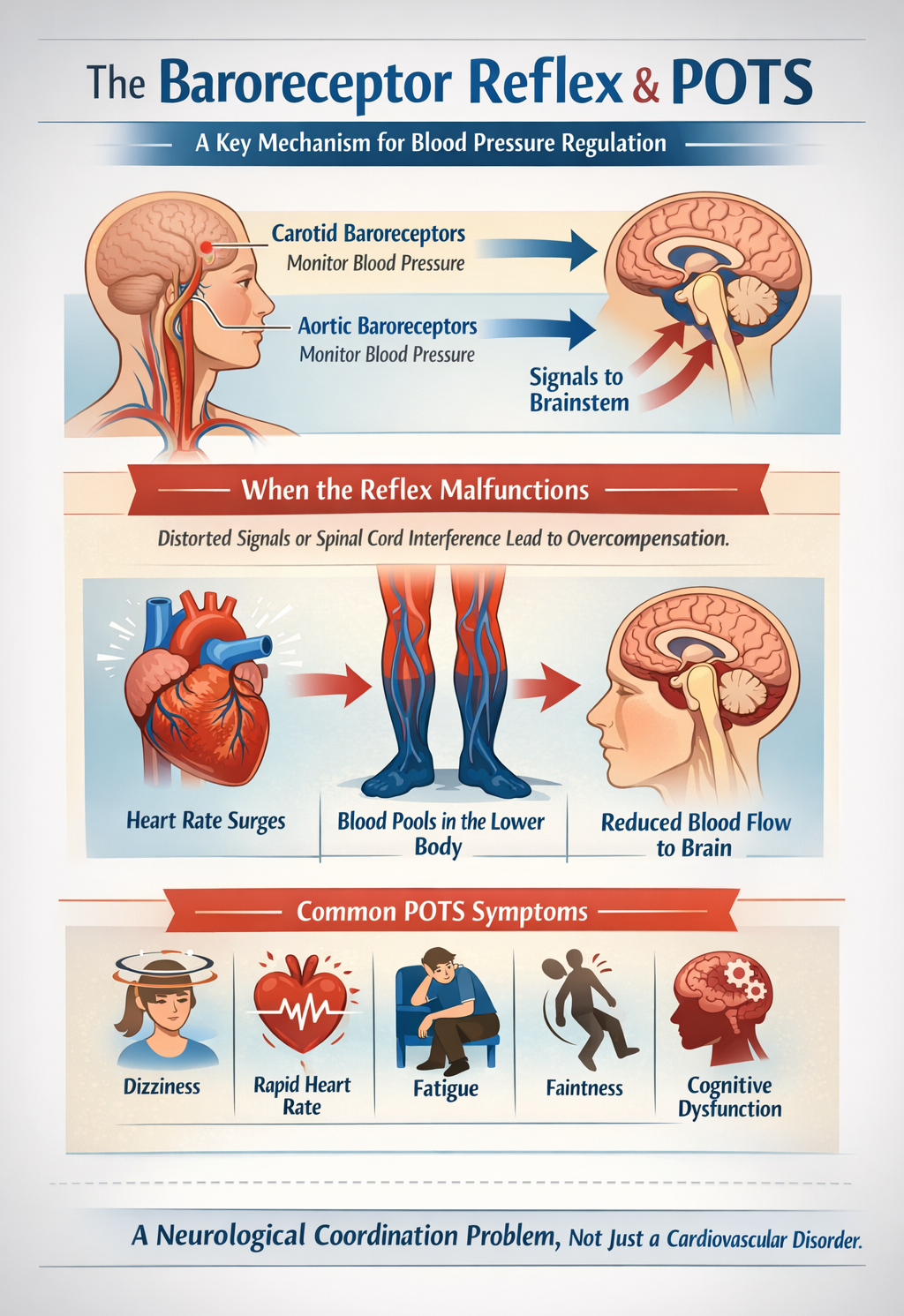
To understand this further, it is important to look at the baroreceptor reflex, a key mechanism responsible for stabilizing blood pressure when we change positions.
Baroreceptors located in the carotid arteries and aortic arch continuously monitor blood pressure. When we stand up, these receptors detect the drop in pressure and send signals to the brainstem. The brainstem then activates sympathetic responses to maintain circulation to the brain.
If the brainstem receives distorted signals—or sends faulty output due to interference in the spinal cord—the reflex can malfunction.
Instead of precise regulation, the body overcompensates.
The heart rate surges. Blood vessels fail to constrict properly. Blood pools in the lower body. The brain briefly receives less oxygenated blood.
The result is the familiar constellation of symptoms seen in POTS:
- dizziness
- rapid heart rate
- fatigue
- faintness
- cognitive dysfunction
From this perspective, the condition begins to look less like a mysterious cardiovascular disorder and more like a neurological coordination problem.
Trauma: The Hidden Trigger
Many individuals diagnosed with POTS report a history of trauma before the onset of symptoms.
Common triggers include:
- concussions or head injuries
- whiplash from car accidents
- sports injuries
- falls
- prolonged poor posture
- repetitive strain on the neck
These types of injuries frequently affect the upper cervical spine.
Even subtle trauma can alter the biomechanics of the neck and interfere with normal neurological signaling. Because the upper cervical spine sits so close to the brainstem, small structural disruptions can have disproportionate neurological effects.
Interestingly, research in cervical spine dysfunction and autonomic regulation has demonstrated that abnormal cervical mechanics can influence heart rate variability, blood pressure control, and vagal nerve function.
These are the very systems disrupted in POTS.
The Vagus Nerve Connection
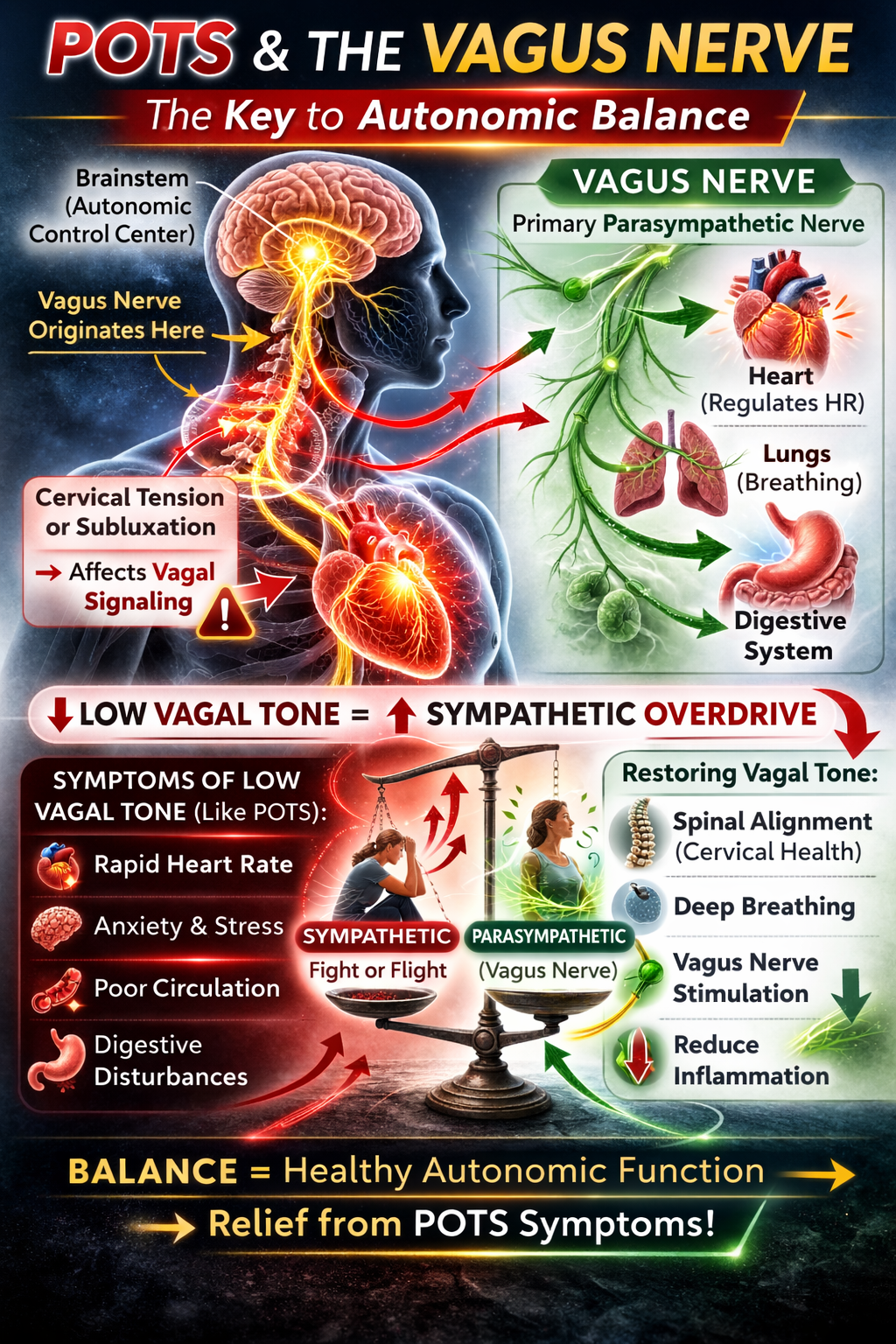
Another critical piece of the puzzle lies in the vagus nerve, the primary parasympathetic nerve of the body.
The vagus nerve originates in the brainstem and travels through the neck before branching out to influence the heart, lungs, and digestive organs. It plays a vital role in regulating heart rate and maintaining autonomic balance.
When vagal tone is reduced, sympathetic activity becomes dominant. This can produce:
- rapid heart rate
- anxiety-like symptoms
- poor circulation
- digestive disturbances
These symptoms overlap almost perfectly with those reported by POTS patients.
Structural tension or neurological interference in the cervical region may affect vagal signaling, creating the imbalance observed in dysautonomia.
Why Conventional Treatments Often Fall Short
Traditional medical treatments for POTS are largely designed to manage symptoms rather than address neurological function.
For example:
Beta blockers slow the heart rate but do not correct the underlying autonomic miscommunication.
Salt loading and hydration increase blood volume but do not restore proper neurological reflexes.
Compression garments help prevent blood pooling but do not resolve the central regulatory problem.
While these strategies may provide temporary relief, they rarely restore normal autonomic balance.
Patients often cycle through medications for years without achieving full recovery.
Restoring Autonomic Balance
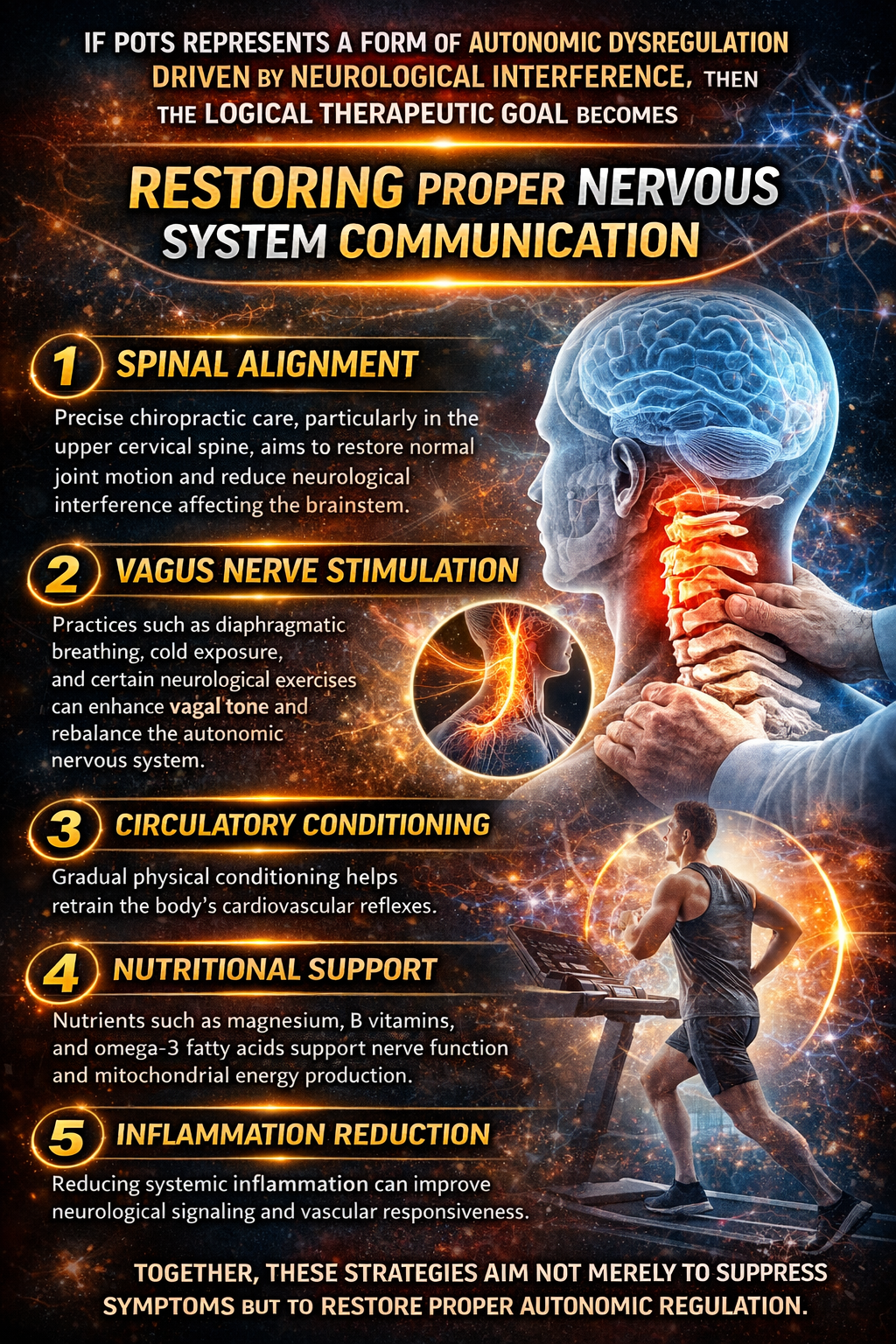
If POTS represents a form of autonomic dysregulation driven by neurological interference, then the logical therapeutic goal becomes restoring proper nervous system communication.
This approach focuses on several key areas:
1. Spinal Alignment
Precise chiropractic care, particularly in the upper cervical spine, aims to restore normal joint motion and reduce neurological interference affecting the brainstem.
2. Vagus Nerve Stimulation
Practices such as diaphragmatic breathing, cold exposure, and certain neurological exercises can enhance vagal tone and rebalance the autonomic nervous system.
3. Circulatory Conditioning
Gradual physical conditioning helps retrain the body’s cardiovascular reflexes.
4. Nutritional Support
Nutrients such as magnesium, B vitamins, and omega-3 fatty acids support nerve function and mitochondrial energy production.
5. Inflammation Reduction
Reducing systemic inflammation can improve neurological signaling and vascular responsiveness.
Together, these strategies aim not merely to suppress symptoms but to restore proper autonomic regulation.
A New Perspective on POTS
POTS should not be viewed simply as a mysterious cardiovascular disorder or an incurable dysautonomia.
Instead, it may represent the body’s response to disrupted neurological communication within the autonomic nervous system.
When the structural integrity of the spine is compromised, especially near the brainstem, the delicate balance of autonomic regulation can falter. The resulting symptoms—tachycardia, dizziness, fatigue, and brain fog—are not random. They are signals that the body’s regulatory systems are struggling to maintain equilibrium.
By shifting our perspective from symptom management to neurological restoration, a far more hopeful path emerges.
Rather than asking how to control the symptoms of POTS, the more important question becomes:
How can we restore the nervous system’s ability to regulate itself?
When that question is pursued with curiosity, clinical insight, and a willingness to look beyond conventional frameworks, many patients discover that recovery is not only possible—it is entirely within reach.